November, 2026
Home › Credit, Banking & Cash Flow › The Financial Infrastructure System › The 3 Systems That Control Your Financial Life
What You Need to Know
— Three systems control most household financial outcomes: the banking system (account structure), the cash flow system (money movement and timing), and the credit system (borrowing profile and cost).
— Each system has a specific architecture — the financial system architecture of each layer determines the outcomes it produces, independently of income level or financial knowledge.
— Most financial problems are systems problems: a specific layer is missing, poorly designed, or producing the wrong output because its architecture was never intentionally built.
— Knowing which system is producing the problem changes the diagnosis from “I am bad with money” to “my cash flow system has a specific structural gap.”
— The financial system architecture that connects all three is the framework this cluster is built around.
The financial system architecture governing most household outcomes consists of three distinct systems that operate simultaneously and interact continuously. The banking system controls how accounts are structured and how money is stored and routed. The cash flow system controls how money moves through time — the timing of income, obligation coverage, and savings accumulation. The credit system controls the profile that determines borrowing costs and credit access. Each system has its own design variables, its own failure modes, and its own set of improvements that produce compounding results when the architecture is correct.
Understanding the three systems separately — what each one controls, how it fails, and what good architecture looks like in each — is the prerequisite for diagnosing financial problems accurately and applying the right structural solutions rather than behavioral interventions to structural problems.
System 1: The Banking System
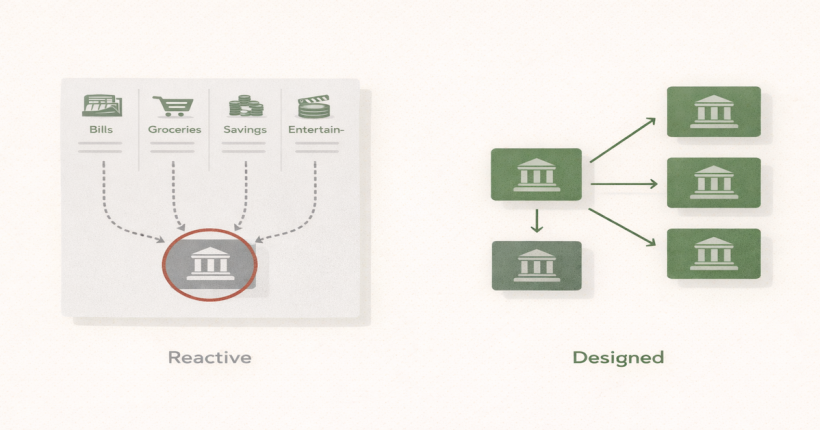
The banking system is the account infrastructure that determines how money is stored and what behaviors happen by default. Its primary design variables are account count and type, how income routes across accounts, what transfers are automated, and what balance is visible and available at any point in the spending decision environment.
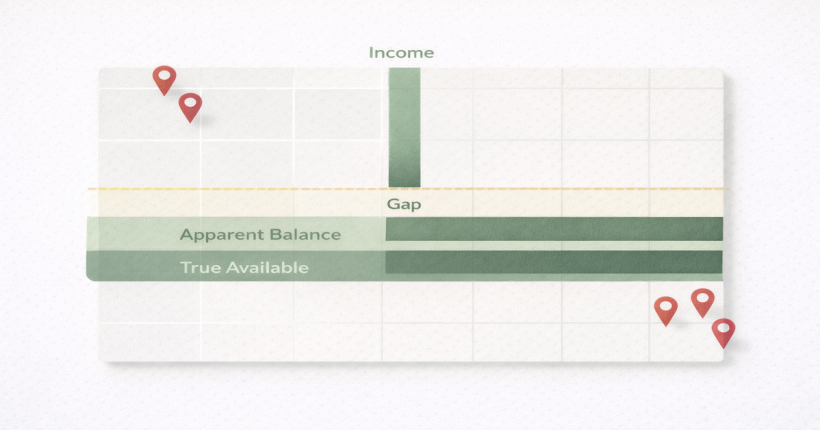
What it controls: Whether bill money competes with spending money. Whether savings happen before or after spending decisions. Whether the balance visible at any point accurately represents what is available for the current purpose or a misleading mixture of all purposes. Whether financial behaviors that require consistency — saving, bill payment, debt payoff — happen automatically or require active decision-making each cycle.
How it fails: Single account structures that mix all categories into one balance. No automation for savings or bill payment. No account separation between committed and discretionary funds. The result is consistent cash flow instability, budget breakdown, and financial behaviors that depend on willpower rather than infrastructure to maintain.
What good architecture looks like: A minimum three-account structure with dedicated bills, spending, and savings accounts. Automated transfers on payday routing each category to its account before any discretionary spending decision is made. Bills account reserved exclusively for fixed obligations. Spending account balance representing the accurate discretionary budget. The banking structure and cash flow control framework covers this architecture in detail.
System 2: The Cash Flow System
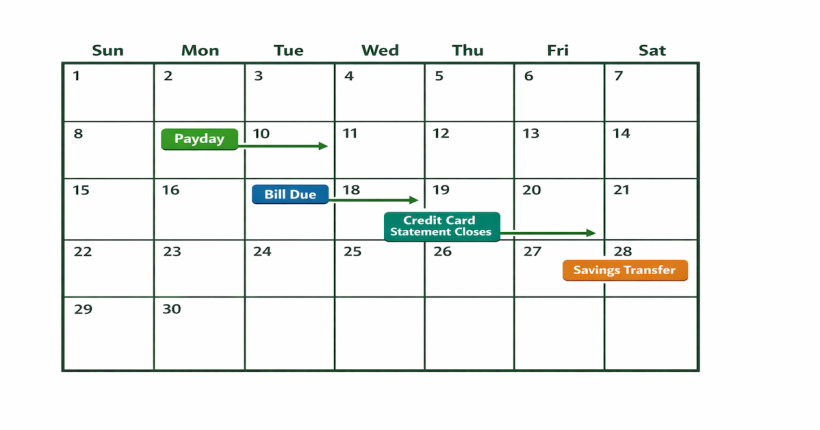
The cash flow system is the timing and routing layer that governs how money moves through the banking structure. Its primary design variables are the sequence of transfers on payday, the timing of bill and credit card payments relative to due dates and statement close dates, and the handling of income timing mismatches against obligation timing.
What it controls: Whether bills are covered before spending occurs. Whether savings accumulate reliably regardless of what else happens in a given month. Whether credit card payments are timed relative to statement close dates to manage reported utilization. Whether income variability produces cash flow instability or gets smoothed by a buffer account before it reaches the accounts where spending decisions happen.
How it fails: Spending against available balance rather than against available-after-obligations balance. Paying credit card bills only at the due date rather than making a pre-statement payment to manage utilization. No buffer for timing gaps between income arrival and clustered obligation due dates. Income variability flowing directly into the spending account without smoothing. The hidden cash flow problem is the most common failure mode in this system.
What good architecture looks like: Savings transfer first on payday. Bills account pre-funded before spending account. Credit card pre-statement payments automated three to five days before each card’s statement close date. Buffer account absorbing income variability for irregular earners. The cash flow system runs the banking structure — the accounts are the containers, the cash flow routing is what moves money through them correctly.
System 3: The Credit System
The credit system is the profile and behavior layer that governs borrowing costs and credit access over time. Its primary design variables are payment history, credit utilization, account age, credit mix, and the timing of credit applications. The output of this system is the credit score and the terms it produces on every borrowing decision for the next decade.
What it controls: The interest rate on any debt product — mortgage, auto loan, personal loan, credit card APR. The credit limits available on new accounts. The access to certain financial products that use credit as a qualification criterion. The long-term cost difference between a well-managed and a poorly managed credit profile is measured in tens of thousands of dollars over a borrowing lifetime.
How it fails: Late payments from cash flow system failures that cause bills to miss due dates. High utilization from spending against credit cards without pre-statement payment management. Closing old accounts that reduce average account age. Applying for multiple new accounts in short periods that generate hard inquiry clusters. Most credit system failures trace back to cash flow system or banking system failures rather than deliberate credit management errors.
What good architecture looks like: On-time payment history maintained automatically through bills account automation. Utilization managed below 30% on each card through pre-statement payment timing. Account portfolio maintained with no unnecessary closures. Credit applications timed and spaced to minimize hard inquiry impact. The credit system is downstream of the banking and cash flow systems — fixing the upstream systems improves credit system outputs automatically in most cases.
Three systems. One integrated architecture. The model connects them all.
The complete financial infrastructure system covers the architecture of all three layers and the specific implementation sequence that builds them in the right order.
Explore the Financial Infrastructure System →How to Diagnose Which System Has the Problem
Most financial problems have a clear system address. Running short before payday despite adequate income is a cash flow system problem — specifically a timing and visibility gap produced by account structure. A credit score that drops despite on-time payments is a credit system problem — specifically high utilization at statement date produced by a cash flow system that is not making pre-statement payments. A budget that works for two months then breaks down is a banking system problem — specifically the absence of account separation that makes budget categories enforceable.
Diagnosing at the system level rather than the symptom level changes the intervention. Telling yourself to spend less does not fix a cash flow visibility problem. Monitoring your credit score more carefully does not fix a statement-date utilization problem. Trying harder to stick to the budget does not fix the absence of account infrastructure. System problems require system solutions — and the personal finance infrastructure model provides the diagnostic framework and the complete architecture for building all three systems correctly.
Resources
CFPB — Credit Reports and Scores
CFPB — How to Create a Budget and Stick With It
Federal Reserve — Survey of Consumer Finances
FDIC — Money Smart Financial Education Program
This article is part of the Credit, Banking & Cash Flow integration system on PersonalOne — the complete framework for building a personal finance infrastructure that runs reliably by design.
Frequently Asked Questions
How do I know which of the three systems is causing my financial problems?
Start with symptom mapping. Running short before payday despite adequate income points to the cash flow system. A credit score that fluctuates or stays lower than expected despite responsible payment behavior points to the credit system — specifically utilization timing. A budget that works for a few months then breaks down points to the banking system. In many cases, all three systems have issues simultaneously, because the banking system failure produces the cash flow failure that produces the credit system failure. Fixing the banking system first is usually the correct starting sequence because it resolves upstream problems that cascade.
Can I build all three systems at the same time?
The account structure and cash flow routing can be built simultaneously — they are implemented together in the same session when the accounts are opened and the automated transfers are configured. The credit system layer requires the banking and cash flow layers to be functional first, because it depends on the bills account and the pre-statement payment automation that those layers provide. The practical sequence is: account structure and cash flow routing in one session, credit optimization automation in the second session once the account structure is confirmed working correctly.
What is the most common mistake people make when trying to improve their finances?
Addressing the credit system without building the banking and cash flow systems first. Credit repair advice — pay down balances, dispute errors, add authorized user accounts — produces temporary improvement that reverts when the underlying cash flow system continues producing the high utilization and occasional late payment that the credit repair was trying to counteract. Building the infrastructure that makes good credit behaviors automatic is more durable than any direct credit intervention, and most of the direct credit improvements follow automatically once the infrastructure is in place.
Disclaimer: This content is for educational purposes only and does not constitute financial advice. Individual financial situations vary — consult a qualified financial professional for personalized guidance.