April 6, 2026
Home › Financial Stability › Expense Compression › Needs vs Wants: A Framework That Actually Works Under Pressure
Needs vs Wants: A Framework That Actually Works Under Pressure
What You Need to Know
— The standard needs vs wants framework fails under financial pressure because it asks a moral question instead of a functional one
— A functional needs vs wants framework asks one question: does this expense directly prevent a worse financial outcome if I eliminate it?
— The framework produces three categories, not two: non-negotiable needs, recoverable wants, and high-value wants worth protecting
— High-value wants are not luxuries to be eliminated — they are the spending that makes compression sustainable rather than a short-term willpower exercise
— The framework is most useful as a decision filter during expense compression, not as a permanent budget philosophy
The needs vs wants framework is one of the most frequently cited concepts in personal finance and one of the most frequently misapplied. The standard version — needs are things you must have, wants are things you desire — produces immediate disagreement about which category any given expense belongs in, and that disagreement makes the framework useless precisely when it is needed most: during financial pressure when decisions need to be fast, clear, and defensible.
An aggressive expense reduction strategy requires a framework that produces clear decisions without debate, that works consistently under stress, and that does not require perfect willpower to sustain. The version of the needs vs wants framework laid out here replaces the moral distinction — need is virtuous, want is indulgent — with a functional one that produces the same result more reliably. The aggressive expense reduction strategy in the Expense Compression cluster is built on this functional approach specifically because the moral framework breaks down under the cognitive load of a real financial crisis.
Why the Standard Framework Fails Under Pressure
The standard needs vs wants framework fails for three specific reasons when applied during financial pressure.
It invites rationalization. Almost any expense can be rationalized as a need by someone motivated to keep it. The gym membership becomes necessary for mental health. The streaming service becomes necessary for family connection. The daily coffee becomes necessary for work performance. Under financial stress, the brain is highly motivated to preserve existing spending patterns, and the vague moral definition of "need" provides ample room to rationalize almost anything into the need category.
It ignores degree. The standard framework is binary: need or want. But most spending exists on a spectrum. Groceries are a need. Organic specialty groceries at three times the price of equivalent conventional produce are a want attached to a need. Transportation to work is a need. Transportation in the newest model with premium features is a want attached to a need. A binary framework cannot handle this spectrum, so it either incorrectly categorizes the entire expense as a need, or it incorrectly suggests eliminating something that genuinely has a necessary component.
It creates shame without direction. When something is labeled a want in the standard framework, the implied conclusion is that you should not have spent money on it. This framing is backward-looking and produces shame rather than forward-looking decisions. It also generates resistance: people are more likely to defend their spending when it is labeled a moral failure than when it is evaluated on functional grounds.
The Functional Framework: One Question, Three Categories
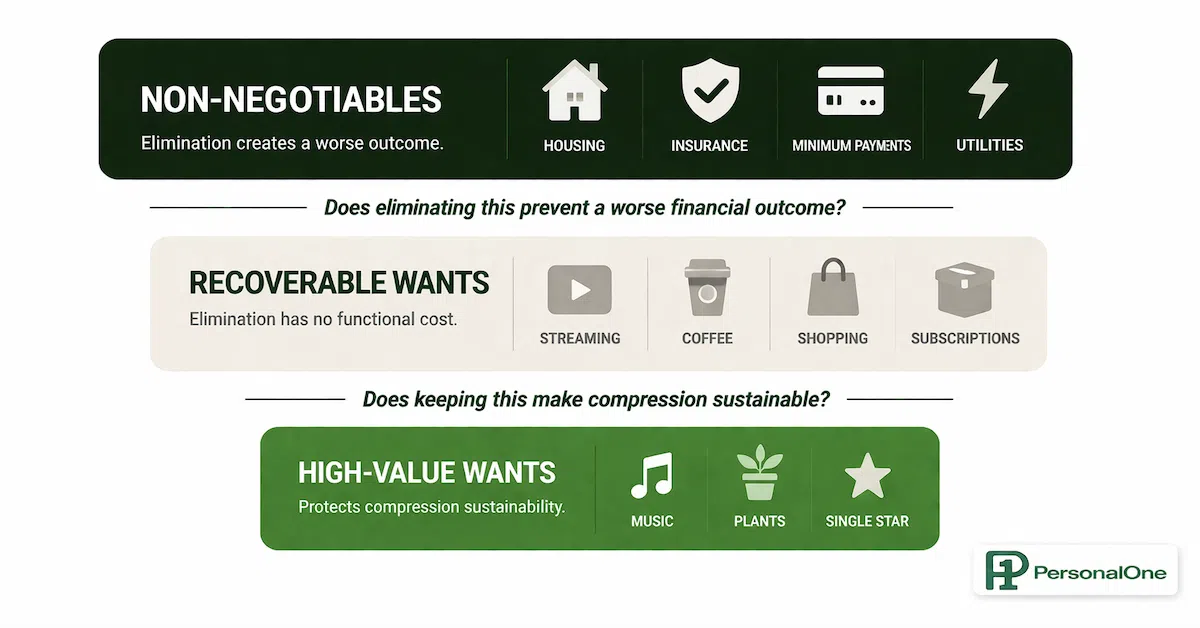
Replace the needs vs wants binary with a single functional question applied to every expense: does eliminating this expense directly prevent a worse financial outcome? If yes, it is a non-negotiable. If no, it is either a recoverable want or a high-value want, distinguished by a second question: does keeping this expense make compression significantly more sustainable?
Category 1 — Non-Negotiables. Expenses whose elimination directly produces a worse financial outcome. Housing payment — because non-payment triggers eviction or foreclosure. Minimum debt payments — because non-payment triggers penalty interest, credit damage, and collections. Health insurance — because going uninsured during a compression period creates catastrophic financial risk that would dwarf the premium cost. Utilities at a survival level — because disconnection creates additional reconnection fees and work productivity impact. Transportation required for employment — because losing transportation can cost the income that makes the compression possible. These are non-negotiable not because they are morally virtuous needs, but because eliminating them produces outcomes that cost more than keeping them.
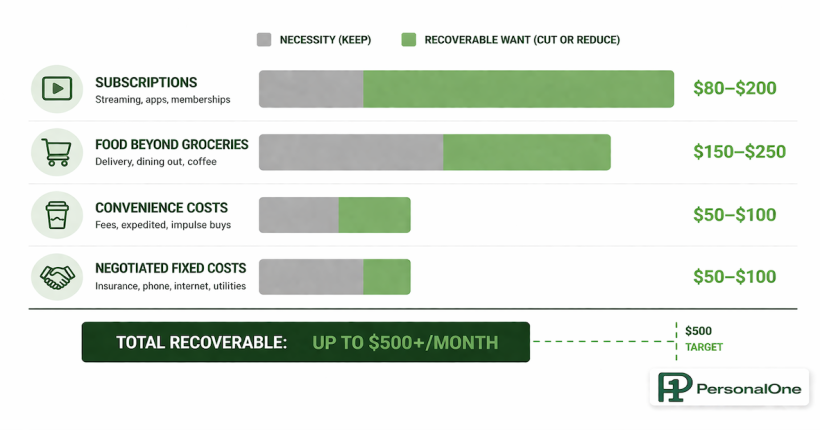
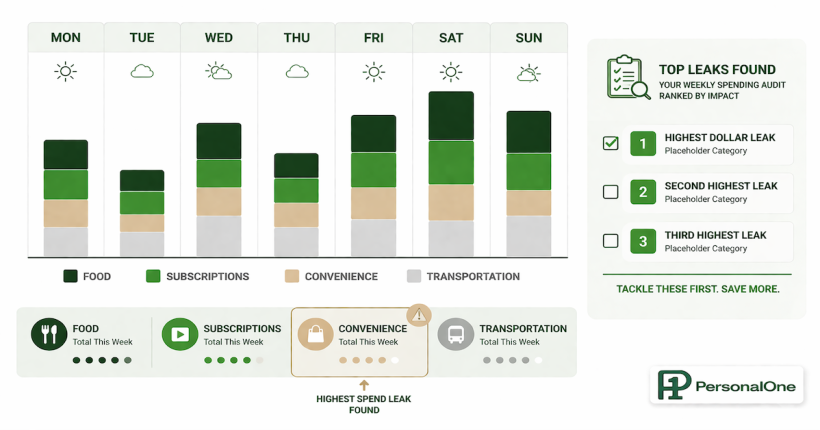
Category 2 — Recoverable Wants. Expenses whose elimination produces no worse financial outcome and no significant impact on compression sustainability. Streaming services beyond one. Dining out and delivery above a minimal defined level. Gym memberships used infrequently. Subscriptions not actively used. Clothing beyond genuine replacement needs. Entertainment spending. Premium tiers of services with adequate free alternatives. These compress cleanly because they produce no functional cost when removed, only a lifestyle adjustment that most people adapt to faster than anticipated. The 7-day spending audit identifies exactly which of your current expenses fall into this category with actual dollar amounts attached — making the elimination decision easier because it is based on data rather than assumption.
Category 3 — High-Value Wants. Expenses whose elimination produces no worse financial outcome in isolation, but whose removal significantly undermines the sustainability of the compression plan. These are different from Category 2 not in their functional necessity but in their psychological function. A $15 per month music subscription that provides genuine daily value and mood support during a stressful financial period may be worth protecting because its psychological function — maintaining normalcy and mental resilience during compression — makes the rest of the compression plan more likely to hold. This category requires honest evaluation rather than automatic retention. The question is not whether you like the expense. The question is whether removing it is likely to cause the compression plan to collapse earlier, leading to worse outcomes overall.
Applying the Framework to a Real Expense List
Take your complete monthly expense list — ideally generated from the spending audit — and run each item through the framework. Apply the first question: does eliminating this expense directly prevent a worse financial outcome? If yes, it is a non-negotiable. Stop there.
If no, apply the second question: does keeping this expense significantly increase the sustainability of the compression plan? If yes, it is a high-value want to protect. If no, it is a recoverable want to eliminate or reduce.
Work through the entire list before making any elimination decisions. This prevents the common pattern of eliminating the first few easy items and then getting stuck on harder evaluations because decision fatigue has set in. The full list categorized at once is easier to act on than a series of individual decisions made one at a time over several days.
After categorizing, total the recoverable wants. That total is your compression ceiling — the maximum monthly savings achievable without touching non-negotiables or high-value wants. Compare it to your compression target. If the ceiling exceeds your target, you have options about which recoverable wants to cut and can prioritize the highest-dollar ones. If the ceiling does not reach your target, you need to revisit the non-negotiable classification of some expenses — specifically looking at whether any expenses classified as non-negotiable have a cheaper version that maintains the functional protection without the full current cost.
The Spectrum Problem: Needs Attached to Wants
The most common category error in expense classification is the need-attached-to-want problem: a genuinely necessary expense at a non-necessary price level. Food is a non-negotiable. But $800 per month in total food spending when $400 would adequately cover home-cooked meals means the need is $400 and the want is the additional $400. Transportation is a non-negotiable. But a $650 monthly car payment on a vehicle that could be replaced functionally for a $250 payment on a lower-cost car means the transportation need is covered at the $250 level and the additional $400 is a want attached to a need.
During normal financial circumstances, paying for a higher level of a necessary category is a reasonable personal choice. During expense compression, the framework requires separating the necessity level from the premium level and evaluating the premium as a recoverable want even though it is attached to a non-negotiable category. This distinction is uncomfortable because it surfaces the reality that significant compression is available within categories that feel entirely necessary. But it is also where the largest compression opportunities exist for households that have already eliminated obvious non-necessity spending.
One question. Three categories. Clear decisions.
This framework is one part of the complete Expense Compression system. The full toolkit for cutting spending without destroying your financial progress is in the cluster hub.
Expense Compression Strategy →When to Exit the Framework
The functional needs vs wants framework is a compression tool, not a permanent financial philosophy. It is designed to produce clear decisions during financial pressure and should not be applied as a permanent lens on every spending decision once the compression period ends. Living permanently under a framework that evaluates every purchase for functional necessity is both exhausting and counterproductive — it removes the psychological space for discretionary spending choices that are part of a normal, functional relationship with money.
Define a specific exit condition before you start applying the framework: the month where your emergency fund is restored to its target level, or where replacement income consistently covers all non-negotiables without drawing on savings, or where debt that triggered the compression is eliminated. When the exit condition is met, the framework retires. The financial stability strategy at PersonalOne is built on the principle that compression and recovery tools are temporary tools with defined beginning and end points, not permanent constraints. The goal is always to use these tools to reach a financial position where they are no longer necessary. Use the debt paydown calculator to establish a concrete payoff date that becomes your exit condition — a specific month where the compression work is demonstrably finished.
Resources
Official Sources
CFPB: Budgeting and Spending Tools — Consumer Financial Protection Bureau tools for categorizing expenses, building a budget, and managing spending during financial pressure.
BLS: Consumer Expenditure Survey — Bureau of Labor Statistics national household spending data by category, useful for benchmarking where your spending sits relative to comparable households.
FDIC: Money Smart Financial Education — FDIC financial literacy resources covering expense management, spending decisions, and building sustainable financial habits.
Continue Building Your Expense Compression System
This framework is one part of the complete Expense Compression cluster. The full system — including the 7-day spending audit, targeted $500 cuts, and lean living strategy — lives in the Expense Compression cluster hub inside the Financial Stability authority hub.
Frequently Asked Questions
Is health insurance always a non-negotiable even if the premium is very high?
The premium level may have a want component if you are paying for a plan significantly richer than you need — a gold plan when a silver plan would adequately cover your actual healthcare usage. The non-negotiable principle is continuous coverage. Switching to a lower-cost plan during compression while maintaining coverage is a legitimate compression action. Going uninsured entirely is not — the financial risk of an uninsured medical event during a compression period creates catastrophic potential losses that vastly exceed the premium savings.
How do I handle an expense that my partner considers a non-negotiable but I consider recoverable?
Apply the functional question together rather than separately. The question — does eliminating this expense directly prevent a worse financial outcome? — is answerable with the same logic regardless of who values the expense. If the answer is no for both people, the expense is recoverable. If one partner argues that removing it would cause the compression plan to collapse, that is a high-value want argument worth taking seriously. Disagreements that cannot be resolved this way usually indicate that the compression plan itself needs negotiation before individual line items can be resolved.
What about expenses for children — are those automatically non-negotiable?
Baseline child expenses — food, clothing at a functional level, healthcare, and anything required for school — are non-negotiable. Extracurricular activities, enrichment programs, and entertainment are evaluated the same way as adult expenses. High-value want status may apply to activities that significantly affect the child's wellbeing or the household's psychological sustainability during compression, but this should be evaluated honestly rather than used as a blanket justification for protecting the entire category.
Can I apply this framework to a single large purchase decision, not just ongoing expenses?
Yes, and it works well there too. Apply the same question: does not making this purchase directly prevent a worse financial outcome? For large purchases during a compression period, the answer is almost always no — which means the purchase is either a recoverable want to defer or a high-value want that requires genuine justification against the compression goal. The framework is particularly useful for impulse purchases and large discretionary spending decisions because it interrupts the rationalization process with a functional question.
Does this framework apply to the 50/30/20 budget rule?
They address different problems. The 50/30/20 rule is a budget allocation framework for normal financial circumstances — it tells you what percentage of income should go to each broad category. The needs vs wants framework is a compression and decision tool for financial pressure — it tells you what to eliminate when total spending needs to come down quickly. The two can work together: use the 50/30/20 framework to plan normal spending targets, and use the functional needs vs wants framework when compression is required. The 50/30/20 budget calculator shows you how your current spending compares against the allocation targets, which can inform which categories are over-allocated and most likely to yield recoverable wants.
Disclaimer: This article is for informational and educational purposes only and does not constitute financial or legal advice. Individual financial situations vary. Consult a qualified financial advisor before making significant financial decisions. PersonalOne is not a licensed financial advisor.