By Don Briscoe, a personal finance educator with over 12 years of experience guiding everyday people through smarter banking, credit, and money decisions.
TL;DR — Break Free from Credit Card Debt Fast
- Face the numbers first: List all cards, balances, APRs, and minimum payments—knowledge reduces stress and creates a clear action plan
- Choose your payoff method: Avalanche (highest interest first) saves money, Snowball (smallest balance first) builds momentum—both work if you stay consistent
- Negotiate with creditors: Call and ask for lower interest rates, waived fees, or hardship programs—it works more often than you'd expect
- Balance transfers with strategy: 0% APR cards can save thousands, but only if you avoid new debt and pay off balances during the promo period
- Increase income faster than cutting expenses: Side hustles accelerate payoff better than extreme frugality—aim for $200-500 extra monthly
Struggling with credit card debt? You're not alone. Over 191 million Americans carry credit cards, and more than half carry balances month-to-month. The good news? There are real, proven ways to escape this financial trap without extreme sacrifice or years of financial struggle.
In today's credit-dependent economy, especially for Gen Z and Millennials juggling student loans, rent increases, and rising costs, falling into credit card debt is easier than ever. But climbing out? That's where strategy matters.
This guide shows you exactly how to break free from credit card debt fast using proven methods, practical tools, and realistic timelines. No gimmicks, no shame—just a clear path to financial freedom.
For a complete overview of all debt relief strategies and how credit card debt fits into the bigger picture, visit our debt relief and credit repair hub. Then return here for specific credit card payoff tactics.
Why Credit Card Debt Feels Like Quicksand
Credit card debt isn't just stressful—it's sneaky. With average interest rates hovering around 20-28% APR in 2025, even small balances can balloon fast if you're only making minimum payments.
How Credit Card Debt Compounds Against You
Here's the brutal math: A $3,000 balance at 20% APR with a $90 minimum monthly payment will take over 14 years to pay off. Worse, you'll pay nearly $4,000 in interest—more than the original balance.
Why this happens:
- Minimum payments barely cover interest: Most of your payment goes to interest, not principal
- Interest compounds daily: Unlike simple interest, credit card interest calculates on your daily balance
- New charges reset progress: Any new purchases while carrying a balance immediately start accruing interest
- Psychological trap: Small minimums feel manageable but keep you in debt for years
Common Causes of Credit Card Debt
Most people don't wake up and decide to go into debt. It happens gradually through:
- Emergency expenses: Medical bills, car repairs, urgent home fixes without an emergency fund
- Income disruption: Job loss, reduced hours, unexpected pay cuts
- Lifestyle inflation: Spending increases to match (or exceed) income gains
- Impulse purchases: Emotional spending, retail therapy, keeping up with social media
- Only paying minimums: The single biggest trap that extends debt for years
Understanding the cause helps prevent future debt, but right now, let's focus on getting out.
Step 1: List It Out, Don't Black Out
Before you can attack credit card debt, you need to know exactly what you're dealing with. Avoidance makes the problem bigger—facing it makes it manageable.
Create Your Debt Inventory
Open a spreadsheet or grab a notebook and list:
- Card name/issuer: Chase Freedom, Capital One Quicksilver, etc.
- Current balance: The total you owe right now
- Interest rate (APR): Find this on your statement or online account
- Minimum payment: What they require each month
- Due date: When payments are due
Example inventory:
- Chase Freedom: $4,200 @ 22% APR, $126 minimum, due 15th
- Capital One: $2,800 @ 18% APR, $84 minimum, due 5th
- Discover: $1,500 @ 24% APR, $45 minimum, due 20th
- Total debt: $8,500, $255 in minimums
This simple exercise transforms "overwhelming debt" into "specific numbers I can tackle." Knowledge reduces anxiety.
Step 2: Choose Your Payoff Method
Two proven methods dominate debt payoff strategies. Both work—the best one is whichever you'll actually stick with.
Debt Avalanche: The Math-Optimal Method
How it works: Pay minimums on all cards, then throw all extra money at the card with the highest interest rate. Once that's paid off, move to the next highest rate.
Why it works: You pay the least total interest. On $8,500 of debt, avalanche can save you $800-1,500 in interest compared to other methods.
Best for:
- People motivated by optimization and math
- Strong willpower—you won't get quick wins at first
- Those with significant high-interest debt (20%+ APR)
Debt Snowball: The Momentum Method
How it works: Pay minimums on all cards, then throw all extra money at the card with the smallest balance. Once that's paid off, move to the next smallest.
Why it works: Quick wins build psychological momentum. Paying off a $1,500 card in 3 months feels amazing and motivates you to keep going.
Best for:
- People motivated by visible progress
- Those who've tried and quit debt payoff plans before
- Anyone who needs regular encouragement
Real Example: Same Debt, Different Approaches
Alex's Credit Card Debt:
- Card A: $4,200 @ 22% APR
- Card B: $2,800 @ 18% APR
- Card C: $1,500 @ 24% APR
Extra payment capacity: $400/month
Avalanche (highest rate first): Attacks Card C (24% APR) first despite it being mid-sized. Payoff timeline: 26 months, total interest paid: $1,847
Snowball (smallest balance first): Attacks Card C ($1,500) first for quick win. Payoff timeline: 27 months, total interest paid: $2,013
Verdict: Avalanche saves $166 but takes similar time. If Alex needs motivation from early wins, snowball is worth the small extra cost.
For more detailed strategies on balancing multiple debts and creating a comprehensive payoff plan, see our debt payoff without losing your mind guide.
Step 3: Negotiate Like a Pro
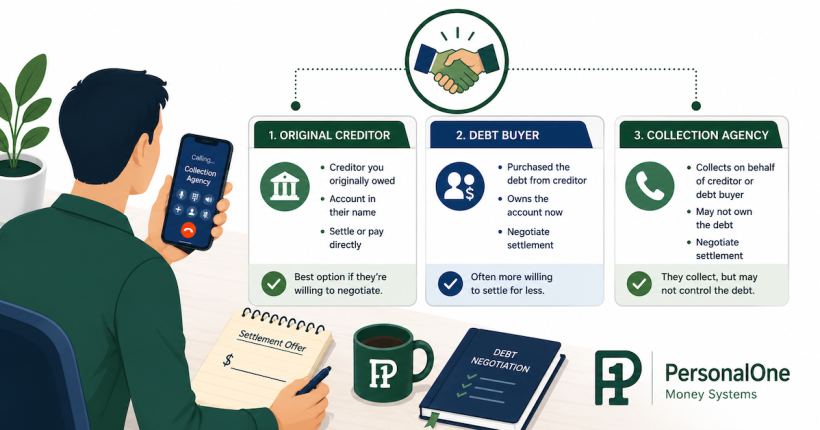
Most people don't realize credit card companies will negotiate—especially if you have decent payment history or are facing hardship. One phone call can save you thousands.
What to Ask For (And How to Ask)
Lower interest rate:
- Call and say: "I've been a customer for [X years] and have maintained good payment history. I'm currently evaluating balance transfer offers at lower rates. Can you reduce my APR to help me stay with you?"
- Success rate: 50-70% if you have decent credit and payment history
- Potential savings: Reducing from 22% to 16% APR on $5,000 saves you about $300/year
Waived late fees:
- If you miss a payment (it happens), call immediately: "I've been on time for [X months/years], but I missed this payment due to [brief reason]. Can you waive the late fee as a courtesy?"
- Success rate: 80%+ for first-time or rare occurrences
- Savings: $25-40 per waived fee
Hardship programs:
- If you're truly struggling (job loss, medical emergency, disaster), most issuers have formal hardship programs
- Benefits: Reduced interest (sometimes to 0%), lower minimum payments, fee waivers for 6-12 months
- Trade-off: Account typically gets closed, you can't make new charges
Negotiation tips:
- Call during business hours (avoid peak times)
- Be polite but firm—you're asking for help, not begging
- Have your account info and payment history ready
- If first rep says no, politely ask for a supervisor
- Get any agreement in writing before hanging up
Step 4: Balance Transfer Strategy
Balance transfer cards with 0% APR promotional periods can be powerful debt payoff tools—but only if used strategically.
How Balance Transfers Work
You open a new credit card offering 0% APR on balance transfers for 12-21 months. You transfer your high-interest balances to this card and pay them off interest-free during the promo period.
The math: $5,000 at 20% APR costs $1,000 in interest over 12 months. Transfer to 0% card and that interest disappears.
Balance Transfer Success Rules
Do this:
- Calculate whether you can pay off the balance during the 0% period
- Factor in the transfer fee (usually 3-5% of balance transferred)
- Set up automatic payments to guarantee payoff before promo ends
- Stop using the old cards (or better, close them after transfer completes)
Don't do this:
- Transfer debt just to rack up new charges on the freed-up cards
- Miss a payment (often voids the 0% rate immediately)
- Carry a balance past the promo period (rates jump to 18-25%)
- Apply for multiple balance transfer cards at once (hurts credit, looks desperate)
Balance Transfer Example
Jordan's situation: $6,000 credit card debt at 22% APR
Plan: Transfer to 0% APR card for 18 months with 3% fee ($180)
Monthly payment needed: $343/month to pay off in 18 months
Savings: Would have paid $1,320 in interest at 22% APR. Cost $180 in transfer fee. Net savings: $1,140
Result: Debt-free 18 months faster than minimum payments, saving over $1,000
Balance transfers work best when combined with other strategies. For more on when to use professional debt relief versus DIY methods, check our debt settlement versus bankruptcy comparison.
Step 5: Increase Income to Accelerate Payoff
Cutting expenses has a floor—you can only reduce spending so much. Income has no ceiling. Even an extra $200-500 per month can cut your debt payoff timeline in half.
Side Hustles That Actually Work
Fast cash (start this week):
- Food delivery (DoorDash, Uber Eats): $15-25/hour, flexible schedule, same-day pay options
- Rideshare (Uber, Lyft): $18-30/hour depending on market, weekends pay better
- Task services (TaskRabbit): $20-40/hour for handyman work, moving help, furniture assembly
- Pet sitting (Rover): $25-50/night, great if you love animals
Skill-based (higher pay, longer ramp):
- Freelance writing: $50-200/article, scalable once you build clients
- Graphic design: $25-100/hour on Fiverr or Upwork
- Web development: $50-150/hour, high demand
- Online tutoring: $20-60/hour, evenings and weekends
The 10-hour rule: Just 10 hours per week at $20/hour = $800/month extra. On $8,500 debt, that's the difference between 3+ years and 12 months to freedom.
One-Time Cash Injections
Beyond regular side hustles, look for one-time money sources:
- Sell unused items: Electronics, clothes, furniture, collectibles—target $500-1,000
- Tax refund: Redirect 50-75% to debt (keep some for sanity)
- Work bonuses: Resist the urge to celebrate until debt is gone
- Gift money: Birthdays, holidays—use half for debt
- Unexpected windfalls: Rebates, old forgotten accounts, side gig one-offs
Debt Payoff Apps and Tools That Actually Help
Technology can make the debt payoff process easier, more visual, and more motivating.
Best Free and Low-Cost Tools
Undebt.it (Free):
- Visualizes debt snowball and avalanche methods
- Shows exact payoff dates and interest saved
- Tracks payments and sends reminders
YNAB - You Need A Budget ($14.99/month or $99/year):
- Full budgeting system that helps prevent new debt
- Assigns every dollar a job before you spend it
- Users report paying off debt 4-6 months faster on average
Tally (Free, optional paid version):
- Automates credit card payments using debt avalanche method
- Offers line of credit to pay off high-interest cards (if approved)
- Best for: people who want to automate the entire process
Mint (Free):
- Tracks all accounts in one place
- Shows spending patterns and budget categories
- Sends alerts for unusual spending or upcoming bills
Your 4-Step Monthly Debt Payoff System
Having a strategy is great. Having a repeatable monthly system is better. Here's your game plan:
Step 1: Cut Non-Essentials (But Not Joy)
Review monthly subscriptions and recurring charges:
- Cancel forgotten free trials that converted to paid
- Pause subscriptions you rarely use (can always reactivate later)
- Downgrade services (smaller streaming plans, fewer apps)
- Target savings: $50-150/month
Step 2: Use Windfalls Wisely
Any unexpected money follows the 50/25/25 rule:
- 50% to debt immediately
- 25% to emergency fund
- 25% to enjoy guilt-free
Step 3: Automate Minimums (Avoid Late Fees)
Set up autopay for minimum payments on every card. You can always pay more manually, but this ensures you never miss a payment.
Step 4: Throw Extra Income at Target Debt
Every dollar beyond minimums goes to your avalanche or snowball target card. No exceptions, no negotiations with yourself.
Sample Monthly Debt Payoff Schedule
Income: $3,500/month take-home + $400 side hustle = $3,900 total
Fixed expenses: $2,100 (rent, utilities, insurance, groceries, gas)
Debt minimums: $255
Small joy budget: $100 (prevents burnout)
Available for extra debt payments: $1,445/month
Result: $8,500 debt paid off in 6-7 months instead of 14+ years with minimums only
When to Consider Professional Debt Relief
Sometimes DIY debt payoff isn't realistic. That doesn't mean failure—it means you need different tools.
Signs You Need Professional Help
- Your minimum payments exceed 40% of income
- You're only paying minimums but balances aren't dropping
- Creditors are calling constantly or threatening legal action
- You've tried self-directed payoff for 6+ months with no progress
- The stress is affecting your health, sleep, or relationships
Professional Options Beyond DIY
Credit counseling (non-profit): Agencies negotiate lower rates and create debt management plans. You make one payment to them, they distribute to creditors. Usually costs $25-50/month.
Debt settlement: Companies negotiate to settle debts for 40-60% of what you owe. Damages credit temporarily but resolves debt faster. Takes 2-4 years typically.
Bankruptcy: Last resort but sometimes the right choice. Chapter 7 wipes most unsecured debt in 3-6 months. Chapter 13 creates court-approved payment plan over 3-5 years.
For detailed comparisons of these options and when each makes sense, see our debt relief options comparison and CuraDebt review.
Ready to Break Free from Credit Card Debt?
Start with your debt inventory today. List every card, balance, and interest rate. Then choose your payoff method and make your first extra payment this week.
Explore All Debt Relief StrategiesFrequently Asked Questions
Is paying off credit card debt or saving more important?
Pay off high-interest debt first—it's like getting a guaranteed 20%+ return on investment. Here's the logic: if your credit card charges 22% APR and your savings account pays 4%, paying off the card is equivalent to earning an 18% spread. Exception: Keep a small emergency fund ($500-1,000) while paying off debt to avoid new charges when emergencies hit. Once high-interest debt is gone, shift focus to building a full 3-6 month emergency fund.
Can I really negotiate my credit card interest rate?
Yes, and it works more often than people think—success rate is 50-70% if you have decent payment history. Credit card companies would rather keep you as a customer at a lower rate than lose you to a balance transfer. Call and be direct: "I've been offered balance transfer cards at lower rates. Can you reduce my APR to help me stay with you?" Be polite but firm. If the first representative says no, ask to speak with a retention specialist or supervisor. Document who you spoke with and any rate reduction offered.
What's the best debt payoff method—avalanche or snowball?
Whichever one you'll actually stick with for the long haul. Avalanche (highest interest first) saves more money mathematically—often $500-2,000 on typical debt loads. Snowball (smallest balance first) provides faster psychological wins that keep you motivated. If you've quit debt payoff plans before, snowball's early victories might be worth the small extra interest cost. If you're disciplined and math-motivated, avalanche is optimal. Both work infinitely better than minimum payments only.
Should I use my emergency fund to pay off credit card debt?
No—keep at least $500-1,000 in savings even while aggressively paying off debt. Using your emergency fund to pay off cards feels productive, but the next time your car breaks down or you have a medical bill, you'll put it right back on credit cards—often at even higher balances. The small buffer prevents this backsliding. Once you have your starter emergency fund, throw everything extra at debt. After debt is gone, build your emergency fund to 3-6 months of expenses. For more on balancing emergency funds and debt payoff, see our complete debt payoff guide.
Will paying off credit cards improve my credit score?
Yes, often significantly—paying down credit cards improves your utilization ratio, which is 30% of your FICO score. As you reduce balances below 30% of limits (and ideally below 10%), your score can jump 50-100 points. The improvement happens fast—usually within 30-60 days after the lower balance reports to credit bureaus. Important: Keep cards open after paying them off. Closing cards reduces your available credit and can hurt your score. Just use them occasionally and pay in full each month to keep accounts active. For more credit improvement strategies, read our credit repair guide for Millennials.
How long does it take to pay off credit card debt realistically?
It depends on your debt-to-income ratio and extra payment capacity, but expect 12-36 months for most situations. Quick math: If you can pay $500/month on $8,000 debt at 20% APR, you'll be free in about 20 months. Double payments to $1,000/month and you're done in 9 months. With only minimum payments ($240/month), it would take 14+ years. The biggest variable is how much extra you can throw at debt beyond minimums. Side hustle income is the fastest accelerator—$300-500/month extra can cut payoff time in half.
What should I do if I can't afford minimum payments anymore?
Contact your creditors immediately before you miss payments—most have hardship programs that can help. Call and explain your situation honestly: job loss, medical emergency, income reduction. Many creditors will offer temporary relief: reduced interest rates (sometimes to 0%), lower minimum payments, waived fees for 6-12 months. Getting ahead of missed payments preserves your credit and prevents collections. If creditors won't work with you, consider credit counseling agencies (non-profit) that can negotiate on your behalf. For guidance on when DIY isn't enough, see our framework for choosing debt relief options.
Resources
Related PersonalOne Articles:
- Debt Relief and Credit Repair Hub – Complete overview of all debt strategies
- Pay Off Debt Without Losing It – Comprehensive debt payoff framework
- Debt Settlement vs Bankruptcy vs Credit Counseling – Compare professional relief options
- 30-Day Debt Detox – Quick-start action plan
- How to Get Out of Debt Quickly – Accelerated payoff strategies
- CuraDebt Review 2025 – Professional debt settlement service review
- Credit Repair Guide for Millennials – Rebuild credit while paying off debt
PersonalOne Calculators & Tools:
- Debt Paydown Calculator – Calculate your exact payoff timeline and interest savings
- Interest Comparison Calculator – Compare interest costs across different payoff strategies
External Resources:
- Consumer.gov – Making a Budget – Government budgeting resource
Disclaimer: The information provided in this article is for educational and informational purposes only and should not be construed as financial advice. PersonalOne.org is not a financial advisor, credit counselor, or debt settlement company, and we do not provide personalized financial, investment, or legal advice.
Credit card debt payoff strategies can affect your credit score and financial situation. Before making any decisions about debt repayment, balance transfers, debt settlement, or other debt relief options, we strongly recommend consulting with a qualified financial advisor or credit counselor who can evaluate your specific circumstances.
Individual results may vary based on your unique financial situation, debt amounts, interest rates, income, and other factors. The examples, timelines, and savings amounts mentioned in this article are for illustration purposes only and do not guarantee specific outcomes.
PersonalOne.org may earn affiliate commissions from some of the products or services mentioned in this article. However, our editorial content is independent and objective, and we only recommend products or services we believe may benefit our readers. For more information, please see our Privacy Policy and Terms of Service.