Updated: February 2026 • 8 min read
Home › Investing & Wealth Growth › Investing for Beginners › Best Apps to Automatically Invest Spare Change
About the Author
Don Briscoe is a Financial Systems Coach with 12+ years of experience helping Millennials and Gen Z escape paycheck-to-paycheck cycles. He founded PersonalOne on a framework-first philosophy — less willpower, more infrastructure — and provides structured, honest, free financial education.
Automatically Invest Spare Change in 2026
Micro-investing apps round up everyday purchases and invest the difference automatically. No spreadsheets, no manual transfers — just passive wealth-building running in the background while you live your life. Here's how to choose the right one.
TL;DR
- Micro-investing apps round up purchases and invest spare change automatically — no manual transfers needed
- Acorns and Stash lead for automation with $3–9/month fees covering investing, banking, and retirement accounts
- Wealthsimple and M1 Finance offer robo-management with portfolio customization and lower percentage-based fees
- Watch fee-to-balance ratios closely — flat monthly fees can outpace returns on small balances under $1,000
- Scale investments with multipliers and recurring deposits to accelerate compounding beyond spare change alone
You grab coffee. You swipe your card. Three dollars and forty-seven cents. What if that extra 53 cents could build wealth instead of disappearing into your transaction history?
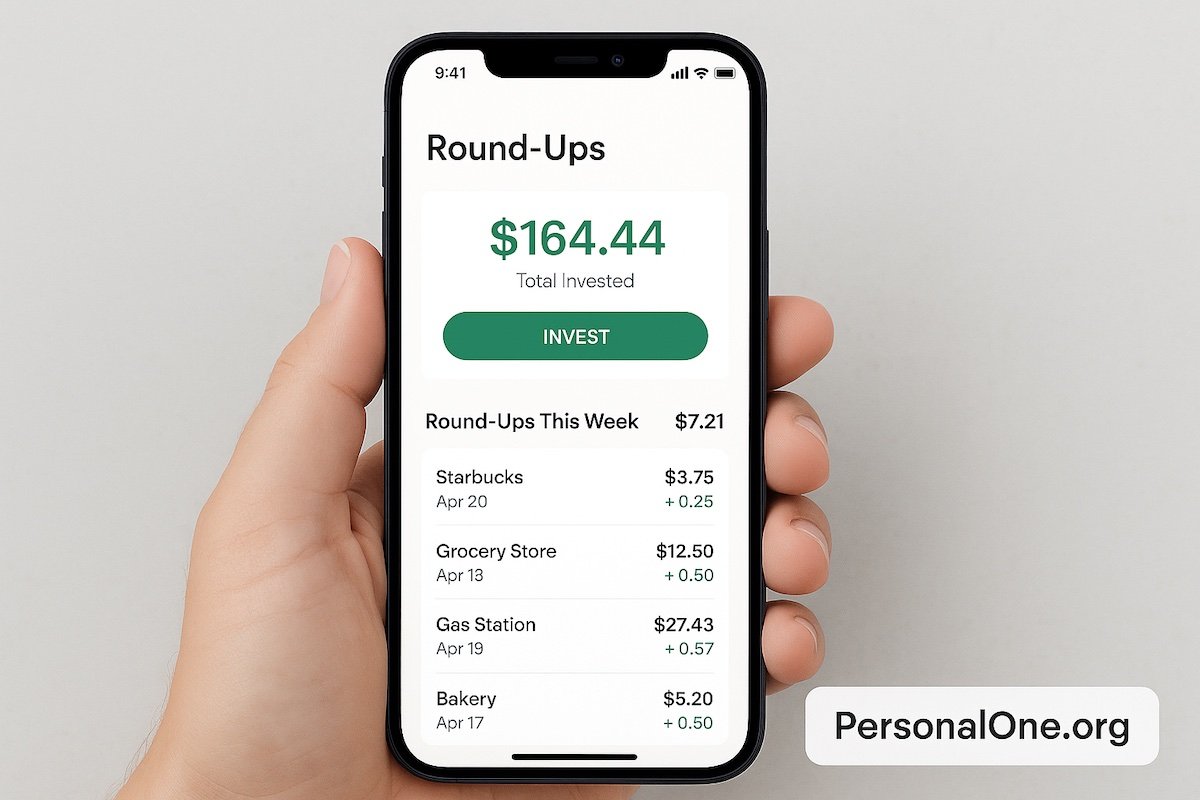
That's the premise of spare change investing apps — automated platforms that round up everyday purchases to the nearest dollar and invest the difference. No spreadsheets. No manual transfers. Just passive wealth-building that happens in the background while you live your life.
But here's what most articles won't tell you: not all micro-investing apps work the same way, and choosing the wrong one can cost you more in fees than you'll earn in returns. Some apps prioritize full automation. Others give you control over stock selection. A few focus on robo-advisory services with diversified ETF portfolios.
This guide breaks down the best spare change investing apps available in 2026 — how they work, what they cost, and which one fits your financial situation. For the complete beginner investing framework — including where spare change apps fit within a broader portfolio strategy — the Investing for Beginners hub covers the full system.
What Is Micro-Investing and How Does Round-Up Automation Work?
Micro-investing turns small amounts — often less than $5 per transaction — into investable capital. Instead of waiting until you have "enough" to open a brokerage account, these apps let you start building a portfolio with pocket change.
The mechanical process behind round-up investing:
- Link your checking or credit card — the app connects to your primary spending accounts via open banking API
- Automatic rounding — every purchase rounds up to the nearest dollar (e.g., $3.47 becomes $4.00)
- Spare change accumulation — the app tracks the difference (53 cents) across all transactions
- Batch transfers — once round-ups hit a threshold (usually $5), the app initiates an ACH transfer from your bank
- Portfolio allocation — funds are invested into fractional shares of stocks, ETFs, or pre-built portfolios based on your risk profile
The key advantage: you never miss the money. Because amounts are small and spread across dozens of transactions, most people don't notice the transfers. Over time, these nickels and dimes compound into meaningful balances — especially when combined with recurring deposits or round-up multipliers.
Top Apps to Automatically Invest Spare Change
Acorns – All-in-One Investing + Banking Platform
Best for: People who want complete automation with minimal decision-making
Core Features:
- Round-up automation with optional 2x, 5x, or 10x multipliers
- Found Money cashback program with partner brands invested directly into your portfolio
- Retirement accounts (Roth IRA, Traditional IRA, SEP IRA)
- Kids investment accounts (UTMA/UGMA)
- Checking account with debit card and direct deposit
- Diversified ETF portfolios managed based on risk tolerance
Pricing: Personal $3/month (investing only) | Premium $6/month (+ retirement) | Premium Plus $12/month (+ kids accounts + expert advice)
Investment Options: Automated ETF portfolios only — no individual stock selection
Why it works: Acorns handles everything. You set your risk level once, link your cards, and the platform invests automatically. The Found Money program adds cashback rewards that go directly into your portfolio, and the banking integration means you can manage spending and investing in one place.
Watch out for: Monthly fees eat into returns on small balances. If you're investing less than $100/month, the $3–12 monthly fee represents 3–12% of your contributions — far exceeding typical ETF expense ratios. This platform works better once your balance exceeds $1,000 and fees represent a smaller slice of total returns.
Stash – Personalized Stock Selection with Round-Ups
Best for: Investors who want some control over their portfolio without full DIY management
Core Features:
- Round-up automation with Smart-Stash recurring deposits
- Fractional shares of individual stocks and ETFs starting at $1
- Portfolio themes (clean energy, tech innovation, dividend stocks)
- Stock-Back rewards with partner retailers
- Banking with debit card and early paycheck access
- Retirement and custodial accounts available
Pricing: Beginner $3/month (investing + banking) | Growth $9/month (+ retirement + custodial + advanced tools)
Investment Options: Choose from 3,000+ stocks and ETFs or use pre-built portfolios
Why it works: Stash splits the difference between full automation and DIY investing. You can let the app handle everything through Smart Portfolios, or hand-pick specific companies you believe in. The educational content helps new investors understand what they own instead of blindly trusting an algorithm.
Watch out for: More choices mean more decisions. If you're prone to analysis paralysis or emotional trading, Stash's flexibility can backfire. Stick to automated portfolios if you tend to overthink investment moves.
Wealthsimple – Robo-Advisory with Human Support
Best for: Investors who want professional portfolio management without high minimum balances
Core Features:
- Round-up automation (available in Canada, limited US rollout)
- Robo-managed ETF portfolios with automatic rebalancing
- Access to human financial advisors
- Socially responsible investing (SRI) portfolio options
- Tax-loss harvesting on Premium accounts
- No minimum balance requirement
Pricing: Basic 0.5% annual management fee | Premium 0.4% annual fee (balances over $100,000 — includes advisor access and tax-loss harvesting)
Investment Options: Diversified ETF portfolios based on risk assessment — no individual stock selection
Why it works: Wealthsimple operates like a traditional robo-advisor with spare change functionality added. You get professional-grade portfolio management — rebalancing, diversification, risk-appropriate allocation — without needing $10,000 to get started. Advisor support helps when life changes require strategy adjustments.
Watch out for: Percentage-based fees scale with your balance. While 0.5% sounds small, it compounds over decades. On a $50,000 portfolio, you're paying $250 annually — manageable for hands-off management, but worth tracking as your balance grows.
M1 Finance – Customizable Pie Portfolios with Automation
Best for: Detail-oriented investors who want precise control over asset allocation
Core Features:
- Create custom "pie" portfolios with up to 100 slices
- Automatic rebalancing to maintain target allocations
- Dynamic rebalancing — new deposits fill underweight positions first
- Fractional shares across all holdings
- Retirement accounts (Traditional IRA, Roth IRA, SEP IRA)
- M1 Spend checking account with debit card
Pricing: M1 Basic free (standard features, one trading window/day) | M1 Plus $95/year (multiple trading windows, lower margin rates, higher FDIC insurance on cash)
Investment Options: Choose from 6,000+ stocks and ETFs or use expert-built pies
Why it works: M1 Finance gives you robo-efficiency with full customization. You decide exactly which stocks and ETFs belong in your portfolio and what percentage each represents. The platform then handles all buying, rebalancing, and allocation maintenance automatically — ideal for long-term investors with a specific asset mix target (e.g., 70% total market index, 20% bonds, 10% REITs).
Watch out for: The learning curve is steeper than Acorns or Stash. If you don't have a clear investment thesis or target allocation, M1's flexibility becomes overwhelming. Start with an expert pie if you're unsure what to build.
Qapital – Gamified Savings Rules with Investment Options
Best for: Behavioral savers who need extra motivation through rule-based automation
Core Features:
- If-this-then-that automation rules (e.g., "save $5 every time I skip the coffee shop")
- Round-up investing with customizable multipliers
- Goal-based saving buckets with visual progress tracking
- Partner rewards that boost savings
- Payday divider — automatically splits deposits across spending and saving
Pricing: Basic $3/month (saving only) | Complete $6/month (saving + investing) | Master $12/month (all features + personalized coaching)
Investment Options: ETF portfolios managed based on risk tolerance
Why it works: Qapital treats money management as a behavioral design problem. You set automation rules that move money based on your actual behavior — removing the willpower requirement entirely. The visual goal-tracking keeps you motivated without requiring constant manual intervention.
Watch out for: The gamification appeals to certain personality types but feels gimmicky to others. If you prefer straightforward automation without achievement mechanics, Acorns or M1 deliver better value per dollar of fees.
How to Choose the Right Spare Change Investing App
| App | Automation Level | Cost Structure | Control Level | Best For |
|---|---|---|---|---|
| Acorns | Fully automated | $3–12/month | Low (set and forget) | Beginners wanting simplicity |
| Stash | Automated + manual | $3–9/month | Medium (stock selection) | Learners building confidence |
| Wealthsimple | Robo-managed | 0.4–0.5% AUM | Low (advisor-guided) | Hands-off investors |
| M1 Finance | Custom automation | Free or $95/year | High (full customization) | Detail-oriented planners |
| Qapital | Rule-based triggers | $3–12/month | Medium (gamified) | Behavioral savers |
If you want zero thinking: Choose Acorns. The platform handles portfolio selection, rebalancing, and allocation automatically. Link cards and let it run.
If you want to learn while investing: Choose Stash. Educational content and stock selection options help you understand what you own without requiring advanced knowledge.
If you want professional management: Choose Wealthsimple. Access to human advisors and tax-loss harvesting on Premium makes this a true robo-advisory service with spare change features built in.
If you want precise control: Choose M1 Finance. Build your exact target portfolio and let automation maintain it over time.
If you struggle with saving consistently: Choose Qapital. Behavioral triggers work especially well if willpower is the weak point in your system.
Maximizing Returns from Round-Up Investing
Spare change alone won't build substantial wealth. A typical person generates $50–100 in monthly round-ups — useful, but not transformative on its own. To accelerate growth:
1. Use round-up multipliers strategically. Most apps let you multiply round-ups by 2x, 5x, or 10x. A $3.47 purchase normally rounds up by 53 cents. At 5x, it becomes $2.65. This accelerates portfolio growth without requiring separate manual transfers — just make sure your checking account balance can handle the higher withdrawal volume.
2. Add recurring deposits on top of round-ups. Set a weekly or monthly auto-transfer of $50–200 depending on your budget. This removes market-timing decisions while building consistent contribution habits. Round-ups become the bonus layer, not the foundation.
3. Link all spending accounts. Don't limit round-ups to one card. Link your primary credit card, debit card, and any other accounts you use regularly. More transactions means more round-ups means faster compounding.
4. Watch fee-to-balance ratios closely. A $3/month fee on a $500 balance represents 0.72% annually before market returns factor in. These platforms make the most economic sense once you have $1,000+ invested and fees represent less than 0.5% of your balance.
5. Treat micro-investing as the on-ramp, not the destination. These apps excel at building habits and removing psychological barriers to starting. Once your balance reaches $5,000–10,000, evaluate whether a traditional brokerage with lower expense ratios makes more sense for your long-term situation. Spare change investing is how you start — not how you finish.
Where This Fits in the PersonalOne System
Investing for Beginners Hub
Micro-investing apps are the entry point to the Investing for Beginners framework — removing barriers, building habits, and getting your first dollars into the market automatically. The full hub covers portfolio allocation, risk tolerance, and how to scale beyond spare change.
Investing & Wealth Growth Authority Hub
The complete Stage 7 framework for long-term wealth — from first investments through portfolio optimization, tax-advantaged accounts, and building lasting financial independence.
How to Fearlessly Start Investing with Just $100
The companion guide for people who want to move beyond round-ups into intentional first investments — covering index funds, risk tolerance, and the psychology of getting started.
FinTech Payroll Apps That Automate Direct Deposit Allocation
The next level after spare change investing — payroll apps that split your direct deposit across savings, investing, and spending accounts before money even hits your checking account.
Frequently Asked Questions
Ready to Build a Complete Investment Strategy?
Spare change investing solves the "getting started" problem — but it's the on-ramp, not the destination. The Investing for Beginners hub covers portfolio allocation, risk management, and scaling strategies that build on the habits these apps create.
Explore Investing for Beginners →Authority Resources
Government & Regulatory Sources:
- SEC: Exchange-Traded Funds (ETFs) — Official explanation of how ETF investing works and what investors should know
- FINRA: Fractional Share Investing — Regulatory perspective on partial stock ownership, risks, and disclosures
- FDIC: Deposit Insurance Coverage — How banking features in investing apps are protected up to $250,000
Related PersonalOne Articles: