July, 2026
Home › Credit, Banking & Cash Flow › Banking Structure & Cash Flow Control › The Hidden Cash Flow Problem Most People Have
TL;DR
— The hidden cash flow problem is a timing and visibility gap — money looks available when it is actually already committed to upcoming obligations.
— It is not caused by overspending. It is caused by spending against a misleading account balance that includes committed money alongside discretionary money.
— The problem is invisible in a single-account structure because there is no visual distinction between bill money and spending money.
— Account separation makes the problem disappear structurally — the spending account balance is accurate because it only contains discretionary money.
— The full banking structure and cash flow control framework covers how to design the account infrastructure that eliminates this problem permanently.
The hidden cash flow problem is the most common financial instability pattern that has nothing to do with income level, spending habits, or financial discipline. It is a visibility and timing problem — a structural flaw in how most households’ bank accounts present financial information — and it produces consistent month-to-month shortfall for households that have technically adequate income to cover their obligations.
The problem is hidden precisely because the account structure that creates it makes the cause invisible. The shortfall appears to be a spending problem or an income problem. It is neither. It is a cash flow design problem, and it has a design solution.
What the Hidden Cash Flow Problem Actually Is
Every household that receives income has two distinct categories of money in their account at any given moment: money that is already committed to upcoming obligations, and money that is genuinely available for discretionary use. Rent, utilities, insurance premiums, minimum debt payments, and subscriptions are all committed — they will process on their due dates regardless of what spending decisions are made between now and then. The remaining balance after those commitments is the actual discretionary budget for the period.
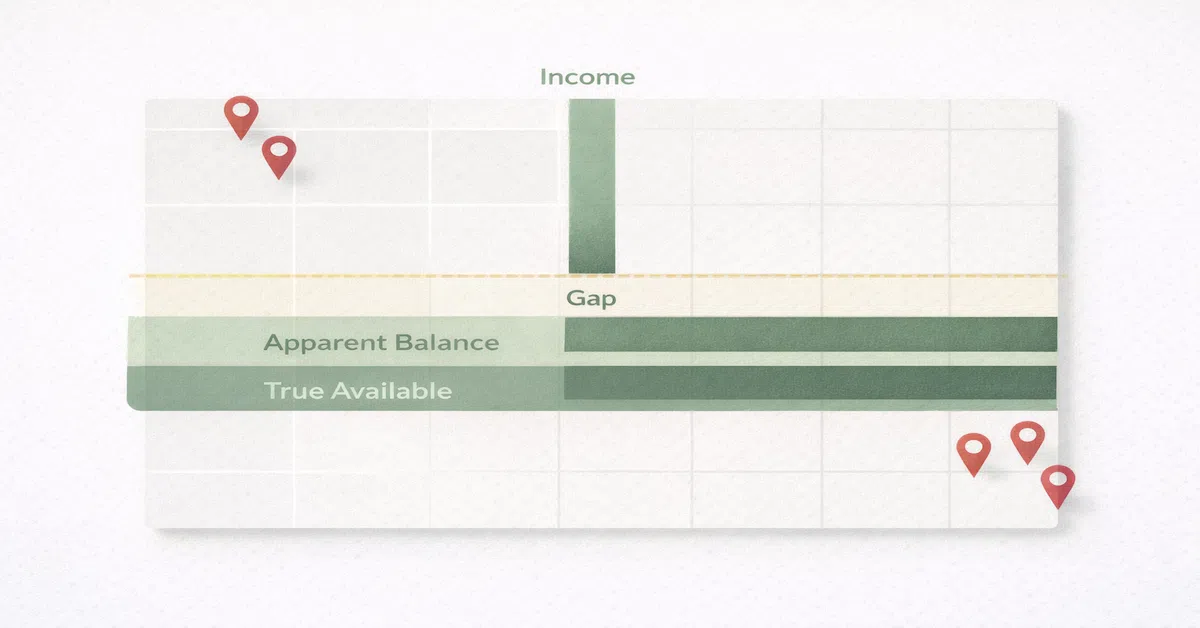
In a single checking account, these two categories are presented as one number. The balance the account shows on the third day after payday includes both the $900 that will process as rent on the first, the $180 in utility and subscription charges due mid-month, and the $340 that is genuinely available for food, transportation, and discretionary spending. The account presents all of it as one available balance, and spending decisions are made against that combined number.
The result is consistent overspending relative to the actual discretionary budget — not because spending is excessive in any meaningful sense, but because the spending is calibrated to the wrong number. The household believes it has $1,420 available. It actually has $340 available for non-committed purposes. The difference between those two numbers is the hidden cash flow problem, and it surfaces reliably as late fees, overdrafts, or emergency credit card use in the week before payday.
Why It Feels Like an Income Problem
The hidden cash flow problem produces symptoms that are diagnostically identical to an income problem: running short before payday, difficulty covering unexpected expenses, relying on credit to bridge the gap between paychecks. These are the same outcomes that insufficient income produces, which is why most people experiencing the hidden cash flow problem conclude that they simply do not earn enough.
The CFPB’s consumer research documents this misattribution consistently. Households that report difficulty making ends meet are not primarily households with income below their expense level. They are frequently households whose income would technically cover all obligations and reasonable discretionary spending — but whose account structure makes it impossible to spend accurately within the discretionary budget because that budget is never visibly separated from committed funds.
This misattribution matters because an income problem requires an income solution — earning more money. A cash flow design problem requires a design solution — changing how the account structure presents and separates money. These are entirely different interventions, and applying the wrong one (working more, taking on debt to bridge gaps) does not solve the underlying structural issue and often makes it worse.
How Timing Makes the Problem Worse
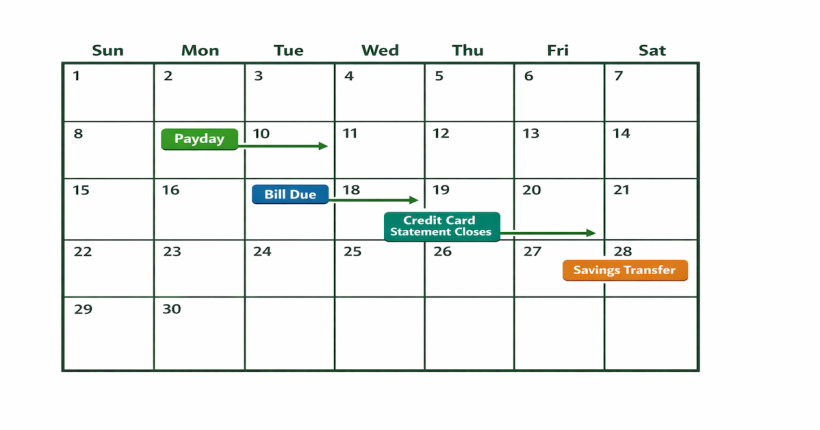
The timing dimension of the hidden cash flow problem compounds the visibility problem. Most fixed obligations — rent, mortgage, major utilities — cluster at the beginning and end of the month. Most income, for households paid biweekly or semi-monthly, arrives mid-month or mid-period. The combination creates a predictable pattern where income arrives when obligations are temporarily lower, creating a misleading surplus that disappears when the clustered obligations process.
A household paid on the 15th and the last day of the month, with rent due on the first, experiences the largest apparent surplus on the 15th — two weeks before the largest single obligation processes. Spending decisions made against the 15th balance are consistently incompatible with rent coverage on the first, not because of financial irresponsibility, but because the account balance on the 15th is a structurally misleading number that does not represent actual available funds for the period.
The problem is structural. The solution is structural.
Account separation eliminates the hidden cash flow problem permanently by making the discretionary budget the only balance visible in the spending account. No tracking required. No willpower required. Just a structure that shows accurate numbers.
See the Account Separation Strategy →The Structural Solution
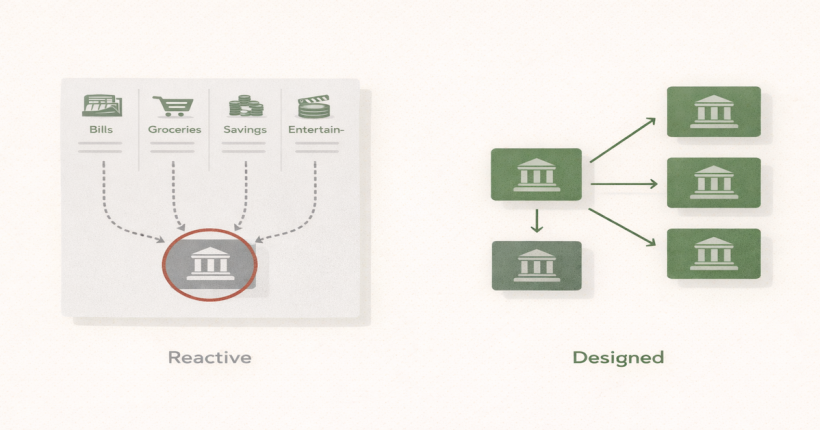
The fix for the hidden cash flow problem is making the two categories of money visually and structurally distinct. When committed money and discretionary money occupy the same account, the balance is always misleading. When they are separated into different accounts, each account balance is accurate for its purpose — the bills account shows what is reserved for obligations, and the spending account shows what is genuinely available to spend.
The mechanics of account separation are covered in the account separation strategy article. The broader context of why bank account structure controls financial outcomes explains why this single infrastructure change has a larger impact on financial stability than most behavioral changes a household could make. The structure produces the accurate information that spending decisions need — and accurate information produces better decisions without requiring any additional effort.
Resources
CFPB — How to Create a Budget and Stick With It
CFPB — Track Your Spending With This Easy Tool
FDIC — Money Smart Financial Education Program
This article is part of the Credit, Banking & Cash Flow integration system on PersonalOne — the complete framework for building a personal finance infrastructure that runs reliably by design.
Frequently Asked Questions
How do I know if I have the hidden cash flow problem?
The clearest indicator is a pattern of running short in the week before payday despite having what feels like adequate income. If you consistently have money immediately after payday and consistently feel squeezed by the end of the pay period — and your spending does not seem dramatically higher than your income — the timing and visibility gap is almost certainly the cause. Calculate your true discretionary budget by subtracting all committed obligations from your monthly income. Compare that number to what you typically spend on discretionary categories. The gap between those numbers reveals whether you have a spending problem or a structure problem.
Does budgeting solve this problem?
Traditional budgeting — tracking categories and trying to stay within limits — only partially addresses the hidden cash flow problem because it still requires accurate mental accounting against a misleading single balance. Account separation solves the problem more completely because it makes the accurate balance visible without requiring any tracking. The spending account balance is always an honest answer to “how much can I spend?” — no calculation, no tracking, no mental subtraction required.
What if my income and expenses vary month to month?
Variable income makes the hidden cash flow problem more acute, not less relevant to solve. With variable income, the misleading balance problem is compounded by uncertainty about how much committed money will be needed in a given month. The solution for variable income uses a buffer account that receives irregular income, then transfers a consistent “salary equivalent” to the bills and spending accounts on a schedule — smoothing the variability before it reaches the accounts where spending decisions are made.
Disclaimer: This content is for educational purposes only and does not constitute financial advice. Individual financial situations vary — consult a qualified financial professional for personalized guidance.