September 23, 2026
Home › Credit Building & Protection › Credit Optimization for Approvals › How Long Does Bad Credit Stay on Your Report?
Part of Credit Optimization for Approvals — getting your credit profile lender-ready before you apply.
What You Need to Know
— Every negative item has its own removal date, and most are calculated from the date the problem started, not the date it was resolved.
— Late payments, foreclosures, and repossessions fall off 7 years from the date of first delinquency. Collections and charge-offs get an extra 180 days on top of that.
— Chapter 7 bankruptcy stays 10 years from filing. Chapter 13 is treated as 7 years by the major bureaus as a policy choice, even though the law technically allows up to 10.
— Civil judgments and tax liens are no longer on standard credit reports at all. The bureaus stopped reporting them in 2017 and 2018.
— How long something stays on your report and how long it actually hurts your score are two different clocks. Most score damage fades well before the removal date.
How long does bad credit stay on your credit report? Every negative item type, late payments, collections, bankruptcies, inquiries, has its own specific removal date, and none of them work quite the same way. Most guides on this explain each one in a separate paragraph scattered across a long page, which makes it hard to actually check your own situation without reading the whole thing twice.
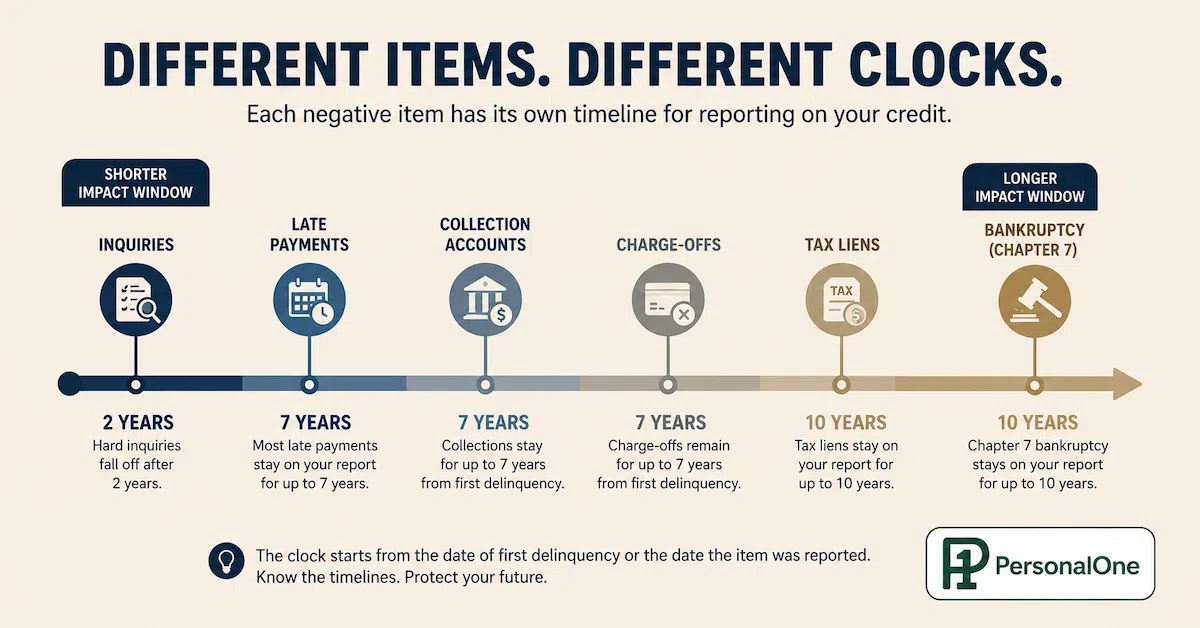
Below is the full reporting timeline in one table: what starts the clock, when each item is required to come off, and how its actual score impact compares to how long it stays visible.
The Complete Credit Report Timeline
Use this as a quick-reference lookup. Find your situation in the left column, then check when the clock starts and when it legally has to end.
| Item Type | Clock Starts | Must Be Removed By | Current Score Impact |
|---|---|---|---|
| Late payment | Date of first missed payment | 7 years from that date | Fades most within 24 months |
| Collection account / charge-off | 180 days after first delinquency | 7 years + 180 days from delinquency | Depends on scoring model; see our collections guide |
| Chapter 7 bankruptcy | Filing date | 10 years from filing | Heaviest in years 1-2; most rebuild access to credit in 2-4 years |
| Chapter 13 bankruptcy | Filing date | 7 years from filing (bureau policy; FCRA allows up to 10) | Generally less severe than Chapter 7; recovery often starts during repayment |
| Foreclosure | Date of first missed mortgage payment | 7 years from that date | Follows the same fading pattern as other 7-year items |
| Repossession | Date of first missed payment | 7 years from that date | Follows the same fading pattern as other 7-year items |
| Hard inquiry | Date of the credit application | 2 years on your report | Affects your score for roughly the first 12 months only |
| Soft inquiry | Date of the check | Up to 2 years, visible to you only | Never affects your score |
| Civil judgment | N/A | Not reported on standard credit reports since 2017 | No score impact, though it can still surface in manual underwriting |
| Tax lien | N/A | Not reported on standard credit reports since April 2018 | No score impact, though it can still surface in manual underwriting |
Two entries on this list, civil judgments and tax liens, might surprise you. They used to be some of the most damaging things a credit report could show. They aren't anymore, and the next section explains why.
How the Clock Actually Starts
Almost every timeline in the table above is measured from the date of first delinquency, the original missed payment that the account never recovered from, not the date the account was closed, sent to collections, or discharged in bankruptcy. This trips people up constantly, because a debt can go through several stages, late, charged off, sold to a collector, before it settles into its final form on your report. All of those stages share the same original delinquency date for reporting purposes.
Collection accounts and charge-offs get one specific exception: the 7-year clock doesn't start immediately at the first missed payment. It starts 180 days later. This accounts for the grace period a creditor typically allows before formally charging off a debt or referring it to collections, and it means these accounts realistically stay reportable for about 7 years and 6 months from your very first missed payment, not a flat 7 years.
Bankruptcy works differently again. The clock starts on your filing date, the day you submit your petition to the court, not your discharge date. Chapter 7 discharges typically happen 4 to 6 months after filing, while Chapter 13 discharges happen 3 to 5 years after filing, once the repayment plan is complete. Either way, the reporting clock has been running since day one of the case, which means your report clears sooner after discharge than the raw "7 or 10 years" number might suggest.
Why Judgments and Tax Liens Aren't on This List Anymore
If you've read older articles about credit report timelines, you may have seen civil judgments and tax liens listed as 7-year items, sometimes worse. That information is outdated. Starting in July 2017 and finishing by April 2018, the three major bureaus removed civil judgments and tax liens from consumer credit reports entirely, as part of a broader public-records cleanup called the National Consumer Assistance Plan.
The change came out of a settlement between the bureaus and a large group of state attorneys general, after data showed public records were frequently mismatched to the wrong consumer, missing identifying details, or simply outdated. Rather than continue verifying that data to a higher standard, the bureaus chose to stop reporting it altogether. Bankruptcy is the only public record type that continued to be reported.
This isn't a loophole you should count on staying open forever. It's a voluntary bureau policy, not something the Fair Credit Reporting Act requires, and the bureaus could technically resume reporting judgments and liens in the future if they meet stricter accuracy standards. It's also worth knowing that a judgment or lien not appearing on your credit report doesn't make the underlying debt disappear. Mortgage lenders in particular often run separate public-records searches during underwriting, so an old judgment can still complicate a home purchase even though it's invisible to your credit score.
Score Impact vs. Report Presence: Two Different Clocks
The removal date in the table above tells you when an item legally has to disappear. It does not tell you how much that item is currently hurting your score, and conflating the two leads to a lot of unnecessary discouragement.
Credit scoring models weight recent negative information far more heavily than older negative information. A late payment from eight months ago is doing real, measurable damage. The same late payment from five years ago, still sitting on your report with two years left before its removal date, is doing very little. The account hasn't changed. Its relevance to a scoring model built around predicting near-term risk has.
This is why someone can have a bankruptcy that's several years from falling off their report and still qualify for a mortgage, or have a late payment technically visible for years to come and still watch their score climb steadily during that time. The removal date is a hard deadline for visibility. It is not a countdown to when your credit "gets better," and treating it that way tends to make people give up on rebuilding long before they need to. If a mortgage application is the goal, our mortgage credit readiness checklist covers how to time everything around it.
What to Do If an Item Is Past Its Removal Date
Bureaus don't always catch expired items automatically. If you spot something on your report that's past the deadline in the table above, based on your actual delinquency or filing date, you have a legitimate dispute, not because the debt was never valid, but because it's now obsolete under federal law.
1. Confirm the exact date that starts the clock for that specific item, using the rules above rather than the date printed elsewhere on the report, which can sometimes be a different, later date.
2. Calculate the actual removal deadline, remembering the 180-day addition for collections and charge-offs.
3. File a dispute with each bureau still reporting it, citing the specific date and the fact that the reporting period has expired.
4. Follow up if the item isn't removed within the standard investigation window. An expired item that's still being reported after a documented dispute is a stronger basis for escalation, including a complaint to the CFPB, than a routine accuracy dispute.
Get Your Full Credit Profile Lender-Ready
Knowing when negative items expire is one piece of preparing for an application. The Credit Optimization for Approvals hub covers the complete pre-application checklist — utilization, inquiries, report accuracy, and timing.
More From This Hub
Return to Credit Building & Protection for the complete system — score fundamentals, monitoring, utilization strategy, and approval optimization.
Frequently Asked Questions
Does paying off a debt reset the 7-year clock?
No. The clock is based on your original date of delinquency, not when you paid, settled, or otherwise resolved the debt. Paying an old collection doesn't restart the reporting period or extend it. It stays anchored to the date the account first went unpaid.
Why does my report still show a judgment from a few years ago?
If it's genuinely a civil judgment and it's still appearing, that's likely a reporting error, since the major bureaus stopped including them by 2018. Dispute it directly with the bureau showing it. If it's actually a related collection or charge-off account rather than the judgment itself, that account follows the normal 7-year-plus-180-day rule instead.
Do hard inquiries really only matter for one year?
Yes, for scoring purposes. A hard inquiry stays visible on your report for 2 years so lenders can see your recent credit-seeking activity, but it only factors into your actual score for roughly the first 12 months.
Is Chapter 13 really shorter than Chapter 7 on my report?
By bureau policy, yes, 7 years versus 10, even though the law technically permits either chapter to be reported for up to 10 years. The shorter window for Chapter 13 reflects that filers repay some portion of their debt through a court-supervised plan rather than discharging it outright.
If an item is past its removal date, will it disappear automatically?
Not always. Bureaus are required to stop reporting items past their legal deadline, but errors happen, and expired items sometimes linger. If you spot one, calculate the correct removal date yourself and file a dispute rather than assuming it will clear on its own.
This content is for educational purposes only and does not constitute financial advice. PersonalOne is not a licensed financial advisor, broker, or investment professional. Individual financial situations vary — consult a qualified financial professional for personalized guidance.