November, 2026
Home › Credit, Banking & Cash Flow › The Financial Infrastructure System › The Personal Finance Infrastructure Model Explained
What You Need to Know
— The PersonalOne financial infrastructure model is a complete, stackable architecture for building the three financial systems that control most household outcomes.
— The model builds in a specific sequence: account infrastructure first, cash flow routing second, credit optimization third — each layer enabling the next.
— The financial infrastructure system is the implementation layer of the full PersonalOne approach — not a strategy for a specific goal, but the plumbing that makes every financial goal more achievable.
— Every component of the model is buildable in a single weekend for most households and runs automatically from that point forward.
— The complete financial infrastructure system covers all components of the model with specific implementation steps for each layer.
The PersonalOne financial infrastructure model is the complete architectural framework that connects the three systems governing household financial outcomes — banking structure, cash flow routing, and credit optimization — into one integrated design. It is not a theory or a mindset framework. It is a practical, buildable model with specific components, a specific build sequence, and specific outcomes at each layer that compound together over time.
This article documents the model in full: what it consists of, why the components are ordered the way they are, what each layer produces when it is correctly built, and how the complete system functions once all three layers are assembled. It is the capstone of this cluster — the view from above that makes every individual component in the surrounding articles make sense as part of a complete architecture rather than a collection of isolated improvements.
The Model: Three Layers, One Integrated System
The model has three layers stacked in dependency order. Layer 1 is the foundation and must be built first because Layers 2 and 3 depend on it. Layer 2 runs through the infrastructure of Layer 1 and enables Layer 3. Layer 3 is the optimization layer that produces the most visible long-term financial improvement, but only holds if Layers 1 and 2 are functioning correctly beneath it.
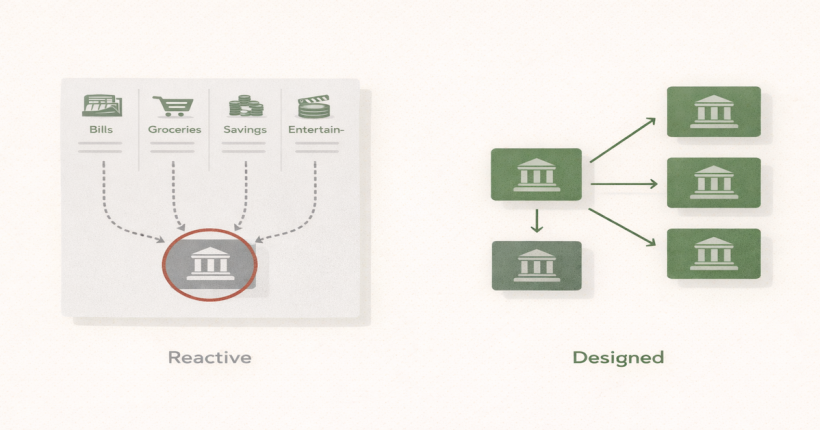
Layer 1 — Account Infrastructure (Banking System). The account design that separates committed money from discretionary money, creates dedicated accounts for each category of funds, and automates the movement of savings before spending decisions are available. Components: bills account, spending account, savings account, and optionally a buffer account for variable income households. This layer is documented in detail in the banking structure and cash flow control cluster.
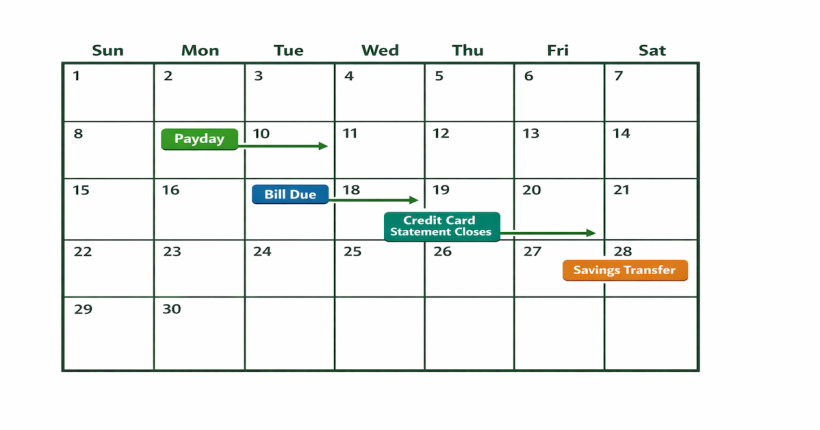
Layer 2 — Cash Flow Routing (Cash Flow System). The transfer schedule and timing decisions that move money through the Layer 1 accounts in the correct sequence each pay cycle. Components: savings transfer on payday, spending transfer after savings, bills account reserve maintained above obligation total, credit card pre-statement payments timed three to five days before each card’s statement close date. This layer runs on top of the account infrastructure and converts static accounts into a dynamic system that executes each cycle automatically. The cash flow timing and credit utilization cluster covers the credit-facing components of this layer in full.
Layer 3 — Credit Optimization (Credit System). The payment timing and account management strategy that uses the Layer 2 cash flow routing to produce consistently favorable credit bureau reporting. Components: pre-statement payment automation from the bills account, due date autopay for remaining balances, account portfolio management to preserve average account age, and timed credit applications that minimize hard inquiry clustering. This layer produces the credit profile that governs borrowing costs for every major financial decision over the following decade.
Why the Build Sequence Matters
The model must be built in layer order because each layer provides the infrastructure the next layer depends on. Attempting to build Layer 3 without Layer 1 is like wiring a building before the walls are framed — the components are correct but the structure they depend on does not exist. Credit optimization that requires consistent pre-statement payments cannot hold without a bills account that funds those payments reliably. Cash flow routing that separates discretionary from committed money cannot produce accurate spending account balances without the account separation that makes the categories physically distinct.
The most common partial-build failure pattern is attempting Layer 3 improvements directly. Someone focuses on paying down credit card balances to reduce utilization, which works temporarily, then reverts when the spending that produced the original balances continues without the cash flow and account infrastructure that would prevent it from recurring. Direct credit interventions without the underlying infrastructure produce temporary improvements that require ongoing effort to maintain — which eventually lapses. Structural interventions produce improvements that maintain themselves because the structure is doing the maintaining rather than the person.
What the Complete System Produces
When all three layers are correctly assembled and running, the complete system produces a specific set of financial outcomes that reinforce each other. Bills are covered by design, not by effort — the bills account holds the correct reserve and the obligations process automatically. Savings accumulate consistently regardless of what else happens in a given month — the payday transfer moves before any spending decision is possible. The spending account balance is always an accurate reflection of what is available for discretionary use — no mental arithmetic, no category tracking, no budget maintenance required.
Credit utilization stays below 30% on every card every month — the pre-statement payment automation runs regardless of whether anyone is paying attention to it. Payment history remains clean — every due date payment processes automatically from the bills account that has been specifically reserved for that purpose. The credit score responds to these consistent inputs with a gradual upward trajectory that compounds over time as the account age increases and the utilization history builds.
The Federal Reserve’s Survey of Consumer Finances documents the long-term wealth outcomes associated with these behavioral patterns — households that automate savings and maintain consistent credit behavior accumulate significantly more wealth and carry lower borrowing costs than households with equivalent incomes that manage the same behaviors reactively. The model converts reactive behavior into automatic behavior — which is why its results compound rather than requiring sustained effort to maintain.
This is the full model. The cluster covers every component with specific implementation steps.
Every article in this cluster covers one component or layer of the financial infrastructure system. The hub connects them all into the complete build sequence.
Return to the Financial Infrastructure System Hub →How This Model Connects to the Broader PersonalOne System
The financial infrastructure model described in this cluster is the plumbing layer of the broader PersonalOne financial framework. It is not the entire system — budgeting strategy, savings rate optimization, investment allocation, and debt elimination are all covered across other hubs. But it is the layer that makes every other component of the system function reliably in practice rather than in theory.
Budgeting strategy that does not rest on account infrastructure breaks down as this cluster documents in detail. Savings rate optimization that does not include automated pre-payday transfers accumulates inconsistently. Investment contributions that compete with discretionary spending for the same account balance get skipped in difficult months. The infrastructure model removes all of those failure modes by making the right behaviors automatic — which is the prerequisite for every other financial improvement to compound rather than stall.
The complete view of how credit, banking, and cash flow work together provides the systemic context. The three-systems framework provides the diagnostic tool for identifying which layer needs attention. The infrastructure article explains why most people never assemble the complete system despite understanding the individual components. Together, the cluster provides both the architecture and the reasoning that makes building it feel not just possible but straightforward.
Resources
Federal Reserve — Survey of Consumer Finances
CFPB — Credit Reports and Scores
CFPB — How to Create a Budget and Stick With It
FDIC — Money Smart Financial Education Program
This article is part of the Credit, Banking & Cash Flow integration system on PersonalOne — the complete framework for building a personal finance infrastructure that runs reliably by design.
Frequently Asked Questions
Is this model the same as the envelope budgeting system?
It shares the same core insight as envelope budgeting — that separating money by purpose makes category limits visible and enforceable. The PersonalOne infrastructure model is the digital, automated version of that principle, extended beyond spending categories to include cash flow timing, credit utilization management, and savings automation. Envelope budgeting addresses the spending layer. The infrastructure model addresses the full stack: account design, cash flow routing, and credit optimization simultaneously, with automation replacing the physical envelope mechanics.
How does this model handle debt payoff?
Debt payoff is built into the cash flow routing layer as an allocated transfer from the bills account. The minimum payment runs automatically from the bills account as a fixed obligation. The extra payment — the accelerator that reduces the principal faster than the minimum payment schedule allows — is configured as a second automated transfer on the same account, timed to run at the same point in the pay cycle as the minimum. Both run without requiring a monthly decision. The infrastructure model makes debt payoff automatic in the same way it makes savings automatic — by converting it from a recurring decision into a recurring structure.
What happens to the model when income changes significantly?
The model scales with income because it is percentage-based rather than fixed-amount. When income increases, the correct response is to recalibrate the transfer amounts: increase the savings transfer by a defined percentage of the income increase, increase the spending transfer by a smaller percentage if desired, and maintain the bills account at the minimum needed to cover obligations reliably. The architecture stays identical. Only the dollar amounts in the automated transfers change. The key discipline is recalibrating deliberately rather than allowing lifestyle inflation to absorb the entire increase before any of it is routed into savings or investment.
Disclaimer: This content is for educational purposes only and does not constitute financial advice. Individual financial situations vary — consult a qualified financial professional for personalized guidance.