June 27, 2026
Home › Money Through Life Stages › Building Stability: Late 20s–30s › 7 Financial Systems Every 20-Something Should Build Now
Part of the building stability in your late 20s and 30s guide — infrastructure to build, not tips to try.
About the Author
Don Briscoe has spent 20 years in banking and finance, the last 12+ of which have been focused on helping Millennials and Gen Z build income and financial stability. He founded PersonalOne to provide the financial education he wished existed — structured, honest, and free.
What You Need to Know
— The financial habits built in your 20s don't just affect your 20s — they compound forward into every subsequent life stage, for better or worse
— Long-term financial stability isn't built in one move — it's built by stacking seven systems in roughly the right sequence: emergency fund, high-interest debt elimination, budgeting infrastructure, early investing, credit building, insurance protection, and goal-aligned savings
— Each system protects the others — an emergency fund protects credit, credit protects access, insurance protects savings, investing protects long-term income independence
— The most expensive financial mistakes of your 30s and 40s are almost always the result of systems that weren't built in your 20s, not bad luck
— You don't need a high income to start — you need a system, and the system works at $35,000 a year if it's actually in place
The financial habits in your 20s are your highest-leverage decade — not because you have the most money, but because you have the most time. The financial systems built now compound forward across every subsequent life stage. The emergency fund started at 24 is the reason a job loss at 31 doesn't become a credit crisis. The investing habit started at 26 is the reason retirement at 62 is possible without desperation. The credit built at 23 is the reason the mortgage at 34 comes with a rate that saves tens of thousands over the loan's life.
Most people in their 20s are told to be better with money without being given a clear sequence for what to build and in what order. The result is unfocused effort — saving a little, investing a little, paying down debt a little — that produces slow progress in all directions rather than meaningful progress in the right direction. This guide covers the seven financial systems that create lasting stability: what each one does, why it matters beyond the immediate term, and how it connects to everything else in the stack. These aren't tips to try. They're infrastructure to build.
Move 1 — Build an Emergency Fund Before Anything Else
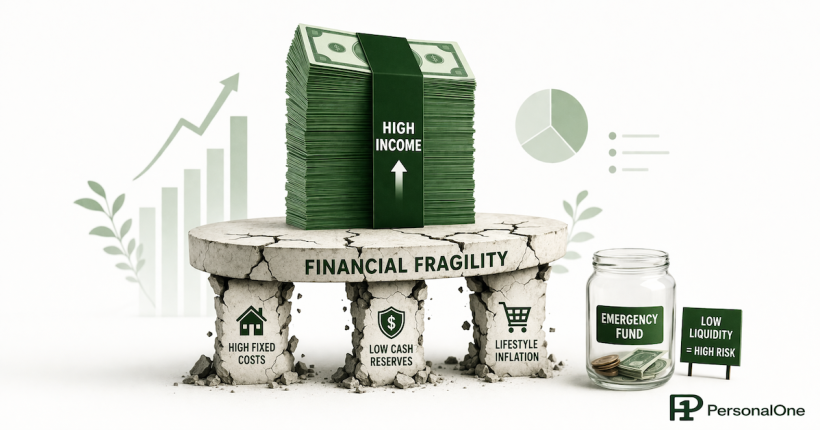
An emergency fund is not a savings goal — it's the foundation every other financial system rests on. Without it, every unexpected expense becomes a credit event. Every car repair, urgent care visit, or month of reduced income that would otherwise be a minor disruption instead gets added to a credit card balance, where it accumulates interest and creates a debt load that compounds against every other financial goal you're working toward.
The target for a full emergency fund is three to six months of survival expenses held in a high-yield savings account separate from checking. The first milestone — and the one to reach as quickly as possible — is $1,000. That amount covers the most common single-event emergencies without requiring credit. The full fund covers income disruption. How to build an emergency fund that protects you from setbacks covers target amounts, account structure, and how to build each layer in sequence.
The mechanism that makes this work long-term is automation: a fixed transfer from checking to the emergency fund account on every payday, sized to whatever is genuinely available after survival expenses. The transfer should happen before the money is visible as discretionary income, not from whatever is left at the end of the month. People who enter their 30s with a funded emergency fund experience income disruptions, health events, and major unexpected expenses as manageable interruptions rather than financial crises.
Move 2 — Eliminate High-Interest Debt Before It Compounds Against You
High-interest debt — primarily credit card balances at 20% to 27% APR — is the single most effective destroyer of financial progress available. Every dollar carrying a 22% interest rate is generating 22 cents of new debt per year, guaranteed, without any market risk or uncertainty. That's working against you as reliably as a well-built investment works for you.
The Avalanche Method
The avalanche method is the mathematically optimal approach: pay minimums on all balances, then direct all additional available cash toward the balance with the highest rate. When that balance reaches zero, redirect that payment toward the next highest rate. Continue until all high-interest debt is eliminated.
Sequencing With Your Emergency Fund
One important sequencing note: build the $1,000 starter emergency fund before aggressively attacking debt. Without it, the next unexpected expense goes back onto the credit card, resetting progress. The starter fund and debt elimination work in sequence, not in parallel at equal priority — cash reserves and debt elimination come before investment optimization, not after.
Move 3 — Build Budget Infrastructure That Runs Without You
Budgeting done right isn't a monthly exercise in willpower — it's infrastructure built once that allocates money automatically before discretionary decisions occur. The goal is a system where bills pay themselves on payday, savings transfer automatically, and the money remaining in checking is genuinely available to spend without mental accounting or guilt.
The 50/30/20 Framework
The 50/30/20 framework — 50% to essential expenses, 30% to discretionary spending, 20% to savings and debt goals — is a useful diagnostic tool for identifying structural imbalances. If essential expenses are consuming 65% of income, the system has a structural problem that willpower can't solve. How to build a budget that actually works covers the specific structures that keep this allocation automated and sustainable as income grows.
Zero-Based Budgeting
Zero-based budgeting — assigning every dollar of income to a specific category before the month begins — is particularly effective for people building financial habits for the first time. People with automated budget infrastructure maintain financial momentum through life transitions — job changes, moves, income disruptions — because the system continues running even when life is demanding full attention elsewhere.
What I've Seen
A client once tried to build all seven of these systems at once in their mid-20s — emergency fund, debt payoff, investing, and credit building simultaneously, each getting a small slice of an already-stretched paycheck. None of it gained real momentum, since every dollar was split too thin to move any single number meaningfully. Once we resequenced it — starter emergency fund first, then debt, then the rest layered in afterward — the same total dollar amount started producing visible progress within a few months, simply because it was concentrated rather than scattered.
The takeaway: building all seven systems at once usually means none of them get built well. The sequence matters as much as the commitment to building them at all.
Move 4 — Start Investing Early Enough for Compounding to Do Heavy Work
The most important variable in long-term investing isn't the amount invested per month — it's the number of years the investment has to compound. Someone who invests $200 a month starting at 22 will, under historical average market return assumptions, accumulate significantly more than someone who invests $400 a month starting at 32. The decade of compounding on the early contributions is worth more than the doubled contribution amount started later.
The Investing Sequence for Most 20-Somethings
First, contribute enough to a 401(k) to capture any available employer match — an immediate 50% to 100% return on the contributed dollar, guaranteed, before any market movement. Second, fund a Roth IRA to the annual limit if income-eligible, since contributions grow tax-free. Third, return to maximizing the 401(k) beyond the match. Fourth, open a taxable brokerage account for goals beyond retirement.
The Right Investment Vehicle
Low-cost index funds tracking broad market indices are the appropriate starting vehicle for most people at this stage — diversified, low expense ratios, and long-term returns that consistently outperform the majority of actively managed funds over extended periods. Investment accounts built in your 20s are the reason financial independence in your 50s or 60s is achievable rather than theoretical, and the reason a job loss at 45 is survivable.
Move 5 — Build a Credit Profile That Opens Doors Across Decades
Credit is not primarily a borrowing tool — it's an access tool. A strong credit profile determines the interest rate on a mortgage (a difference of 1% on a $350,000 loan is approximately $75,000 over 30 years), the approval on a rental application in a competitive market, and the premium on auto and sometimes health insurance. The people who treat credit as unimportant until they need it discover its importance at exactly the wrong moment.
The Foundational Credit Behaviors
Payment history is the single largest component of FICO scores — paying every account on time, every month, is the non-negotiable foundation. Credit utilization should be kept below 30%, with lower being consistently better. Account age is a significant factor, which means keeping older accounts open even when they're not actively used. How to build credit the right way covers the complete system for building a credit profile from any starting point.
Why Credit Built Now Pays Off for Decades
Credit built carefully in your 20s is still working for you in your 40s. A credit profile with twenty years of on-time payments and low utilization is qualitatively different from one built in a rush before a major purchase, and the difference shows up in terms, rates, and access at exactly the moments when those differences are most consequential — mortgage approval being the clearest example. If buying a home is on your timeline, the mortgage-ready checklist covers exactly what lenders are looking for and how to get there within 90 days.
Know your starting point before building the stack.
Credit Karma gives you free, ongoing access to your score, which is the foundation Move 5 depends on.
Check Your Score Free (affiliate)Move 6 — Build the Insurance Layer Before You Need It
Insurance is the prevention layer of financial resilience — the mechanism that transfers catastrophic risk away from your personal balance sheet at a known, manageable cost. A single emergency room visit without adequate health insurance can generate a bill that exceeds an annual income. A single at-fault car accident without adequate liability coverage can result in a judgment that follows you for years.
The Core Insurance Layer for Your 20s
Four types of coverage make up the foundational layer most people in their 20s should have in place:
- Health insurance at coverage levels that make the out-of-pocket maximum survivable, not just the monthly premium manageable.
- Renter's insurance — typically $15 to $30 a month — covering personal property and providing liability protection.
- Auto insurance at liability limits above the state minimum, since the minimum is rarely enough to cover a serious accident.
- Disability insurance — often available through employers at group rates — protecting income if illness or injury prevents work for an extended period.
Insurance doesn't produce a return. It prevents a loss, and the years of emergency fund and investment building that go unprotected by adequate insurance are years of progress that can be wiped out by exactly the kind of event that feels unlikely until it happens.
Move 7 — Set Specific Financial Goals That Make the System Purposeful
Financial systems without goals are technically functional but motivationally fragile. "Save more money" is not a goal — it's a preference. "Save $12,000 for a home down payment by December 2027 by automating $400 a month to a dedicated high-yield savings account" is a goal. The specificity creates a monthly action, a measurable milestone, and a clear signal of whether the current system is on track.
Tiering Goals by Time Horizon
- Short-term (one to two years): an expense buffer, a specific purchase, or a defined debt-payoff target.
- Medium-term (three to seven years): a home down payment, a career investment, or a major life transition.
- Long-term (ten-plus years): retirement targets and financial independence milestones.
People who reach their 30s and 40s without having set and pursued specific financial goals in their 20s typically have diffuse, unfocused financial progress. The goal-setting habit created now is exactly what this seven-system sequence depends on to actually hold together.
Official Sources
CFPB: Credit Building Checklist — guidance on establishing a credit profile from scratch.
CFPB: Save and Invest — resources on savings vehicles, investing basics, and building financial security.
IRS: Roth IRA Contribution Rules and Eligibility — official guidance on contribution limits and income eligibility.
This article is part of Building Stability: Late 20s–30s, within the complete Money Through Life Stages guide.
Frequently Asked Questions
I have very little money right now. Where do I actually start?
Start with visibility — a full 30-day tracking period across all accounts and payment methods. Before any system is built, you need your actual survival expense number and what's genuinely available after it. Even $30 to $50 a month directed automatically toward a starter emergency fund begins building the infrastructure everything else depends on. The amount matters less than the consistency and the automation.
Should I pay off student loans or invest first?
It depends on the rate. Below roughly 5% to 6%, paying on the standard schedule while directing surplus toward investing is generally the stronger move. Above 7%, prioritize the loan over general investing, though not over capturing an employer 401(k) match. Between those numbers, run the calculation for your specific rate and timeline.
What's the right order to work through all seven of these?
First, build the $1,000 starter emergency fund. Second, capture any employer retirement match available. Third, eliminate high-interest debt using the avalanche method. Fourth, build the full three-to-six-month emergency fund. Fifth, begin systematic investing beyond the match. Credit building, insurance, and goal-setting run in parallel throughout this sequence rather than after it.
When should I start investing if I still have debt?
The employer 401(k) match is the exception to the debt-first rule — contribute enough to capture it regardless of debt status, since it's an immediate guaranteed return no loan payoff replicates. Beyond the match, prioritize eliminating high-interest debt before directing additional dollars to investing.
How does credit building fit into this sequence if I don't have any credit yet?
It starts immediately and runs in parallel with every other priority on this list, since it requires consistent on-time payment behavior over time rather than available cash. A secured credit card or a credit-builder loan provides the payment history needed to establish a score, using one recurring charge per month and paying the full balance every cycle.
Disclaimer: This content is for educational purposes only and does not constitute financial advice. Investment returns are not guaranteed and involve risk. Individual financial situations vary — consult a qualified financial professional for personalized guidance before making investment, insurance, or debt management decisions. PersonalOne is not a licensed financial advisor.