Updated: May 26, 2026
Home › Financial Stability › Emergency Fund & Cash Reserves
Part of Financial Stability — the complete system for building emergency reserves, income buffers, and financial resilience.
What You Need to Know
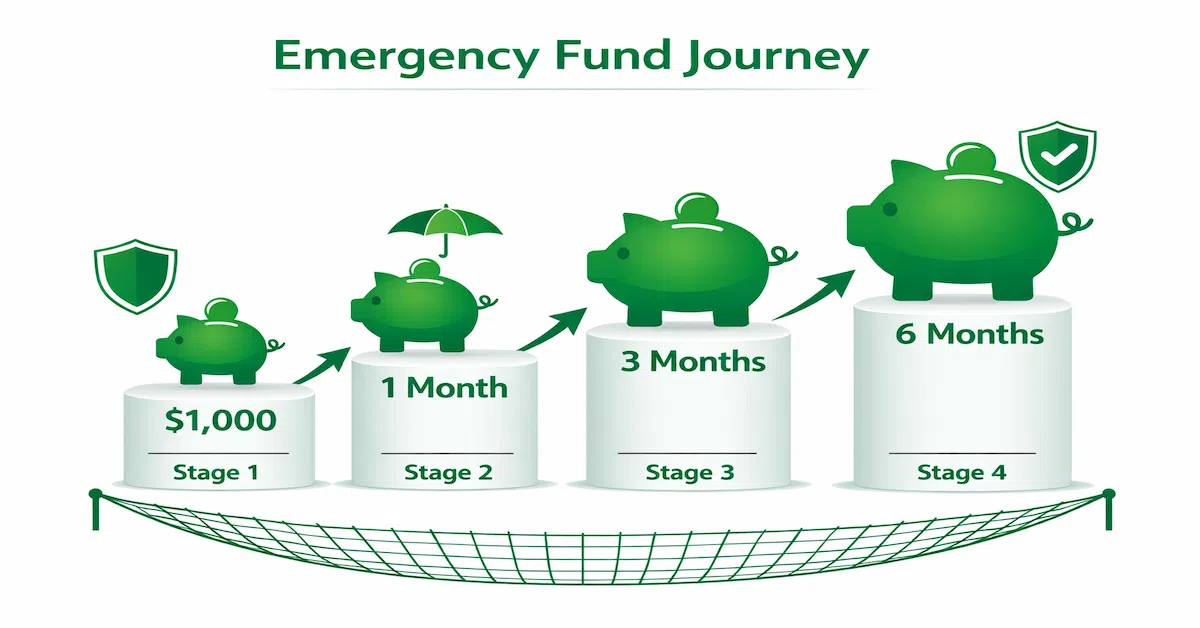
— Build your emergency fund in stages: $1,000 first, then one month, then three months, then six months. Each stage solves a different problem. Each makes the next one easier.
— Keep your cash reserves in a high-yield savings account earning 4–5% APY. Traditional banks pay almost nothing. Online banks pay real interest on the same FDIC-insured money.
— Only use the fund for genuine emergencies — job loss, medical crises, urgent repairs. Not for sales, vacations, or expenses you saw coming.
— Calculate your target based on survival spending, not normal spending. In an emergency you cut everything non-essential. Your fund reflects that reality.
— Rebuild immediately after using the fund. The next emergency does not wait for you to be ready.
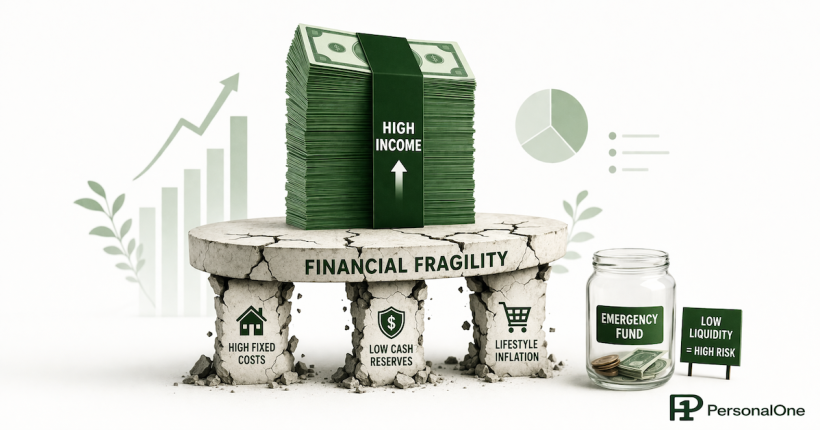
Most emergency fund advice is useless because it treats all emergency savings as if they are the same thing. They are not. A $1,000 emergency fund serves a completely different purpose than a six-month cash reserve. Treating them the same — or worse, thinking you do not need one until you have the full amount — keeps people stuck in the paycheck-to-paycheck cycle indefinitely.
What actually works is staged building. You target $1,000 first. Then one month. Then three months. Then six months. Each stage solves different problems. Each stage gives you more protection. Each stage makes the next one achievable. The financial stability system that emergency funds anchor — buffers, income protection, and long-term resilience — is built on this foundation.
This guide shows you exactly how to build an emergency fund that survives real emergencies, not theoretical ones.
What an Emergency Fund Actually Is
An emergency fund — also called cash reserves — is money you set aside to handle unexpected financial shocks without going into debt or disrupting your regular budget. It is not savings toward a goal. It is not an investment. It is insurance against life going sideways.
What it protects you from:
Job loss. Your primary income stops. Bills do not. An emergency fund gives you three to six months to find new work without panic-accepting the first offer or missing rent.
Medical emergencies. Insurance does not cover everything. Deductibles, copays, and out-of-network surprises can hit $5,000 or more instantly. Emergency funds prevent medical debt from becoming long-term financial damage.
Urgent repairs. Car breaks down and you need it for work. Water heater dies in winter. HVAC fails in summer. These are not optional expenses. They are survival.
Family emergencies. A parent gets sick. A sibling needs help. An unexpected funeral requires travel. Life happens. Emergency funds let you show up without financial devastation.
What it does not cover: Sales. Vacations. Holiday spending. New electronics. Furniture. Anything you saw coming. Anything that can wait. Anything that is a want disguised as a need.
The test is simple: if you do not spend this money right now, will something essential break or will you lose your ability to earn income? If yes, it is an emergency. If no, it is not.
The Four Stages of Building Your Cash Reserves
Do not think about building an emergency fund as a single task. Think about building cash reserves in stages. Each stage serves a different purpose and makes the next one possible.
Stage 1: The $1,000 Emergency Fund
Purpose: Prevents small emergencies from becoming debt.
What it covers: Car repairs under $1,000. Urgent care visits. Broken appliances. Vet emergencies. Phone repairs. Minor home fixes. The stuff that happens regularly but feels like a crisis when there is no buffer.
Timeline: Two to six months depending on income. Save $50–$200 per month. Cut discretionary spending temporarily. Sell unused items. Take a short-term side gig. This is a sprint, not a pace you maintain forever.
Why this first: Most financial crises are not job loss. They are $400–$800 surprises that snowball into credit card debt because there was no buffer. $1,000 stops that cycle immediately. Once you have it, you can breathe. For the fastest path to this first milestone, the $1,000 starter emergency fund guide covers the sprint strategies in detail.
Stage 2: One Month of Expenses
Purpose: Handles income disruption and larger unexpected costs.
What it covers: Rent if your paycheck is delayed. Bills if a commission month falls short. Major car repairs in the $1,500–$3,000 range. Medical deductibles. The gap between a small problem and a catastrophic one.
Timeline: Six to twelve months. Save 10–15% of income monthly at a sustainable pace.
Why this second: One month gives you real options. Paycheck late? No stress. Income drops temporarily? You adjust without panic. Car needs $2,000 in repairs? Annoying but manageable. This is where financial stability actually begins.
Stage 3: Three Months of Expenses
Purpose: Standard safety net for W-2 employees with stable income.
What it covers: Job loss. Extended medical leave. Family emergency requiring time away from work. Any major life disruption that temporarily stops income.
Timeline: Twelve to twenty-four months. Save 10–20% of income monthly.
When to stop here: If you have stable W-2 employment, good health insurance, reliable transportation, and no dependents, three months is the right target. Beyond this, focus shifts toward debt payoff or investing. But if you have income volatility, dependents, or a single-income household, keep building.
Stage 4: Six Months of Expenses
Purpose: Full protection for freelancers, single-income households, and anyone with volatile income.
What it covers: Extended job search in a tough market. Business income drop lasting multiple quarters. Major industry disruption. Prolonged health issues. Anything that takes longer than three months to resolve.
Timeline: Twenty-four to thirty-six months. Save 15–25% of income monthly.
Who needs this: Freelancers. Commission-based workers. Single parents. Single-income households. Anyone in a volatile industry. Six months gives you the freedom to make good decisions rather than desperate ones.
Where to Keep Your Cash Reserves
Location matters. Your cash reserves need to be accessible but not too accessible. They need to earn interest but stay liquid. They need to be separate from daily spending but not locked away.
The answer is a high-yield savings account at an online bank. Here is why that is the only account that makes sense for emergency funds — and where not to keep them.
Why a High-Yield Savings Account at an Online Bank
Online banks pay 4–5% APY. Traditional banks pay a national average of 0.38% APY on standard savings. On a $10,000 emergency fund, that is $400–$500 per year versus $38. Your emergency fund should earn while it waits.
Accessible in one to two business days. Transfer to checking when needed. Not instant — which prevents impulse use — but fast enough for real emergencies.
FDIC-insured up to $250,000. The same federal insurance as any traditional bank. There is zero additional risk from choosing an online bank over a branch-based one. Verify any institution at FDIC.gov before opening.
Psychologically separate. A different bank from your checking account means you will not see the balance during normal spending reviews. Out of sight, out of mind — friction that protects the fund from non-emergency use.
Do not keep it in: checking (too accessible), traditional savings (earns almost nothing), investments (too volatile — you may need it when the market is down 30%), CDs (early withdrawal penalties), or cash at home (inflation erosion, theft risk).
For a current comparison of which high-yield savings accounts are paying the most right now, which have no minimums, and which conditions apply, the where to keep your emergency fund guide covers every option with current rates and the trade-offs between them.
How Much You Actually Need
Most people calculate emergency funds incorrectly. They use their current normal spending. That is not what matters. What matters is your survival spending — the absolute minimum needed to cover essentials if income stops.
The Correct Calculation
Step 1 — List essential monthly expenses only. Rent or mortgage. Utilities. Groceries (not restaurants). Insurance. Car payment. Minimum debt payments. Childcare. Phone. Anything that cannot be cut immediately without serious consequences.
Step 2 — Remove everything optional. Streaming services, gym memberships, subscriptions, dining out, shopping. You are calculating survival mode, not normal life.
Step 3 — Add a 10–15% buffer. There is always something you forgot. Round up, never down.
Example: Rent $1,200 + Utilities $150 + Groceries $400 + Insurance $300 + Car payment $350 + Minimum debt payments $200 + Phone $50 + Gas $150 = $2,800 total. Add 15% buffer = $3,220 per month. Three months = $9,660. Six months = $19,320. That is your target range. For the full calculation breakdown and how target amounts change by situation, the how much emergency fund do you actually need guide covers every scenario.
Notice the target is typically 30–40% less than normal monthly spending. That is correct. In an emergency, everything non-essential gets cut. The fund reflects that reality, not a comfortable lifestyle.
The Fastest Way to Build Your Cash Reserves
Speed matters. The faster you reach $1,000, the faster the debt cycle stops. The faster you reach three months, the faster you can focus on building wealth. Here is how to accelerate both phases.
Month 1–3: Sprint to $1,000. Automate $50–$200 per paycheck — set it to transfer the day after payday so you never see it. Cut one major discretionary category temporarily. Sell unused items. Take one-off gigs for two to three months, then stop. Bank every windfall — tax refund, work bonus, birthday money, any unexpected cash. Do not spend windfalls. Bank them.
Months 4–24: Sustainable build to three to six months. Save 10–20% of every paycheck automatically. Bank every raise — a $200 per month raise is $2,400 per year toward the fund. Redirect freed debt payments — when a card or car gets paid off, redirect that payment to the emergency fund rather than lifestyle.
One distinction the staged approach requires is understanding the difference between emergency savings and sinking funds — money set aside for predictable expenses like car maintenance, annual insurance premiums, and holiday spending. Those planned expenses are not emergencies and should not come from the same account. The sinking funds vs emergency funds guide explains the difference clearly and why keeping them separate protects the emergency fund from being drained by predictable costs.
Five Mistakes That Keep People From Building Cash Reserves
Mistake 1: Waiting for the right time or enough money. There is no right time. Start with $25. The habit matters more than the amount. Waiting for perfect conditions means never starting.
Mistake 2: Keeping it too accessible. An emergency fund in a checking account gets spent. Always. Move it to a different bank — online savings account with no debit card attached. Friction prevents non-emergency use.
Mistake 3: Using it for non-emergencies. Concert tickets are not an emergency. Christmas shopping is not an emergency. Black Friday is not an emergency. Budget separately for predictable expenses. The fund is for unpredictable shocks only.
Mistake 4: Not rebuilding after use. You use $800 for a car repair — that is what the fund is for. But rebuild immediately. Pause aggressive debt payoff temporarily. Pause extra investment contributions temporarily. Rebuild the fund first. The next emergency does not wait for you.
Mistake 5: Letting perfect be the enemy of good. "I can't save 20% so I won't save anything" is the wrong mindset. Save 5%. Save 3%. Save $25 per month. Imperfect action beats perfect inaction. Always.
What Actually Counts as an Emergency
This is where most people fail. They build the fund and then drain it on things that are not emergencies.
Real Emergencies — Use the Fund
— Job loss or involuntary income reduction
— Medical emergency not covered by insurance
— Car repair needed to get to work
— Home repair preventing habitability
— Family death or serious illness requiring travel
— Legal emergency requiring immediate representation
— Pet emergency (life-threatening injury or illness)
Not Emergencies — Budget Separately
— Holiday shopping, birthdays, gifts
— Weddings (yours or someone else's)
— Vacations
— Electronics upgrades
— Car maintenance you delayed
— Annual expenses you knew were coming
— Sales and limited-time offers
— Moving because you want to
When in doubt apply the test: if you do not spend this money right now, will something essential break or will you lose your ability to earn income? If the answer is no, it is not an emergency — it is a want with urgency framing.
Start Building Your Cash Reserves Today
You do not need perfect conditions. You do not need extra money. You need to start with whatever you have — even $25. Open a high-yield savings account. Set up an automatic transfer on payday. In six months you will have a buffer. In a year, real protection. For the complete financial stability framework — emergency funds, income buffers, and long-term resilience — see the Financial Stability system.
Go Deeper: Emergency Fund Guides
This guide covered the foundation. For the specific questions this article surfaces — how much you need, where to keep it, how to build the first $1,000, and how emergency funds differ from sinking funds — these guides go deeper:
5 Keys to Building Financial Stability in Your Life
The complete financial stability framework — how emergency funds, income buffers, and resilience systems work together to protect your financial life from the ground up.
How Much Emergency Fund Do You Actually Need?
The correct calculation based on survival spending, not normal spending — and how the right target changes based on employment type, income stability, and family situation.
Where Should You Keep Your Emergency Fund?
A full comparison of account options — high-yield savings, money market accounts, and what to avoid — with current rates and the accessibility vs protection trade-offs explained clearly.
How to Build a $1,000 Starter Emergency Fund Fast
Sprint strategies, selling guides, temporary cuts, and the specific actions that get most people to $1,000 in under 90 days regardless of income level.
Sinking Funds vs Emergency Funds: What's the Difference?
Why predictable expenses need their own account — and how keeping sinking funds separate from your emergency fund prevents the fund from being drained by expenses you saw coming.
How Much Money Should You Have in Savings?
The broader savings picture beyond emergency funds — how much total savings is appropriate at each income level and life stage, and how to prioritize across competing savings goals.
Frequently Asked Questions
Is $1,000 really enough for an emergency fund?
For the first stage, yes. $1,000 covers 80–90% of small emergencies — car repairs, urgent care, broken appliances. It is not the final target, but it is the first milestone. Most people never start because they think they need $10,000 immediately. That is wrong. $1,000 gets you off the debt treadmill. Then you build to three to six months systematically.
Should I pause retirement contributions to build my emergency fund?
If you have zero emergency fund, pause temporarily — with one exception. If your employer matches 401(k) contributions, contribute enough to capture the full match first. That is free money with an immediate 100% return. Then redirect everything else to the emergency fund until you hit $1,000. After that, resume retirement contributions while building the rest of the fund more gradually.
Can I invest my emergency fund to make it grow faster?
No. Emergency funds are not investments. They are insurance. You may need the money exactly when the market is down 30% — which is when you cannot afford to sell. High-yield savings accounts earning 4–5% APY provide real growth without risk. That is the correct tool. Investing an emergency fund converts a job loss into a potential financial catastrophe.
What if I use my emergency fund and cannot rebuild it quickly?
Start rebuilding immediately, even at $50 per month. After a major emergency, temporarily pause aggressive debt payoff and pause investment contributions above the employer match. Get back to at least $1,000 as fast as possible, then rebuild the rest over six to twelve months. The fund protected you once — protect it so it can protect you again.
How do I stop myself from raiding the fund for non-emergencies?
Friction is the answer. Keep it at a different bank from your checking account with no debit card attached. Name the account "DO NOT TOUCH — EMERGENCIES ONLY." Set a 24-hour rule: if you are considering using it, wait 24 hours. Most emergencies reveal themselves as wants when you pause. And keep a separate discretionary spending account with a clear balance so you never feel like the emergency fund is the only money available.
Official Sources
More From This Cluster
Return to Financial Stability for the complete system — emergency funds, buffer accounts, income volatility planning, and long-term financial resilience.
This content is for educational purposes only and does not constitute financial advice. PersonalOne is not a licensed financial advisor, broker, or investment professional. Emergency fund strategies and savings targets should be tailored to your individual circumstances. Always verify FDIC insurance status before opening any account. Consult a qualified financial professional before making significant changes to your financial approach.