July 2026
Home › Credit Building & Protection › Credit Score Building Strategies › Does Checking Your Credit Score Lower It?
What You Need to Know
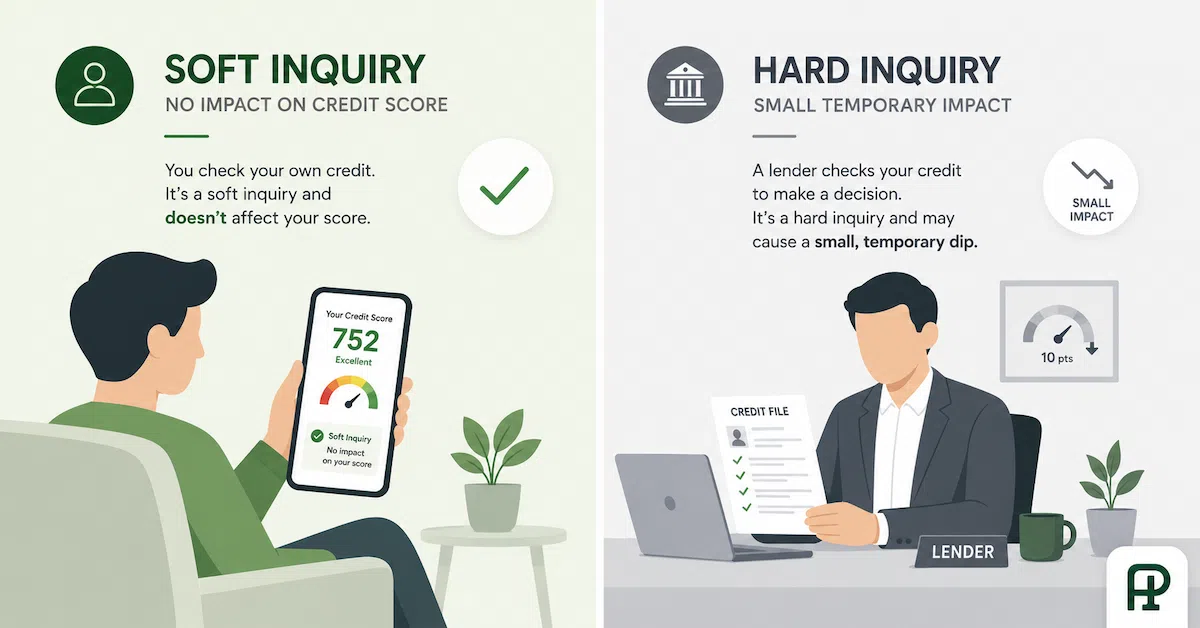
— Checking your own credit score does not lower it. It is classified as a soft inquiry and has zero impact on your FICO or VantageScore.
— Hard inquiries — triggered when a lender pulls your credit as part of an application — are what can temporarily reduce your score, typically by five points or fewer.
— The confusion between the two is the source of the myth. Most people who "checked their score and watched it drop" had also applied for credit in the same window.
— Checking your score regularly is not just safe — it is a required maintenance behavior for anyone building credit with intention.
— Free access to your credit reports is federally mandated. You are entitled to reports from all three bureaus at no cost through AnnualCreditReport.com.
The Answer Is No — and Understanding Why the Myth Persists Matters More
Does checking your credit score lower it? No. Checking your own credit score is classified as a soft inquiry — it leaves a record on your report that only you can see, and it has no effect on your score whatsoever. You can check your score every day for a year and your FICO will not move a single point as a result. This is not a technicality or a loophole. It is simply how the system is designed.
But the myth that checking your score hurts it is remarkably persistent — and that persistence is worth understanding, because it causes real damage. People who believe the myth avoid monitoring their own credit. They go months or years without looking at their reports. They miss errors that compound quietly in the background. They apply for credit without knowing where they stand. The fear of "hurting their score by looking" ends up costing them far more than any hard inquiry ever would. Understanding what actually moves your credit score is what separates people who build deliberately from people who hope passively and wonder why their score isn't moving.
This article explains exactly where the confusion comes from, what soft and hard inquiries actually are, what checking your score does and doesn't trigger, and how to build a monitoring habit that turns your credit report into a tool instead of something you're afraid to look at.
Why the Myth Exists: What People Are Actually Confusing
The myth doesn't come from nowhere. It comes from a real observation that gets misattributed. Here's what typically happens: someone checks their credit score on a Monday. On Wednesday, they apply for a credit card. The following month, they check their score again and it's down a few points. They connect the two events — checking the score and the drop — and conclude that checking caused it. The actual cause was the credit card application, which triggered a hard inquiry from the lender.
This is a classic case of correlation being misread as causation, and it's understandable. The events happened close together. The person didn't know the difference between a soft pull and a hard pull. The drop was small but visible. The wrong lesson got learned and repeated — often confidently, to other people who were also confused.
The second source of confusion is credit monitoring services that send alerts every time any inquiry appears on your report. When you check your own score through one of these services, you sometimes receive an alert that says something like "a new inquiry has been added to your report." That sounds alarming. But soft inquiries and hard inquiries both appear as records on your report — the difference is that only hard inquiries affect your score. The alert is informational. It is not a warning that damage has occurred.
A third source is the general cultural anxiety around credit that leads people to treat their score like something fragile that can be damaged by looking at it too directly. Credit scores are built on behavioral patterns measured over months and years. They are not that brittle. A single soft inquiry, a single hard inquiry, even a single missed payment — none of these destroy a score that has been built carefully. They are inputs in a long-running system, not glass that shatters on contact.
Soft Inquiries vs. Hard Inquiries: The Distinction That Resolves the Confusion
Every time your credit is accessed, an inquiry is logged on your credit report. The two categories of inquiries — soft and hard — are treated completely differently by credit scoring models, and understanding the difference makes the entire landscape clear.
Soft inquiries are credit checks that happen without you applying for new credit. Your own checks fall into this category. So do checks by potential employers reviewing your background, pre-approved credit card offers generated by marketing departments, insurance companies running preliminary assessments, and credit monitoring services running regular scans on your behalf. The common thread is that none of these involve a lending decision being made about you based on the check. Soft inquiries appear on the version of your credit report that only you can see. They are not visible to lenders. And they have no effect on any credit score — FICO or VantageScore — under any scoring model.
Hard inquiries are triggered when a lender or creditor pulls your credit as part of evaluating an application for new credit. Applying for a credit card, a mortgage, an auto loan, a personal loan, a student loan, or even some apartment rental applications generates a hard inquiry. These do appear on the reports that lenders see, and they can have a small, temporary effect on your score — typically in the range of two to five points, lasting no more than twelve months, and disappearing entirely from score calculations after two years even though the record remains on your report for that long.
The critical nuance on hard inquiries: rate shopping for the same type of credit within a compressed window is treated as a single inquiry by FICO's deduplication logic. If you apply to five mortgage lenders in a 14 to 45-day window to compare rates, FICO counts all five applications as one inquiry for scoring purposes. This protects consumers from being penalized for doing the financially responsible thing — comparing offers before committing to a loan. For a deeper look at exactly how these two inquiry types interact with your score at a mechanical level, the article on hard inquiries vs soft inquiries covers the full breakdown including the deduplication windows for different loan types.
What I've Seen
The people most likely to have errors sitting unaddressed on their credit reports are the ones who avoided checking because they were afraid of hurting their score. I've seen clients with accounts belonging to someone else with a similar name, late payment notations on accounts they paid and closed years ago, and collection accounts that had already been resolved — all sitting there, suppressing scores, because no one had looked. One client had an error that had been on her report for three years. Disputing it moved her score 40 points in a single cycle. The damage wasn't from checking. It was from not checking.
What Checking Your Score Actually Does — and What It Doesn't
When you check your credit score through your bank's app, a credit monitoring service, or directly through one of the three bureaus, here is what actually happens: a soft inquiry is logged on your report, you receive a score reading, and nothing else changes. Your score is not recalculated as a result of the check. No lender is notified. No flag is placed on your file. The process is entirely passive — you are reading a number that was already calculated based on the information already in your file.
What you are reading when you check your score depends on the source. Banks and credit card issuers typically provide a FICO 8 score from one bureau — most commonly Experian or TransUnion. Free monitoring services like Credit Karma provide VantageScore 3.0 from Equifax and TransUnion. These numbers will often differ from each other, sometimes by 20 to 40 points, because they use different models and pull from different bureaus. Neither number is wrong. They are different snapshots of the same underlying data processed through different algorithms.
The score you see through a monitoring tool is also not necessarily the score a lender will use when you apply for credit. Mortgage lenders typically use older FICO models — FICO 2, 4, and 5 — which weight factors differently than FICO 8. Auto lenders often use FICO Auto Score versions. This is not a reason to distrust consumer-facing score tools. It's a reason to understand that the number you see is a directional indicator of your credit health, not the exact number a specific lender will pull. The directional signal is what matters for monitoring purposes.
The more important output of checking your score is not the number itself but the factors listed alongside it. Every credit score tool is required to display the key factors that are currently helping or hurting your score. These factor disclosures — often called reason codes — tell you what is actually moving the needle. High utilization, a recent late payment, a thin file, too many recent inquiries: the factor list tells you where to focus. The score is the headline. The factors are the story. Understanding how your credit score works at the component level makes those factor disclosures immediately actionable rather than just informational.
How Often to Check and What to Look For
There is no monitoring frequency that is too high from a score-impact standpoint. Checking your score daily would not harm it. From a practical standpoint, monthly monitoring is the standard recommendation — frequent enough to catch changes quickly, not so frequent that you're reacting to noise. Most credit card issuers and banks now provide free monthly score updates directly through their apps, which makes this frictionless for most people.
Pulling your full credit reports is a separate and equally important practice. Your credit score is a compressed number calculated from your credit report. The report is the underlying data. Errors live in the report, not the score — and you cannot see the errors without reading the report. The CFPB recommends reviewing reports from all three bureaus — Equifax, Experian, and TransUnion — at least once per year. AnnualCreditReport.com is the federally mandated source for free reports from all three. Since the COVID-19 pandemic, weekly free reports have been made permanently available through this portal.
When you pull your full reports, here is what to look for specifically. Accounts you don't recognize — could indicate identity theft or a mixed file where another consumer's data has been merged into yours. Late payment notations on accounts you paid on time — common data entry errors that can be disputed and corrected. Accounts listed as open that you closed — these don't typically hurt your score but are worth correcting for accuracy. Collection accounts you've already paid — paid collections should be noted as such; an unpaid status on a resolved account is disputable. Incorrect personal information — wrong addresses, former employer listed as current, misspelled name variations — these are lower priority but worth correcting for file integrity.
A robust approach to credit monitoring and protection combines regular score checks with periodic full report reviews and, for anyone actively building credit or in a high-identity-theft-risk period, a credit monitoring alert service that flags new accounts, hard inquiries, and significant score changes in real time. The monitoring layer is what converts credit from something that happens to you into something you manage.
Build Your Score With a System, Not Guesswork
The Credit Score Building Strategies hub covers every factor, every monitoring tool, and every action that moves your score — organized as a system you can actually follow.
Explore the Full StrategyWhat Actually Does Hurt Your Credit Score
Since the answer to the original question is a clean no, the more useful question becomes: what does lower a credit score? The myth persists partly because people are right that something hurt their score — they just blamed the wrong action. Here is what actually causes score damage, in rough order of impact.
Late and missed payments are the single most damaging event for most people's scores. Payment history is the largest factor in FICO scoring at 35% of the total. A 30-day late payment can drop a score by 60 to 110 points depending on the starting score and the age of the account. The higher your score before the miss, the more dramatic the drop — a 780 score takes a harder hit from a single late payment than a 620 score does. The damage fades over time but the record stays for seven years.
High credit utilization is the second most impactful factor and the most immediately actionable. Using more than 30% of your available credit on revolving accounts — and especially on individual cards — signals stress to scoring models even when you're paying on time. Unlike a late payment, utilization damage is reversible in a single billing cycle. Pay the balance down and the next statement close reflects the lower utilization. This is the fastest legitimate lever available for score improvement.
Hard inquiries from credit applications do have a real but small effect — typically two to five points per inquiry, with the impact fading within twelve months. The concern about hard inquiries is often disproportionate to their actual damage. One or two hard inquiries in a year are almost never a meaningful factor for someone whose payment history and utilization are in good shape. The situation where inquiries become a real problem is multiple applications in a short window outside of rate-shopping — applying for several credit cards in a month, for instance, signals credit-seeking behavior that scoring models treat as elevated risk.
Closing old accounts hurts in two ways: it reduces total available credit (raising utilization) and eventually reduces average account age. Neither effect is immediate on a dramatic scale, but the compound effect over time is real. The old card you stopped using is quietly contributing to your score simply by existing with a positive history and available credit limit.
For a complete system-level view of what builds and what damages a score over time, building good credit wisely covers the full behavioral framework — the habits, the timing, and the structural decisions that produce a score that stays strong rather than one that has to be constantly repaired.
Where to Check Your Score for Free
Federally mandated free access to credit reports and widely available free score tools have made credit monitoring accessible to anyone. There is no reason to pay for basic score access, and no reason to avoid checking out of concern for your score.
AnnualCreditReport.com is the only federally authorized source for free reports from all three bureaus — Equifax, Experian, and TransUnion. Weekly free reports are currently available. This is the gold standard for full report review and the starting point for any dispute process.
Your existing credit card issuer or bank is likely already providing your score for free. Most major issuers — Chase, Capital One, Citi, Discover, American Express, and others — include free monthly FICO or VantageScore updates in their apps or online portals. Check your current accounts before signing up for a separate service.
Credit Karma provides free VantageScore 3.0 scores from Equifax and TransUnion with regular updates. The scores differ from FICO scores but track directionally with your credit health and come with factor disclosures that identify what is currently helping or hurting your score.
Experian provides free FICO Score 8 access directly at Experian.com, updated monthly. This is one of the scores lenders actually use and provides a more precise read than VantageScore tools for people evaluating their readiness for a credit application.
None of these checks — regardless of how frequently you use them — will lower your score. Every one of them is a soft inquiry. Use them freely and use them often. Monitoring is not a risk. Avoiding it is.
Government Resources
CFPB — Credit Reports and Scores — Official guidance on how inquiries work, how to access your reports, and how to dispute errors.
AnnualCreditReport.com — Federally mandated free access to all three bureau reports. Weekly free reports currently available.
FTC — Free Credit Reports — Consumer rights guidance on accessing your credit file and what lenders are permitted to pull.
Federal Reserve — Consumer Credit Information — Context on inquiry types and credit scoring in the broader lending system.
Return to the full credit building and protection guide for a complete overview of every credit strategy covered on PersonalOne.
Frequently Asked Questions
Does checking your credit score on Credit Karma lower it?
No. Credit Karma uses a soft inquiry to pull your VantageScore 3.0 from Equifax and TransUnion. Soft inquiries do not affect any credit score under any scoring model. You can check your score on Credit Karma daily without any impact on your credit. The scores provided by Credit Karma are real scores — they are VantageScore 3.0 readings, which differ from FICO scores but track the same underlying credit health. Lenders most commonly use FICO scores for credit decisions, but the directional information from Credit Karma is accurate and useful for monitoring purposes.
Can an employer checking your credit score lower it?
No. Employment credit checks are classified as soft inquiries and do not affect your score. Employers who run credit checks as part of background screening are required to obtain your written permission first under the Fair Credit Reporting Act, and the inquiry they generate is soft — it is not visible to lenders and has no scoring impact. Employment credit checks typically show a limited version of your credit report focused on account history and public records rather than your actual score.
How many points does a hard inquiry lower your credit score?
Most hard inquiries reduce a score by two to five points, though the actual impact varies based on the starting score, the number of existing accounts, and the overall credit profile. For someone with a thin file and few accounts, a single hard inquiry can have a larger impact than for someone with a long, established credit history. The effect is temporary — it fades within twelve months and disappears from score calculations entirely after two years, though the inquiry record itself stays on your report. Multiple hard inquiries in a short window outside of rate-shopping can have a compounding effect that is more significant than a single inquiry alone.
What is a soft inquiry and what are some examples?
A soft inquiry is any credit check that happens for informational or non-lending purposes. Examples include: checking your own score or report through any consumer tool; pre-approved credit card and loan offers generated by card issuers; employment background checks; insurance company assessments; landlord screening in some states; and regular scans by credit monitoring services you've subscribed to. None of these affect your score. Soft inquiries appear only on the version of your credit report that you see — they are not visible to lenders reviewing your file as part of a credit application.
How often should I check my credit score?
Monthly score monitoring is the practical standard for most people — frequent enough to catch meaningful changes, not so frequent that minor fluctuations cause unnecessary concern. Pulling full credit reports from all three bureaus at least once per year is the CFPB's baseline recommendation, though anyone actively building credit, planning a major credit application, or who has experienced identity theft should review reports more frequently. AnnualCreditReport.com currently offers weekly free reports from all three bureaus. None of this monitoring affects your score regardless of frequency.
Will checking my credit score before applying for a mortgage hurt my application?
No. Checking your own score before a mortgage application is a soft inquiry and has no impact on the score the mortgage lender will pull. In fact, checking your score and reviewing your full credit report before applying is strongly recommended — it allows you to identify and dispute any errors before the lender sees your file, confirm your score is in the range needed for the loan product you're targeting, and address any outstanding issues that could affect your rate. The mortgage lender's own inquiry will be a hard pull that may reduce your score by a few points, but checking your own score first does not compound or amplify that effect in any way.
This article is for educational purposes only and does not constitute financial or legal advice. Credit scoring models and inquiry rules may vary by bureau and lender. PersonalOne is a free financial education platform and does not offer credit repair services.