September 2026
Home › Credit Building & Protection › Credit Card Selection & Strategy › How to Use Your Credit Cards to Build Wealth Instead of Debt
Part of the Credit Card Selection & Strategy cluster.
Quick Answer: Using Credit Cards to Build Wealth Instead of Debt
— Pay in full, every cycle: A credit card only builds wealth when the statement balance is paid in full. The moment interest accrues, the math flips against you.
— Use rewards as a discount, not income: Cash back and points only add value on spending you were already going to do — not spending created to chase the reward.
— Treat the credit limit as a tool, not a budget: Available credit is not available income. Spending decisions should be based on your bank balance, not your credit limit.
— Let utilization work for you: Keeping balances below 10% of your limit strengthens your credit score, which lowers borrowing costs on every future loan — a real and compounding wealth effect.
— A strong score is leverage: The wealth-building power of a credit card isn't the rewards — it's the access to cheaper mortgages, auto loans, and business credit that a high score unlocks over a lifetime.
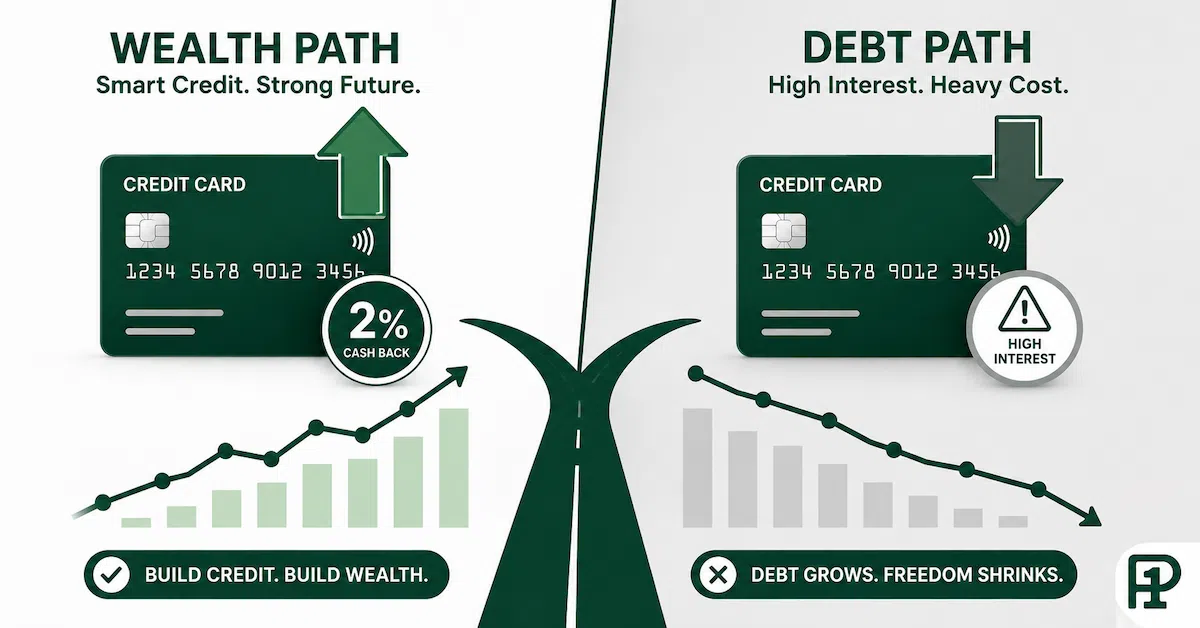
A credit card is neutral. It is not a wealth-building tool and it is not a debt trap — it is a piece of financial infrastructure that amplifies whatever habits you already have. Used with full monthly payoff and intention, it becomes one of the most efficient tools available for building credit, earning rewards on money you were already spending, and developing the documented payment history that lowers the cost of every loan you take out for the rest of your life. Used to extend spending beyond what you can pay back, it becomes the single most common entry point into consumer debt.
The difference between those two outcomes is not the card. It is the system around the card. This guide covers the specific habits, math, and decision points that separate credit cards as a wealth tool from credit cards as a debt trap. For the full framework on selecting the right card for your stage, see the credit card selection strategy hub.
Wealth-Building Use vs. Debt-Trap Use: Comparison
| Behavior | Wealth-Building Use | Debt-Trap Use |
|---|---|---|
| Monthly balance | Paid in full every statement cycle | Partial payments, balance carried month to month |
| Spending source | Based on bank account balance and budget | Based on available credit limit |
| Rewards mindset | Discount on planned spending | Justification for unplanned spending |
| Utilization | Kept below 10% of credit limit | Frequently above 50%, sometimes maxed |
| Number of cards | Limited, each with a clear purpose | Accumulated faster than they can be tracked |
| Long-term result | Rising credit score, lower borrowing costs over time | Falling credit score, rising interest costs, compounding debt |
The Single Rule That Determines Which Path You're On
Every wealth-building use of a credit card depends on one habit: paying the statement balance in full, every cycle, with no exceptions. The moment a balance carries forward, interest begins accruing at the card's APR — typically 20% to 30% — and every dollar of rewards or cash back earned that month is almost certainly smaller than the interest charge that follows. A card earning 2% cash back while carrying a balance at 24% APR is not a wealth tool. It is a 22% net loss wearing a rewards program as a disguise.
This is not a matter of card selection or rewards structure. It is purely behavioral. The same physical card, used by two different people, produces opposite financial outcomes depending entirely on whether the balance is paid in full. Before evaluating any rewards program, travel card, or cash-back structure, the full-payoff habit has to be in place. Everything else is optimization on top of a foundation that either exists or doesn't.
Treat Available Credit as a Tool, Not a Budget
A $5,000 credit limit is not $5,000 of available money. It is access to short-term liquidity that has to be repaid, with interest, if not paid in full. The debt-trap pattern almost always starts with this confusion: spending decisions get anchored to the credit limit instead of the checking account balance. A person with $800 in their bank account and a $5,000 credit limit who spends based on the $5,000 figure is one unexpected expense away from a balance they cannot pay off.
The wealth-building version of this habit is simple: every credit card purchase should already be affordable in cash. The card is a payment method and a credit-building tool, not a financing source for purchases the bank account can't cover. If a purchase requires the credit limit to be possible at all, it is not the right time to make that purchase on credit.
What I've Seen
One pattern shows up again and again: people who think they have a credit card problem actually have a budget visibility problem. The card isn't causing the overspending — it's just making the overspending possible to sustain for a few extra months before the bank account would have stopped it.
In one case, a reader had three cards open, each with a few hundred dollars of balance, and felt like their finances were spiraling. The actual numbers told a different story: total card debt was under $2,000, but it had been carried for over a year, quietly accruing interest at an average of 23% APR. The fix wasn't a debt consolidation product or a balance transfer gimmick — it was a single spreadsheet showing exactly what was being spent on cards versus what was coming in, paired with a firm rule to stop new card spending until the existing balances hit zero.
Within five months the balances were cleared. The cards didn't change. The habit around them did.
The takeaway: the card is rarely the actual problem. The visibility into spending — and the discipline to spend only what's already in the bank — is what determines whether a credit card becomes a wealth tool or a debt trap.
How Rewards Actually Create Value (and When They Don't)
Cash back and points are real value, but only under one condition: the spending would have happened anyway. A 2% cash-back card on $2,000 of monthly expenses you were already paying — groceries, gas, utilities, recurring bills — returns $40 a month with zero behavior change required. That is genuine, low-effort value creation.
The trap version inverts the logic: spending increases because the rewards make it feel justified. Buying something at full price to "earn the points" is never a net gain — a $100 purchase earning 2% cash back still costs $98 net, while not making the purchase at all costs $0. Rewards only create wealth when layered on top of spending that was already planned. They never create wealth when used as the reason for the spending itself.
Utilization: The Quiet Wealth Multiplier
Credit utilization — the percentage of your credit limit currently in use — is 30% of your FICO score, the second-largest factor after payment history. Keeping reported utilization below 10% produces a measurably higher score than letting it run between 30% and 50%, even with a perfect on-time payment record. This matters for wealth building because credit score is not a vanity number. It is a direct multiplier on the interest rate offered for every future mortgage, auto loan, and line of credit.
The dollar value of this is significant and compounding. A 60-point score improvement can be the difference between qualifying for a mortgage rate that's a full percentage point lower — which on a 30-year loan can mean tens of thousands of dollars in interest saved over the life of the loan. Low utilization, maintained consistently over years, is one of the most overlooked wealth-building functions a credit card performs. It has nothing to do with rewards and everything to do with what the card reports to the bureaus every month.
Build the Full Credit System
Using your credit cards to build wealth instead of debt is one piece of a larger system. The PersonalOne Credit Building & Protection hub covers the full framework — score building, utilization strategy, monitoring, and optimization for major loan approvals.
Framework-first. Less willpower. More infrastructure.
Get the Credit Card Wealth-Building Checklist
A free one-page checklist covering the habits in this guide — payoff discipline, utilization targets, and rewards math — delivered straight to your inbox.
Resources
CFPB: Credit Card Resources and Tools — Consumer Financial Protection Bureau guidance on credit card terms, interest, and consumer protections.
MyFICO: How Credit Utilization Affects Your Score — Official FICO guidance on how utilization is calculated and weighted in scoring models.
For the complete credit card selection and strategy framework, visit the Credit Card Selection & Strategy cluster hub.
Frequently Asked Questions
Can a credit card actually help build wealth, or is that just marketing?
It can, but only under specific conditions: the balance is paid in full every cycle, spending is based on cash already available rather than the credit limit, and rewards are earned on planned spending rather than spending created to chase the reward. Under those conditions, a credit card builds credit history that lowers future borrowing costs and returns cash back on money already being spent — both genuine wealth-building effects. Without those conditions, the same card becomes a debt accumulation tool.
Is it bad to carry a small balance to build credit?
No, and it's also not necessary. Carrying a balance does not improve your score faster than paying in full — it only costs you interest. The bureaus see your statement balance relative to your limit, not whether you paid interest on it. Paying in full every cycle produces the same credit-building benefit as carrying a balance, at zero interest cost.
How much credit card debt is considered dangerous?
There's no single dollar figure that applies to everyone — it depends on income and overall financial picture. A more useful marker is utilization: once balances regularly exceed 30% of total credit limits, both your score and your interest costs start climbing meaningfully. If minimum payments are the only payments being made, or new charges are added before the previous balance clears, that's a stronger warning sign than any specific dollar amount.
Are rewards credit cards worth it if I don't carry a balance?
Yes, with one caveat: only if the rewards structure matches spending you'd do anyway. A cash-back or points card earning 1.5% to 5% on regular expenses is close to free money when paid in full every cycle. The math only breaks down if the rewards encourage discretionary spending that wouldn't otherwise happen, or if an annual fee exceeds the realistic rewards earned in a typical year.
Should I use multiple credit cards to build wealth faster?
Multiple cards can help by increasing total available credit, which lowers overall utilization for the same spending level — a real benefit. But each additional card adds tracking complexity and a new opportunity to lose visibility into total spending. The wealth-building benefit of multiple cards only holds if each one is managed with the same payoff discipline as a single card. Adding cards faster than they can be tracked is how the debt-trap pattern usually starts.
What's the fastest way to tell if my credit card use is building wealth or building debt?
Check whether last month's statement balance was paid in full. If yes, the card is functioning as a wealth tool regardless of how much was spent. If no — if any portion carried forward and began accruing interest — the card moved from wealth-building to debt-accumulation for that cycle, even if it's the first time it's happened. This single check is more reliable than tracking total spending, rewards earned, or credit limit usage in isolation.
This content is for educational purposes only and does not constitute financial advice. PersonalOne is not a licensed financial advisor, broker, or investment professional. Individual financial situations vary — consult a qualified financial professional for personalized guidance. Credit card products, terms, APRs, and rewards structures are subject to change. Always review current terms and conditions before applying for or using any credit product.