Updated: June 13, 2026
Home › Financial Stability › Emergency Funds & Cash Reserves › How Much Money Should You Have in Savings?
What You Need to Know
— The question "how much should I have in savings?" doesn't have one answer — it has three, because financial safety is built in layers, not in a single account with a single number.
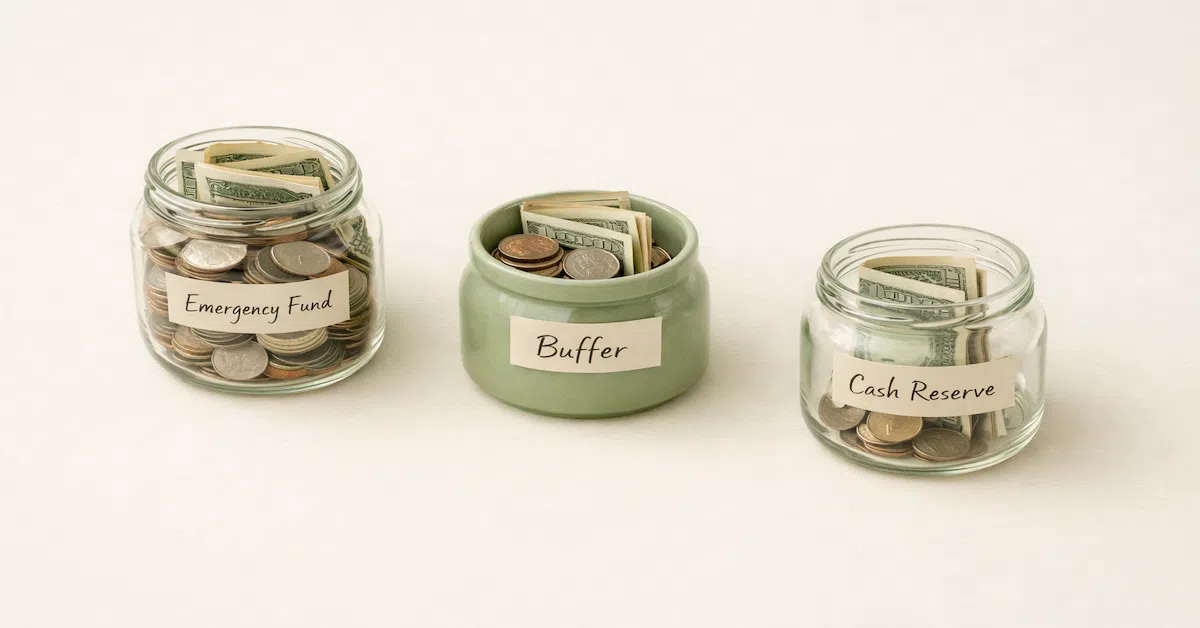
— Layer 1 is the emergency fund: 3 to 6 months of survival expenses held in a dedicated high-yield savings account, sized to cover income disruption and major unexpected events.
— Layer 2 is the buffer account: 1 month of expenses held in or adjacent to checking, designed to absorb timing gaps between income and bills without creating overdrafts or debt.
— Layer 3 is long-term cash reserves: a stability layer beyond the emergency fund — typically 6 to 12 months of expenses — for people with irregular income, single income households, or those approaching major life transitions.
— Most people feel financially unsafe not because their numbers are wrong, but because they don't have a framework for knowing what "safe" looks like. This article provides that framework.
If you've ever wondered how much money should you have in savings — whether you're financially safe, whether a job loss or a medical bill would send everything sideways — you're not alone. That uncertainty is one of the most common financial anxieties people carry, and it exists largely because no one has ever given a clear, honest answer to the question.
The conventional advice you've probably encountered — "save three to six months of expenses" — is not wrong, but it is incomplete. It treats financial safety as a single target rather than a layered system, which means most people either hit the number and still feel unsafe, or spend years trying to reach a target that was defined without reference to their actual situation.
The reason the question is so hard to answer is that financial safety requires three distinct things: a reserve large enough to survive income disruption, a buffer that prevents day-to-day cash flow from creating debt, and a longer-term stability layer that creates genuine resilience against the unexpected. Each serves a different purpose. Each is sized differently. Each needs to live in a different account.
This article breaks down all three layers — what they are, how to size them for your specific situation, how to build them in the right sequence, and how to know when each layer is actually funded. By the end you'll have a clear picture of what "financially safe" means in concrete dollar terms for your life — not a generic rule, but a framework you can apply.
Why Most Savings Advice Leaves You Still Feeling Unsafe
The "three to six months of expenses" rule has been repeated so frequently that most people treat it as settled fact. It isn't wrong — a 3 to 6 month emergency fund is a legitimate and important target — but it fails as a complete answer to the savings question because it collapses three distinct financial needs into one number and then offers a range so wide it provides almost no practical guidance.
Three months of expenses and six months of expenses are very different amounts of money. For someone spending $3,500 per month on survival expenses, three months is $10,500 and six months is $21,000. That's a $10,500 gap between the low end and high end of the same commonly cited rule — and no standard explanation tells you which end is right for your situation or why.
The second problem with the single-number approach is that it doesn't account for the different jobs that different savings layers do. An emergency fund designed to survive a job loss cannot also serve as the day-to-day buffer that prevents overdrafts. A buffer account designed to smooth cash flow timing cannot also serve as a long-term stability reserve. Combining them into one account and one number means the money is always doing the wrong job at the wrong time.
The third problem is psychological. People who reach the three-month target and still feel anxious tend to conclude that they need more money rather than a better system. Sometimes that's true. More often, the anxiety persists because the money isn't structured to provide the protection it's supposed to provide — it's sitting in one account doing an undefined job, and the lack of clarity about its purpose makes it feel less safe than it actually is. The complete framework for the emergency fund strategy — including how to size each layer, where to keep it, and how to automate contributions — is covered in the emergency funds and cash reserves cluster hub.
What I've Seen
The most common pattern I see is someone who has saved $12,000 and still feels financially anxious — not because the number is wrong but because the money is doing an undefined job. It's in one savings account that serves as emergency fund, buffer, travel fund, and general reassurance simultaneously. When an unexpected expense hits, they draw from it and then feel like the emergency fund is depleted even if they only used $800. When cash flow gets tight they look at it as a backup for bills even though it was supposed to be untouchable. The structure is absent and the structure is doing the work that willpower can't. The same $12,000 separated into a properly funded buffer of $4,500 in an adjacent savings account and $7,500 in a dedicated emergency fund at a different institution feels completely different — because each account has one job and both jobs are being done.
Layer 1 — The Emergency Fund: Your Income Disruption Reserve
The emergency fund has one job: to cover your survival expenses if your income stops or drops significantly for an extended period. Job loss, serious illness, a major injury, a family emergency that requires extended leave — these are the events the emergency fund is designed to absorb. It is not a general savings account. It is not a travel fund. It is not the account you draw from for home repairs or car maintenance. It is the account that keeps your financial system intact when your income temporarily can't.
How to Calculate Your Survival Expense Number
Sizing the emergency fund correctly requires knowing your actual survival expense number — not your total monthly spending, but the non-negotiable fixed costs that would continue regardless of your income status: rent or mortgage, utilities, groceries, insurance, minimum debt payments, and essential transportation. Discretionary spending — dining out, entertainment, subscriptions, clothing — is not part of the survival expense number because it can be eliminated quickly in a genuine emergency. The difference between your total monthly spending and your survival expense number is typically larger than most people expect — which is why emergency funds sized against total spending are often over-built while emergency funds sized against survival expenses are exactly right.
How to Choose the Right Target Range
The correct target range depends on several factors the generic rule ignores. Three months is appropriate for salaried employees in stable roles with dual household income, no dependents, and good employer-provided benefits. Four months is appropriate for salaried employees with dependents or single-income households. Five to six months is appropriate for contract workers, freelancers, self-employed individuals, or anyone in an industry with meaningful job security risk. More than six months is appropriate for anyone with highly variable income or significant household financial dependencies. Employment stability is the primary variable — someone in a stable salaried role has a fundamentally different risk profile than someone who is self-employed or in an industry with frequent layoffs. The full calculation breakdown — including how to determine which target is right for your specific employment type, household structure, and risk profile — is covered in the article on how much emergency fund do you actually need.
Where to Keep It
A high-yield savings account at an online bank, entirely separate from any checking account you use for bills or daily spending. The separation is structural, not optional — money that sits in the same account as daily spending will drift into daily spending over time. A separate institution adds enough friction to prevent casual access while keeping the account reachable within one business day when it's genuinely needed. The CFPB notes that keeping emergency savings in a dedicated account separate from spending accounts is one of the highest-impact structural decisions for maintaining the fund's integrity over time. A full comparison of account options — high-yield savings, money market accounts, current rates, and the trade-offs between accessibility and protection — is covered in the article on where to keep your emergency fund.
Layer 2 — The Buffer Account: Your Cash Flow Stability Layer
The buffer account solves a different problem than the emergency fund — one that most people experience far more frequently than job loss or major illness. The problem it solves is timing: the gap between when income arrives and when bills are due, the irregular timing of variable expenses across the month, the difference between months with three pay periods and months with two. These timing gaps are why checking accounts run low before the next payday even when the monthly numbers technically work, and they are why small unexpected expenses generate overdrafts and the debt cycle that follows.
How the Buffer Is Sized
The buffer account is sized at approximately one month of total expenses — not survival expenses alone, but total monthly spending including discretionary categories. That amount held as a permanent floor in or adjacent to checking means that any given month's bills and expenses are already covered before that month's income arrives. Bills draft against last month's income, not this month's — eliminating the timing vulnerability entirely. This is distinct from the emergency fund in both purpose and location. The emergency fund is the reserve you draw from if income stops. The buffer is the operational cushion that makes the month-to-month system run smoothly when income is normal but timing is imperfect. The full mechanics of building and maintaining a dedicated buffer — including how much to keep, where to keep it, and how to fund it in a single sprint — are covered in the article on how to build a buffer account.
Where to Keep It and How to Fund It
Either as a permanent minimum balance in your primary checking account, or in a separate savings account at the same institution as your checking so transfers are instant. The key difference from the emergency fund's separate institution requirement is that the buffer needs to be accessible in real time — same-day or instant transfer capability — because its job is to absorb day-to-day cash flow gaps, not longer-term disruptions. Building the buffer is a sprint, not a marathon. Treat it as a one-time funding goal: save toward it aggressively until it's funded, then stop contributing and let it function as a permanent floor. Once in place, it doesn't need to be rebuilt unless a genuine emergency draws it down — at which point rebuilding it becomes the immediate priority before returning to other financial goals.
Layer 3 — Long-Term Cash Reserves: Your Financial Stability Layer
The third layer is not universally necessary — it is the appropriate next step for people whose income, household structure, or life stage creates financial exposure that a 3 to 6 month emergency fund doesn't fully cover. It is the savings layer that exists beyond the emergency fund, providing extended stability for scenarios that last longer than six months or involve compounding financial pressures that a standard emergency fund wasn't sized to handle.
Who Needs Layer 3
The people for whom this layer is most relevant are those with genuinely variable income — freelancers, commission-based earners, seasonal workers, small business owners — where six months of expenses provides a meaningful but not comprehensive safety net given the probability and potential duration of income disruption. Also people who are single-income households with dependents, people approaching major life transitions (career change, return to school, starting a business, retirement within 5 to 10 years), and people with health conditions that create meaningful financial risk beyond what standard disability coverage addresses. The target for this layer is typically 6 to 12 months of survival expenses beyond the core emergency fund — meaning total cash reserve coverage of 9 to 18 months for the highest-risk profiles.
Where to Keep It and the Opportunity Cost Question
A high-yield savings account or a short-term CD ladder that provides slightly higher returns than a standard savings account without locking the money into a timeframe that creates access risk. The goal is to keep the money liquid enough to access within a week or two if needed, while earning a return that partially offsets the opportunity cost of holding cash rather than investing it. The FDIC notes that high-yield savings accounts at FDIC-insured institutions provide both safety and liquidity appropriate for this purpose. The opportunity cost of holding cash in savings versus investing it is real — but the reserve layers exist specifically because they serve a function investment accounts cannot: they are available immediately, carry no market risk, and don't fluctuate with market conditions. They are the structural foundation that makes it safe to invest the rest of your money without needing to liquidate at the worst possible time.
How to Build All Three Layers in the Right Sequence
The sequence matters. Building the layers in the wrong order creates systems that collapse at the first disruption or require constant manual intervention to maintain. The correct sequence is determined by which layer provides the most protection per dollar during the build phase — not by which target is easiest to reach.
Milestone 1 — The $1,000 Starter Fund
The first milestone is $1,000 in a dedicated savings account. This is not Layer 1 complete — it is Layer 1 begun. But $1,000 is the threshold at which the most common single-event emergencies (a car repair, an urgent care visit, a broken appliance) can be handled without a credit card. Every dollar below $1,000 is a dollar that a surprise expense converts into debt. The first $1,000 is the highest-priority financial goal for anyone whose savings are currently below that threshold, regardless of income or other financial priorities. The sprint strategies, selling guides, and temporary cuts that get most people to $1,000 in under 90 days are covered in the article on how to build a $1,000 starter emergency fund fast.
Milestone 2 — The Full Buffer Account
Once the starter fund exists, building the buffer account to its full one-month-of-expenses target is the next priority. Without the buffer, money freed up for savings is at constant risk of being redirected to cover timing gaps before it reaches its intended destination. The cash flow stability the buffer provides is what makes every subsequent savings milestone actually reachable. The complete system for structuring your accounts so that bill payments, savings contributions, and spending are all handled without active management is covered in the article on the 3-account money flow system.
Milestone 3 — The Full Emergency Fund
The full emergency fund at its correctly sized target — three, four, five, or six months of survival expenses — is built through automated monthly contributions to the dedicated savings account, sized to whatever is genuinely available after survival expenses and buffer maintenance. Automating the contribution is the structural decision that makes this milestone reachable. The BLS Consumer Expenditure Survey consistently shows that households that automate savings contributions reach funding targets significantly faster than those who save manually from whatever remains at month end — because automated savings happen before discretionary decisions, not after them. A distinction the staged approach requires is understanding the difference between emergency savings and sinking funds — money set aside for predictable expenses like car maintenance, annual insurance premiums, and holiday spending. Those planned expenses should not come from the same account as the emergency fund. The article on sinking funds vs emergency funds explains why keeping them separate is what protects the emergency fund from being drained by costs you saw coming.
Milestone 4 — The Long-Term Reserve Layer
Built after the emergency fund is complete, using the same automated contribution redirected to the reserve account. This layer is funded more slowly because the urgency is lower — the emergency fund already provides meaningful protection, and the reserve layer is adding coverage depth rather than creating basic safety. People simultaneously working toward other financial goals (debt elimination, retirement contributions, down payment savings) typically build this layer in parallel at a lower contribution rate rather than pausing other goals entirely. The complete picture of how savings milestones fit within a broader financial stability system — including how to prioritize savings against debt payoff and investment goals — is covered in the financial stability authority hub.
What "Financially Safe" Actually Looks Like in Dollar Terms
To make this concrete: consider someone with $3,200 per month in survival expenses and $4,500 in total monthly spending. They are a salaried employee with moderate job security, no dependents, and dual household income.
Their Layer 1 target is three months of survival expenses: $9,600. Their Layer 2 target is one month of total expenses: $4,500. They do not have significant risk factors requiring a Layer 3 reserve. Their total savings target across all layers is $14,100. At that number they have covered the most common cash flow disruptions with the buffer, covered up to three months of income disruption with the emergency fund, and have a clear picture of what "financially safe" means for their situation.
Now consider someone with the same spending profile but who is freelance with variable income. Their Layer 1 target rises to six months of survival expenses: $19,200. Their Layer 2 target remains at $4,500. Given their income variability they add a Layer 3 reserve of an additional six months of survival expenses: another $19,200. Their total target is $42,900 — three times the dual-income salaried example, reflecting the fundamentally different risk profile of variable income without employer benefits.
Neither number is the "right" savings amount in the abstract. Both are right for the specific situation. The framework produces a defensible, situation-specific target rather than a generic rule applied uniformly to households with completely different risk profiles. That specificity is what turns a vague savings goal into a concrete milestone with a clear completion date. For people managing irregular income — where the monthly savings amount varies as much as the income does — the article on how to route variable income into multiple accounts covers the specific system for keeping savings contributions consistent even when income is not.
Know Your Number — Then Build the System to Reach It
Understanding how much to save is the first step. The Emergency Funds & Cash Reserves cluster covers the complete system for every layer — how to size each one, where to keep it, how to automate contributions, and how to maintain it through income changes and life transitions.
Explore the Full FrameworkGovernment Resources
CFPB — Save and Invest: Consumer Tools and Guidance — Official guidance on building savings, sizing emergency funds, and structuring savings accounts.
CFPB — How to Create a Budget and Stick With It — Federal guidance on calculating monthly expenses and identifying the survival expense number that sizes your emergency fund.
FDIC Money Smart — Financial Education Program — Federal financial education on account structure, savings mechanics, and FDIC-insured high-yield savings options.
Bureau of Labor Statistics — Consumer Expenditure Survey — Data on household spending patterns used to benchmark survival expense calculations and savings adequacy.
Return to the full financial stability guide for the complete framework covering every layer of financial resilience covered on PersonalOne.
Frequently Asked Questions
How much money should I have in savings at any given time?
The framework applies universally: you need a buffer of one month of total expenses in or near checking, an emergency fund of 3 to 6 months of survival expenses (where the right number within that range depends on your income stability, household structure, and employment risk profile), and a long-term reserve layer if your income is variable or your household is single-income with dependents. For most salaried employees with dual household income and no dependents, the combined target is approximately 4 to 7 months of expenses. For freelancers and variable-income earners, the target is substantially higher.
Is it okay to keep all my savings in one account?
It is significantly less effective than separating the layers. When savings serve multiple functions in one account, the balance feels ambiguous — you can't tell at a glance how much is protected emergency reserve and how much is available buffer. The result is that emergency funds get drawn down for non-emergencies and buffers get used for savings goals. Separate accounts with defined purposes — even if the total balance is the same — provide both structural and psychological clarity. The separation is what makes each layer's job visible and defensible.
How much cash should I keep in my checking account specifically?
Your checking account should hold enough to cover all bills drafting this month plus a cash flow buffer to prevent overdrafts from timing gaps. A practical floor is one to two months of fixed expenses as a permanent minimum balance. If your fixed bills total $2,200 per month, keeping $2,200 to $4,400 as a floor in checking eliminates the risk of overdrafts from bill timing while keeping the bulk of your savings in higher-yield accounts where it earns a meaningful return.
What counts as an emergency fund expense versus a regular expense?
Emergency fund expenses are survival expenses only — the non-negotiable fixed costs that continue regardless of income status: housing, utilities, groceries, minimum debt payments, essential insurance, and required transportation. Discretionary spending — dining out, entertainment, streaming subscriptions, clothing, travel — is not an emergency expense because it can be eliminated immediately in a genuine income disruption without threatening basic stability. Sizing your emergency fund against survival expenses rather than total spending keeps the target realistic and the fund appropriately sized for its actual job.
I have some savings but I'm not sure if it's enough. How do I check?
Run through the three-layer check. First, calculate your monthly survival expense number — non-negotiable fixed costs only. Multiply by your correct emergency fund target (3, 4, 5, or 6 months based on your risk profile). Second, calculate your total monthly spending — that's your buffer target. Third, add the two together — that's your combined Layer 1 and Layer 2 target. Compare your current savings to that number. If you're short, you know exactly how much you need and in which layer. If you've met it, you're at the baseline of financial safety and can direct surplus savings toward Layer 3 or investment goals.
Where should I keep my emergency fund?
A high-yield savings account at an FDIC-insured online bank, separate from your primary checking institution. The separation prevents the fund from drifting into daily spending and the high-yield account ensures the money earns a competitive interest rate while it waits. The account should be accessible within one business day but not connected to any debit card or linked for instant transfer to checking — which removes the temptation to treat it as a spending overflow account. Most online banks currently offer significantly higher yields than traditional brick-and-mortar banks on the same FDIC-insured balances.
This article is for educational purposes only and does not constitute financial advice. Individual financial situations vary — consult a qualified financial professional for personalized guidance. PersonalOne is a free financial education platform.