May 4, 2026
What You Need to Know
- Every dollar of freelance income needs a destination before it hits your operating account.
- Route variable income using fixed percentages, not fixed dollar amounts — the percentages scale with what you earn.
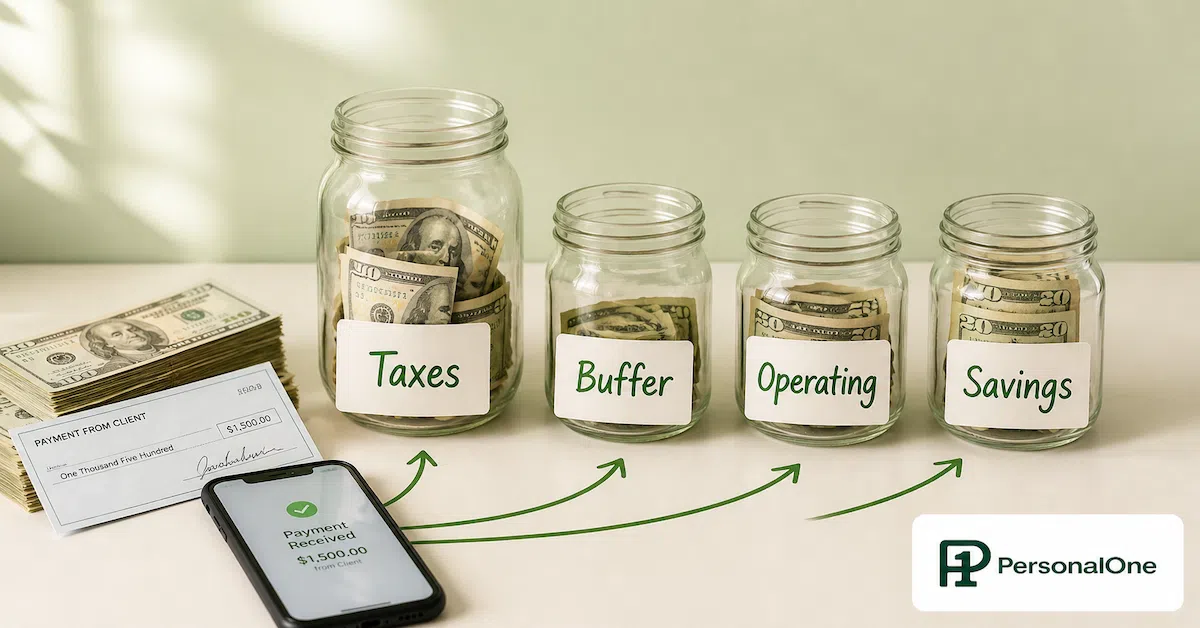
- The four destination buckets are: taxes, buffer, operating, and savings — in that order.
- Each bucket lives in a separate account so spending from one never bleeds into another.
- The routing system runs the same way every month, regardless of how much or how little came in.
Most freelancers treat every client payment the same way: it lands in their checking account and gets spent until it runs out. That approach works fine when income is steady. When income swings by 40% month to month — as it does for most variable-income earners — it produces a chronic cycle of overspending in good months and undercovering in bad ones. Learning how to route variable income across multiple accounts replaces that cycle with a system where every dollar has a job before it ever touches your spending flow. This is the operational core of banking for irregular income — not a theory, but an account-by-account structure you execute the same way every deposit.
It is also one of the most high-leverage moves inside a complete banking system for money management. Most people think of bank accounts as storage. This framework uses them as routing infrastructure — a set of pipes that direct money to its correct destination automatically, before behavior or impulse can redirect it.
Why Fixed Dollar Budgets Fail Variable Income Earners
Traditional budgeting assumes a consistent paycheck. You know exactly what is coming in, so you assign fixed amounts to fixed categories and track what is left. This model breaks immediately when income varies. A $500 grocery budget is easy to maintain on a $6,000 month. On a $2,100 month, it is either unsustainable or it crowds out something more important.
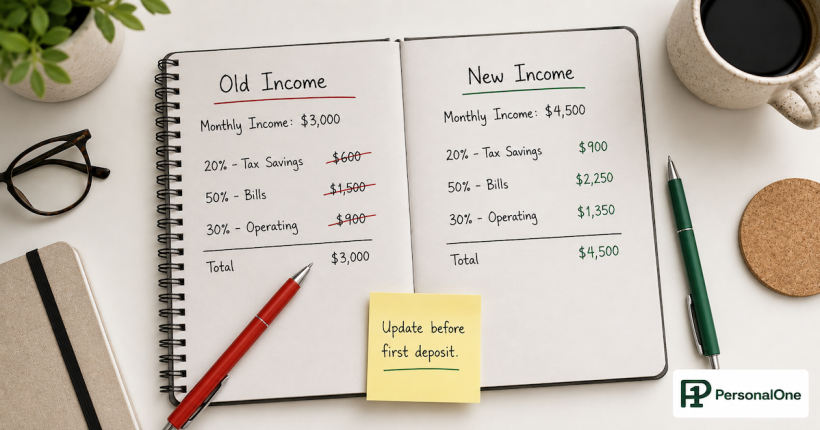
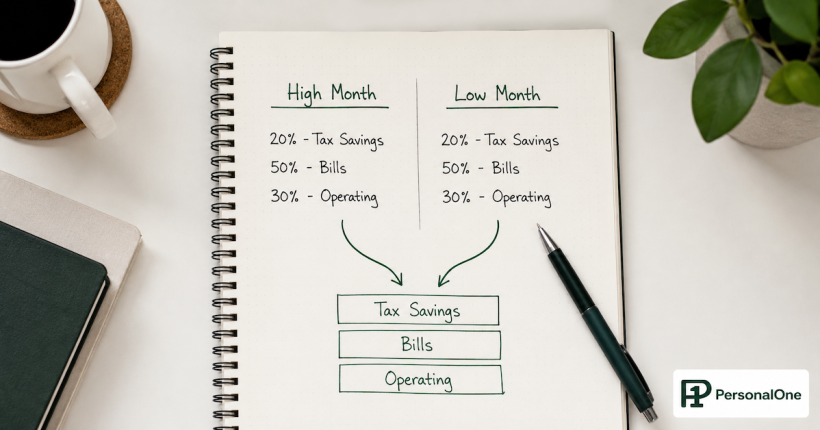
Percentage-based routing solves this by making every allocation proportional to what actually came in. If 25% goes to taxes, it is 25% whether the deposit is $900 or $9,000. The percentages stay constant. The dollar amounts scale. Your financial commitments stay proportional to your actual earnings in real time, without requiring you to re-budget every month from scratch.
The Four Routing Buckets
Every variable income deposit gets split across four destination buckets in a specific order. The order matters because it determines what gets protected first when income is low.
Bucket 1 — Taxes (20–30%). Self-employed income is not withheld at the source. If you do not route a fixed percentage to a dedicated tax account on every deposit, you will eventually owe money you have already spent. Route 25% to a high-yield savings account earmarked exclusively for quarterly estimated tax payments. This account is never touched for any other purpose. If your effective tax rate turns out to be lower when you file, the surplus becomes a savings windfall. There is no downside to over-saving for taxes.
Bucket 2 — Buffer (10% until funded, then 0%). After taxes are routed, 10% of the remaining deposit goes to your buffer account until the buffer reaches its target of 1–3 months of fixed expenses. Once fully funded, this allocation stops and redirects to savings until the buffer is drawn down. The buffer is your income smoothing mechanism — the account that makes it possible to build a buffer for slow months that actually holds through your worst revenue periods.
Bucket 3 — Operating (salary transfer to personal). After taxes and buffer are funded, a fixed dollar amount — your defined monthly salary — transfers to your personal checking account on a set date each month. This amount does not vary with income. It is your personal paycheck. Everything above the salary stays in the business operating account until it is allocated to the final bucket.
Bucket 4 — Savings and surplus. Whatever remains after taxes, buffer, and salary goes to savings goals: an emergency fund, a business investment account, retirement contributions, or a future income gap reserve. In strong months, this bucket grows significantly. In slow months, it may receive nothing — and that is correct. It is the last priority, not the first.
The Account Structure Behind the Routing System
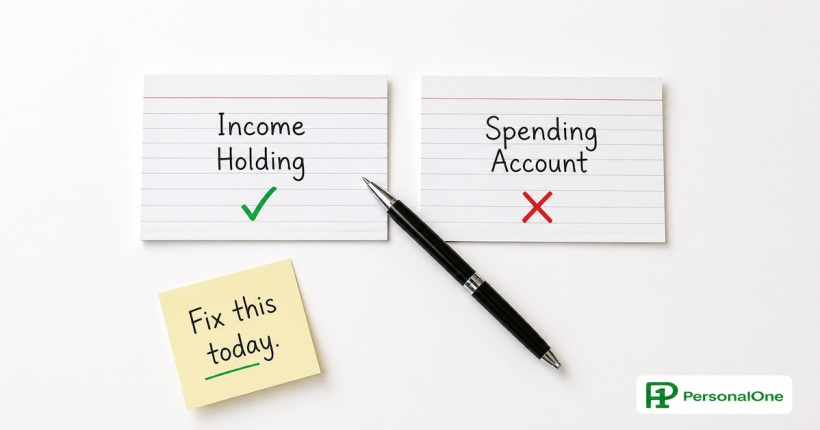
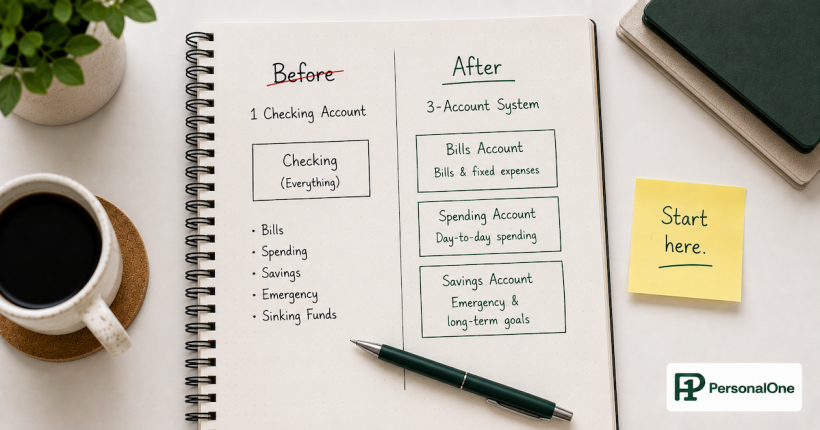
The multiple account system for freelancers requires a minimum of four accounts to function correctly. Each bucket needs its own account. Combining any two buckets in the same account will eventually result in one bleeding into the other.
The four accounts are: a business operating checking account where all client revenue lands, a dedicated tax savings account (HYSA, separate bank preferred), a buffer savings account (HYSA, separate from tax account), and a personal checking account where the salary transfer arrives. A fifth account for general savings goals is optional but useful once the first four are established and funded.
Keep your tax account and buffer account at separate institutions from your primary operating account. The friction of a 1–2 business day transfer window is a feature, not an inconvenience — it reduces the temptation to pull from those accounts impulsively.
How to Execute the Routing on Every Deposit
When a client payment clears your business operating account, execute the routing in sequence within 24–48 hours. Do not let the deposit sit as a single undivided balance. The longer it sits undivided, the more likely it is to be treated as available spending money.
Step one: transfer the tax percentage to the tax savings account. Step two: if the buffer is below its target, transfer 10% to the buffer account. Step three: on your scheduled salary date, transfer the fixed salary amount to personal checking. Step four: leave the remainder in business operating until month-end, then assess what qualifies for savings allocation versus what needs to remain as a business operating reserve for upcoming expenses.
Document every routing transaction in a simple spreadsheet or notes app. Over six months, this log becomes your income map — revealing your actual seasonal patterns, your average tax rate, and how often you draw from the buffer. That data drives every future adjustment to your percentages.
Build the Full Banking System
Income routing is one layer of a complete banking structure. The Banking Systems hub covers every account, every automation, and every linking strategy that makes a freelancer's finances run without constant attention.
Explore the Banking Systems HubAdjusting the Percentages Over Time
Your routing percentages are not permanent. They should be reviewed every six months based on actual income data. If you consistently over-save for taxes, lower the tax percentage by 2–3 points and redirect the difference to savings. If you are drawing the buffer frequently, increase the buffer contribution percentage until the account reaches a more durable balance.
Never adjust percentages reactively based on a single bad or good month. A pattern of three or more months in the same direction justifies a percentage change. A single outlier month — either direction — does not. This is the same discipline that governs salary adjustments: wait for the pattern, not the exception.
What Happens When a Large Payment Arrives
The routing system handles large irregular payments exactly the same way it handles small ones — same percentages, same sequence, same accounts. The temptation with a large deposit is to treat it as discretionary money and spend the excess before the system processes it. Resist that. Run the routing first. Every time. What remains after the routing is allocated is what is actually available for discretionary spending or bonus purposes.
For payments large enough to create a meaningful surplus after routing — a $12,000 project payment when your monthly operating needs are $3,500 — the guide on managing lump sum freelance income covers how to handle the surplus allocation decision without leaving money idle or spending it impulsively.
When the System Protects You Most
The routing system is easiest to execute in strong months. Its real value shows up in slow ones. When a low-income month arrives, the routing still runs — but the amounts are smaller. Taxes, buffer, and salary are funded proportionally to what came in. If the salary transfer falls short because income was too low to cover it in full, the buffer account covers the gap. The income volatility management that feels impossible without a system becomes nearly automatic when the accounts are in place and the routing runs consistently.
Resources
Official sources used to inform this guide:
- IRS: Estimated Taxes for Self-Employed Individuals
- SBA: Managing Business Finances and Accounting
- FDIC: Money Smart Financial Education Program
- CFPB: Consumer Savings Tools and Resources
For the complete banking framework, return to the banking systems and account structure guide.
Frequently Asked Questions
Do I really need four separate bank accounts?
Yes. Each account represents a firewall. Without the separation, tax money gets spent, buffer money gets used for discretionary purchases, and salary money gets confused with business reserves. The inconvenience of managing four accounts is negligible compared to the clarity they create. Most online banks offer free accounts with no minimums.
What if I have irregular deposit timing and can't route every payment immediately?
Route on a weekly cadence instead of per-deposit. Every Friday, review what landed in your operating account since the last routing and execute the split. The important thing is that the routing happens before the balance gets treated as available spending money — the frequency matters less than the consistency.
Should I automate the routing transfers?
Partially. Tax and buffer contributions can be automated on a percentage basis using some banking apps. The salary transfer should be automated on a fixed date. Leave the savings allocation manual until you have enough data to know what your reliable surplus looks like. Automating too early can create overdrafts in low-income months when the automated amounts exceed what came in.
How do I handle a month where income is so low that even the tax percentage would leave me short for operating expenses?
Never skip the tax routing. That money is already owed — spending it creates a liability, not relief. If operating cash is genuinely too tight, draw from the buffer to cover the gap. The buffer exists precisely for this scenario. Tax savings is not optional spending; it is a debt to the IRS that accrues regardless of what you do with the money.
What percentage should I route to taxes if I don't know my effective rate yet?
Start at 25% of gross revenue. This is conservative enough to cover federal self-employment tax (15.3%) plus federal income tax for most income brackets, with a buffer for state taxes. After your first full year of filing, adjust based on your actual effective rate. Over-saving for taxes is always the safer error.
Disclaimer: This content is for educational purposes only and does not constitute financial, legal, or tax advice. PersonalOne is a free financial education platform. Individual financial situations vary. Consult a qualified financial professional for advice specific to your circumstances.