Updated: May 28, 2026
Home › Banking Systems › The 3-Account System Explained
What You Need to Know
— The 3-account system separates money into bills, spending, and savings accounts — each with one job, no overlap.
— This method prevents overspending, automates savings, and eliminates bill-paying stress without requiring constant tracking.
— Setup takes two to three hours initially but eliminates hours of financial mental load every month going forward.
— Works best with direct deposit splits and automatic transfers scheduled on payday.
— Start with the 50/30/20 rule as a baseline, then adjust percentages based on your actual spending patterns.
Picture this: it is three days before payday, you check your account balance, and your stomach drops. You thought you had enough money to last the week, but you forgot about an automatic bill coming out tomorrow. Now you are scrambling to move money around, hoping nothing bounces.
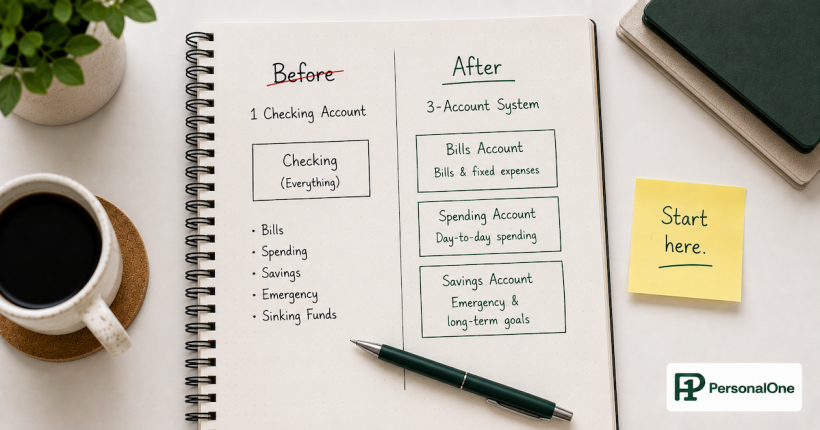
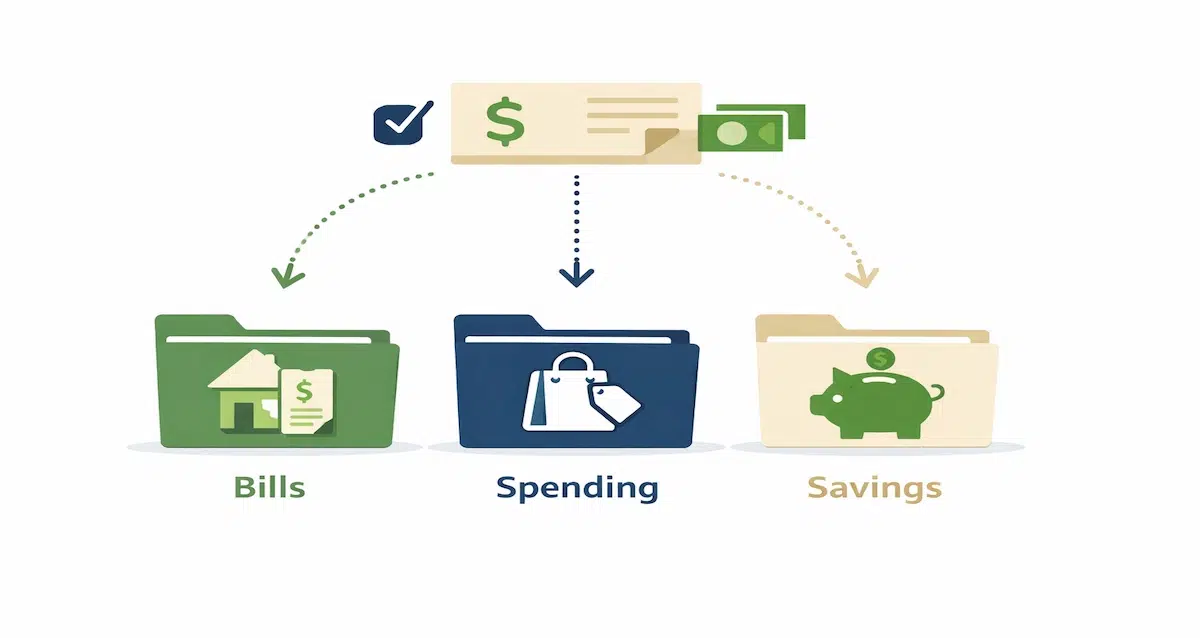
If this feels familiar, you are not alone. The problem is almost never income — it is structure. When everything lives in one account with no clear separation, the balance looks fine until it suddenly is not. The 3-account system solves this by creating clear boundaries. Instead of one checking account doing everything, money splits into three dedicated accounts: one for bills, one for spending, and one for savings. Each account has one job. No overlap, no confusion.
This is not about restriction. It is about clarity. When you know exactly what money is for what purpose, financial decisions become straightforward — and most of them stop requiring decisions at all. The complete banking systems framework that this account structure sits within covers how the three-account foundation connects to income routing, paycheck flow, and full banking automation.
What Is the 3-Account System?
The 3-account system is a money management framework that divides income into three separate bank accounts, each with a specific purpose. Each dollar knows exactly where it belongs. Instead of all money merging into one undifferentiated balance, it flows into accounts that enforce its purpose automatically.
Account 1 — Bills
Fixed expenses live here. Rent, utilities, insurance, subscriptions, loan payments — anything automatic or on a predictable schedule. This account should be boring and stable.
Account 2 — Spending
Daily life money. Groceries, gas, restaurants, entertainment, clothing — anything you actively decide to spend on. This is where your debit card lives. The balance here is your actual available money.
Account 3 — Savings
Your financial future. Emergency fund, goals, down payments — off-limits for daily spending. It grows quietly in the background while you live your life.
Unlike budgeting methods that require tracking every transaction, the 3-account system creates automatic boundaries. You are not constantly deciding whether you can afford something — the answer is already built into which account the money lives in.
Why the 3-Account System Works
Traditional single-account banking creates what psychologists call mental accounting errors. When all money lives in one place, your brain constantly calculates: can I afford this? Will I have enough for rent? Did I forget about any bills? That mental load is exhausting, and it leads to two predictable mistakes.
Overspending from a seemingly large balance. Your account shows $2,000, so dinner out feels fine — except $1,400 of that is already spoken for by bills you have not paid yet.
Artificial scarcity mindset. You deny yourself reasonable purchases because you are worried about unknown future expenses — even when the money is genuinely available.
The 3-account system eliminates both problems by making your financial reality visible and concrete. When you look at your spending account balance, that number is accurate. No mental math required.
Behavioral economics research consistently shows that people manage money better when it is physically or digitally separated. It is the same reason envelope budgeting works — when you can see that your grocery envelope only has $80 left, you naturally adjust behavior. Digital account separation creates the same psychological boundary without dealing with cash.
Setting Up Your 3-Account System
Setup takes two to three hours of focused work upfront. That initial investment eliminates financial stress month after month.
The Five Setup Steps
Step 1 — Choose your banking setup. One bank with multiple accounts is the simplest approach — transfers are instant and management is easy. A strategic multi-bank setup (bills at a credit union, spending at a full-featured checking bank, savings at a high-yield online bank) takes more setup but maximizes the benefits of each account. Either way, prioritize zero monthly fees and no minimum balance requirements.
Step 2 — Calculate your numbers. Bills account: list every fixed expense and add a 5–10% buffer for variable utilities and annual charges divided monthly. Savings: aim for 20% of income, but 10% is a valid starting point. Spending: everything remaining after bills and savings.
Step 3 — Automate the flow. If your employer offers direct deposit splitting, request paycheck splits directly to each account. If not, have the full paycheck deposit into your primary account and set automatic transfers to bills and savings to fire on the same day the paycheck hits. Manual transfers get skipped. Automation does not.
Step 4 — Connect bills to autopay. Set every recurring bill to autopay from the bills account. Schedule payment dates with a buffer after payday. Keep a running list of each bill, amount, and payment date. Review it quarterly to catch changes or forgotten subscriptions.
Step 5 — Link spending account to daily life. Connect your debit card, Apple Pay, Google Pay, Venmo, and PayPal to the spending account. Your bills account should be nearly invisible in daily life — no debit card, no daily logins. It quietly handles obligations in the background.
How to Allocate Money Across the Three Accounts
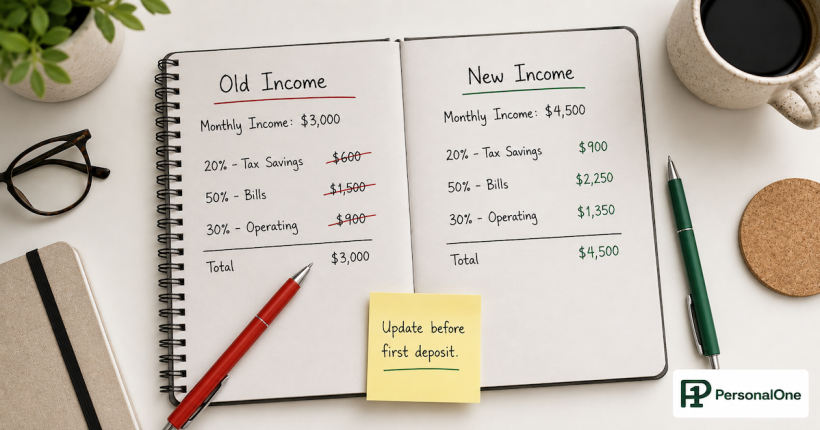
The 50/30/20 rule is a proven starting point — 50% to bills, 30% to spending, 20% to savings. It works well for middle-income households in moderate cost-of-living areas. Your actual allocation should reflect real expenses, not an ideal ratio.
| Account | Starting % | What It Covers |
|---|---|---|
| Bills Account | 50% | Fixed expenses and necessities |
| Spending Account | 30% | Variable expenses and daily life |
| Savings Account | 20% | Emergency fund and financial goals |
High cost-of-living adjustments: If bills consume 60–70% of income, adjust to 65% bills / 25% spending / 10% savings. That is not failure — that is reality.
Debt payoff mode: Treat extra debt payments as part of bills — 55–60% bills (including accelerated payments) / 20–25% spending / 15–20% savings. Never reduce savings to zero.
Building emergency fund: Temporarily boost savings to 25% until you hit $1,000–$2,000, then ease back to a sustainable rate.
Common Mistakes and How to Avoid Them
Underfunding the bills account. Add a 10% buffer to your bills calculation to cover variable utilities, annual subscriptions divided monthly, and quarterly charges. Review the bills account every three months to catch shortfalls early.
Raiding savings for non-emergencies. Every withdrawal for discretionary spending teaches you that the boundaries do not matter. If you consistently cannot leave savings alone, either create a fourth sinking fund account for planned non-essential purchases, or adjust spending upward and savings down to a rate you can actually maintain. An 18% savings rate you stick to beats a 20% rate you constantly undermine.
Making the spending account too small. When the spending account runs dry mid-month and you still need groceries, the system breaks. Be honest about actual spending patterns before finalizing allocations.
Not accounting for irregular expenses. Birthdays, holidays, car registration, medical copays — these feel like surprises but are entirely predictable. Calculate annual irregular expenses, divide by 12, and add that amount to your monthly bills allocation.
Quitting after one bad month. The first month is always messy. Commit to three full months: month one to discover problems, month two to adjust, month three to experience the system working smoothly.
The 3-Account System Is the Foundation. The Full Architecture Goes Further.
The three-account structure solves the most common banking problems. For the complete banking framework — income routing, paycheck flow design, and multi-account infrastructure for every income type — see the Banking Systems hub.
Go Deeper: 3-Account System Guides
This article covered the complete 3-account framework. The guides below go deep on the specific account products, fee structures, and savings decisions the system depends on.
Checking vs Savings Account: Where Should Your Money Go
Where spending money, emergency savings, and long-term reserves should actually live inside your banking system — and how to choose the right account type for each role in the 3-account structure.
How to Open a High-Yield Savings Account in 10 Minutes
The step-by-step process for opening an online high-yield savings account — the right home for Account 3 in the system — including which institutions require no minimum balance and how to set up the automated transfer from day one.
Best Savings Accounts for 2026: High-Yield Picks
The top FDIC-insured high-yield savings accounts for the savings layer of the 3-account system — current rates, minimum balance requirements, and which accounts work best at different balance levels.
High-Yield Savings vs Money Market Accounts
Which account type works best for the savings layer of the 3-account system — how high-yield savings and money market accounts compare on rates, access, and minimum balance requirements at different savings levels.
Banks With No Monthly Fees: Top Options for 2026
The checking and savings accounts with zero monthly fees and no minimum balance requirements — the right infrastructure for a 3-account system that should not cost money to maintain.
How overdraft charges, ATM fees, and monthly maintenance costs quietly drain your money system — and the specific account choices and operating rules that eliminate them permanently.
How Much Money Should You Keep in a Money Market Account
When a money market account makes sense for the savings layer — the balance thresholds where money market rates and access features outperform standard high-yield savings, and when they do not.
Resources
Official Sources
CFPB — Bank Account Consumer Tools and Resources — Federal guidance on checking, savings, and consumer protections.
FDIC — Consumer Protection and Deposit Insurance — Deposit coverage and consumer rights across account types.
FDIC BankFind — Verify Institution Insurance Status — Confirm FDIC coverage for any bank before opening an account.
More From This Cluster
Return to Banking Systems for the complete account architecture framework — how the 3-account foundation connects to income routing, paycheck flow design, and full banking automation.
Frequently Asked Questions
Do I need three separate banks or can I use one?
One bank works fine. Most banks allow multiple checking and savings accounts under one login, making transfers instant. The psychological separation of having distinct accounts is what matters — not whether they are at different institutions. Using different banks can have advantages (higher APY on savings at online banks, better ATM access elsewhere), but the system works either way.
What if I get paid weekly or biweekly instead of monthly?
The system works with any pay frequency. Divide monthly allocations by pay periods: weekly divide by 4, biweekly divide by 2. For biweekly pay, the two extra paychecks per year (26 periods vs 24) can go entirely to savings or debt payoff since monthly bills are already covered by the standard 24.
Should credit card payments come from bills or spending?
Minimum payments and balances you are actively paying down belong in bills — they are fixed obligations. If you use a credit card for daily spending and pay it off monthly, pay the statement balance from spending, since the card was just a payment method for expenses you already tracked there.
How much buffer should each account carry?
Bills account: one month of bills beyond current obligations — covers early-hitting charges or payroll delays. Spending account: keep it lean, just enough to cover one week between paychecks. A large balance here is money better deployed in savings. Savings account: no upper limit — build toward three to six months of expenses for an emergency fund, then save for specific goals.
What do I do with windfalls like tax refunds or bonuses?
Direct windfalls to savings first, then follow your financial priorities. High-interest debt: 80% toward payoff, 20% discretionary. Incomplete emergency fund: all of it there. Financially stable: 50% to savings goals, 30% to guilt-free spending, 20% to bills buffer. A $3,000 tax refund should not dissolve into routine spending.
Can I use this system while paying off debt?
Yes — the 3-account system makes debt payoff more reliable because extra payments happen automatically rather than requiring willpower at month-end. Treat accelerated debt payments as part of your bills allocation. Never reduce savings to zero while paying debt — a small emergency fund prevents you from going deeper into debt when unexpected expenses hit.
What if my income varies significantly month to month?
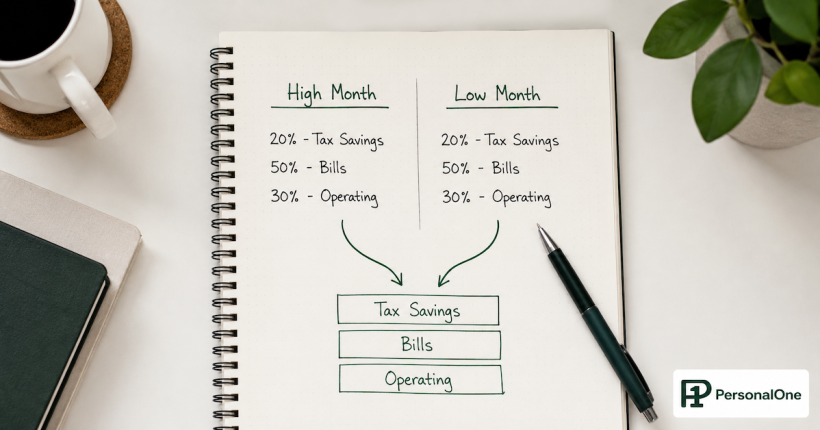
Calculate your average monthly income over the past six to twelve months and use that as your allocation baseline. In high-earning months, surplus flows to savings. In low months, draw from savings to maintain standard bills and spending allocations. Keep a larger bills buffer — two to three months of fixed expenses — to protect against extended slow periods.
PersonalOne Money System
This content is researched, written, and owned by PersonalOne — a free financial education platform built to help Millennials and Gen Z build real financial systems.
Disclaimer: This content is for educational purposes only and does not constitute financial advice. Banking products, interest rates, and account features change over time. Always review current account agreements and fee schedules before opening new accounts or making banking changes. FDIC insurance covers up to $250,000 per depositor per institution — verify coverage directly with the FDIC before opening any account.