Updated: May 27, 2026
Home › Banking Systems › Multi-Account Budgeting System
What You Need to Know
— Separating money into multiple accounts creates clear boundaries between spending, saving, and bills — transforming money management from constant stress into autopilot simplicity.
— The core principle: physical account separation removes the mental burden of tracking categories. When your spending account shows $300, that is genuinely available money — not “$300 minus upcoming rent minus what I should probably save.”
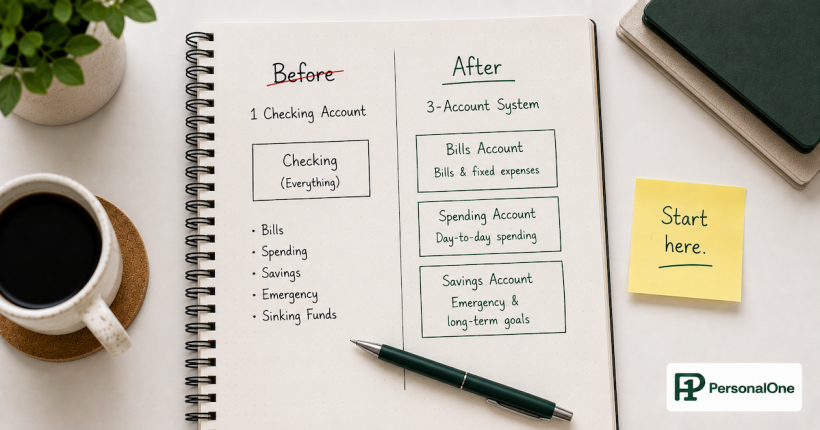
— The three-account foundation most people need: a bills account for fixed expenses, a spending account for variable daily costs, and a high-yield savings account for emergency fund and goals.
— You are not relying on willpower to avoid spending bill money. It is in a different account. The structure enforces the boundary, not your self-control.
— The system becomes fully automatic and habitual after three to six months. Setup takes one afternoon. The stress reduction is immediate.
The most common reason checking account balances feel lower than expected has nothing to do with spending too much. It has to do with everything living in the same place. When rent money, grocery money, emergency savings, and spending money all share one account, every dollar feels both available and already spoken for simultaneously. That ambiguity is what creates the constant low-grade financial anxiety that follows most people through every purchase decision.
A multi-account budgeting system solves this structurally rather than behaviorally. Instead of tracking mental categories, physical accounts create real separation. The bills account holds bill money. The spending account holds spending money. The savings account holds savings. When the spending account shows a balance, that number is accurate — it does not require any adjustment for upcoming obligations or savings intentions. It is simply what is available to spend.
This article covers how to build and operate a multi-account banking system from the three-account foundation through advanced account structures — including how to calculate each account's funding level, how to automate the transfers, and how to handle the challenges that come up in the first 90 days. For the complete account architecture framework, the Banking Systems authority hub covers how the multi-account system connects to income routing, account separation by life stage, and the full banking infrastructure.
Why Physical Separation Works When Mental Accounting Fails
Mental accounting — the practice of mentally dividing money into categories while keeping it all in one place — fails for a predictable reason. The brain does not maintain those categories reliably under normal conditions. They erode when the account balance looks healthy, when a discretionary purchase feels justified, and when the mental overhead of tracking everything becomes too high to sustain.
Physical separation removes the mental overhead entirely. When money is in different accounts, the categories are enforced by infrastructure rather than attention. You cannot accidentally spend bill money from the spending account because the bill money is not in the spending account. The structural boundary does the work that willpower and tracking cannot sustain long-term.
This is not a new idea. Every functional household budget already uses this principle in at least one place — the mortgage or rent payment that comes out automatically before discretionary spending begins. Multi-account systems extend that structural separation to every major spending category, producing the same automatic protection across the entire budget.
The Three-Account Foundation
Most households need three core accounts to start. The system can expand later, but three accounts handle the fundamental separation that eliminates most daily financial stress.
Account 1 — The Bills Account
Purpose: Fixed monthly expenses only — rent or mortgage, utilities, insurance premiums, phone bill, car payment, minimum debt payments, recurring subscriptions. Every expense that arrives on a predictable schedule regardless of spending decisions.
Why it works: When bills are in a separate account, the spending account balance becomes genuinely accurate. What you see in spending is what you can actually spend.
How to size it: Add up every fixed monthly obligation. Add a 10 to 15% buffer for unexpected bill changes or forgotten subscriptions. If monthly bills total $2,000, keep $2,200 to $2,300 in this account.
Operating rule: Every bill autopays from this account. No debit card attached. No personal purchases ever. This account exists only to send money to billers.
Account 2 — The Spending Account
Purpose: Variable daily expenses — groceries, gas, dining, entertainment, clothing, personal care. Everything discretionary that varies month to month based on choices.
Why it works: Once bills and savings are funded elsewhere, the spending account balance is the honest answer to “what can I spend?” No mental adjustments required. Spend freely from this account until it reaches zero.
How to size it: After bills and savings are accounted for, whatever remains is spending money. If monthly income is $4,000, bills are $2,000, and savings is $600, spending gets $1,400. Divide by pay periods and transfer that amount each payday.
Operating rule: The debit card for daily purchases is attached to this account only. When it reaches zero, spending stops until the next transfer.
Account 3 — The High-Yield Savings Account
Purpose: Emergency fund, short-term goals, and longer-term savings. Money that needs to be accessible but should not be touched for daily spending.
Why high-yield: Standard bank savings accounts pay a national average of approximately 0.38% APY. Online high-yield savings accounts currently pay 4 to 5% APY on the same FDIC-insured money. On a $5,000 emergency fund, that difference is $230 per year in additional earnings for no additional risk or effort.
Where to keep it: At a different institution from your bills and spending accounts. The one to two business day transfer delay creates useful friction — enough to prevent impulse withdrawals, fast enough for real emergencies.
Operating rule: Fund this account on payday before spending decisions begin. Treat the savings transfer as a non-negotiable obligation, not an afterthought.
Automating the System: The Payday Sequence
The system works automatically when the transfers fire on payday without any manual action required. Setting up the automation is a one-time task that takes 20 to 30 minutes. After that, the money flows into position at every pay cycle without decisions, reminders, or oversight.
The Automated Payday Sequence
Step 1: Income deposits into the bills account or a primary income account. This is the first account that receives the paycheck.
Step 2: Automatic transfer fires to savings account immediately — “pay yourself first.” The amount is fixed and runs whether the month feels flush or tight.
Step 3: Automatic transfer fires to spending account. The amount equals the spending budget for that pay period.
Step 4: Bills autopay from the bills account throughout the month. No action required. No decisions needed. The infrastructure handles everything.
For biweekly pay cycles, transfer half the monthly bills amount to the bills account with each paycheck. For monthly pay, the full monthly amount transfers at the start of the month. The goal is matching the transfer schedule to the pay schedule so money is always available when bills are due.
The most important automation principle: if transfers require manual action, they will eventually get skipped. Set every transfer to fire automatically. Review the system quarterly to adjust amounts as income and expenses change, but never let the day-to-day operation depend on a manual decision.
The System in Practice: A Real Example
A household earning $3,500 per month paid biweekly ($1,750 per paycheck) with the following expenses: fixed bills $1,800, savings goal $400, discretionary spending $1,300.
Every payday the following fires automatically:
— $1,750 deposits into primary account
— $900 transfers to bills account (half of $1,800 monthly total)
— $200 transfers to high-yield savings ($400 monthly divided by two paydays)
— $650 transfers to spending account ($1,300 monthly divided by two paydays)
All bills autopay from the bills account throughout the month. Spending happens freely from the spending account — when it reaches zero, spending stops until the next payday transfer. Savings grow automatically. The household makes no daily financial decisions because the system has already made them. That elimination of daily decision fatigue is what most people report as the most immediate and meaningful change after implementing this structure.
Common Challenges in the First 90 Days
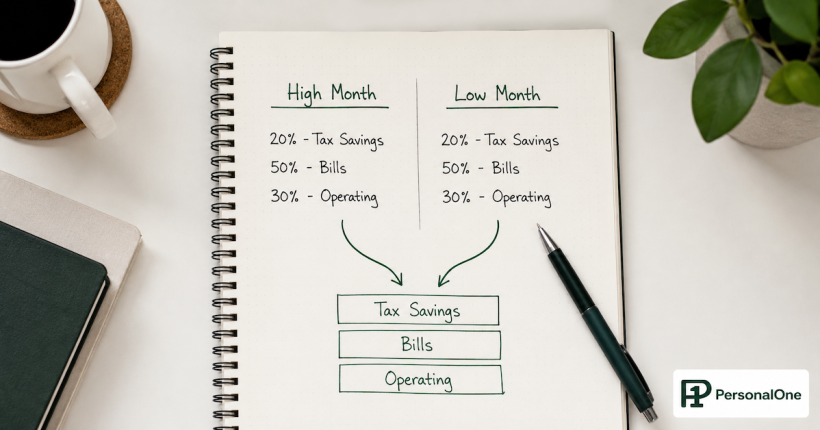
Irregular income: Base the system on the lowest typical income month. During higher-income months, extra funds flow to savings or cover irregular expenses. Calculate your average monthly income over six months, use the lowest month to set allocations, and treat anything above that floor as surplus that builds reserves.
Spending account running out before payday: The problem is almost always allocation, not willpower. Track spending for one month to identify where the money is actually going. The spending account may be undersized relative to real variable costs — or a category that should be in the bills account (regular subscriptions, predictable monthly expenses) is being paid from spending. Diagnose before adjusting amounts.
Overdraft concerns: Keep a small buffer in the bills account — an extra $100 to $200 above the monthly bills total. This absorbs forgotten subscriptions, annual charges that hit unexpectedly, and small billing changes without creating an overdraft event. Review the bills account balance monthly until the buffer amount feels calibrated to your actual bill patterns.
Too complicated to track: Start with two accounts if three feels overwhelming — bills and everything else. Add the dedicated spending account once the bills separation is running smoothly. Add the high-yield savings account as the third step. Building sequentially produces better results than trying to implement everything simultaneously.
Expanding Beyond Three Accounts
Once the three-account foundation is running automatically, additional accounts for specific purposes extend the same structural separation to more financial goals. Each additional account follows the same principle: money that is physically separated from daily spending stays protected from daily spending decisions.
Common additions that produce meaningful results:
— Irregular expenses account: Annual bills (car registration, insurance renewals, holiday spending) funded monthly at one-twelfth of the annual total. Eliminates the “I forgot this was coming” cash flow shock.
— Vacation fund: Monthly contribution toward a specific travel goal, separate from the emergency fund so travel savings cannot be raided during a financial shock.
— Home maintenance fund: For homeowners, one percent of home value annually set aside monthly for repairs. Transforms unpredictable repair costs into a planned expense.
— Investment account: Once the emergency fund is established, a dedicated investment account separates wealth-building contributions from accessible savings.
Build the Complete Banking Structure
Multi-account separation is one cluster in the complete banking systems framework. For the full architecture — how accounts connect, how income routes correctly, and how the system scales through every life stage — the Banking Systems hub covers it all.
Explore Banking Systems →Go Deeper: Multi-Account Budgeting System
This hub covered the foundation. The guides below go deep on specific implementation challenges, structural mistakes, behavioral dynamics, and advanced strategies for the multi-account system.
Why You Need a Separate Account for Bills
The single most impactful account structure change most households can make — why keeping bills in their own account eliminates the financial anxiety that comes from bills and spending competing for the same dollars.
The Psychology of Account Separation
Why physical account separation works when mental budgeting categories fail — the behavioral science behind why structure outperforms willpower, and how the multi-account system changes your default financial behavior without requiring discipline changes.
How to extend the three-account foundation into a four-bucket system that adds a dedicated irregular expenses account — eliminating the cash flow shocks from annual bills, irregular costs, and expenses that feel like emergencies because they weren't planned for.
How to Set Spending Limits by Account Without a Budget App
How account structure itself functions as a spending limit system — no app, no tracking, no ongoing management required. The account balance is always the honest answer to what is available to spend.
5 Multi-Account System Mistakes That Sabotage Your Money
The most common structural errors people make when implementing a multi-account system — wrong account types, miscalibrated allocation amounts, automation gaps, and the one mistake that makes the whole system collapse in the first 90 days.
How to Build a Banking System That Supports Your Budget
How to structure accounts around your budget so the two systems reinforce each other — the account architecture that makes the right spending behavior the automatic default rather than the result of ongoing discipline.
The complete account stack for a modern household — which checking accounts, savings accounts, and tools belong in the system, how they connect, and how to build a banking setup that runs on autopilot without requiring active management.
How to Fix Banking Mistakes That Are Quietly Costing You Money
The structural errors most households never notice — wrong account types in the wrong roles, fees that compound silently, and setup decisions made years ago that are still producing unnecessary costs today.
How to Build a Banking System Where Overspending Is Structurally Impossible
The account architecture that makes overspending a structural impossibility rather than a willpower failure — how to design the system so the right behavior is always the path of least resistance.
Government Resources
FDIC — Deposit Insurance Coverage and Account Verification — Verify FDIC insurance on any account you open for the multi-account system before depositing.
CFPB — Bank Account Tools and Consumer Rights — Official guidance on checking and savings account types, overdraft protection, and consumer protections.
CFPB — What Is Overdraft Protection? — How overdraft protection works and when to use it as a safety net for your bills account buffer.
Return to Banking Systems for the complete account architecture framework — how the multi-account system connects to income routing, account separation by life stage, and the full banking infrastructure.
Frequently Asked Questions
How many accounts do I actually need?
Three accounts — bills checking, spending checking, and high-yield savings — provide the complete foundation for most households. Add more only when you have a specific goal that benefits from dedicated separation. Starting with three and operating them well produces better results than building a complex system you do not fully understand yet.
Will having multiple accounts hurt my credit score?
No. Bank accounts do not appear on credit reports. Opening checking or savings accounts has zero impact on your credit score. Only credit products — loans, credit cards, lines of credit — affect your credit file. You can open as many bank accounts as your financial system requires without any credit consequence.
Should I use one bank or multiple banks for the different accounts?
Both approaches work. One bank simplifies login and transfer management. Multiple banks let you optimize — a local bank or credit union for the bills account where same-day transfers matter, an online bank for the high-yield savings account where the rate matters. The most important principle is that the savings account should be at a different institution from the spending account to create the access friction that protects savings from impulse use.
What if I consistently overspend from the spending account?
The problem is almost always the allocation rather than the discipline. If the spending account runs dry before the next payday regularly, either the amount is undersized relative to real variable costs, or expenses that should be in the bills account (recurring subscriptions, regular services) are being paid from spending. Track one month of transactions without changing behavior to diagnose which situation applies before adjusting.
How long until the system feels automatic?
Most people feel meaningfully less financial stress within the first month as bills begin autopaying from a dedicated account and the spending account provides a clear daily limit. The system feels fully habitual after three to six months. The automation setup takes one afternoon. The stress reduction begins the first payday the transfers run without any action required.
This content is for educational purposes only and does not constitute financial advice. Your optimal account structure depends on your income patterns, expense stability, financial goals, and personal preferences. Banking products and account features vary by institution — verify specific terms and conditions before implementation. PersonalOne is a free financial education platform.