July, 2026
Home › Banking Systems › Where Your Paycheck Should Go First › How to Route Income When You Don't Know How Much Is Coming
What You Need to Know
— Standard income routing advice assumes a fixed paycheck. When you do not know how much is coming, the routing system has to work differently — percentage-based rather than fixed-amount, and built around a holding account that absorbs the variation before it reaches spending.
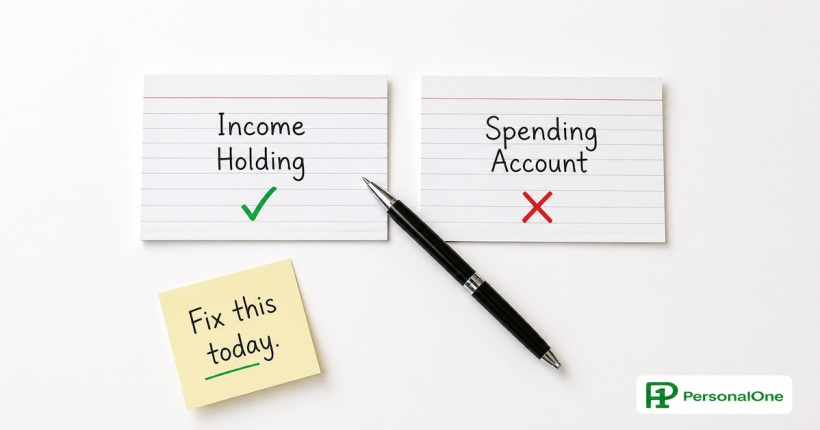
— The income holding account is the critical first step. Every deposit lands there before any distribution happens. This single structural decision separates income volatility from spending stability.
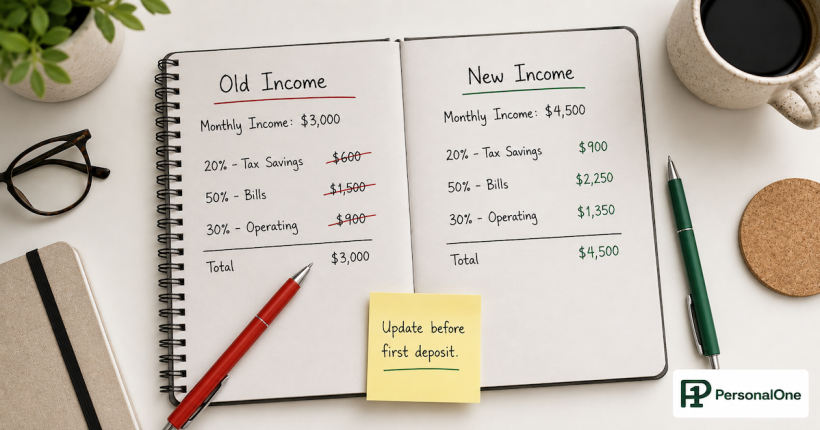
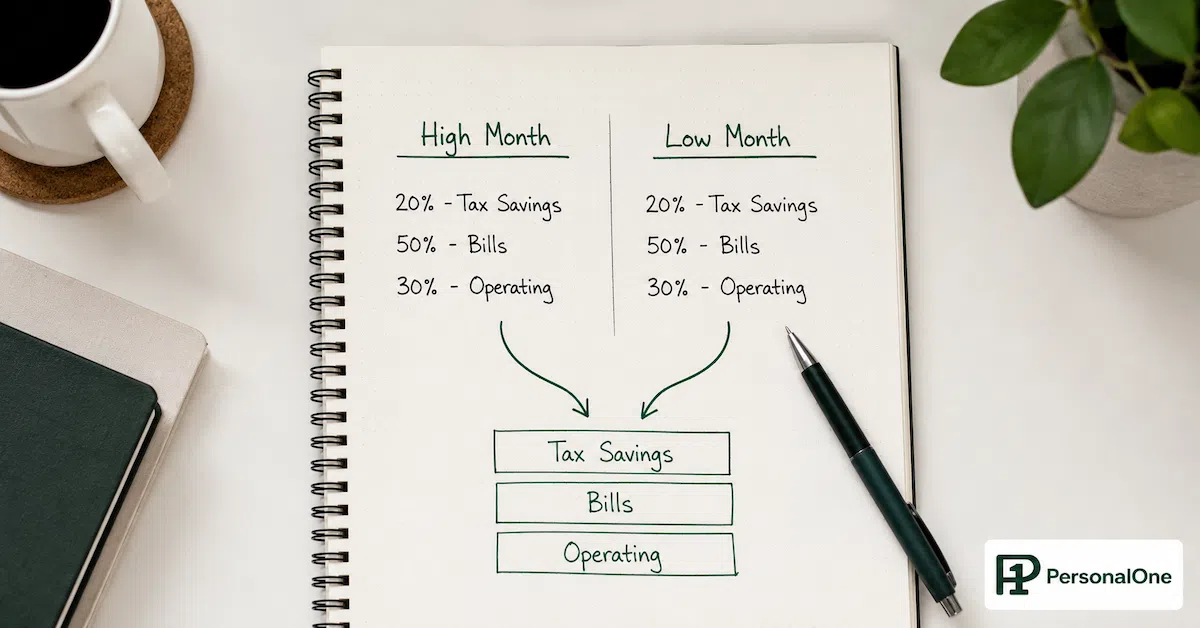
— Percentage-based routing solves the variable amount problem. Instead of transferring fixed dollar amounts, you transfer fixed percentages: 25–30% to tax reserves immediately, a defined percentage to bills, a defined percentage to operating. The amounts flex with income. The structure stays constant.
— A two-month buffer in the holding account is what allows fixed monthly spending transfers even when income is low. Without the buffer, every slow month breaks the system. With it, the Operating and Bills accounts receive consistent amounts regardless of what arrived that month.
— Variable income routing is not a budgeting problem. It is a structural problem. The right account architecture solves it permanently without requiring new discipline or constant manual decisions.
Knowing how to route income when you don't know how much is coming is one of the most practical problems in personal finance — and one of the least directly addressed. Most income routing advice starts with a fixed paycheck amount and works backward from there. If you earn $4,200 every two weeks, here is where it goes. That framework is useless when the deposit is $800 one week, $4,500 the next, and nothing for three weeks after that.
Variable income does not just make budgeting harder. It makes standard routing logic structurally inapplicable. You cannot split a direct deposit into fixed amounts when the deposit amount changes every time. You cannot set up automated transfers to bills and savings if you do not know whether the incoming deposit will cover them. The entire payday automation framework that works for stable earners requires modification before it functions for variable earners.
This article covers the specific routing system that works when income amounts are unpredictable — percentage-based distribution, the holding account structure that absorbs volatility, the buffer that keeps spending stable through low-income months, and how this system connects to the complete paycheck routing framework for variable earners.
Why Fixed-Amount Routing Fails Variable Income
Fixed-amount routing — the standard approach where specific dollar amounts are automatically transferred to bills, savings, and spending on payday — has one fundamental assumption built in: the deposit will always be large enough to cover the transfers. When that assumption is true, the system runs flawlessly. When it is not, every transfer that fires from a deposit smaller than expected either overdrafts the source account or fails entirely.
For a variable income earner, that assumption fails regularly. A $900 deposit cannot fund a $1,200 automatic transfer to the bills account. A slow freelance month cannot produce the same automated distribution as a strong one. Every time income falls below the fixed transfer threshold, the system that was supposed to run automatically requires manual intervention — which means it is no longer automatic, which means it will eventually fail when the manual intervention does not happen.
The fix is not better discipline or higher savings. The fix is a routing architecture that was designed for variable amounts from the start — one where the structure adjusts to income rather than requiring income to adjust to the structure.
The Two-Part Solution: Percentage Routing Plus a Holding Buffer
Variable income routing requires two structural elements working together. Neither one alone is sufficient. Both together create a system that handles any deposit amount without manual adjustment.
Element 1 — Percentage-Based Distribution
Instead of transferring fixed dollar amounts on payday, every distribution is expressed as a percentage of whatever arrived. The amounts flex automatically with income. The structure — the percentages, the destination accounts, the timing — stays constant regardless of the deposit size.
A $3,000 deposit and an $800 deposit follow the same routing rules. The percentages fire identically. The amounts are smaller on the $800 deposit, but every destination account receives its correct proportional share. No transfer fails because the deposit was smaller than expected. No manual decision is required.
The critical percentage to set first is the tax reserve: 25–30% of every deposit to a dedicated Tax Savings Account, transferred the same day income arrives. This is the most time-sensitive routing decision because the tax liability is created the moment income is received. Everything else distributes from what remains after taxes.
Element 2 — The Income Holding Buffer
Percentage routing solves the variable amount problem on the income side. The holding buffer solves the variable timing problem on the spending side. Even with perfect percentage routing, a low-income month still produces less money to cover bills and operating expenses. Without a buffer, a slow month means bills go underfunded. With a buffer, the holding account covers the shortfall from reserves built during strong months.
The Income Holding Account receives every deposit after the immediate tax transfer. It never gets spent from directly. Instead, it funds fixed monthly transfers to the Bills Account and Operating Account on the 1st of each month — the same amounts every month. When income was strong, the holding account grew. When income is weak, it draws down. The Operating and Bills accounts never see the volatility.
The minimum viable buffer is two months of total monthly needs (Bills plus Operating combined). Below that, a single low-income month depletes the holding account before the fixed monthly transfers can fire. Above two months, the system absorbs normal income variation without stress. At three to four months, it handles extended slow periods without any change to spending behavior.
The Variable Income Routing Sequence
Every deposit follows the same sequence regardless of amount. The sequence is designed to handle a $200 deposit and a $20,000 deposit identically — the same steps, the same structure, different numbers.
The Variable Income Routing Sequence
On the day income arrives:
— Transfer 25–30% to Tax Savings Account immediately. Same day. Every deposit, no exceptions. This is the non-negotiable first move for any 1099 or self-employed earner.
— The remaining 70–75% stays in the Income Holding Account. Do not distribute further until the monthly transfer date.
On the 1st of each month:
— Transfer fixed monthly Bills amount from Income Holding to Bills Account. Same amount every month. All autopay runs from the Bills Account.
— Transfer fixed monthly Operating amount from Income Holding to Operating Account. Same amount every month. This is the spending budget for variable daily expenses.
— Whatever remains in Income Holding is the buffer. High-income months build it. Low-income months draw it down.
Quarterly: Transfer the accumulated tax reserve to cover estimated tax payments. Review the Income Holding balance against the two-month minimum. If consistently above four months, increase the monthly Operating transfer. If consistently below two months, reduce it or prioritize income growth.
From Don's Work
A graphic designer, 31, freelancing full-time with monthly income ranging from $1,900 to $6,400. Six-month average: $3,800. Fixed bills: $2,100. She had been running everything through a single checking account and described the experience as "never knowing whether I'm okay or not." We set the Income Holding Account at her primary bank, opened a high-yield savings account at a separate institution for the tax reserve (28% of every deposit, transferred same day), and set the 1st-of-month transfers at $2,100 to Bills and $1,200 to Operating — deliberately conservative at 85% of her actual spending need. Buffer building took four months. In month five, a $1,900 income month arrived. The Bills and Operating transfers fired at their standard amounts. Her spending account showed the same balance it showed in a $5,000 month. She described it as the first time in three years of freelancing that a slow month did not feel like a crisis.
Setting the Right Percentages for Your Income Pattern
The exact percentages depend on three variables: your tax situation, your fixed monthly obligations, and your average monthly income across the last six months. All three feed into the routing calculation.
How to Calculate Your Routing Percentages
Step 1 — Calculate your six-month average income. Add up every deposit received over the last six months. Divide by six. This is your working baseline — not your best month, not your worst, the honest average.
Step 2 — Set the tax percentage first. For most 1099 earners, 25–30% covers federal self-employment tax plus estimated state tax. If your effective rate is higher, adjust upward. When in doubt, overpay the reserve and receive a refund rather than underpay and face a penalty.
Step 3 — Calculate bills as a percentage of average income. Divide your total fixed monthly obligations by your six-month average income. If fixed bills are $1,800 and average monthly income is $4,500, bills represent 40% of average income. This is not the transfer percentage — it is the benchmark that tells you whether your income reliably covers obligations.
Step 4 — Set the monthly fixed transfer amounts conservatively. The Bills transfer should equal actual monthly bills plus a 10% buffer. The Operating transfer should be set at 80–85% of what you actually need — conservative enough to build buffer during average months, realistic enough to cover genuine variable expenses.
Step 5 — Recalculate every quarter. Income patterns shift. A client roster that produces $5,000 average monthly income in Q1 may produce $3,200 in Q3. Quarterly recalibration keeps the routing percentages anchored to actual conditions rather than outdated averages.
What to Do When a Deposit Is Unusually Large or Unusually Small
The routing sequence handles both extremes without modification. That is the point of building it around percentages and a holding buffer rather than fixed amounts. But there are deliberate decisions worth making at each extreme that improve the system's long-term performance.
Unusually large deposit: The routing sequence fires normally — 25–30% to tax savings, the rest to Income Holding. The holding account balance increases significantly. At the next quarterly review, if the buffer has grown beyond four months of needs, the excess above that threshold can be redirected: to a dedicated emergency fund, to debt payoff, or to an investment account. A large deposit is the highest-leverage moment in the variable income system — it is the opportunity to build structural resilience that sustains the system through the slow months that will follow.
Unusually small deposit: The routing sequence fires normally — the smaller tax reserve percentage goes to Tax Savings, the smaller remainder stays in Income Holding. The 1st of the month transfers still fire at their standard amounts because the holding buffer covers the shortfall. Nothing in the spending system changes. The buffer absorbs the impact entirely. If several small deposits arrive consecutively and the buffer approaches the two-month minimum, the response is to reduce the Operating transfer temporarily — not to break the structure, but to preserve the buffer that makes the structure possible.
No deposit at all: A month with zero income is handled the same way as a low-income month — the 1st of the month transfers draw from the existing buffer. This is the most important reason the buffer needs to be at least two months of needs before the fixed transfer system begins. One zero-income month should not collapse the structure. If zero-income months are recurring, the buffer sizing needs to expand to three to four months minimum and income stabilization becomes the primary financial priority.
How This System Bridges Variable Income and Stable Spending
The psychological benefit of this routing architecture is as significant as the structural one. When income is variable, the anxiety is not just about whether bills will be paid. It is about the constant uncertainty of not knowing what financial state you are in on any given day. A $6,000 month feels fine. A $1,200 month feels like crisis. Both produce the same emotional response to the checking account balance — but one is genuinely dangerous and one is not, and without a routing system, they are indistinguishable.
With the holding buffer and percentage routing in place, the Operating Account always shows a predictable balance. Bills always get paid from the Bills Account on schedule. The Income Holding balance fluctuates — but that account is not the one you look at for spending decisions. The only number that matters for day-to-day financial behavior is the Operating Account balance, and that number is always the result of a deliberate fixed transfer rather than whatever income happened to arrive.
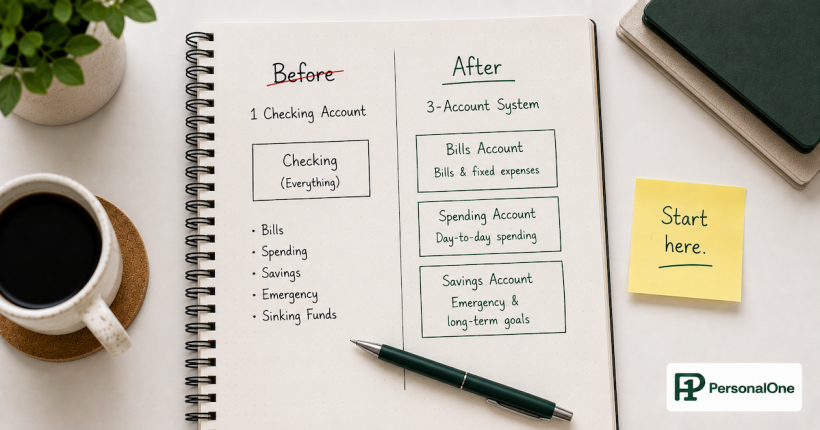
This separation — income volatility contained in the Holding Account, spending stability produced by the Operating Account — is what turns variable income from a source of constant financial anxiety into a manageable, structural reality. The income is still variable. The financial system stops being variable. For the complete account architecture that this routing system sits within, the banking for irregular income guide covers every account, every transfer, and the full setup process from scratch.
Your Income Is Variable. Your Financial System Does Not Have to Be.
Variable income routing is one piece of the complete paycheck flow framework. For the full system — where every dollar goes the moment it arrives, how the accounts connect, and how to automate the entire structure — see Where Your Paycheck Should Go First.
Frequently Asked Questions
Can I automate percentage-based transfers if my bank only supports fixed-amount transfers?
Most banks only support fixed-amount scheduled transfers, not percentage-based ones. The workaround is a two-step process: income lands in the Holding Account, and you manually execute the tax reserve transfer as a fixed-percentage calculation the same day it arrives. The monthly Bills and Operating transfers can remain fixed-amount automated transfers because they draw from the Holding buffer rather than directly from variable deposits. Only the tax transfer requires manual calculation on arrival — everything else runs automatically on schedule.
How do I handle income that arrives from multiple sources on different dates throughout the month?
All sources route to the same Income Holding Account. It does not matter whether $800 arrives on the 4th from one client and $2,200 arrives on the 19th from another — both land in Holding and the tax reserve transfer fires on each arrival date. The monthly Operating and Bills transfers still fire on the 1st from whatever the Holding Account balance is at that point. Multiple income sources arriving at different times is exactly what the holding account is designed to absorb.
What if my variable income is so unpredictable I cannot calculate a reliable six-month average?
Use twelve months if six produces too much variance. If twelve months is also highly variable, use the bottom third of your monthly income data — the average of your four or five lowest months — as the baseline for setting Bills and Operating transfer amounts. This is deliberately conservative. The Operating transfer will feel small during high-income months, which means the buffer builds quickly. It is always safer to under-transfer to spending and build a stronger buffer than to over-transfer and deplete the holding account.
Should I keep the Income Holding Account at the same bank as my Operating and Bills accounts?
Same bank makes transfers instant and automation simpler. A different bank creates stronger separation between the buffer and daily spending, which helps prevent the temptation to treat the holding account balance as available spending money. Most people start at the same bank for convenience and move the holding account to a separate institution if the psychological separation matters. The Tax Savings Account should always be at a different bank from all operating accounts — the transfer friction protects the tax reserve from being accidentally spent.
How do I know when my buffer is large enough to increase my Operating transfer?
When the Income Holding Account balance stays consistently above three months of total monthly needs (Bills plus Operating combined) for two consecutive quarters, the buffer is strong enough to support a modest increase in the Operating transfer. Increase by $100–$200 per month and observe the buffer trajectory over the next quarter. If it continues growing or holds steady, the new transfer level is sustainable. If it begins declining, hold at the previous level until income increases or expenses decrease.
Official Sources
IRS — Self-Employed Individuals Tax Center
IRS Form 1040-ES — Estimated Tax for Individuals
CFPB — Bank Account Tools and Consumer Rights
More From This Cluster
Return to Where Your Paycheck Should Go First for the complete income routing framework. For the full account architecture designed specifically for variable earners — holding accounts, buffer building, and tax reserve management — see Banking for Irregular Income.
PersonalOne Money System
This content is researched, written, and owned by PersonalOne — a free financial education platform built to help Millennials and Gen Z build real financial systems.
Disclaimer: This content is for educational purposes only and does not constitute financial or tax advice. PersonalOne is not a licensed financial advisor or tax professional. Income routing strategies and tax reserve percentages should be tailored to your specific income pattern, tax situation, and financial obligations. Consult a qualified tax professional for guidance on estimated tax payments and self-employment tax obligations.