June, 2026
Home › Banking Systems › Bills System That Never Overdrafts › What to Do When All Your Bills Hit at the Same Time
What You Need to Know
— Bills clustering — multiple large obligations hitting the same account in a short window — is almost always a timing problem, not an income problem. The money exists. It arrives at the wrong time relative to when the bills are due.
— If you are in the middle of the problem right now: triage by priority, contact billers immediately about short deferrals, and do not let the urgency of one bill cause you to miss a higher-priority one. The triage sequence in this article covers the correct order of operations.
— The permanent fix is structural, not behavioral. A dedicated Bills Account funded monthly at the correct amount eliminates the timing problem entirely — bills money is always pre-loaded and waiting, regardless of when individual charges arrive.
— Most billers will defer a payment by 7–14 days on request, no penalty, no credit impact, if you call before the due date and ask. You do not need to explain a crisis. You need to call before the bill is late.
— Bills clustering is a symptom of a single-account banking setup. Once the Bills Account is in place and funded correctly, the clustering problem cannot recur — because the bills account holds the money independently of the spending account balance.
When all your bills hit at the same time, the immediate experience is financial panic — a checking account balance dropping faster than expected, multiple large charges clearing in the same few days, and the uncomfortable question of which ones can wait and which ones cannot. If you are searching for this article right now, you may be in that moment. The first section covers immediate triage. The rest covers the structural fix that makes this experience impossible going forward.
Bills clustering — the experience of multiple large obligations arriving in the same account within a short window — is almost never an income problem. Most people who experience it have enough money across a full month to cover all their bills. The problem is timing: rent is due on the 1st, auto insurance drafts on the 3rd, the credit card minimum posts on the 5th, and the phone bill hits on the 8th. The paycheck that covers all of it does not arrive until the 15th. The bills and the income are misaligned, and the single checking account that holds both has no mechanism to bridge the gap.
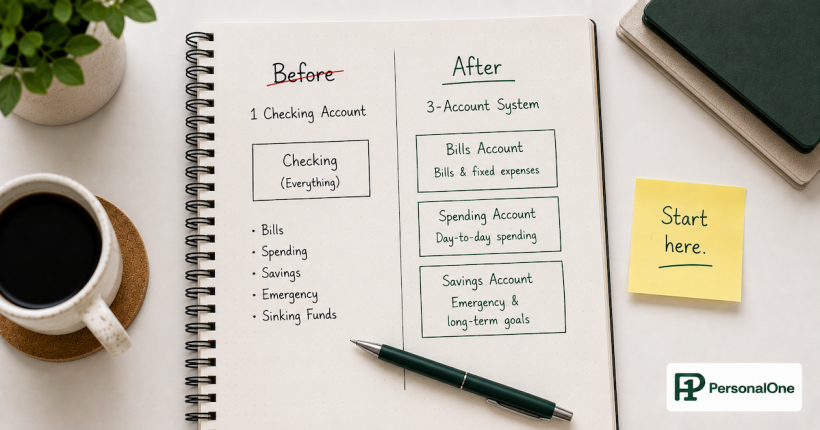
The complete structural solution to bills clustering is the Bills Account system — a dedicated account that receives a monthly transfer and holds bills money separately from spending money, making the timing of individual charges irrelevant to the daily spending balance. This article covers both what to do right now and how to build the system that prevents this from happening again. The full banking system architecture that the Bills Account sits within is in the Banking Systems hub.
Immediate Triage: If the Bills Are Hitting Right Now
If multiple bills are due in the next 48–72 hours and the account balance is insufficient to cover all of them, work through this sequence in order. The priority ranking matters — the consequences of missing different bill types are not equal.
Priority Triage Sequence
Priority 1 — Housing payment. Rent or mortgage. Missing this triggers late fees, potential eviction proceedings, or credit damage faster than any other bill. If this payment is at risk, this is the first call to make and the first dollar to protect. Most landlords accept a 5–7 day late payment before initiating any formal process. Most mortgage servicers have a 15-day grace period before reporting to credit bureaus. Call before the due date, explain the timing situation, and confirm the grace period in writing.
Priority 2 — Utilities required for essential function. Electricity, gas, water. These have formal shutoff processes that take weeks — a single late payment does not trigger immediate shutoff. However, if there is already a past-due balance, a second missed payment can accelerate the timeline. Call the utility, ask about a payment extension, and ask about any hardship programs available. Most utilities offer short-term deferrals by phone with no impact to service.
Priority 3 — Minimum debt payments (loans, credit cards). Missing a minimum payment triggers a late fee and, after 30 days, a negative credit bureau report. One missed minimum payment is recoverable. Multiple missed minimums are not. If you cannot cover all minimum payments, pay the ones closest to the 30-day reporting threshold first. Call any creditor where payment will be late and ask for a hardship deferral — most will offer one payment cycle with no credit impact if you ask before the due date.
Priority 4 — Insurance premiums. Auto and health insurance have grace periods (typically 10–30 days depending on the policy and state). Missing a payment does not immediately cancel coverage. Call the insurer, confirm the grace period, and request a short extension. Do not let insurance lapse without understanding the grace period first — lapsed auto insurance creates a coverage gap that is expensive to close.
Priority 5 — Subscriptions and discretionary services. These can be paused, cancelled, or simply allowed to fail without meaningful consequences beyond loss of service. If cash flow is tight, these are the first items to temporarily cancel. Most can be restarted later with no penalty.
Calling Billers for Short Deferrals: What to Say and What to Expect
Most billers will accommodate a short payment deferral — 7 to 14 days — if you call before the due date and ask. The key words are "before the due date." Once a payment is late, your options narrow significantly. Calling proactively, while the payment is technically still on time, gives you maximum flexibility.
You do not need to explain a financial crisis. A simple, direct request is most effective:
"I have a payment due on [date] and I'd like to request a short extension to [7–14 days later]. Can you accommodate that without a late fee or any impact to my account?"
Most customer service representatives can approve a one-time extension on the spot for accounts in good standing. If the first representative says no, ask to speak with a supervisor or account retention specialist — these roles typically have more flexibility.
What to expect by biller type:
Utilities: Almost universally accommodating for one-time extensions. Many have formal hardship programs that provide 30–90 day deferrals for qualifying situations. Ask about both the short extension and any hardship program options.
Credit card issuers: Most offer one-cycle forbearance with no fee and no credit impact for accounts in good standing. This is a standard customer retention practice — they prefer a short wait to a missed payment.
Loan servicers (auto, student, personal): Federal student loan servicers have formal deferral programs. Private auto and personal loan servicers offer hardship extensions for accounts in good standing. Call the servicer directly — not the general customer service line — and ask specifically about hardship or payment extension options.
Landlords: This varies significantly. Many individual landlords will accommodate a short delay informally if you communicate proactively. Large property management companies have stricter processes. Know your lease terms, specifically the late fee provisions and the date after which a formal late notice is issued, before making the call.
What I've Seen
The clients who experience bills clustering most acutely are almost always running a biweekly pay schedule with bills due on a cluster in the first week of the month. The math works out — over the course of the year, the income covers the bills. But any given month where the first paycheck of the month arrives on the 10th and rent is due on the 1st creates a visible gap that feels like a shortage. The actual problem is not cash flow — it is that the money is in the wrong place at the wrong time. Every client I have seen implement the Bills Account system stopped experiencing this problem within one pay cycle of setup. The bills account holds the money in advance. The timing of individual paycheck arrival becomes irrelevant to whether bills are covered.
The Timing Problem: Why Bills Cluster and Paychecks Do Not Align
Bills clustering is structural — it is the predictable result of how the billing calendar works combined with how income arrives. Understanding the mechanics explains why behavioral solutions (being more careful, checking the account more often, building better habits) do not solve it.
Most fixed obligations are due in the first two weeks of the month. Rent and mortgage payments are almost universally due on the 1st. Utility billing cycles typically close and charge in the first week. Credit card due dates cluster around the beginning of the month because most cards were opened in January, the most common month for new account applications. Insurance premiums, loan payments, and subscription renewals follow similar patterns.
Paychecks, by contrast, arrive on whatever schedule an employer uses — biweekly, semimonthly, or weekly — which may or may not align with the first-of-month bill cluster. A biweekly paycheck schedule produces two paychecks most months but three in some months. The paycheck that should cover the first-of-month bills may arrive on the 25th of the prior month, or it may arrive on the 8th — after most of the bills have already fired.
The mismatch between the bill-cluster timing and the paycheck timing is not a budgeting failure. It is a structural feature of how billing and payroll calendars work. No amount of spending awareness or budget discipline changes when rent is due or when the paycheck arrives. The only solution is a mechanism that holds bill money in advance of when the bills arrive — which is precisely what the Bills Account does.
The Tactical Fix: Redistributing Due Dates
While the Bills Account is the permanent structural solution, there is a tactical step worth taking in parallel: redistributing bill due dates to spread the cluster across the month. Many billers allow due date changes on request, and shifting a few large bills from the first week of the month to the third week distributes the cash flow demand more evenly across payday cycles.
How to request a due date change: Call the biller's customer service line and ask to change your billing due date. Most utility companies, credit card issuers, subscription services, and some loan servicers can accommodate this request. Be specific — ask for a date that aligns with your paycheck schedule, typically 3–5 days after payday to allow for ACH processing time.
Which bills to target for date changes: Focus on the large non-housing bills where the biller has flexibility — credit cards, utilities, phone bill, insurance premiums. Rent and mortgage due dates are typically fixed by lease or loan terms and cannot be changed. But shifting a $800 insurance premium and two credit card payments from the 1st-5th cluster to the 18th-22nd window can dramatically reduce the cash flow pressure in the first week of the month.
The limitation of due date redistribution: This tactical fix reduces the clustering problem but does not eliminate it. It also requires ongoing management — if a new bill is added to the first-week cluster, the problem resurfaces. The Bills Account approach is the complete solution because it makes due date timing irrelevant entirely.
The Structural Fix: The Bills Account System
The permanent solution to bills clustering is a dedicated Bills Account that pre-loads bill money every payday and holds it until each charge arrives. When this account is in place, the question of whether the timing of paychecks aligns with the timing of bills becomes irrelevant — the bills account holds the money in advance of every charge, regardless of when in the month it arrives.
The Bills Account receives a fixed transfer on every payday. The amount equals the true monthly bills total plus a 10% buffer, divided by the number of pay periods per month. On a biweekly schedule, half the monthly bills total transfers each payday. Over the month, the full amount accumulates in the Bills Account before the bills arrive. Every autopay charges from the Bills Account independently of the spending account balance.
The spending account never contains bills money. Its balance is always accurate — it shows genuinely available money, not available money minus upcoming obligations. The first-of-month bill cluster charges from the Bills Account, which holds the money regardless of when the last paycheck arrived. The cluster stops being a problem because the money is already there.
Setting up the Bills Account correctly requires two things: opening the account and migrating all autopay to it (covered in how to separate bills from spending), and calculating the correct monthly transfer amount (covered in how to calculate your true monthly bills). Both articles are in this cluster and cover the complete setup process.
The Timing Problem Has a Structural Solution.
Bills clustering is not a budgeting failure — it is a structural mismatch between billing calendars and paycheck timing. The complete system that eliminates it permanently is in the Bills System That Never Overdrafts guide.
Frequently Asked Questions
Will calling a biller for a deferral hurt my credit score?
No — calling before the due date and requesting an extension does not affect your credit score. Credit bureaus are only notified of payments that are 30 or more days late. A biller-approved extension moves the due date forward, meaning the payment is technically on time under the new arrangement. The key is calling before the original due date, not after. A payment that is already late and then deferred is still reported as late from the original due date.
What if I cannot cover all my bills even with deferrals?
Work through the priority triage sequence in this article and protect housing and utilities first. For genuinely insufficient cash flow — where income across the month does not cover bills even when spread across the full period — the problem is not timing but margin. The correct response is an expense audit to identify what can be reduced or eliminated, not a timing fix. The Bills System That Never Overdrafts cluster covers the full framework. If the income shortfall is related to job loss or a temporary income disruption, contact billers about formal hardship programs — most utilities, credit card issuers, and loan servicers have them.
Can I change the due dates on all my bills?
Most but not all. Credit card issuers and utility companies almost universally accommodate due date change requests. Cell phone carriers and subscription services typically do as well. Mortgage servicers and auto loan servicers vary — some allow it, some do not. Rent due dates are set by the lease and typically cannot be changed mid-lease. The most impactful bills to target for date changes are the large non-housing obligations — auto insurance, credit cards, and utilities — where shifting the due date from the first-week cluster to the third week creates meaningful cash flow relief.
How long does it take to set up a Bills Account?
The account opens in 10–15 minutes online. Migrating all autopay to the new account — logging into each biller's portal and updating the payment source — takes one to two hours depending on the number of bills. The first transfer to the new account can be set up the same day. The complete Bills Account setup process is in how to separate bills from spending.
Is the bills clustering problem different for biweekly versus monthly pay?
Yes — the experience differs significantly by pay schedule. Monthly pay recipients receive the full month's income in one deposit and the clustering problem is primarily a first-of-month front-loading issue: one large payment needs to cover everything that hits before the next paycheck in 30 days. Biweekly pay recipients have a different problem: the paycheck timing rotates across the month, meaning the first paycheck of any given month may arrive anywhere from the 1st to the 14th. In months where the first paycheck arrives after the 5th-7th bill cluster, the bills are already due before the money arrives. The Bills Account solution works identically for both pay schedules — the transfer amount is adjusted to match the pay frequency, and the account holds the money in advance regardless of the specific arrival date.
Official Sources
CFPB — Bank Account Consumer Tools and Rights
CFPB — What to Do If You Are Having Trouble Paying Bills
FDIC — Consumer Financial Education Resources
More From This Cluster
Return to Bills System That Never Overdrafts for the complete framework. The two setup articles that make the Bills Account work: How to Separate Bills From Spending — the one-time account setup that prevents clustering permanently, and How to Calculate Your True Monthly Bills — the 12-month inventory that produces the correct Bills Account transfer amount. For the complete banking architecture, see Banking Systems.
PersonalOne Money System
This content is researched, written, and owned by PersonalOne — a free financial education platform built to help Millennials and Gen Z build real financial systems.
Disclaimer: This content is for educational purposes only and does not constitute financial or legal advice. Biller policies on payment deferrals, grace periods, and due date changes vary by company, account type, and jurisdiction. Always contact your biller directly to confirm their specific policies before relying on the general information in this article. PersonalOne is not a licensed financial advisor.