June, 2026
Home › Banking Systems › Account Separation for Different Life Stages › How to Upgrade Your Bank Account Structure as Your Income Grows
What You Need to Know
— A bank account structure built for $32,000 a year will not serve you at $65,000 — and a system built for $65,000 will actively hold you back at $120,000. The account architecture that fits your income needs to evolve as your income does.
— Most people upgrade their lifestyle as income grows but never upgrade their banking structure. The result is more money flowing through a system designed for less of it — with predictable inefficiencies at every layer.
— There are four income stages that each call for a distinct banking structure: foundation (first job to $45K), growth ($45K to $80K), acceleration ($80K to $150K), and wealth-building ($150K and above). Each stage adds structural layers that the previous stage could not support.
— Upgrading your banking structure is not about switching banks. It is about adding accounts with specific roles, increasing automation, and routing income with more precision as the amounts and the destinations become more sophisticated.
— The trigger for each upgrade is not a specific income number — it is when the current structure creates friction that a more evolved structure would eliminate. The income stages are guides, not thresholds.
When most people think about upgrading their bank as their income grows, they think about switching to a premium checking account or opening a brokerage account. Those decisions matter — but they are downstream of the more fundamental question that most people never explicitly address: does your banking structure match your current income, or are you running more money through a system designed for less of it?
The answer for most people is the latter. The account structure they set up at their first job — a checking account, a savings account, maybe a credit card — is still the system they are using five years and two income jumps later. The money flowing through it has doubled. The structure has not changed at all. The result is a system that works well enough at the surface level while quietly failing to capture the financial progress that the income growth should be producing.
Knowing how to upgrade your bank as your income grows means understanding what each income stage demands structurally — which accounts to add, which routing decisions to automate, and which inefficiencies in the current system are costing real money or real opportunity. This article covers the complete upgrade path from first-job banking through wealth-building infrastructure, with the specific structural changes that each transition requires. The full life-stage account framework that this article sits within is in Account Separation for Different Life Stages.
Why Banking Structure Needs to Evolve With Income
A banking structure is not just a collection of accounts. It is the infrastructure that determines how efficiently income is converted into financial progress. At lower income levels, the primary structural job is protection — making sure bills are covered, preventing overdrafts, building the first emergency fund. At higher income levels, the structural job shifts toward optimization — routing surplus to the highest-return destinations, capturing tax advantages, separating accounts by time horizon and purpose.
A structure designed for protection creates friction at the optimization stage. A single checking account with an attached savings account is sufficient infrastructure for someone building a $1,000 emergency fund. It is inadequate infrastructure for someone who needs to simultaneously fund a Roth IRA, accelerate mortgage payoff, build a six-month business emergency fund, and maximize an HSA. The mismatch between income complexity and structural sophistication is what causes financial progress to stall even when income is growing.
The upgrade path is not about complexity for its own sake. Every account added at each stage has a specific job that the previous structure could not perform. When the job exists and the account does not, money that should be directed somewhere productive flows instead into the general pool and gets absorbed into spending. The structural upgrade captures it before that happens.
Stage 1 — Foundation Structure: First Job to $45,000
The foundation stage is about protection and clarity. The income is sufficient to cover essential expenses with margin left over, but not so much that sophisticated routing decisions are necessary. The structural priority is creating separation between different types of money so that bills are protected, savings accumulate automatically, and daily spending has a clear, accurate number.
Stage 1 Account Structure
Bills Checking Account: All fixed monthly obligations autopay from here. Funded by automatic transfer on payday. No debit card for daily spending.
Spending Checking Account: Receives the remaining balance after bills and savings are funded. This is the daily spending account. The balance is always accurate — no mental accounting required.
High-Yield Savings Account: Emergency fund and short-term goals. At a separate online institution for both the higher APY and the friction that prevents impulse withdrawals.
Routing: Direct deposit splits to Bills and Spending. Automatic transfer to Savings on payday. Everything automated from setup — no manual transfers required month to month.
The Stage 1 structure solves the most common financial problems at this income level: not knowing what is safe to spend, bills hitting an underfunded account, savings never happening because it is always planned for later. Three accounts and basic automation handle all of it.
The signal that Stage 1 is ready to upgrade: the emergency fund is fully funded at three to six months of expenses, high-interest debt is eliminated, and income has grown to the point where savings accumulation is happening but routing to a single savings account is insufficient for the number of destinations the surplus should reach.
Stage 2 — Growth Structure: $45,000 to $80,000
The growth stage is where income starts producing meaningful surplus after obligations and basic savings. The structural priority shifts from protection to capture — making sure the surplus reaches specific high-value destinations rather than dispersing into general spending. The most common failure at this stage is having the income to fund multiple financial goals simultaneously but no structural mechanism to route money to each of them before spending absorbs it.
Stage 2 Account Structure — Adds to Stage 1
Roth IRA or Investment Account: Automatic monthly contribution from the savings account or direct from paycheck. At this income level, Roth IRA eligibility exists for most earners. The contribution should be automated so it fires regardless of monthly spending decisions.
Sinking Fund Account (or sub-accounts): A dedicated account or labeled sub-accounts for predictable irregular expenses — car maintenance, annual insurance renewals, holiday spending, planned travel. Funded monthly at one-twelfth of the annual target for each category. Eliminates the "unexpected" large expense that derails the monthly budget.
Employer 401(k) fully optimized: At minimum, capturing the full employer match. At this income stage, increasing contributions toward 10–15% of gross income is realistic and produces compounding returns that are irreversible in value.
Routing upgrade: Direct deposit split now routes to Bills, Spending, and Investment simultaneously. The sinking fund receives a scheduled transfer from Savings. No more single-destination savings that relies on manual reallocation.
The signal that Stage 2 is ready to upgrade: investment contributions are automated and consistent, sinking funds are covering irregular expenses without disrupting the budget, and income has grown to the point where tax efficiency becomes a meaningful variable. At this point the structure needs accounts that serve tax optimization, not just savings accumulation.
What I've Seen
The Stage 1 to Stage 2 transition is where I see the most financial progress get quietly lost. The income is there — $55,000, $62,000, $70,000 — and the person has a solid Stage 1 foundation. The emergency fund is complete. There is no high-interest debt. A few hundred dollars of surplus is landing in a savings account every month. But it is all going into one account with no routing rules. Car repair pulls from it. A vacation pulls from it. A spontaneous purchase pulls from it. Six months later the savings account balance is almost identical to where it was. The income is genuinely capable of funding a Roth IRA, a sinking fund, and a 401(k) increase simultaneously. The structure just has no mechanism to route it there before spending absorbs it. Adding three accounts and three automated transfers changes the outcome entirely.
Stage 3 — Acceleration Structure: $80,000 to $150,000
The acceleration stage is where tax efficiency becomes a structural priority rather than an afterthought. At this income level, the difference between routing surplus to tax-advantaged accounts versus taxable accounts is thousands of dollars per year in tax liability. The structural priority is maximizing every available tax-advantaged destination before surplus flows to taxable investment accounts.
Stage 3 Account Structure — Adds to Stage 2
HSA (Health Savings Account): If enrolled in a high-deductible health plan, the HSA is the most tax-advantaged account available — triple tax benefit on contributions, growth, and qualified withdrawals. Maximum contribution automated annually. Invested in index funds rather than held in cash.
Taxable Brokerage Account: Once 401(k), Roth IRA, and HSA are maximized, surplus investment flows to a taxable brokerage account. This account handles medium-term goals (five to fifteen years) and provides flexibility that retirement accounts do not.
Separate Emergency Business or Opportunity Fund: At this income level, career transitions, investment opportunities, and entrepreneurial decisions become more frequent. A dedicated fund beyond the personal emergency fund provides capital for these decisions without disrupting the household financial system.
Routing upgrade: The paycheck distribution sequence now routes to: Bills, HSA contribution, 401(k) contribution (pre-tax via payroll), Roth IRA automated transfer, taxable brokerage automated transfer, Spending. Every destination is funded before the Spending account receives its allocation.
The signal that Stage 3 is ready to upgrade: all tax-advantaged accounts are maximized, taxable investment contributions are automated, and income has grown to the point where the household financial picture is complex enough that a single-system view across all accounts — net worth tracking, asset allocation monitoring — produces better routing decisions than managing each account in isolation.
Stage 4 — Wealth-Building Structure: $150,000 and Above
The wealth-building stage is where the banking structure stops being primarily about routing income and starts being about coordinating multiple asset classes, tax strategies, and financial goals across time horizons that extend decades. The structural priority is integration — ensuring that every account decision is made in the context of the complete financial picture rather than in isolation.
Stage 4 Account Structure — Adds to Stage 3
Multiple taxable brokerage accounts by goal and time horizon: Short-term taxable (five to ten years), long-term taxable (ten-plus years), and potentially a joint account if applicable. Different time horizons support different asset allocation decisions.
529 or education savings accounts: If dependents exist or are planned, education savings becomes a tax-advantaged routing destination. Automated monthly contributions to a 529 plan.
Real estate or alternative investment accounts: At this income level, real estate investment, private equity, or alternative asset allocations may become relevant. These require separate capital pools to avoid commingling investment capital with operating cash.
Routing upgrade: Income routing at this stage is managed at the system level rather than the account level. A net worth dashboard tracks all accounts. A quarterly routing review assesses whether allocations match current goals, tax situation, and time horizons. The paycheck routing decisions are still structural and automated — but they are reviewed in the context of total asset allocation, not just monthly cash flow.
The Upgrade Triggers: How to Know When Your Structure Needs to Evolve
The four income stages are guides, not rigid thresholds. The real signal that a banking structure needs upgrading is functional friction — the system is creating problems that a more evolved structure would eliminate. These are the specific signals to watch for at each transition.
Stage 1 → Stage 2 trigger: The emergency fund is complete and high-interest debt is gone, but savings beyond the emergency fund have no structural destination. Surplus goes to a general savings account that gets raided for irregular expenses. Investment contributions have not started or are inconsistent. The structure has no mechanism to route money to multiple destinations simultaneously.
Stage 2 → Stage 3 trigger: Investment contributions are automated but routing is not tax-optimized. Money flows to taxable accounts before tax-advantaged accounts are maximized. An HSA is available but not being used. The 401(k) is receiving the employer match but not being maximized. Tax efficiency is leaving real money on the table.
Stage 3 → Stage 4 trigger: All tax-advantaged accounts are maximized and surplus is flowing to taxable accounts, but there is no coordination across the accounts. Asset allocation is not being managed at the portfolio level. Financial decisions about one account are made without reference to total holdings. The complexity of the picture requires a system-level view rather than account-by-account management.
None of these transitions require switching banks or rebuilding from scratch. Each one adds specific accounts and routing decisions to an existing structure. The foundation built at Stage 1 remains intact through every subsequent upgrade — the Bills account, the Spending account, and the High-Yield Savings account are still doing their jobs at Stage 4. The upgrade adds layers above the foundation, not replacements for it.
What Changes in Routing at Each Stage
The routing architecture evolves at each stage in a consistent direction: more destinations, more automation, more precision. The payday sequence that routes a Stage 1 income to three accounts becomes a sequence that routes a Stage 4 income to eight or more. Each additional destination has a specific job that the previous structure could not perform.
Stage 1 routing: Income → Bills (automatic transfer) → Savings (automatic transfer) → Spending (remainder). Three destinations. One decision made at setup.
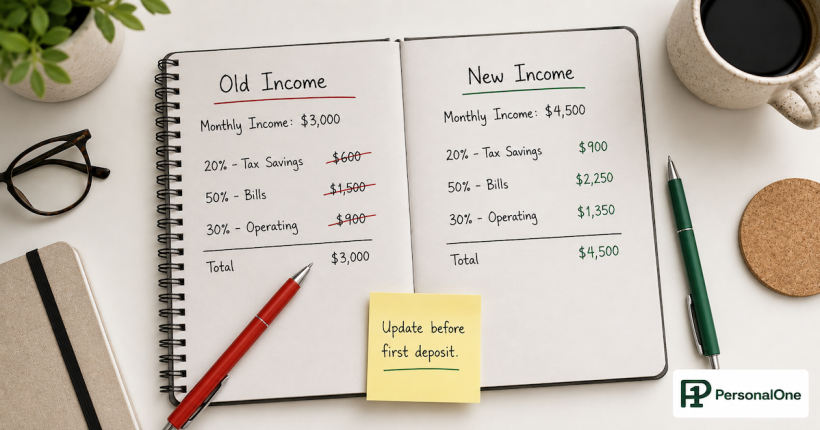
Stage 2 routing: Income → 401(k) (pre-tax via payroll) → Bills → Roth IRA (automated transfer) → Sinking Fund (automated transfer) → Savings → Spending. Six destinations. All automated. The routing recalibration that happens at each income change keeps the amounts current without rebuilding the structure.
Stage 3 routing: Income → 401(k) maximum → HSA maximum → Bills → Roth IRA maximum → Taxable Brokerage (automated) → Sinking Fund → Emergency/Opportunity Fund → Spending. Eight or more destinations. Quarterly review ensures allocations reflect current goals.
Stage 4 routing: Same sequence as Stage 3 with additional destinations for education savings, alternative investments, and time-horizon-specific taxable accounts. The sequence is managed at the system level. Individual transfers are still automated but the allocation review is portfolio-level rather than account-level. For variable income earners at this stage, the variable income routing framework applies a percentage-based version of this same sequence.
Your Income Has Grown. Has Your Banking Structure?
The complete account separation framework for every life stage — students, first jobs, couples, families, entrepreneurs — is in Account Separation for Different Life Stages. For the complete banking architecture this structure sits within, see the Banking Systems hub.
Frequently Asked Questions
Do I need to switch banks when I upgrade my banking structure?
Rarely. Most upgrades involve adding accounts rather than replacing existing ones. The foundation accounts — Bills, Spending, High-Yield Savings — stay in place across every stage. You may add accounts at your existing bank, open accounts at specialized institutions (online bank for savings, brokerage for investments), or open an HSA through your employer's benefits provider. The upgrade is structural, not institutional. Switch banks only if your current bank cannot support the accounts the new structure requires, or if a competing institution offers meaningfully better rates or features for a specific account role.
What if my income jumps multiple stages at once — for example, from $40K to $90K after a career change?
Implement the upgrade in sequence rather than all at once. Verify Stage 1 structure is solid first — emergency fund complete, high-interest debt eliminated, basic automation running. Then add Stage 2 elements: maximize 401(k) match, open Roth IRA, set up sinking funds. Then add Stage 3 elements: maximize tax-advantaged accounts, open taxable brokerage. The income jump creates the capacity to move through this sequence faster, not the justification for skipping it. Each stage builds the infrastructure the next stage requires.
I am at Stage 2 income but my emergency fund is not complete yet. Should I start investing or finish the fund first?
Finish the emergency fund first, with one exception: capture the full employer 401(k) match even while building the emergency fund. The match is a guaranteed 50–100% immediate return that no investment account can replicate — it is always worth capturing before anything else. Beyond the match, direct surplus to the emergency fund until it is fully funded at three months minimum, six months for anyone with variable income or a single household income. Once the fund is complete, redirect that monthly surplus to Roth IRA contributions and any additional investment vehicles.
How do I handle the upgrade if my income is variable and does not fit neatly into a stage?
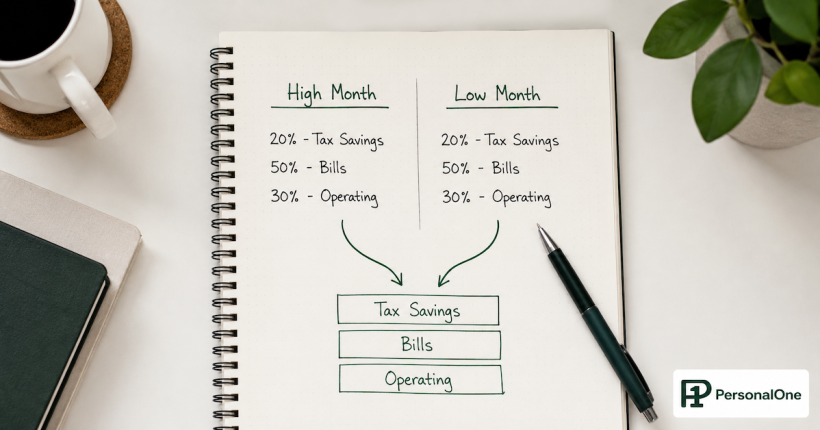
Use your six-month average income as the baseline for identifying which stage applies. A freelancer whose monthly income ranges from $3,000 to $9,000 with a $5,500 average is functionally operating at Stage 2. Apply Stage 2 structure using average income for transfer calculations. The variable income routing system covers the specific holding account and percentage-based distribution that handles variability within the stage structure.
When should I involve a financial advisor in the banking structure upgrade?
Stage 1 and Stage 2 upgrades are straightforward enough to implement independently using the frameworks in this cluster. Stage 3 is where a fee-only financial advisor begins adding meaningful value — specifically for tax optimization decisions, Roth conversion strategy, and HSA investment choices that interact with total household tax liability in ways that general guidance cannot fully address. Stage 4 almost always benefits from professional coordination given the complexity of multiple asset classes, estate planning considerations, and tax strategy across accounts.
Official Sources
IRS — IRA Contribution Limits
IRS Publication 969 — Health Savings Accounts (HSAs)
CFPB — Bank Account Tools and Consumer Rights
FDIC — Deposit Insurance Coverage
More From This Cluster
Return to Account Separation for Different Life Stages for the complete life-stage account framework. Other articles in this cluster that connect to the upgrade path: How to Adjust Your Paycheck Routing When Your Income Changes, How to Route Income When You Don't Know How Much Is Coming, and What to Do When Your Paycheck Goes to the Wrong Account. For the complete banking infrastructure, see Banking Systems.
PersonalOne Money System
This content is researched, written, and owned by PersonalOne — a free financial education platform built to help Millennials and Gen Z build real financial systems.
Disclaimer: This content is for educational purposes only and does not constitute financial, tax, or investment advice. PersonalOne is not a licensed financial advisor, tax professional, or investment advisor. Account structure decisions, tax-advantaged contribution strategies, and investment allocation choices should be tailored to your specific financial situation. Consult a qualified financial professional for personalized guidance, particularly at Stage 3 and Stage 4 income levels where tax optimization and investment coordination decisions carry significant long-term implications.