June 19, 2026
Home › Banking Systems › Bills System That Never Overdrafts › How to Separate Your Bills From Spending So You Never Accidentally Overspend
What You Need to Know
— Keeping bills and spending money in the same account creates a specific and predictable problem: every dollar in the account appears available when it is not. The balance looks fine until an autopay fires and overdrafts it.
— The fix is structural, not behavioral. A separate Bills Account removes bills money from the spendable balance entirely. When the spending account shows $400, that is genuinely available money — not $400 minus rent minus utilities minus subscriptions.
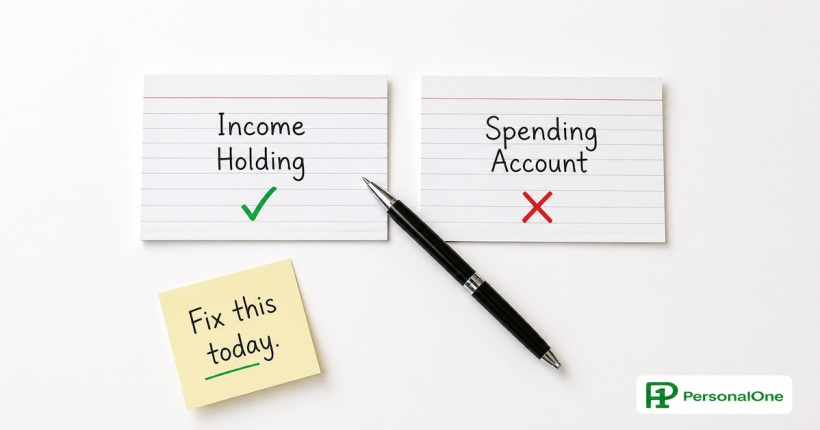
— The Bills Account has one job: receive a fixed monthly transfer and pay all fixed obligations via autopay. No debit card. No personal spending. No exceptions. The separation only works if it is absolute.
— The spending account has one job: receive the remaining balance after bills and savings are funded. Every dollar in it is genuinely available. When it reaches zero, spending stops — not because of willpower but because the money is gone.
— Setup takes one afternoon. The stress reduction from never wondering whether a bill will overdraft the account is immediate and permanent.
When bills and spending money live in the same account, the balance is always lying to you. It shows a number that looks like available money — but some portion of it is already spoken for by rent, utilities, insurance, subscriptions, and every other autopay scheduled to fire before the next paycheck arrives. The balance does not distinguish between money that is genuinely available and money that is already committed. That ambiguity is what produces the specific experience of checking the account, feeling fine, spending normally, and then watching an autopay create a shortfall that was invisible an hour ago.
Separating bills from spending is the foundational containment principle of the Bills System That Never Overdrafts. It is not a budgeting technique — it does not require tracking, categorizing, or monitoring spending behavior. It is a structural change that makes the problem physically impossible rather than behaviorally avoidable. When bills money is in a different account from spending money, it cannot be accidentally spent. The separation enforces the boundary without requiring ongoing attention.
This article covers exactly how the separation works, why it eliminates the specific failure modes that single-account banking produces, how to set it up correctly from day one, and how it connects to the complete banking system architecture that makes money management automatic.
The Single-Account Problem: Why Mixed Money Always Fails
The single-account setup produces a specific set of failure modes with remarkable consistency regardless of income level, spending habits, or financial awareness. Understanding exactly what goes wrong explains why the structural fix is so effective.
The false balance problem. When all money lives in one account, the balance shown is not the spendable balance. It is the total balance before upcoming autopay obligations are subtracted. A person with $1,800 in their checking account who has $1,400 in bills due before their next paycheck has $400 of genuinely available money — but the account shows $1,800. The gap between the displayed balance and the actual available balance is the source of most overdraft events. The person is not irresponsible. They are working with inaccurate information.
The mental accounting failure. The natural response to the false balance problem is mental accounting — tracking which bills are coming, calculating the remaining available balance, and making spending decisions based on those calculations. This works acceptably when bills are regular, predictable, and easy to remember. It fails when a quarterly charge fires unexpectedly, when a bill amount changes without notice, when an annual subscription renews at a different time than expected, or simply when the mental calculation is done at a moment of fatigue or distraction. Mental accounting is a skill that degrades under normal life conditions. Physical account separation does not.
The timing trap. Even when the total monthly balance is sufficient to cover all bills and spending, the timing of when bills arrive versus when spending happens creates frequent shortfalls. Rent due on the 1st, car insurance autopay on the 8th, credit card payment on the 15th — these do not space themselves conveniently around payday. Spending money before a bill fires reduces the balance, the bill fires against the reduced balance, the account is short. The structural fix is not timing management — it is removing bills money from the spendable pool entirely so the timing of bills becomes irrelevant to spending decisions.
How the Separation Works: Two Accounts, Two Jobs
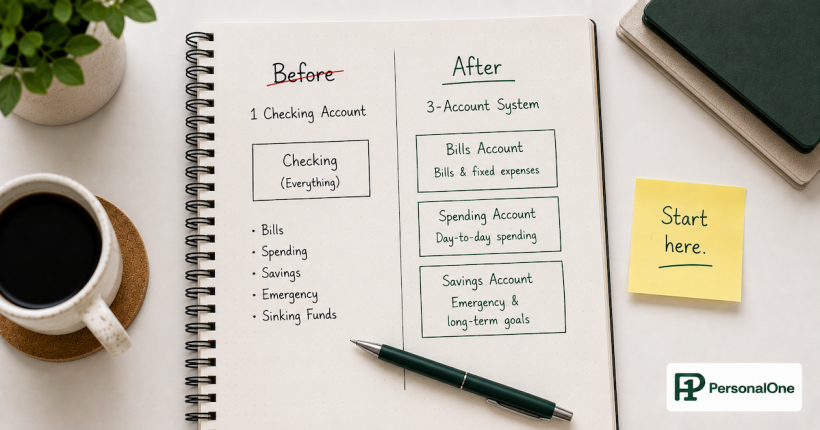
The separation requires exactly two checking accounts. Not two categories in one account. Not a budgeting app overlay. Two physically separate accounts at a bank, each with a specific and exclusive job.
Account 1 — The Bills Account
Job: Receive a fixed monthly transfer and pay all fixed obligations via autopay. Nothing else.
What goes in: One scheduled transfer from the primary income account on payday. The amount equals the true monthly bills total plus a 10% buffer. The bills calculation guide covers exactly how to get this number right.
What comes out: Every fixed obligation via autopay. Rent or mortgage, utilities, insurance premiums, phone bill, loan minimum payments, subscriptions — every recurring fixed charge autopays from this account.
What never touches this account: Personal spending of any kind. No debit card attached. No personal purchases. No ATM withdrawals. The Bills Account is invisible in daily life except for the monthly transfer that funds it.
Why it works: Bills money that is physically in a different account cannot be accidentally spent. The autopay schedule runs independently of daily financial decisions. Bills are always funded. No monitoring required.
Account 2 — The Spending Account
Job: Receive the remaining balance after bills and savings are funded. Serve as the daily spending account.
What goes in: A fixed transfer each payday equal to the spending budget for that pay period — whatever remains of take-home pay after the Bills Account transfer and savings transfer are subtracted.
What the balance means: Everything in this account is genuinely available to spend. No mental subtraction required. No upcoming bills to track. The displayed balance is the actual available balance.
What the debit card is attached to: This account only. All daily spending, groceries, dining, entertainment, personal purchases flow through here.
Why it works: When the Spending Account reaches zero, spending stops — not because of willpower or a tracking alert, but because the money is gone. The structural limit replaces behavioral discipline as the spending control mechanism.
What I've Seen
The most common response when clients implement the bills separation for the first time is surprise at how much of their apparent checking account balance was never actually available to spend. On average, clients who had been running a single-account setup discovered that their spendable balance was 30–40% lower than their displayed balance once bills obligations were accounted for. The second most common response is relief — not from having more money, but from having accurate information. The anxiety of not knowing whether a purchase is safe disappears the moment the spending account balance becomes a genuine number rather than a calculation that requires subtracting upcoming bills from a combined total.
What Belongs in the Bills Account vs the Spending Account
The separation only works cleanly if every expense is correctly assigned to the right account. Mixed assignment — putting some fixed expenses in the Spending Account, or using the Bills Account debit card for personal spending — reintroduces the ambiguity the separation was designed to eliminate.
Bills Account — Fixed and Scheduled Obligations
— Rent or mortgage payment
— All utility autopays (electricity, gas, water, internet)
— Insurance premiums (auto, renter's, health if paid personally)
— Phone bill
— Loan minimum payments (student loans, car payment, personal loan)
— All subscription and membership autopays (streaming, software, gym, professional)
— Credit card minimum payment (if carrying a balance)
— Any other recurring charge that arrives on a predictable schedule regardless of discretionary decisions
Spending Account — Variable and Discretionary Expenses
— Groceries
— Dining and restaurants
— Gas and transportation (beyond any fixed payment)
— Entertainment and personal spending
— Clothing and personal care
— Any purchase that results from a day-to-day decision rather than a pre-committed obligation
— Credit card full balance payment if using a rewards card for daily spending (the card is a spending tool, not a bill)
The assignment test for any expense is simple: does this charge arrive on a schedule regardless of what spending decisions are made? If yes — Bills Account. If it results from a day-to-day choice — Spending Account. Groceries are a spending decision even though they happen regularly. Rent is a fixed obligation regardless of choices. The distinction is commitment, not frequency.
Setting Up the Separation: The One-Time Configuration
The setup is a one-time afternoon of work that eliminates the bills-spending confusion permanently. After the configuration is complete, the system runs automatically.
Step 1 — Open the Bills Account. Open a second free checking account at your existing bank or at a different institution. Most banks allow multiple checking accounts under one login with instant internal transfers. No minimum balance requirement, no monthly fee. The account needs only basic checking features — no ATM card, no debit card for personal use.
Step 2 — Calculate the Bills Account transfer amount. Use the 12-month inventory method to calculate your true monthly bills total and add 10%. This is the exact number the Bills Account needs to receive each month. The full calculation process is in how to calculate your true monthly bills.
Step 3 — Migrate all autopay to the Bills Account. Log into every biller's portal and update the payment source to the Bills Account routing and account number. Do this systematically — work through the bills inventory list one item at a time. Confirm each update. This migration takes time but only happens once. After it is complete, every fixed obligation autopays from the Bills Account independently.
Step 4 — Set the scheduled transfer from income to Bills Account. Schedule a recurring transfer from your primary income account to the Bills Account on payday for the calculated amount. For biweekly pay, split the monthly total in half and transfer each payday. The transfer fires automatically every pay cycle.
Step 5 — Confirm the Spending Account balance is accurate. After the Bills Account is funded and all autopay is migrated, the remaining balance in the Spending Account is genuinely available money. Check it. For most people running a single-account setup, this is the first time in months or years the displayed balance accurately reflects what can actually be spent.
Step 6 — Schedule a quarterly review. Every three months, verify that all autopay is still running from the Bills Account (not any card that might have been updated by a biller), check for any new recurring charges that need to be added to the Bills Account, and verify the transfer amount still covers actual monthly obligations. The review takes 20 minutes and keeps the system accurate indefinitely.
The Most Common Setup Mistakes
Attaching a debit card to the Bills Account. A debit card attached to the Bills Account is a direct channel for accidentally spending bills money. The Bills Account should have no debit card connected to it for personal use. If the bank requires a debit card to open the account, request it and then lock it in a drawer or freeze it through the mobile app. The Bills Account is not a spending account.
Leaving some autopay on the Spending Account. A single autopay that remains in the Spending Account reintroduces the ambiguity the separation was built to eliminate. The Spending Account balance is only accurate if no autopay charges fire from it. Migrate every fixed recurring charge to the Bills Account — not most of them, all of them.
Setting the Bills Account transfer too low. The most common Bills Account failure. If the transfer amount is calculated from a single month of statements rather than a 12-month inventory, it will be 15–25% too low. The first quarterly or annual charge that fires against an underfunded Bills Account creates a shortfall. Use the 12-month inventory calculation and the 10% buffer.
Keeping both accounts at the same bank with instant transfers. This is not a mistake for the Bills Account — instant internal transfers between the income account and the Bills Account are convenient and work well. It becomes an issue if the Spending Account has instant transfer access to the Bills Account, which tempts raiding the Bills Account when the Spending Account runs low. If this is a problem in practice, moving the Bills Account to a different institution adds one to two business day transfer friction that protects the bills reserve from impulse access.
Separate the Money. Eliminate the Problem Permanently.
Bills and spending separation is the foundational containment principle. The complete system — how the Bills Account connects to the spending account, the savings layer, and the automated transfer structure that runs everything without ongoing decisions — is in the Bills System That Never Overdrafts guide.
Frequently Asked Questions
Can I do this with two accounts at the same bank?
Yes — and for most people this is the right setup. Two accounts at the same bank means instant internal transfers between the income account and the Bills Account, simplified login management, and no transfer delay when funding the Bills Account on payday. The only reason to use a different bank for the Bills Account is if instant transfer access between the accounts makes it too easy to raid the Bills Account when the Spending Account runs low. For most people the same-bank setup works well and the discipline issue does not arise because the Bills Account has no debit card for daily spending.
What if a biller only allows one bank account on file?
Update the payment source to the Bills Account. Most billers allow you to update the bank account through their online portal or by calling customer service. The Bills Account routing and account number replace whatever was previously on file. If a biller has a card on file rather than a bank account, update to either a dedicated debit card linked only to the Bills Account or set up direct bank transfer from the Bills Account. The goal is ensuring every fixed obligation payment flows from the Bills Account regardless of the biller's preferred payment method.
What happens if the Bills Account runs short?
An underfunded Bills Account means either the transfer amount was set too low or an unexpected charge fired. In the short term, transfer the shortfall from the Spending Account or primary income account immediately to cover the pending autopay. Then diagnose the cause: if the transfer amount is consistently too low, recalculate using the 12-month bills inventory and update the scheduled transfer. If an unexpected charge appeared, add it to the bills inventory and include it in the next transfer amount calculation. A Bills Account shortfall is a diagnostic signal, not a failure of the system. It surfaces exactly which calculation was incomplete.
Should I tell billers that my account number changed?
You are not telling billers — you are updating the payment source in their system. Log into each biller's portal and change the bank account from which payment is drawn to the Bills Account. Most billers confirm the change by sending a small test deposit or requiring re-verification. Some billers will send a notification to the previous account email address confirming the change. The process is standard and billers handle account updates routinely. Give yourself two to three billing cycles to confirm every biller has successfully updated before considering the migration complete.
Is this the same as the envelope budgeting system?
Structurally similar in principle, but executed through bank accounts rather than physical envelopes. Envelope budgeting separates money into categories to enforce spending limits by category. The bills-spending separation specifically separates fixed obligations from discretionary spending using real account boundaries rather than category labels. The advantage over traditional envelope budgeting is that the boundary is enforced by the banking system rather than requiring active management — money in the Bills Account cannot be spent from the Spending Account debit card regardless of any intention or distraction. The structural enforcement replaces the behavioral discipline that envelope budgeting requires.
Official Sources
CFPB — Bank Account Consumer Tools and Rights
FDIC — Deposit Insurance Coverage
FDIC — Money Smart Financial Education Program
More From This Cluster
Return to Bills System That Never Overdrafts for the complete framework. Before setting up the separation, calculate the correct Bills Account transfer amount using the true monthly bills calculator — the most common setup mistake is funding the Bills Account with the wrong number. For the complete banking architecture this system sits within, see Banking Systems.
PersonalOne Money System
This content is researched, written, and owned by PersonalOne — a free financial education platform built to help Millennials and Gen Z build real financial systems.
Disclaimer: This content is for educational purposes only and does not constitute financial advice. Banking products, account features, and transfer capabilities vary by institution. Always verify account terms directly with your bank before opening accounts or changing autopay configurations. PersonalOne is not a licensed financial advisor.