July, 2026
Home › Banking Systems › Where Your Paycheck Should Go First › How to Adjust Your Paycheck Routing When Your Income Changes
What You Need to Know
— When income changes — a raise, a job change, a new freelance client, a lost client, a partner's income shifting — your paycheck routing system needs to be recalibrated. A system built for a $4,200 paycheck does not automatically work for a $6,100 paycheck or a $2,800 one.
— Most people update their spending when income changes. Almost nobody updates their routing structure. The result is either a windfall that disappears into lifestyle inflation, or an income drop that breaks automated transfers and creates cascading shortfalls.
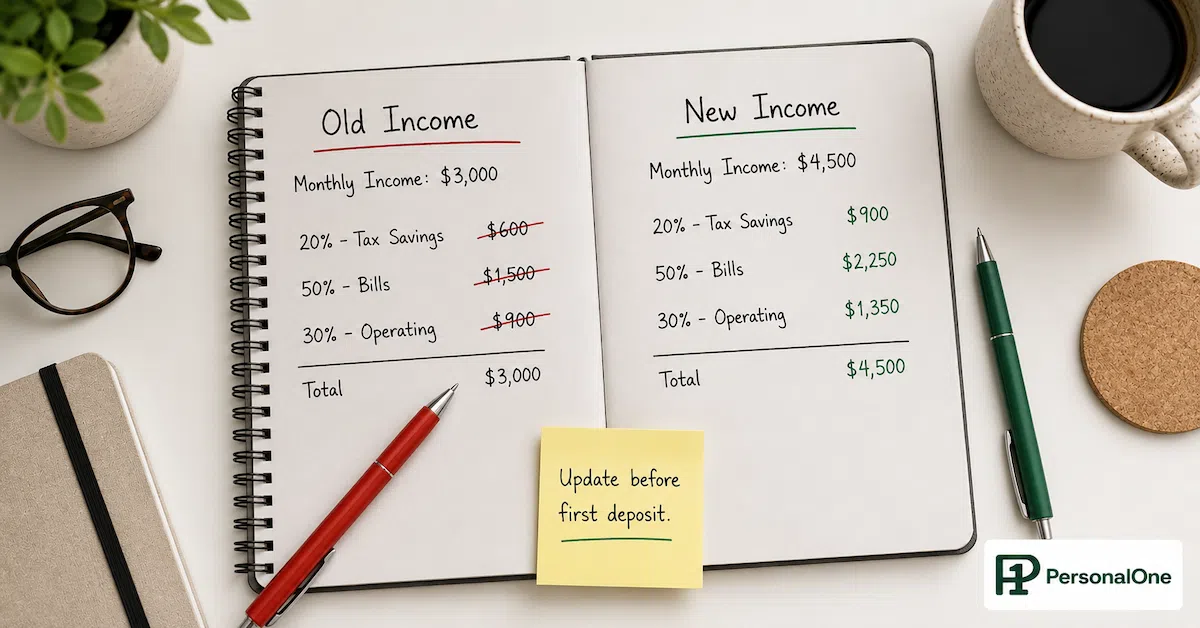
— Every material income change triggers a routing review: new income amount, new account allocations, new transfer amounts, and for variable earners, a new buffer calculation. This takes 30 minutes and protects months of financial progress.
— Income increases should be routed deliberately before lifestyle adjusts to the new amount. The window between when a raise hits and when spending expands to meet it is the highest-leverage moment in personal finance.
— Income decreases require a different response: immediate triage of automated transfers, identification of which accounts are now underfunded, and a revised routing structure calibrated to the new baseline.
Most advice about adjusting to an income change focuses on one of two things: updating your W-4 withholding for tax purposes, or cutting expenses to match a lower income. Both are useful. Neither addresses the more immediate and more impactful question of how to adjust your paycheck routing when your income changes — the actual account structure, transfer amounts, and distribution sequence that determines where every dollar lands the moment it arrives.
A paycheck routing system built for your previous income is quietly miscalibrated the moment that income changes. It may still run — the automated transfers still fire, the accounts still receive money — but the amounts are wrong. Bills accounts are over or underfunded. Savings allocations reflect old goals rather than new capacity. Buffer targets that made sense at $3,800 per month are too conservative at $5,400 and potentially dangerous at $2,600. The system looks functional from the outside while producing results that do not match the current financial situation.
This article covers exactly how to adjust your paycheck routing system when income changes — the specific recalibration steps for income increases, income decreases, and transitions between income types, and how to make the adjustment before the new income level has already normalized into spending habits that are hard to reverse.
Why Most People Never Update Their Routing System After Income Changes
The most common response to a raise is to update spending. The paycheck gets larger, daily life adjusts over the following weeks, and within two to three months the new income level feels exactly as tight as the old one. This is not a character flaw — it is what happens when income increases without a deliberate routing decision about where the additional money should go. Spending expands to fill available space because no structural decision was made to direct the surplus elsewhere first.
The most common response to an income drop is panic followed by inaction. Automated transfers continue firing at amounts calibrated to the previous income level. Accounts run short. Overdrafts or missed transfers create additional problems. The person knows something needs to change but the routing system itself — the specific accounts, amounts, and scheduled transfers — never gets updated because the adjustment feels overwhelming to tackle while managing the immediate cash flow stress.
Both situations share the same root problem: the routing system was set up once and treated as permanent. Income routing is not permanent. It is a living structure that needs to be recalibrated every time the income that feeds it changes materially. The recalibration takes 30 minutes. The cost of not doing it compounds every month until it is done.
The Income Change Triggers That Require a Routing Review
Not every income fluctuation requires a full routing recalibration. A one-time bonus, a slightly higher commission month, or a small annual cost-of-living adjustment does not justify rebuilding the system. The triggers that do require a routing review are material, sustained changes to the baseline income that feeds the system.
Raise or promotion: A new base salary that is 10% or more above the previous level. The new amount will persist indefinitely. The routing system should reflect it from the first paycheck at the new rate — not after lifestyle has already adjusted.
Job change: New employer, new salary, potentially new pay schedule (biweekly to semimonthly, monthly to weekly). Every element of the routing system needs to be verified against the new pay structure before the first deposit arrives.
Transition to freelance or self-employment: The most significant routing change possible. W-2 income with automatic withholding becomes 1099 income that requires immediate tax reserve separation. Fixed predictable deposits become variable unpredictable ones. The entire routing architecture changes.
Loss of a major client or income source: A freelancer losing a client that represented 30% of income, or a side hustle that stops producing. The baseline drops and the routing system needs to reflect the new reality immediately.
Partner income change: A household where one partner changes jobs, starts freelancing, loses income, or returns to work after a period away. The shared routing structure needs to reflect the new household income baseline.
Side income that has become substantial: A side hustle that started generating $200 per month and is now generating $1,500 per month has crossed from negligible to meaningful. It needs its own routing rules rather than being absorbed into general spending.
Adjusting Routing for an Income Increase
An income increase is the highest-leverage moment in the routing system — but only if the additional income is routed deliberately before spending adjusts to the new level. The window between the first paycheck at the new rate and the point where lifestyle has expanded to consume it is typically two to four weeks. Acting within that window is what separates an income increase that produces lasting financial progress from one that simply produces a more expensive lifestyle.
The Income Increase Routing Protocol
Step 1 — Calculate the net increase. Determine the after-tax increase in take-home pay. A $600 monthly gross increase does not produce $600 in additional routing capacity — taxes reduce it. For a W-2 employee in a typical tax situation, expect 65–75% of the gross increase to reach take-home. For a 1099 earner, the tax reserve percentage applies first before any allocation decisions are made.
Step 2 — Route the increase before updating the Operating Account. The Operating Account is where spending happens. If the increase flows directly into the Operating Account without any other routing decision, it will be spent. Deliberate routing means directing the increase to specific destinations first: emergency fund if it is not yet fully funded, then high-interest debt if any remains, then investment contributions, then a modest increase to the Operating allocation. The sequence matters. Lifestyle spending comes last.
Step 3 — Update the Bills Account transfer if obligations have changed. A raise often accompanies life changes that increase fixed obligations — a new apartment, a car upgrade, additional subscriptions. If fixed monthly obligations increased alongside the income increase, update the Bills Account transfer to reflect the new total plus the standard 10% buffer.
Step 4 — Increase savings and investment transfers proportionally. The standard benchmark is directing 50% of a take-home pay increase to savings or investments before any lifestyle allocation. A $400 net monthly increase: $200 to savings or investments, $200 available for lifestyle adjustment. This ratio produces compounding financial progress without requiring the full increase to be saved.
Step 5 — Update all automated transfer amounts. Once the allocation decisions are made, update the scheduled transfers in the banking system to reflect the new amounts. The new routing fires automatically from the next payday. No further decisions required until the next income change.
Where This Usually Fails
The income increase routing failure I see most consistently happens between Step 2 and Step 3 — not because the person disagrees with the framework, but because they take two or three days to set up the new transfers. In that window, the larger paycheck hits the Operating Account at the old transfer structure. The brain immediately registers the higher balance as available spending money. By the time the routing update happens, $150 to $300 of the increase has already dispersed. The routing update that was supposed to capture 50% of the increase ends up capturing 20% of it. The fix is executing the transfer update the same day the raise is confirmed — before the first paycheck at the new rate arrives, not after.
Adjusting Routing for an Income Decrease
An income decrease requires a different kind of routing adjustment — faster, more urgent, and focused first on preventing the automated transfers that were calibrated to the previous income level from creating overdrafts and cascading shortfalls before the system can be recalibrated.
The Income Decrease Routing Protocol
Step 1 — Pause or reduce all non-essential automated transfers immediately. Before the first smaller deposit arrives, identify every automated transfer that fires on payday and evaluate which ones can be reduced or paused. Savings transfers to goals (vacation fund, down payment) can be paused temporarily. Investment contributions above the employer match can be reduced. The Bills Account transfer must be maintained — bills do not pause. The Operating Account transfer needs to be adjusted, not eliminated.
Step 2 — Identify which accounts will be underfunded at the new income level. Calculate the total of all automated transfers that currently fire at payday. Compare to the new take-home amount. Any transfers that exceed the new deposit create an immediate shortfall. Identify these specifically before they fire — not after an overdraft surfaces.
Step 3 — Recalculate the operating budget at the new income baseline. The Operating Account transfer should be set at a level the new income can sustain without drawing down savings. This number is often uncomfortable. It is the honest answer to what is available for variable spending at the new income level. Set it at that number, not at a more optimistic projection of income recovering soon.
Step 4 — Protect the Bills Account at all costs. Fixed obligations do not decrease when income does. Rent, utilities, insurance, minimum debt payments — these continue regardless of income. The Bills Account transfer must be funded in full at every pay cycle. If the new income level cannot cover both Bills and a reasonable Operating allocation, the Operating allocation absorbs the shortfall first, not the Bills account.
Step 5 — Set a review date 60 days out. Income decreases are sometimes temporary (a slow freelance quarter, a job transition period). At 60 days, review whether the new income level is the new permanent baseline or a transitional period. If permanent, the routing system needs to reflect it with no expectation of returning to previous allocations. If temporary, maintain conservative routing and use any surplus from better months to rebuild any savings or buffer that was drawn down.
Adjusting Routing for a W-2 to Freelance Transition
Moving from employed W-2 income to freelance or self-employed income is the most structurally significant routing change a person can make. It is not a matter of adjusting transfer amounts. It requires rebuilding the routing architecture from scratch, because the fundamental structure of how income arrives — and what obligations it carries — changes completely.
Tax withholding disappears. W-2 income arrives with taxes already withheld. Freelance income arrives gross. The first routing decision for every freelance deposit is the tax reserve: 25–30% to a dedicated Tax Savings Account the same day the payment arrives. This is not optional and it is not something to implement after the first few months of freelancing. It starts with the first payment.
Predictable deposits become unpredictable. The fixed-amount automated transfer system that worked for a biweekly paycheck does not work for irregular freelance payments. The routing architecture shifts to the Income Holding Account model — all income lands in holding, fixed monthly transfers to Bills and Operating fire on the 1st from the buffer, and the holding account absorbs the variability. The full transition framework is in the banking for irregular income guide.
Benefits and obligations shift. Health insurance, retirement contributions, and other benefits that were automatic through a W-2 employer become manual decisions and payments that need to be routed deliberately. These are now fixed expenses in the Bills Account, not automatic deductions from a paycheck. The Bills Account total increases significantly in most W-2 to freelance transitions, and the routing system needs to reflect that before the first month of full freelance income arrives.
The Routing Review Checklist for Any Income Change
Regardless of the type of income change, the same review checklist applies. Work through it within the first week of any material income change — before the first new deposit arrives if possible, within one week of the first deposit if not.
Income Change Routing Review Checklist
— New take-home amount calculated. After-tax, after any benefit deductions, actual deposit amount confirmed.
— Bills Account total verified. All fixed monthly obligations listed, totaled, and buffered at 10%. Transfer amount updated to match.
— Operating Account transfer recalculated. Based on new take-home minus bills minus savings allocations. Reflects what is genuinely available for variable spending.
— Savings and investment transfers reviewed. Emergency fund status checked. Investment contributions set at the correct level for the new income. Goal-based savings allocations updated.
— Tax routing confirmed. For any 1099 or self-employment income, tax reserve percentage confirmed and transfer automation verified. For W-2 income changes, W-4 updated to reflect new salary.
— Buffer target recalculated. For variable income earners, the two-month minimum buffer is calculated against the new average monthly needs, not the old ones.
— All automated transfer amounts updated in the banking system. Every scheduled transfer verified against the new allocation decisions. No transfers still firing at old amounts.
— Next review date set. 60 days for income decreases. 90 days for all other changes to verify the new routing is producing the intended results.
Your Income Changed. Your Routing System Should Too.
Routing recalibration is one piece of the complete paycheck flow framework. For the full system — where every dollar goes from the moment it arrives, how accounts connect, and how to automate the entire structure — see Where Your Paycheck Should Go First.
Frequently Asked Questions
How soon after an income change should I update my routing system?
Before the first deposit at the new income level if possible. If that is not realistic, within the first week of the first new deposit. The longer the new income level runs through an old routing system, the more the spending pattern adjusts to the new amount before the routing structure does — which means lifestyle expands to fill increases before savings can capture them, or shortfalls compound before transfers are corrected. Same-week action produces the best outcomes.
Should I update my direct deposit with my employer when I update my routing?
If the income change involves a new employer or a change in which account receives the primary deposit, yes — the direct deposit form needs to reflect the new routing destination. If the income change is a raise at the same employer depositing to the same account, the direct deposit form does not need to change — only the downstream scheduled transfers from that account to bills, savings, and operating need updating.
What percentage of an income increase should go to savings versus lifestyle?
A useful starting benchmark is 50% of the net take-home increase to savings or investments, 50% available for lifestyle adjustment. This ratio produces meaningful financial progress without requiring the full increase to be saved, which is rarely sustainable long-term. If the emergency fund is not yet fully funded, direct 100% of the increase there until it is. Once the emergency fund is complete, the 50/50 split applies to subsequent increases.
My income dropped temporarily. Should I update my routing or wait to see if it recovers?
Update immediately for the Bills Account and Operating Account transfers. Do not wait. A temporary income drop that runs through unchanged routing creates real overdrafts and real missed transfers — the temporary nature of the drop does not prevent the concrete financial damage. Pause goal-based savings transfers that are genuinely discretionary. Maintain essential transfers. Set a 60-day review date to assess whether the recovery has materialized and restore previous routing if it has.
I have both W-2 income and growing freelance income. How do I route both?
Keep them structurally separate until the freelance income is large enough to change the household baseline. W-2 income routes through the standard system — direct deposit split to bills and operating with automatic transfers. Freelance income follows the variable income protocol: all deposits to an Income Holding Account, 25–30% to Tax Savings immediately, the remainder held as buffer with monthly transfers to supplement or accelerate specific financial goals. Once freelance income consistently represents 30% or more of total household income, the two routing systems need to be reviewed together and potentially unified under a single architecture.
Official Sources
IRS Tax Withholding Estimator — For updating W-4 withholding alongside routing recalibration after a W-2 income change.
IRS Form W-4 — Employee's Withholding Certificate
CFPB — Bank Account Tools and Consumer Rights
More From This Cluster
Return to Where Your Paycheck Should Go First for the complete income routing framework. For the variable income routing architecture specifically — holding accounts, percentage-based distribution, and buffer management — see How to Route Income When You Don't Know How Much Is Coming and Banking for Irregular Income.
PersonalOne Money System
This content is researched, written, and owned by PersonalOne — a free financial education platform built to help Millennials and Gen Z build real financial systems.
Disclaimer: This content is for educational purposes only and does not constitute financial or tax advice. PersonalOne is not a licensed financial advisor or tax professional. Income routing strategies, savings allocations, and tax reserve percentages should be tailored to your specific income pattern, tax situation, and financial obligations. Consult a qualified tax professional for guidance on W-4 withholding adjustments and estimated tax payment obligations following an income change.