Updated: May 18, 2026
Home › Banking Systems › Online Banks vs Traditional Banks › How to Avoid Bank Fees: Every Common Fee and How to Eliminate It
Part of Online Banks vs Traditional Banks — a guide to choosing the right banking institution for each role in your financial system.
What You Need to Know
— Americans pay an average of $311/year in bank fees — almost all of it avoidable.
— Seven most common bank fees each have a specific, reliable fix.
— Most fee elimination requires a one-time setup — not ongoing management.
— Structural changes (right bank, right accounts) beat willpower every time.
— A fee-free banking system is achievable in under an hour of setup.
Bank fees are among the most frustrating financial drains because they are silent. They do not show up as line items in your budget. They do not feel like spending. They just reduce your balance, month after month, without ever asking permission.
In 2024, Americans paid approximately $82 billion in bank fees — roughly $311 per adult. Monthly maintenance fees, overdraft charges, out-of-network ATM fees, minimum balance penalties — each one is small. Together, they compound into a meaningful annual cost that most people absorb without ever deciding to.
Most of these fees are completely avoidable. Not by being more careful with money or checking your balance more often — those are willpower solutions that fail under stress. They are avoidable through structural decisions: choosing the right institution, setting up the right automations, and understanding exactly what triggers each fee before it appears. Understanding how online banks differ from traditional banks on fees and structure is where most people find the clearest path to eliminating these costs permanently.
This guide covers every major bank fee, what causes it, and the specific fix that eliminates it permanently. For the complete architecture of how fee-free accounts fit into a structured banking system — how money flows between checking, bills, and savings on autopilot — the banking systems account structure guide covers the full setup.
Fee #1: Monthly Maintenance Fees ($10–$25/month)
What causes it: Most traditional banks charge a monthly maintenance fee just for having a checking or savings account. According to the 2026 MoneyRates Checking Account Fee Survey, the average monthly maintenance fee has hit a record $13.51 — adding up to over $162 per year. Some banks waive it with a minimum daily balance ($500–$1,500) or direct deposit. Miss either condition for a single day and the fee applies.
Annual cost: $120–$300/year per account. $162/year at the current national average.
The fix: Switch to a bank that charges zero monthly fees with no conditions. Online banks — Ally, Discover, Capital One 360, Axos, SoFi — all offer genuinely fee-free checking and savings. No minimum balance. No direct deposit requirement. No exceptions. The banks with no monthly fees guide covers the top 10 no-fee options in 2026 with a full comparison of what each one does best.
Time to fix: 15–30 minutes to open a new account online and initiate a transfer. One decision. Permanent elimination.
Fee #2: Overdraft Fees ($25–$35 per transaction)
What causes it: A transaction processes when your checking balance is insufficient. The average overdraft fee is now $32.75 per occurrence according to the 2026 MoneyRates survey — and charges can come in bunches if you do not catch the overdraft quickly. Some banks stack multiple overdraft fees in a single day.
Annual cost: $35–$350+ depending on frequency. One bad week can cost $100+.
The fixes (multiple options):
Opt out of overdraft coverage entirely. Transactions simply decline instead of going through. No coverage = no fee. Log into your bank app or call customer service and opt out.
Link a savings account as overdraft backup. Many banks transfer from linked savings instead of charging a fee (or charge a much smaller transfer fee of $5–10 instead of $35).
Switch to a no-overdraft-fee bank. Ally, Discover, Capital One 360, Axos, and SoFi all eliminated overdraft fees. Transactions decline or are covered with no charge.
Keep a cash buffer in checking. Maintaining $200–500 above your expected monthly spending creates a cushion that prevents most overdraft triggers.
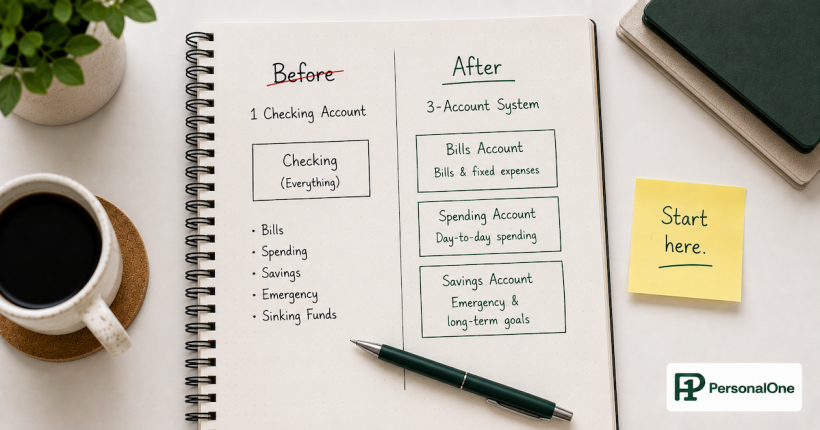
Root cause fix: Overdrafts happen when bill money and spending money share the same account. Separating them structurally — bills account for fixed expenses, spending account for discretionary — eliminates the collision that causes most overdrafts. Once money is separated, it is much harder to accidentally spend what is set aside for rent.
Fee #3: Out-of-Network ATM Fees ($3–$5 per transaction)
What causes it: Using an ATM not in your bank’s network. Your bank charges you a fee ($2–$3), and the ATM operator charges a surcharge ($2–$5). The combined average hit a record $4.64 per transaction in 2026 according to MoneyRates. A single out-of-network withdrawal can cost $7–$10.
Annual cost: $168–$520/year for someone withdrawing cash weekly from out-of-network ATMs.
The fixes:
Know your network. Most banks belong to large ATM networks (Allpoint, MoneyPass, STAR). Download your bank’s app — most have an ATM locator. Finding a network ATM within a few blocks eliminates the fee entirely.
Get cash back at checkout. Grocery stores, pharmacies, and big-box retailers let you get cash back with a debit purchase — no ATM fee, no surcharge. Ask for $20–$40 back when checking out.
Switch to a bank with ATM reimbursements. Axos reimburses all domestic ATM fees. Charles Schwab reimburses all ATM fees globally with no cap. One-time account switch, permanent fee elimination.
Reduce cash dependency. Card payments and digital wallets eliminate ATM fees for people who use them. If you are paying cash regularly, most spending can move to card without lifestyle changes.
Best fix for frequent travelers: Charles Schwab Bank reimburses all ATM fees globally with no limit. If you travel internationally even twice a year, this account pays for itself in the first trip.
Fee #4: Minimum Balance Fees ($10–$25/month)
What causes it: Some accounts require a minimum daily or average monthly balance ($500–$2,500) to avoid a fee. Dip below the threshold even once — on a day when a large bill cleared — and the fee applies for the full month.
Annual cost: $120–$300/year per account.
The fixes:
Switch to a no-minimum account. Every online bank on the no-fee list operates with zero minimum balance requirements. This is the cleanest fix — one switch, permanent elimination.
Ask your bank to waive the requirement. Long-term customers with multiple products sometimes get minimum balance requirements waived. A single phone call is worth trying before switching.
Downgrade your account tier. Many banks offer a basic checking account with no minimums alongside premium tiers. If you are on a premium tier that requires minimums you do not consistently maintain, downgrade to the basic version.
Note: Minimum balance requirements and monthly maintenance fees are often the same fee described differently. Fixing one usually fixes both.
Fee #5: Wire Transfer Fees ($15–$45 per transfer)
What causes it: Sending money via wire transfer — both domestic and international. Banks charge the sender $15–$30 for domestic wires and $35–$50 for international, plus receiving fees at the destination bank.
Annual cost: Varies. Even 2–3 wires per year costs $60–$150.
The fixes:
Use ACH transfers instead. For domestic transfers between U.S. accounts, ACH is free and takes 1–3 business days. Most people wire money when ACH would have worked fine — just slower.
Use Zelle for instant free transfers. Zelle connects directly to your bank account and sends instantly between enrolled U.S. accounts at no cost. Supported by most major banks and many credit unions.
Use Wise for international transfers. Wise charges a fraction of bank wire fees for international transfers — often 0.5–1% of the transfer amount vs. flat $35–50 bank fees.
When wires are unavoidable: Real estate closings and large business transactions sometimes require wire transfers. In those cases, the fee is a cost of the transaction, not an ongoing banking fee to eliminate.
Fee #6: Paper Statement Fees ($1–$5/month)
What causes it: Some banks charge for mailing physical statements. Small per-statement, but recurring.
Annual cost: $12–$60/year.
The fix: Log into your online banking and switch to paperless statements. One click. Takes 30 seconds. Also reduces paper clutter and eliminates the security risk of financial statements in your mailbox.
Note: Some banks make paperless the default for new online accounts. If you are paying this fee, it is worth checking when you last updated your preferences — it may have reset after a bank system update.
Fee #7: Foreign Transaction Fees (1–3% per transaction)
What causes it: Debit or credit card transactions in foreign currencies — while traveling internationally or shopping at overseas retailers online. Banks charge 1–3% of each transaction for currency conversion.
Annual cost: Variable. On a $3,000 international trip, a 3% fee adds $90 in invisible charges.
The fixes:
Charles Schwab Bank: Zero foreign transaction fees on debit, plus unlimited ATM reimbursements globally. Best single solution for international travelers.
No-foreign-fee credit cards: Many travel credit cards (Chase Sapphire, Capital One Venture, etc.) charge zero foreign transaction fees. Using these instead of your debit card abroad eliminates the fee while earning rewards.
Wise debit card: Converts at the real mid-market rate with a small flat fee — typically much cheaper than bank foreign transaction charges.
Do not use airport currency exchange: Airport currency kiosks often charge 5–15% above the actual exchange rate. Always use a card or bank ATM with no foreign transaction fee instead.
The Real Cost: What These Fees Add Up To
| Fee Type | Per Occurrence | Worst Case Annual | Fix Effort |
|---|---|---|---|
| Monthly maintenance | $13.51 avg / up to $25 | $300 | Switch bank (30 min) |
| Overdraft fees | $32.75 avg | $350+ | Opt out or switch bank (10 min) |
| Out-of-network ATM | $4.64 avg combined | $241 | Use ATM locator or switch bank |
| Minimum balance | $10–$25 | $300 | Switch account tier or bank (20 min) |
| Wire transfers | $16–$35 domestic | $150 | Use Zelle or ACH instead |
| Paper statements | $1–$5 | $60 | Switch to paperless (30 sec) |
| Foreign transactions | 1–3% | $90–$150 | Switch to no-fee card |
| Combined worst case | $1,514/year | ~60 min of setup fixes all |
Most people are not paying all seven fees simultaneously. But the average American paying $311/year in bank fees is typically hitting two or three of these regularly without realizing the cumulative cost. Eliminating even the two largest — maintenance fees and overdraft fees — typically saves $200–$400 annually. That is money that should be earning interest in a savings account, not disappearing into fee revenue.
Choosing a Bank That Makes Fee Elimination Permanent
Individual fee fixes are useful, but the most durable solution is choosing a bank where most of these fees simply do not exist. Online banks have structurally lower cost bases — no branch networks, no legacy systems, fewer layers of overhead. Those savings translate to zero-fee checking and savings accounts.
The criteria for a truly fee-free bank: zero monthly maintenance fees with no conditions, no overdraft fees, a large in-network ATM network or unlimited reimbursements, no minimum balance requirements, and FDIC insurance confirmed. For a full comparison of the top 10 no-fee banks in 2026 and which fits which banking situation, the banks with no monthly fees guide covers all 10 options with current features and conditions — including FDIC insurance status, overdraft policy, transfer speed, and rate conditions for each one.
Once you have moved to a fee-free checking account, the next structural move is making sure your savings are working for you rather than sitting idle. A high-yield savings account earning 4–5% APY turns the money you have stopped losing in fees into money that actively grows. The process of opening one takes about 10 minutes — the full walkthrough, including how to link it to your checking account and automate transfers, is in the high yield savings account setup guide.
The Structural Fix: Why Account Separation Eliminates Most Fees
The majority of bank fees — overdraft fees, minimum balance fees, low-balance fees — share a root cause: money that is needed for one purpose gets spent on another. Bill money gets spent on groceries. The emergency fund covers impulse purchases. The result is a chronically low checking balance that repeatedly triggers fees.
Structural account separation solves this at the source. When your spending money, bill money, and savings money live in distinct accounts — each with a clear, defined purpose — the collision that causes most fee triggers disappears. Your bills account always has bill money. Your spending account only holds discretionary cash. Your savings account is untouched by daily spending decisions.
This is the core logic behind every effective personal finance system. For the complete architecture — which accounts you need, how money flows between them, and how to set up the automations that make it run without willpower — the banking systems account structure guide walks through the full setup.
Stop Paying Fees. Start Building the System Instead.
Eliminating bank fees is one half of the equation. The other half is making sure the money you have stopped losing is going somewhere useful — automated into savings, building an emergency fund, funding your next goal. The PersonalOne Banking Systems hub covers the complete setup: fee-free accounts, account structure, savings automation, and the flow that makes it all work without constant management.
Your 60-Minute Fee Elimination Checklist
Do these once. Pay nothing again.
☐ Switch to paperless statements (2 min)
☐ Opt out of overdraft coverage at your current bank (5 min)
☐ Download your bank’s ATM locator and save it to your home screen (2 min)
☐ Enroll in Zelle at your bank for free instant transfers (5 min)
☐ Check whether your account has a minimum balance requirement — downgrade or switch if it does (10 min)
☐ Research a no-fee bank and open an account if your current bank charges maintenance fees (30 min)
☐ If you travel internationally, open a Charles Schwab account or apply for a no-foreign-fee card (15 min)
☐ Set up automatic transfers from checking to savings on payday — so money earns interest instead of waiting to be spent (5 min)
Official Sources
FDIC — Verify Your Bank’s Deposit Insurance
CFPB — Bank Account Tools and Consumer Rights
More From This Cluster
Return to Online Banks vs Traditional Banks for the full comparison — which institution belongs in which role, the hybrid setup most people need, and every article in this cluster.
Frequently Asked Questions
Can I negotiate bank fees directly with my bank?
Sometimes. Long-term customers with direct deposit established and no history of issues can often get one-time fee waivers by calling and asking. Banks do not advertise this, but customer retention matters. That said, negotiating a refund is a temporary fix — the fee will appear again next month. A structural fix (right account, right bank) is more reliable than a goodwill waiver.
Are credit unions better than banks for avoiding fees?
Often yes — credit unions are member-owned nonprofits and typically charge fewer fees than commercial banks. They also tend to offer better rates on savings accounts and loans. The tradeoff is smaller ATM networks and less polished digital banking tools. For people who bank primarily online, online banks often beat credit unions on both rates and technology. For people who value in-person service and community relationships, credit unions are an excellent fee-avoidance option.
What if I need overdraft protection as a safety net?
If you are relying on overdraft coverage regularly, the fee is not the real problem — it is a cash flow issue. Overdraft protection is a $32.75 bridge loan that signals your income and expenses are not properly aligned. The right fix is structural: build a $200–$500 cash cushion in checking, separate bill money from spending money, and set up low-balance alerts. With proper structure in place, you will not need overdraft coverage because you will not run out of money before payday.
How do I know if I am currently being charged fees I do not know about?
Download the last 3 months of statements from your bank and search for any recurring charges that are not purchases. Bank fees show up with descriptions like “monthly service fee,” “maintenance fee,” “overdraft fee,” “ATM surcharge,” or “out-of-network ATM fee.” Add up the total across three months and annualize it. Most people are surprised by how much they find.
Does switching banks affect my credit score?
No. Opening or closing a checking or savings account does not affect your credit score. Credit scores are based on credit products — loans, credit cards, and lines of credit. Deposit accounts do not appear on credit reports. You can switch banks as many times as you want without any impact on your creditworthiness.
This content is for educational purposes only and does not constitute financial advice. PersonalOne is not a licensed financial advisor, broker, or investment professional. Bank fees, account terms, and fee waiver policies vary by institution and are subject to change. Always verify current terms directly with your financial institution before making account decisions. FDIC insurance limits are subject to change — verify current coverage at FDIC.gov.