Updated: May 16, 2026
Home › Banking Systems › The 3-Account System Explained › How to Open a High-Yield Savings Account in 10 Minutes
Part of the 3-Account System Explained cluster — the complete framework for structuring your banking so every dollar has a job.
What You Need to Know
— A high-yield savings account earns 4.00–5.00% APY compared to the national average of 0.38% at traditional banks — a difference of more than 10x.
— Most online HYSAs take 10 minutes to open with no minimum deposit and no monthly fees.
— The account is only half the work. Automating transfers into it from your checking account is what makes it function as a savings system rather than an account you forget to use.
— Before opening, confirm the institution is FDIC-insured. Verify at FDIC.gov.
— If you are unsure whether a HYSA or money market account is the better fit for your situation, that decision belongs before this step.
Your savings account is probably costing you money right now. The average traditional savings account pays 0.38% APY — which means $10,000 sitting in a standard savings account earns about $38 per year. A high-yield savings account at the same balance earning 4.00% APY earns $400. That is $362 you are leaving behind every year for no reason other than not having made the switch. Opening a high-yield savings account takes about 10 minutes and requires no special financial knowledge. The harder part is making sure it fits correctly into a three account system so it actually gets funded and stays funded automatically.
This guide walks through the complete process: what to look for before you open, the exact steps to open, how to connect it to your existing accounts, and how to set up the automation that makes it work without relying on willpower. Most people open the account and consider the job done. The job is not done until the transfers are automated. That distinction is what separates an account that earns money consistently from one that gets opened and ignored.
For the complete framework on how this account fits into your overall banking system for money management — how it connects to your bills account, checking account, and investment contributions — the Banking Systems authority hub covers the full architecture. This article focuses on the tactical execution: how to open the account and make it work.
What You Are Actually Looking For in a High-Yield Savings Account
Not all high-yield savings accounts are equal. The APY headline is the most visible difference, but there are five criteria that matter before rate alone.
FDIC insurance. Non-negotiable. Any account you open should be FDIC-insured up to $250,000 per depositor per institution. Verify this directly at FDIC.gov before depositing a dollar. Most legitimate online banks are FDIC-insured, but some fintech platforms hold deposits through partner banks — verify the actual insured institution, not just the app name.
No monthly maintenance fees. The best HYSAs charge zero monthly fees with no minimum balance requirement to waive them. Any fee structure that requires a minimum balance to avoid a monthly charge introduces a cost that will eventually hit you. Eliminate that risk by choosing a no-fee account from the start.
No minimum opening deposit. Most top online HYSAs require $0 to $100 to open. If an account requires more than $100 and you are just getting started, there are better options. Do not let a minimum deposit requirement delay opening an account that should have been opened six months ago.
ACH transfer speed. This matters more than most people realize. If transfers between your HYSA and checking account take 3–5 business days, cash flow management becomes difficult. Look for institutions that process ACH transfers in 1–2 business days. Some offer same-day or next-day transfers for accounts linked at account opening.
APY that compounds daily. Daily compounding vs. monthly compounding produces a slightly higher effective return over time. At 4.00% APY with daily compounding versus monthly, the difference on $10,000 over a year is small but real. More importantly, daily compounding means your interest earns interest faster. Always verify the compounding frequency, not just the APY headline. Before committing to a specific institution, the best online savings accounts guide compares current rates and institution features side by side so you can confirm you are opening the account with the strongest combination of rate, FDIC coverage, and fee structure.
HYSA vs Money Market Account: Settle This Before You Open
If you have not already confirmed that a high-yield savings account is the right account type for your situation, make that determination before opening anything. The two account types serve different purposes and the difference matters for how you use them.
High-yield savings accounts are the better choice for emergency funds, down payment savings, and goal-based savings where you do not need to access funds more than a few times per month. They pay the highest rates, have the lowest barriers to entry, and are the cleaner structural fit for dedicated savings that should not be easily spent.
Money market accounts add checking features — debit card access, check writing — at slightly lower APYs and typically with higher minimum balance requirements. They are better suited for situations where you need occasional direct access to savings without a transfer delay. A detailed breakdown of when each account type makes sense and when the hybrid approach using both is the right call is in the savings vs money market account comparison. Confirm your account type before proceeding.
How to Open a High-Yield Savings Account: Step by Step
Once you have selected the institution, the opening process is straightforward. Here is the exact sequence.
Step 1 — Gather your information before you start. You will need your Social Security number, a government-issued photo ID (driver's license or passport), your current address, and the routing and account number for your checking account at your existing bank. Having these ready prevents the application from stalling mid-process.
Step 2 — Go to the institution's website or download their app. Do not use a third-party link or comparison site to open the account. Go directly to the institution's official URL. This ensures you are on the legitimate site and not a phishing page.
Step 3 — Complete the application. You will fill in your personal information, verify your identity, and agree to account terms. Most applications take 5–8 minutes. You will receive a confirmation email when the account is opened, usually within minutes for online-only institutions.
Step 4 — Link your checking account. This is the critical step most guides underemphasize. During or immediately after account opening, link your existing checking account using its routing and account number. This creates the ACH connection that allows transfers in both directions. Some institutions use micro-deposits for verification — two small amounts under $1.00 are deposited into your checking account within 1–2 business days, which you then confirm in the HYSA app to complete the link.
Step 5 — Make your initial deposit. Transfer a meaningful amount from your checking account to fund the HYSA. Even if you are starting small, this initial transfer confirms the link is working correctly and starts the interest clock. Most institutions begin crediting interest as soon as the deposit clears.
Step 6 — Enable two-factor authentication immediately. Before closing any windows, go to your account settings and enable two-factor authentication. This is the single most important security step for any financial account. Do not skip it or defer it.
The Step Most People Skip: Automating the Transfers
Opening the account completes the setup. Automating transfers is what makes the account actually work. A high-yield savings account that gets funded manually — when you remember, when there is surplus, when you feel motivated — produces inconsistent results. An account with an automated recurring transfer from your checking account on every payday produces compounding results that build without requiring any ongoing decision-making.
The automation can be set up two ways. The first and most reliable method is to set up the recurring transfer inside your HYSA app. Log in, go to transfers, create a recurring transfer from your linked checking account for a fixed amount on the same day as your direct deposit. This transfers money out of your spending pool before you have a chance to spend it.
The second method is to set up the push from your employer or payroll. Some employers allow direct deposit splits — a percentage or fixed amount of each paycheck goes to one account and the remainder to another. If your employer supports this, it is the cleanest method because the savings contribution never touches your checking account at all.
Either approach works. The key is that the transfer happens automatically on a fixed schedule rather than requiring a conscious decision each pay period. This is the infrastructure principle that runs through every stage of the PersonalOne system: the goal is not to build savings through willpower. It is to build a structure that saves automatically regardless of motivation. If you are currently managing money across multiple accounts without a clear system, the accounts that most people need and how they should be connected are covered in detail through the complete framework on no fee checking accounts — pairing your HYSA with a no-fee checking account at an online bank eliminates the fee drag that quietly costs traditional bank customers hundreds per year.
What Happens After You Open: The First 30 Days
The first 30 days after opening determine whether this account becomes a permanent fixture in your financial system or another account you set up and ignored. A few specific actions in the first week lock the account into a functioning role.
Confirm that the account verification process completed correctly. Log in after 48 hours and verify that your linked checking account shows as active and that transfers are available in both directions. If micro-deposits were used for verification, confirm them immediately once they appear rather than waiting.
Set up your first automated transfer if you have not already done so during account opening. Even a small amount — $25 or $50 per pay period — establishes the habit and the connection. You can increase the amount later. The infrastructure matters more than the initial amount.
Check the account once in the first month to confirm interest is posting and transfers are executing on the expected schedule. After that, a monthly check-in is sufficient. The account should not require daily attention. If you find yourself checking it constantly, that is a signal the emergency fund is not yet large enough to create the psychological buffer that makes market-like volatility in your savings rate feel irrelevant.
The rate will change over time as the Federal Reserve adjusts policy. As of May 2026, top HYSAs are paying 4.00–5.00% APY and rates have been declining gradually from their 2023 peak. Even if rates continue declining, the gap between online HYSAs and traditional bank savings accounts remains substantial. A HYSA at 3.50% still earns nine times more than the national average of 0.38% at a traditional bank. The compounding advantage of staying in a HYSA significantly outperforms the alternative of staying in a traditional savings account even in a declining rate environment.
The Account Is One Piece. The System Is What Compounds.
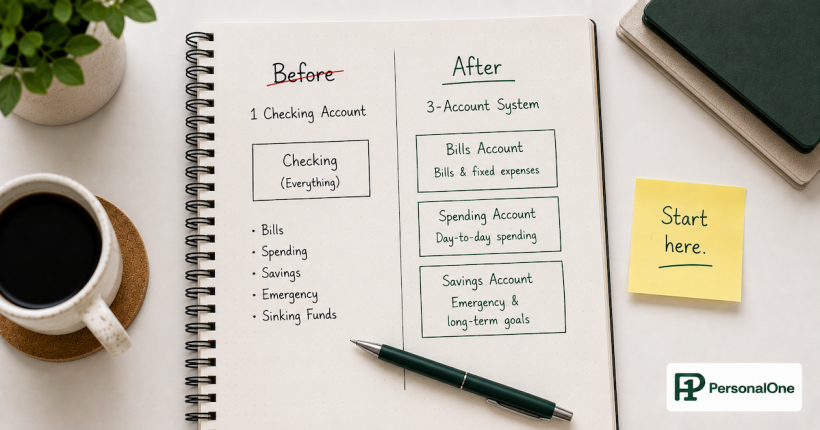
Opening a high-yield savings account is the right move. What makes it produce real results over time is connecting it to a structured banking system where transfers happen automatically on every payday. The 3-Account System shows exactly how to structure your checking, bills, and savings accounts so every dollar has a destination before you have a chance to spend it.
Common Mistakes When Opening a High-Yield Savings Account
Several recurring mistakes reduce the effectiveness of a HYSA or create problems after opening. Knowing these in advance prevents them.
Choosing based on APY alone without checking fees or FDIC status. The highest APY on a comparison site may belong to an institution with a monthly fee, a minimum balance requirement to earn that rate, or deposits held through an intermediary partner bank that limits FDIC coverage. Verify all three before opening: FDIC insurance, no monthly fees, and the conditions under which the advertised APY applies.
Not linking the account to checking immediately. Some people open the HYSA and then leave the linking step for later. Later rarely comes. The ACH link is what enables the automated transfers that make the account function. Complete the link during account opening while the process is active and your motivation is high.
Treating the HYSA as an accessible spending account. High-yield savings accounts are not designed for frequent access. They are designed for money that does not need to move regularly. If you find yourself transferring money back out frequently, the account is being used as a checking account buffer rather than a savings vehicle. The appropriate structure is to keep 1–2 weeks of expenses in checking as an immediate buffer and move everything beyond that into the HYSA.
Opening the account without a funding plan. An unfunded HYSA earns nothing. The account opening is the easy part. Before you open it, decide how much you are transferring on day one and how much will transfer automatically on each payday. Both numbers should be set before you begin the application.
Skipping the security setup. Two-factor authentication is not optional. Online financial accounts without 2FA are meaningfully more vulnerable to unauthorized access. Set it up before closing the browser window after account opening. Use an authenticator app rather than SMS if the institution offers it, as authenticator-based 2FA is significantly more secure than text message codes.
Official Sources
FDIC BankFind Suite: Verify FDIC insurance status for any institution before opening an account. FDIC BankFind Suite
FDIC — Deposit Insurance Coverage: How FDIC insurance works, what is covered, and how to verify your coverage. fdic.gov
CFPB — Savings Accounts: Consumer guidance on savings accounts, how interest is calculated, and what to look for before opening. consumerfinance.gov
Continue Building Your System
This article is part of the 3-Account System Explained cluster. The full cluster covers how to structure your checking, bills, and savings accounts into one automated system where money flows correctly every pay period without manual management.
Frequently Asked Questions
How much do I need to open a high-yield savings account?
Most top HYSAs require $0 to $100 to open. Several of the highest-rated accounts — including SoFi, Ally, and Marcus by Goldman Sachs — have no minimum opening deposit. Do not let a low balance prevent you from opening the account. Start with whatever amount you have available and set up automated transfers from the first payday forward.
How long does it take to open a high-yield savings account online?
The application itself takes 5–10 minutes if you have your Social Security number, ID, and existing account information available. Account approval is typically immediate for online-only institutions. The ACH link to your checking account may take an additional 1–2 business days if micro-deposit verification is required. You can initiate your first transfer before verification completes at most institutions, with the transfer processing after verification is confirmed.
Is my money safe in an online bank?
Yes, provided the institution is FDIC-insured. FDIC insurance covers up to $250,000 per depositor per institution regardless of whether the bank has physical branches. The safety of your deposits is identical between an FDIC-insured online bank and an FDIC-insured traditional bank. Always verify insurance status at FDIC.gov before depositing. The difference between online and traditional banks is access and experience, not safety.
Can I have a high-yield savings account at a different bank than my checking account?
Yes, and this is often the recommended setup. Keeping your HYSA at a separate institution from your primary checking account creates a structural separation between spending money and savings. The 1–3 day ACH transfer time to access the savings acts as a friction barrier that discourages impulse withdrawals without making the account inaccessible in a genuine emergency. Most people find that keeping savings and checking at the same institution makes it too easy to move savings back into spending.
What happens to my HYSA rate when the Federal Reserve cuts rates?
HYSA rates are variable and will decline as the Fed cuts its benchmark rate. Rates have declined gradually from the 5%+ peak of 2023 and are expected to continue declining through 2026. However, the gap between online HYSA rates and traditional bank savings accounts remains substantial regardless of the rate environment. Even if HYSA rates decline to 3.00%, they will still outperform the 0.38% national average at traditional banks by a significant margin. The rate advantage of a HYSA over a traditional savings account does not disappear in a declining rate cycle — it narrows, but remains meaningful.
How often should I check my high-yield savings account?
Once per month is sufficient for most people once the account is set up and automated transfers are running. The goal of the account is to earn interest passively while you focus on other financial priorities. If you find yourself checking daily, it is usually a signal that the emergency fund is not yet large enough to provide the financial security that makes routine balance fluctuations irrelevant. Once the emergency fund reaches its target of three to six months of essential expenses, monthly check-ins for accuracy are all that is needed.
This content is for educational purposes only and does not constitute financial advice. PersonalOne is not a licensed financial advisor, broker, or investment professional. Individual financial situations vary — consult a qualified financial professional for personalized guidance. Interest rates, APYs, and account features are subject to change. Always verify current rates and FDIC insurance status directly with financial institutions before opening accounts.