Updated: May 18, 2026
TL;DR
— Checking accounts are built for daily transactions — spending, bills, and direct deposit. Not for holding money.
— Savings accounts are built for money you are not spending this month — short-term goals, reserves, and buffers.
— Money market accounts serve medium-term goals where you want both growth and occasional access.
— The choice between them is not about preference — it is about matching the account to the purpose of the money.
— Using the wrong account type for a job it was not built for increases cost and reduces control.
The checking vs savings account question is one of the most searched in personal finance — and one of the most incompletely answered. Most people know checking is for spending and savings is for saving. What most people do not know is how to use both accounts together as a deliberate system rather than two separate places where money occasionally lives. The three account system answers this directly: each account has a specific job, a defined funding method, and a clear boundary that keeps money from bleeding between purposes.
Understanding which account type to use — and why — is the foundational layer of a banking system for money management that runs without constant attention. This is not about finding the best interest rate or the lowest fee. It is about matching the right account structure to the right financial purpose so your money is always where it needs to be before you need it.
What a Checking Account Is Actually Built For
A checking account is a transaction account. It is designed for high-frequency movement: money comes in through direct deposit, goes out through bill pay, debit card purchases, and automatic transfers. The defining feature of a checking account is unrestricted access — there are no federal limits on how many withdrawals or transfers you can make per month. That access is the point. Checking accounts are optimized for liquidity, not growth.
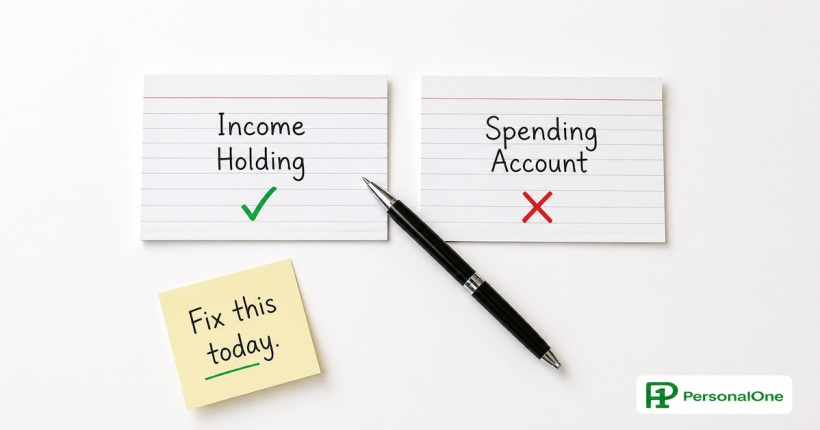
What checking accounts are not built for: holding money you are not spending this month. When extra cash sits in a checking account beyond your current spending needs, it earns nothing and carries full exposure to impulse spending. The checking account is your financial operating account — the hub through which active money flows. It is not a savings vehicle and should not be used as one.
The practical boundary: your checking account should hold your current month’s budgeted spending plus a small overdraft buffer — typically one to two weeks of fixed expenses. Anything above that threshold belongs in a separate account with a specific purpose assigned to it.
What a Savings Account Is Actually Built For
A savings account is a holding account for money that has a future purpose but is not being spent today. Emergency reserves, a buffer for irregular expenses, a vacation fund, a planned purchase — these are savings account jobs. The separation from checking is the feature, not the inconvenience. Money in a dedicated savings account is harder to spend impulsively because it requires a conscious transfer before it can be used.
High-yield savings accounts (HYSAs) at online banks currently offer significantly better interest rates than traditional savings accounts at brick-and-mortar institutions. For money that will sit for weeks or months before it is needed, the interest rate difference is real. According to the FDIC, the national average savings account rate at traditional banks remains well below what online HYSAs offer — making account selection itself a financial decision, not just a convenience choice.
What a Money Market Account Adds
A money market account occupies the space between checking and savings. It typically offers higher interest rates than standard savings accounts, and in many cases provides limited check-writing or debit card access. The FDIC insures money market accounts at member institutions up to $250,000 per depositor, the same protection that applies to checking and savings accounts.
Money market accounts are best suited for medium-term goals — money you will need in six months to two years — where you want your balance to grow while maintaining occasional access. A money market account explained properly is not a replacement for your checking account or your primary savings account. It is a third tier for money that sits between active spending and long-term savings, earning more than a standard savings account while remaining accessible when the goal matures.
Common money market account use cases: a down payment fund accumulating over 18 months, a business reserve account for a freelancer, or a sinking fund for a known large expense. Where a HYSA earns while you wait with no access pressure, the money market adds the option of limited direct access without requiring a transfer to checking first.
How the Three Account Types Work Together as a System
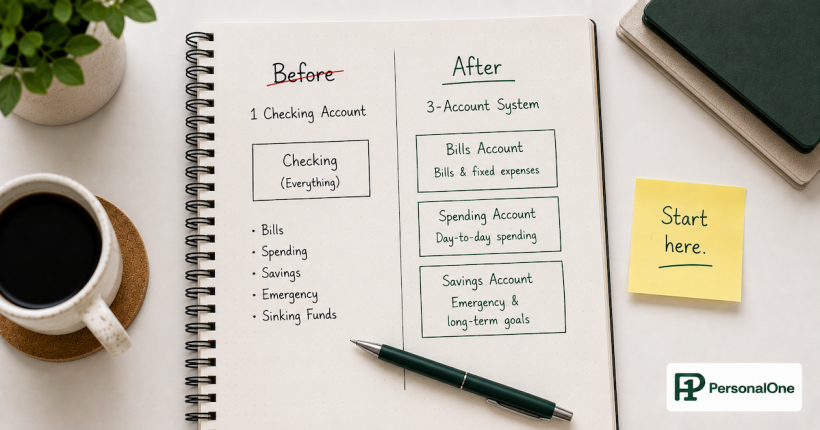
The most effective account structure does not treat checking, savings, and money market as alternatives. It uses all three simultaneously for different purposes. Checking handles daily operating flow. Savings holds reserves and short-term goals. A money market account holds medium-term goals where growth and access both matter. Each account has a defined purpose and a defined funding method — and money does not move between them impulsively.
In practice this looks like: your paycheck lands in checking. A predetermined percentage transfers automatically to savings within 48 hours — before discretionary spending can absorb it. If you are building toward a medium-term goal like a car purchase or home down payment, a second automatic transfer moves a defined amount to the money market account on the same schedule. The checking account never holds more than it needs to. The savings and money market accounts grow on autopilot. If you want to see how this transfer sequence is set up in detail, the high yield savings account setup guide covers the account opening and automation steps from start to finish.
Build the Full Account Structure
The Banking Systems hub covers every account type, routing strategy, and automation approach you need to build a financial system that runs without constant management.
Explore the Banking Systems HubChoosing Based on Purpose, Not Preference
The right account for any dollar is determined by one question: when does this money need to be spent and for what? Money needed daily belongs in checking. Money needed in one to twelve months for a specific goal belongs in a HYSA. Money needed in one to three years for a larger goal belongs in a money market account. Money that should not be touched except in a genuine emergency belongs in a dedicated emergency fund — an account with its own defined rules for access.
Preference — which bank you like, which app has the best interface, which account your parents used — is irrelevant to this decision. Purpose determines account type. Account type determines where each dollar lives. That matching is what separates a financial system from a collection of accounts that happen to exist at the same bank.
The Mistakes That Reduce What Your Accounts Do for You
The most common account structure mistake is using a single checking account for all purposes. When your emergency fund, your vacation savings, your monthly spending, and your bill payments all share the same account, you have no structural visibility into which dollar is doing which job. Every purchase feels like it might be affecting something important. Every transfer feels like a risk. This is not a discipline problem — it is an architecture problem.
The second most common mistake is keeping too much money in a traditional savings account at a brick-and-mortar bank when a HYSA at an online institution would earn meaningfully more on the same balance. The FDIC insures both to the same limits. The only difference is the interest rate, which over 12–24 months at current rate differentials can represent hundreds of dollars on a moderate balance.
Both mistakes are structural, and both are solved by the same fix: assigning each account a specific purpose, funding it according to a defined schedule, and keeping the boundaries between accounts consistent. That structure is what the account system is built to deliver.
Official Sources
Government sources used to inform this guide:
CFPB: Bank Accounts — Consumer Tools and Resources
FDIC: Deposit Insurance Coverage — Savings and Checking Accounts
FDIC: Money Smart Financial Education Program
CFPB: Start Small, Save Up — Building Savings Resources
For the complete account structure framework, return to the banking systems and account structure guide.
Frequently Asked Questions
Can I use one account for both checking and savings?
Technically yes. Practically, it undermines both functions. Without a structural boundary between spending money and reserved money, spending money tends to absorb reserved money over time. Two separate accounts at separate institutions — with a small transfer friction between them — is what protects savings from operating cash flow.
How much should I keep in my checking account?
Your current month’s budgeted expenses plus one to two weeks of fixed costs as an overdraft buffer. Any balance consistently above that threshold is money that would earn more in a high-yield savings account and should be transferred on a defined schedule rather than sitting idle in checking.
Is a money market account better than a high-yield savings account?
Neither is universally better. HYSAs currently offer competitive rates with limited access — ideal for emergency funds and short-term savings goals. Money market accounts offer similar or slightly lower rates in some cases but add limited check-writing or debit access. The distinction matters for medium-term goals where occasional direct access is useful. For pure savings accumulation, a HYSA typically wins on simplicity and rate.
Are all three account types FDIC-insured?
Yes, at FDIC-member institutions. Checking accounts, savings accounts, and money market deposit accounts are all covered up to $250,000 per depositor per institution. Always verify FDIC membership before opening any account. The FDIC BankFind tool at fdic.gov allows you to confirm any institution’s membership status.
What is the biggest mistake people make with these accounts?
Using a single checking account for all purposes. When spending money and reserve money share the same account, there is no structural signal when you are spending reserved funds. The fix is not better discipline — it is better architecture: one account per purpose, funded on a defined schedule, with clear boundaries between them.
Disclaimer: This content is for educational purposes only and does not constitute financial, legal, or tax advice. PersonalOne is a free financial education platform. Individual financial situations vary. Consult a qualified financial professional for advice specific to your circumstances.