Updated: June 13, 2026
Home › Financial Stability › Emergency Fund Cash Reserves › Where Should You Keep Your Emergency Fund?
What You Need to Know
— Your emergency fund belongs in a high-yield savings account at an FDIC-insured bank — accessible within 1 to 3 business days, earning 4 to 5%+ APY, and completely separate from your checking account.
— The account needs to clear three tests: FDIC-insured, immediately accessible without penalties, and earning a competitive yield above traditional savings rates.
— Do not keep your emergency fund in your primary checking account — it will get spent on non-emergencies.
— Do not keep your emergency fund in the stock market, a Roth IRA, or any account where value fluctuates — you need the money when markets are most likely to be down.
— Slight friction between your emergency fund and spending account is a feature, not a bug — it prevents casual spending while keeping funds accessible for genuine emergencies.
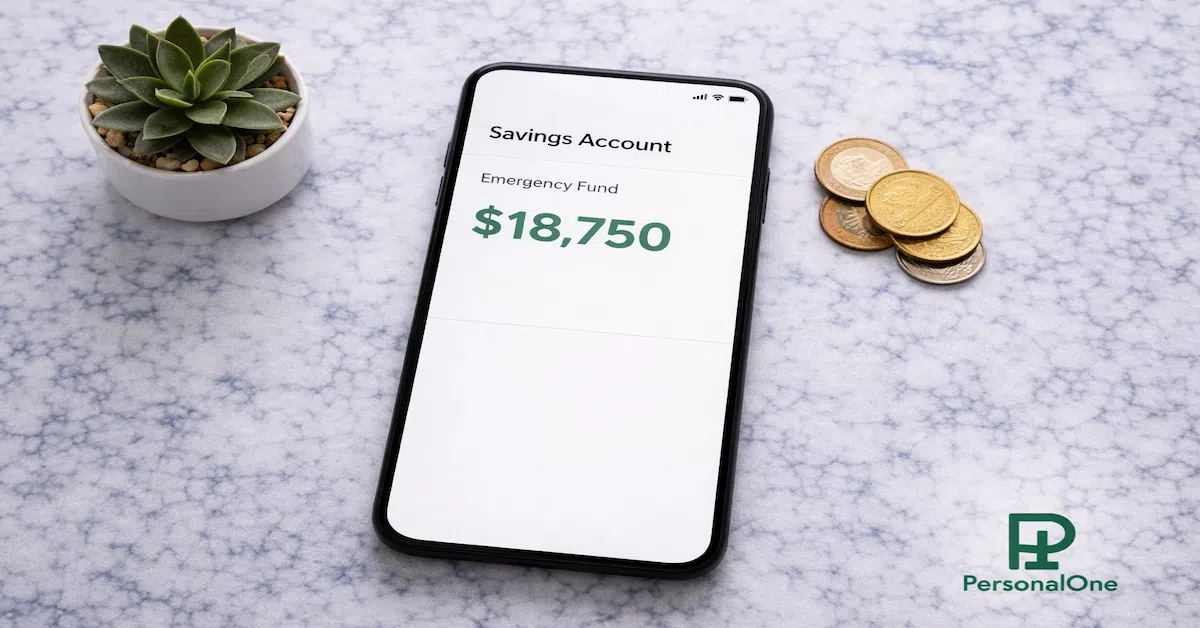
The question of where to keep your emergency fund matters almost as much as having one — and the wrong account type can undermine the entire emergency fund strategy even if the balance is correct. The account you choose needs to satisfy three simultaneous requirements that do not all point in the same direction: it needs to be safe (FDIC-insured), accessible within 1 to 3 business days without penalties, and earning a yield that keeps pace with or exceeds inflation. For the complete framework on building and sizing your emergency fund before deciding where to keep it, the Emergency Fund Cash Reserves cluster hub covers every stage from $1,000 through six months.
Most people default to one of two wrong choices: keeping the emergency fund in their primary checking account where it gets spent on non-emergencies, or keeping it in a traditional savings account at their main bank earning 0.01 to 0.10% APY. Both choices fail the emergency fund's purpose in different ways. A checking account fails the separation test. A low-yield traditional savings account fails the yield test in an environment where FDIC-insured high-yield savings accounts routinely offer 4 to 5%+ APY. The gap isn't trivial — on a $15,000 emergency fund the difference between 0.01% and 4.5% APY is $673 per year in interest, just for keeping the same money in a better account.
This article covers the specific account types that work, the ones that do not work, and exactly why the distinction matters for your financial system.
The Best Account for an Emergency Fund: High-Yield Savings Account
A high-yield savings account at an FDIC-insured online bank is the correct answer for most people. HYSAs offer the exact combination of features an emergency fund requires: FDIC insurance up to $250,000 per depositor, no market risk (your balance does not fluctuate), 1 to 3 business day transfer time to your checking account, and competitive yields that meaningfully exceed traditional bank savings rates. The sizing question — exactly how much to keep in this account based on your employment type, household structure, and risk profile — is covered in the article on how much emergency fund do you actually need.
The most important structural feature of a HYSA is that it sits one step away from your primary checking account. Transfers take 1 to 3 business days. This friction is intentional. An emergency fund in the same checking account as your daily spending will be spent on non-emergencies — the psychological barrier of a separate account and a 1 to 3-day transfer window is what creates the behavioral protection. When a genuine emergency arrives, 1 to 3 days is entirely workable. When a sale, impulse purchase, or cash flow squeeze tempts you to dip into emergency reserves, the transfer delay gives you time to reconsider.
What to Look for in a High-Yield Savings Account
✓ FDIC-insured up to $250,000 per depositor (verify at FDIC.gov before opening)
✓ APY of 4.00% or higher (compare current rates — these change with Federal Reserve rate decisions)
✓ No minimum balance requirements or fees that eat into interest
✓ ACH transfer capability to your primary checking account
✓ No withdrawal penalties (unlike CDs)
✓ Separate from the bank holding your primary checking account (behavioral separation)
What I've Seen
The most common version of this mistake I see is someone who has a legitimate emergency fund balance — $8,000, $12,000, sometimes more — sitting in a traditional savings account at the same bank as their checking account earning 0.01% APY. They built the fund, which is real discipline. Then they left it in the wrong account, which costs them $400 to $600 per year in foregone interest and provides almost no behavioral separation from their spending account. Moving that same balance to a HYSA at a different institution takes about 20 minutes. The friction to access it goes from zero to 1 to 3 business days, which is the protection they need. And the interest goes from $1.50 per year to $600 per year. Same balance. Same FDIC insurance. Completely different outcome. The only thing that changed was where they kept it.
Money Market Accounts: A Solid Alternative
Money market accounts are a viable alternative to HYSAs for emergency fund storage. Like HYSAs, they are FDIC-insured at member banks and earn competitive rates that exceed traditional savings. The distinction is structural: money market accounts typically offer debit card or check-writing access, which can be either convenient or counterproductive depending on how much behavioral separation you need between your emergency fund and daily spending. If having debit card access to your emergency fund creates temptation to spend it, a HYSA without card access provides stronger behavioral protection. If you prefer having immediate access without a transfer delay for genuine emergencies, a money market account provides that without sacrificing FDIC insurance or competitive yield.
Money market accounts at FDIC-insured banks are different from money market funds, which are investment products offered by brokerage firms and are not FDIC-insured. Money market funds hold short-term securities rather than being bank deposits. While money market funds are generally very low risk, they do not carry federal deposit insurance and are not appropriate as the primary emergency fund vehicle for most people. The distinction matters enough to verify before opening — confirm the institution is FDIC-insured using the FDIC BankFind tool before depositing.
Accounts That Do Not Work for an Emergency Fund
Primary checking account. The most common mistake. Keeping your emergency fund in the same account you use for daily spending is the most reliable way to spend it on non-emergencies. Without physical separation, the psychological barrier disappears. An "emergency" becomes any month where spending exceeds income. Keep the emergency fund in a completely separate account at a different bank from your primary checking. For people who are just getting started and don't have a dedicated emergency fund account yet, the fastest path to the first $1,000 — the milestone that stops small emergencies from becoming debt — is covered in the article on how to build a $1,000 starter emergency fund fast.
Traditional savings account at your main bank. Technically this provides separation, but the yield failure makes it difficult to justify. A traditional savings account at a legacy bank earning 0.01% APY on a $15,000 emergency fund earns $1.50 per year. The same balance in a HYSA at 4.5% APY earns $675. There is no practical reason to accept the 0.01% rate when FDIC-insured alternatives paying 4 to 5% are widely available. The only scenario where this makes sense is temporary — if you are in the process of building the fund and have not yet opened a HYSA.
Brokerage account or stock market. Emergency funds cannot be invested in the stock market. This fails the most critical requirement: you will need your emergency fund most urgently when economic conditions are worst — job loss, medical crisis, economic downturn — which are precisely the conditions that correlate with poor stock market performance. An emergency fund that has declined 30% during the market crash that coincides with your job loss is not an emergency fund. Market risk in an emergency fund is an unacceptable structural failure.
Roth IRA. Roth IRA contributions — not earnings — can be withdrawn at any time without taxes or penalties, which is why some people use it as an emergency backup. This strategy has two practical problems: withdrawal processing takes several business days to reach your bank, and more importantly, Roth IRA contribution room is irreplaceable. The 2026 contribution limit is $7,000 per year. Using IRA space for emergency funds and then withdrawing destroys tax-advantaged space that cannot be recaptured in future years. Build your emergency fund in a HYSA and leave the Roth IRA for its intended purpose.
Certificates of Deposit. CDs lock your money for a fixed term — typically 3 months to 5 years — and charge an early withdrawal penalty if you access funds before maturity. Emergency funds by definition need to be accessible without penalty at any time. CDs are inappropriate as the primary emergency fund vehicle for this reason alone, regardless of the yield they offer. One important distinction is keeping your emergency fund separate from sinking funds — money set aside for predictable expenses like car maintenance, annual insurance premiums, and holiday spending. Those planned expenses belong in their own account, not alongside your emergency reserves. The complete explanation of why that separation protects both funds is covered in the article on sinking funds vs emergency funds.
One Exception: CD Ladders for Mature Emergency Funds
People with a fully funded emergency fund significantly larger than their 3 to 6 month expense target sometimes use a CD ladder strategy for a portion of the balance. The structure: keep 1 to 2 months of expenses in an immediately accessible HYSA as the liquid layer, and ladder CDs of varying maturities for the remainder to capture higher fixed yields. As each CD matures, it rolls into the HYSA unless accessed. This approach makes sense only when the emergency fund is substantially over-built and the investor accepts that the CD-allocated portion carries a brief delay in access. For anyone still building toward their target, a simple HYSA is the correct choice — simplicity and liquidity outweigh yield optimization at this stage.
For people who are trying to understand what the right total savings target looks like across all layers — emergency fund, buffer account, and long-term reserves — and how each layer fits into an overall financial stability picture, the article on how much money should you have in savings covers the complete three-layer framework in concrete dollar terms.
Where you keep it matters as much as having it.
The complete framework for building, sizing, and maintaining your emergency fund — every stage from $1,000 through six months — is in the Emergency Fund Cash Reserves cluster.
Emergency Fund Cash Reserves →Government Resources
FDIC — Deposit Insurance — Verify that any bank where you open a high-yield savings account is FDIC-insured. The FDIC BankFind tool allows you to search by institution name before depositing.
CFPB — Savings Tools and Resources — Consumer Financial Protection Bureau guidance on savings account types, what to compare when choosing a savings account, and how deposit insurance works.
Return to the full financial stability guide for the complete framework covering every layer of financial resilience covered on PersonalOne.
Frequently Asked Questions
Should my emergency fund be at a different bank than my checking account?
Yes — and this is a deliberate design choice. Keeping your emergency fund at a different bank from your primary checking creates a 1 to 3 business day transfer delay between the money and your spending account. That friction prevents casual access while preserving access for genuine emergencies. Same-bank transfers are often instant, which eliminates the behavioral protection the separation provides.
What HYSA rate should I expect in 2026?
High-yield savings account rates are directly influenced by Federal Reserve rate decisions and move up and down with the federal funds rate. As of mid-2026, competitive HYSA rates range from approximately 4.00 to 5.00% APY at major online banks. Always compare current rates before opening — the specific rate changes continuously and the best-rate institutions change over time. The FDIC comparison tool at FDIC.gov allows rate comparison across insured institutions.
Is my money safe in an online bank HYSA?
FDIC-insured online banks carry the same deposit insurance as brick-and-mortar banks. FDIC coverage protects up to $250,000 per depositor, per institution, per account category — the same regardless of whether the bank has physical branches. Before opening any HYSA, verify the institution's FDIC membership status using the FDIC BankFind tool at FDIC.gov. Do not deposit funds at any bank that is not confirmed as FDIC-insured.
Can I use my Roth IRA as a backup emergency fund?
Technically Roth IRA contributions can be withdrawn without tax or penalty. In practice, using IRA space for emergency funds is a poor long-term decision because IRA contribution room cannot be recaptured. If you withdraw $5,000 from a Roth IRA for an emergency, that $5,000 in tax-free growth space is permanently lost — you cannot add it back on top of future-year contributions. Build a dedicated HYSA emergency fund and preserve IRA space for retirement.
This article is for informational and educational purposes only. Interest rates on savings accounts change frequently — verify current APY directly with each institution before opening an account. FDIC insurance limits and rules are subject to change — verify coverage at FDIC.gov. This content does not constitute financial or investment advice. PersonalOne is a free financial education platform.