Updated: February 17, 2026 • 12 min read
Home › FinTech & Modern Money Tools › Open Banking & AI FinTech › Why Everyone Needs a Financial Dashboard in 2026
About the Author
Don Briscoe is a Financial Systems Coach with 12+ years of experience helping Millennials and Gen Z escape paycheck-to-paycheck cycles. He founded PersonalOne on a framework-first philosophy — less willpower, more infrastructure — and provides structured, honest, free financial education.
Why Everyone Needs a Financial Dashboard in 2026
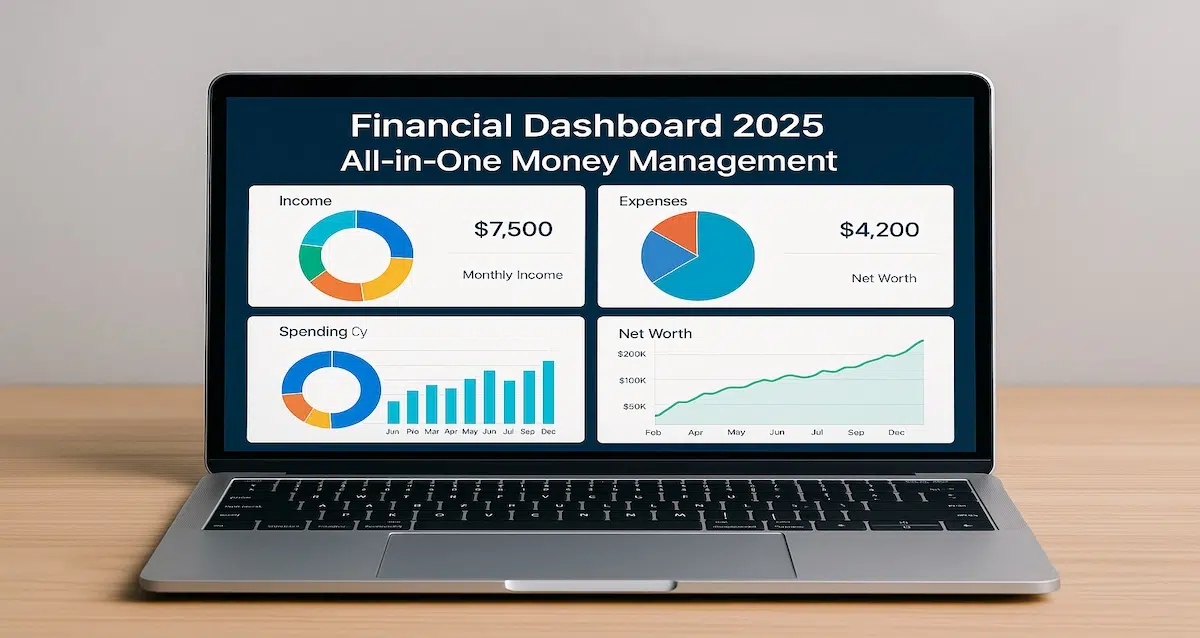
Your money lives across a dozen apps, accounts, and platforms. A financial dashboard aggregates all of it — checking, savings, credit cards, loans, investments — into one real-time view. Stop guessing where your money went. Start directing where it goes.
TL;DR
- A financial dashboard aggregates all accounts — checking, savings, credit cards, loans, investments — into one real-time view via open banking connections like Plaid
- It's not a budgeting app — it's the data layer underneath, showing net worth, debt trajectory, and cash flow across your entire financial life
- The average person now manages 10+ financial accounts — dashboards make that complexity manageable without hours of manual reconciliation
- Security is read-only — dashboards can see your data but cannot move money or initiate transactions
- PersonalOne will offer a Financial Dashboard in the future — this guide explains what to look for and how to use one effectively now
Modern money is fragmented by design. Banks, FinTech apps, investment platforms, loan servicers, and payment tools all compete for pieces of your financial life — and none of them talk to each other by default. The result is that most people have no idea what their complete financial picture looks like at any given moment.
That's the problem a financial dashboard solves. It's not a budgeting tool — it's a data aggregation layer that pulls all your accounts together through open banking infrastructure and shows you everything in one place. To understand why this fragmentation happened and what open banking means for how your data moves between institutions, the FinTech & Modern Money Tools hub covers the full landscape.
This guide covers what a financial dashboard is, why the account aggregation technology behind it matters, what to look for, and how to use one as the command center for your financial system.
What Is a Financial Dashboard?
A financial dashboard is account aggregation software — it connects to your financial institutions via open banking APIs (typically through a service like Plaid, MX, or Finicity) and pulls your balance and transaction data into a single unified interface.
The connection is read-only. A dashboard can see your balances and transactions but cannot move money, initiate transfers, or make purchases. Your credentials are never stored by the dashboard itself — the API layer handles authentication separately.
A strong financial dashboard shows you:
- Real-time account balances: Every checking, savings, credit card, loan, and investment account in one view
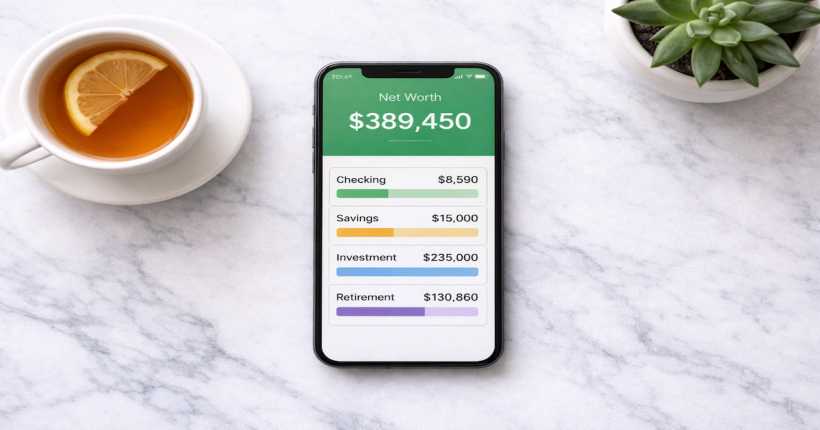
- Net worth calculation: Total assets minus total liabilities, updated automatically as balances change
- Cash flow tracking: Income vs. spending across all accounts, not just one bank
- Debt snapshot: All outstanding balances, interest rates, and payoff timelines consolidated
- Investment performance: Portfolio values, asset allocation, and growth across all brokerage and retirement accounts
- Spending categorization: AI-assigned transaction categories that identify patterns across every account
- Goal tracking: Emergency fund progress, debt payoff timeline, savings milestones
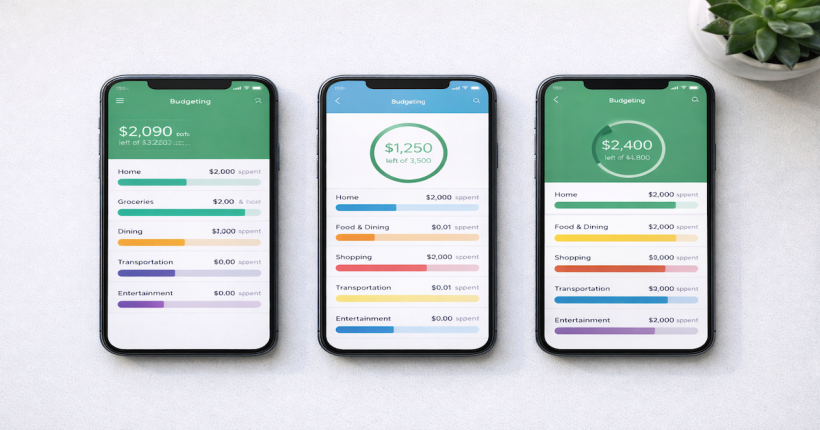
The distinction from a budgeting app is important. Budgeting apps are forward-looking — they set spending limits and allocate money to categories. A dashboard is the complete financial picture: net worth, debt trajectory, investment growth, and cash flow simultaneously. Many modern tools blend both capabilities, but the aggregation layer is what separates a real dashboard from a simple spending tracker.
Why Financial Dashboards Are Essential in 2026
The average person managing their finances in 2026 has a primary checking account, a high-yield savings account at a different institution, two or three credit cards, a 401(k), possibly a Roth IRA, student loans, a car loan, and two or three investment or payment apps. That's ten or more accounts at ten or more institutions — none of which share data with each other automatically.
Dashboards became necessary because financial complexity outpaced manual management. Three specific developments made them critical:
Open Banking Made Aggregation Reliable
Plaid now connects to over 12,000 financial institutions. MX and Finicity cover similar breadth. What used to require screen-scraping and manual CSV imports now happens via standardized API connections that update automatically. The infrastructure finally works well enough to make aggregation practical rather than theoretical.
AI-Driven Categorization Reduced Manual Work
Machine learning now assigns transaction categories with enough accuracy that most people rarely need to correct them. Subscription detection, spending pattern alerts, and anomaly flagging happen automatically — surfacing insights you'd never find manually across ten accounts.
Debt and Investment Complexity Increased Together
Student loans, elevated credit card APRs, and fragmented investment accounts mean that understanding your actual financial position requires simultaneous visibility into liabilities and assets. Dashboards show both — which is why they've become the primary tool for anyone serious about building wealth rather than just tracking spending.
The Four Core Benefits
Control
See everything in one place instead of piecing together your financial picture from scattered apps and monthly statements. Know exactly where you stand at any moment.
Confidence
Make money decisions based on facts, not feelings. When you can see the actual numbers — debt payoff timeline, savings rate, net worth growth — decisions become clearer.
Clarity
Track goals visually against real data. Progress bars and net worth charts are far more motivating than abstract spreadsheet numbers that require manual calculation to update.
Coordination
Some dashboards let couples or families sync accounts for shared visibility. Both people see the same real-time data, which eliminates the information asymmetry that creates money conflicts.
How Dashboards Connect to Your Budgeting System
A dashboard is the visibility layer. The budgeting system is what you do with that visibility. They serve different functions and work best together.
The dashboard tells you what happened across all your accounts — where money came from, where it went, and what your net position is. The budgeting system translates that data into forward-looking decisions: category limits, savings targets, debt payoff priorities.
If you're using a hybrid cash-and-digital budgeting system, the dashboard handles the digital tracking layer automatically — syncing card transactions, monitoring subscription spending, and showing whether your digital envelopes are on track — while you manage the cash categories manually.
For people who want a single tool that handles both aggregation and budgeting, Monarch Money (affiliate) is currently the strongest option — it combines dashboard-level account aggregation with category-based budgeting, investment tracking, and collaborative features for couples in one platform.
Using Dashboards for Debt Payoff
Dashboards make debt payoff decisions data-driven rather than intuition-based. Seeing all your debt in one place — with interest rates, minimum payments, and payoff timelines — changes the decision from "which debt feels worst" to "which debt is mathematically most expensive."
- Interest cost visualization: See exactly how much interest each debt costs monthly, not just the balance
- Payoff timeline comparison: Avalanche (highest interest first) vs. snowball (smallest balance first) calculated automatically
- Extra payment impact: Most dashboards show how an additional $50, $100, or $200 monthly shifts your payoff date
- Debt-to-income ratio tracking: The metric lenders use to evaluate creditworthiness, monitored automatically
Real example: An $8,000 credit card at 21% APR costs approximately $140/month in interest. A $15,000 student loan at 4% costs roughly $50/month. A dashboard surfaces this comparison automatically — making it obvious which debt to prioritize — instead of requiring you to calculate it manually each time you want to make a decision.
For the full debt payoff framework — avalanche vs. snowball methodology, sequencing debt alongside savings goals, and understanding how payoff strategy affects your credit score — the debt relief and credit repair hub covers it comprehensively.
Using Dashboards for Building Wealth
The investment tracking layer is where dashboards earn their subscription cost for people building long-term wealth. Seeing your 401(k), Roth IRA, brokerage, and HSA in one view — rather than logging into four separate platforms — reduces the cognitive overhead of monitoring your portfolio without requiring constant attention.
- Net worth over time: Total assets minus liabilities, charted automatically as balances change
- Asset allocation: Breakdown of stocks, bonds, cash, and alternative assets across all accounts
- Portfolio performance: How your investments are performing vs. benchmarks, without manual calculation
- Retirement projections: Forward projections based on current contribution rate and growth assumptions
- Account consolidation: 401(k), IRA, brokerage, HSA, and taxable accounts in one view
The psychological impact of watching net worth grow month over month is significant. It creates motivation that tracking individual account balances never does — because individual accounts go up and down with market movements, while net worth reflects the complete picture of wealth accumulation.
Key Features to Look For
- Bank-level security: 256-bit encryption, two-factor authentication, read-only account access
- Broad institution support: Connects to 10,000+ banks, credit unions, and financial institutions via Plaid or equivalent
- Net worth calculation: Automatic aggregation of all assets and liabilities
- Investment tracking: Real-time portfolio values and performance across all brokerage and retirement accounts
- Spending categorization: AI-driven transaction categorization that learns your patterns
- Goal tracking: Visual progress toward specific financial targets
- Partner/family access: Shared visibility for couples or households
- Mobile and desktop access: Full functionality on both platforms
- Export capabilities: Transaction history downloadable for tax preparation or external analysis
- Customizable views: Arrange widgets based on your current financial priorities
Common Mistakes to Avoid
Not syncing accounts — entering manually instead
The entire value of a dashboard is automation. If you're spending time on manual data entry, you're replacing one friction with another. Connect accounts via the API layer once and let the system maintain itself.
Overcomplicating the view
Three to four metrics that are directly relevant to your current goal — not fifteen graphs showing variations of the same data. If you're paying off debt, focus on debt payoff timeline and interest costs. If you're building an emergency fund, track savings rate and fund balance. Simplicity sustains engagement.
Checking too frequently or not enough
Multiple daily check-ins create financial anxiety from normal balance fluctuations. Monthly check-ins miss problems until they compound. Weekly reviews (10 minutes) with monthly deep dives (20-30 minutes) is the cadence that keeps you informed without becoming obsessive.
Seeing the data but not acting on it
A dashboard that shows you're overspending dining by $200 monthly is useless if behavior doesn't change. Visibility is step one. Setting limits, creating alerts, and actually responding when the dashboard flags a pattern is step two. The tool surfaces the insight — acting on it is still on you.
Where This Fits in the PersonalOne System
Open Banking & AI FinTech Hub
Financial dashboards run on open banking infrastructure — Plaid, MX, and Finicity connections that make account aggregation possible. The Open Banking hub covers how that infrastructure works, what it means for your data rights, and where it's heading.
Monarch Money Review — The Best Combined Dashboard + Budgeting Tool
If you want account aggregation plus budgeting in one platform, Monarch is the strongest current option. The full review covers setup, features, pricing, and how it compares to standalone budgeting apps.
Budgeting Apps & Financial Automation Hub
Dashboards show you the data. Budgeting apps help you act on it. This hub covers the full landscape of automation-first budgeting tools and how to choose the right one for your financial situation.
Debt Relief & Credit Repair Hub
Dashboard debt tracking surfaces the numbers. This hub covers what to do with them — avalanche vs. snowball method, debt sequencing, and how payoff strategy affects your credit score over time.
Frequently Asked Questions
A dashboard is a data aggregation tool — it pulls all your accounts together and shows your complete financial picture including net worth, investments, and debt. A budgeting app is a decision-making tool — it sets spending limits and allocates money to categories.
Budgeting app: "You spent $450 on dining this month vs. your $300 target." Dashboard: "Your net worth increased $2,500 this quarter because your investments grew $3,000 and you paid down $800 in debt, despite overspending on dining." Many modern tools — like Monarch — blend both capabilities into one platform. See the full budgeting apps hub for the platform comparison.
Yes — reputable dashboards use read-only connections via Plaid or equivalent services, meaning they can see your transactions and balances but cannot move money or initiate any transactions. Your actual bank credentials are handled by Plaid's authentication layer, not stored by the dashboard itself. Look for 256-bit encryption, two-factor authentication, and explicit read-only access statements before connecting any accounts.
Free tiers exist but typically limit account connections, investment tracking, or historical data access. Comprehensive dashboards run $10-15/month or $100-150/year. The ROI calculation is straightforward: if the dashboard helps you find one forgotten $12 subscription, avoid one $35 overdraft fee, or optimize debt payoff to save $500 in interest over a year, it pays for itself many times over.
Most dashboards connect to 12,000+ institutions through Plaid. If your bank isn't supported, options include manual balance entry (weekly updates), CSV transaction imports, or requesting that your bank enable Plaid integration. If dashboard visibility is a priority and your current bank consistently has connection problems, it's a legitimate reason to consider switching to a digital-first bank with better API support.
Yes — and for couples with shared finances, it's highly recommended. Shared dashboards eliminate the information asymmetry that creates money conflicts: both people see the same real-time data, shared goals are tracked transparently, and the "I didn't know" conversation disappears. Most tools support a "yours, mine, ours" approach where joint accounts are shared and individual accounts can remain private.
Weekly reviews (10 minutes) plus monthly deep dives (20-30 minutes) is the cadence that works for most people. Daily checking creates anxiety from normal balance fluctuations — investment accounts move every day regardless of what you do. Quarterly-only reviews miss problems until they've compounded. Sunday morning is a natural weekly slot: review the week's spending, check goal progress, adjust if needed.
Indirectly yes — dashboards organize the financial data that tax preparation requires. Transaction history export, investment gain/loss tracking, retirement contribution totals, and categorized deductible expenses are all maintained year-round rather than requiring a scramble through 12 months of statements in March. Dashboards aren't tax software, but they produce the organized records your accountant or tax software needs.
Understand the Open Banking Infrastructure Behind It
Dashboards run on Plaid, MX, and open banking APIs. The Open Banking hub covers how that infrastructure works, what it means for your financial data rights, and where it's heading.
Explore Open Banking & AI FinTech →Authority Resources
- Consumer Financial Protection Bureau (CFPB): Federal agency providing consumer protection resources and guidance on financial data rights and open banking regulations