Updated: May 4, 2026
Home › Budgeting & Savings › Budget Audit & Reset › Financial Game Plan
TL;DR
-- January motivation fades without structure -- a financial game plan that actually works is built on systems, not renewed intention.
-- The correct sequencing is stability first, then optimization -- trying to build wealth before fixing cash flow instability produces inconsistent results that erode progress.
-- Automation reduces reliance on memory and willpower so that the right financial behaviors happen by default rather than by repeated decision.
-- A mid-year reset in June and a year-end review in December keep the plan aligned with real life as circumstances change through the year.
-- The most common trap is trying to optimize everything simultaneously -- sequencing matters more than intensity when building financial systems that last.
Every year starts the same way. Strong intentions, clear goals, renewed energy. Save more. Spend less. Get out of debt. Start investing. The list is right. The sequencing is often wrong, and the structure to execute it is often missing entirely. Within six to eight weeks, the intentions have faded back into the same patterns that produced the same results as the previous year.
A financial game plan that actually works is not built on motivation. It is built on structure that executes the right behaviors automatically -- before motivation is needed and even when it is absent. The budget audit and reset process that anchors this cluster is where that structure begins: a clear-eyed review of where money went in the prior year, a deliberate redesign of where it should go in the year ahead, and the automation infrastructure that ensures the redesign actually holds.
This article covers the three-phase framework for building a financial plan that compounds through the year -- and the specific sequencing decisions that determine whether the year produces real progress or another cycle of good intentions and unchanged outcomes.
Why Most Financial Plans Fail Before March
The most common error in annual financial planning is jumping immediately to optimization -- maximizing retirement contributions, selecting the best investment accounts, accelerating debt payoff beyond minimum payments -- before the financial foundation that supports those strategies is in place. Optimization built on an unstable foundation fails the first time an unexpected expense or income disruption arrives. The investment contribution stops. The extra debt payment gets skipped. The progress reverses.
Stability means four specific things are reliably in place before growth strategies are layered on top:
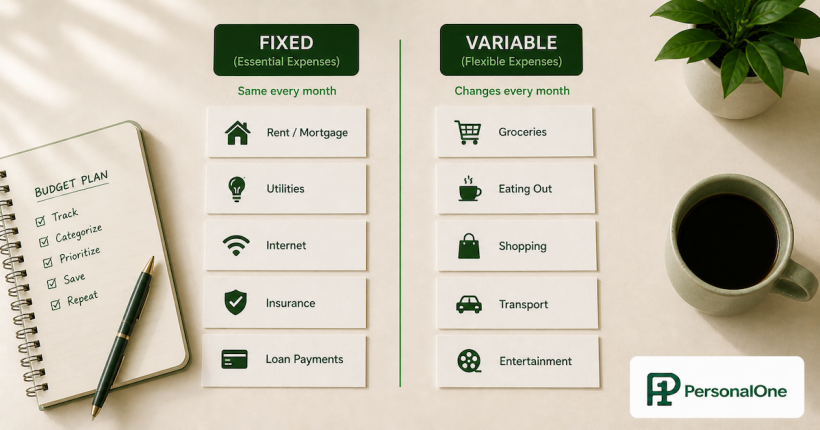
Bills are covered consistently without scrambling. Every fixed monthly obligation -- rent or mortgage, utilities, insurance, minimum debt payments -- autopays from a dedicated bills account funded on payday. No timing stress, no late fees, no manual intervention required.
Actual spending is visible. Not estimated spending, not assumed spending -- actual spending reviewed at least monthly against a zero-based budget. The gap between estimated and actual is typically $200 to $400 per month and cannot be addressed until it is visible.
A starter emergency fund exists. $500 to $1,000 in a dedicated savings account at a separate institution. Not invested, not accessible by debit card, not the same institution as the spending account. This buffer eliminates the most common cause of debt accumulation -- unexpected expenses covered by credit because no cash reserve exists.
Irregular expenses are anticipated. Car maintenance, annual insurance renewals, holiday spending, back-to-school costs, and other predictable-in-category expenses are funded through sinking funds rather than encountered as surprises. A $1,200 annual car maintenance estimate requires $100 per month into a designated savings bucket. The expense stops being a crisis and becomes a scheduled withdrawal. Planning for holiday spending in advance is one of the highest-leverage sinking fund decisions a household can make -- it converts December from a financial emergency into a funded, predictable expense.
Phase 1 Stability Checklist
☐ All fixed bills autopaying from a dedicated bills account
☐ Actual spending reviewed monthly against a zero-based budget
☐ Starter emergency fund of $500 to $1,000 at a separate institution
☐ Sinking funds set up for at least two to three major irregular expense categories
☐ Income landing account structure in place with automated transfers on payday
Do not move to Phase 2 until all five items are consistently operating. A plan built on an incomplete Phase 1 will require Phase 1 repairs every time life interrupts Phase 2 execution.
Phase 2: Build a Repeatable Money System
Once stability is confirmed, the second phase builds the automated system that makes the stability permanent rather than dependent on ongoing manual effort. The critical insight here is that manual money management produces inconsistent results not because people lack discipline but because discipline is a finite resource that depletes under daily demands. Automated systems do not require discipline to execute. They require deliberate design once.
Building a system for how your money flows -- from income landing account through bills, savings, and spending allocation -- is the architecture decision that determines whether automation runs cleanly or collapses under the first disruption. The structure has to be designed before the automation can be configured.
The automation layer covers five flows:
Bills automation. Every fixed obligation autopays from the bills account on the date it is due. The bills account receives its exact monthly allocation via automated transfer one business day after each payday. No bill is paid manually. No due date is tracked in a mental calendar.
Savings automation. Emergency fund contributions, sinking fund contributions, and short-term goal contributions transfer automatically on payday before spending decisions are made. Money that leaves the spending account before it is seen is money that cannot be accidentally spent.
Debt payoff automation. Extra debt payments above the minimum are scheduled as recurring transfers on payday. The debt payoff strategy -- whether snowball (lowest balance first) or avalanche (highest interest rate first) -- is embedded in the transfer schedule rather than requiring a monthly decision to execute it.
Investment automation. Employer 401(k) contributions happen automatically through payroll deduction. Roth IRA contributions are scheduled as automatic monthly transfers to the investment account. Investment automation is the last layer added because it assumes stability, savings, and manageable debt are already in place beneath it.
Subscription and expense audits. A calendar reminder for the first of every quarter triggers a 15-minute review of all recurring charges, bill amounts, and budget category allocations. Automation handles execution but requires quarterly human review to catch the creep that automation cannot prevent: new subscriptions, changed bill amounts, spending categories that have drifted from their allocations.
Phase 3: Plan for Growth Without Rushing It
With stability in place and automation executing consistently, Phase 3 introduces deliberate growth strategies. The sequencing discipline that matters most in this phase is resisting the pressure to accelerate everything simultaneously. Trying to maximize debt payoff, maximize savings rate, and maximize investment contributions simultaneously often exceeds available cash flow and collapses back into instability when a single expense disrupts the stretched system.
It is also worth separating system design from daily behavior. Daily spending decisions that impact your plan are where most growth strategies break down in practice -- not because the strategy is wrong, but because the behavioral layer was never addressed alongside the structural one. Phase 3 works best when both are running in parallel. The full behavioral and structural framework that supports this phase is part of the broader budgeting and savings system that connects cash flow control, savings automation, and long-term wealth building into a single operating architecture.
The priority hierarchy for growth:
First: Capture the full employer 401(k) match. This is a 50 to 100 percent immediate return on the matched portion -- no other investment produces that return reliably. If the employer match is not being fully captured, this is the first growth action regardless of any other financial priority.
Second: Eliminate high-interest debt. Any debt above 8 to 10 percent APR is a guaranteed negative return on every dollar that earns less than that rate elsewhere. Eliminating a 22 percent APR credit card balance is equivalent to earning 22 percent on that amount with no market risk. Accelerated payoff on high-interest debt is the highest-certainty growth action available.
Third: Build the full emergency fund. Three to six months of essential expenses in a high-yield savings account. This is the protection layer that allows all other growth strategies to continue without interruption when life disrupts the plan -- job loss, medical expense, major car or home repair. Without it, the first significant disruption undoes months of progress.
Fourth: Increase savings rate incrementally. Each time income increases, redirect half the increase to savings or investment and allow the other half to increase the lifestyle allocation. The savings rate grows without requiring a reduction in spending because it captures income growth before lifestyle inflation absorbs it.
Fifth: Expand investment contributions. After employer match is captured, high-interest debt is eliminated, and the full emergency fund is in place, additional investment capacity flows to a Roth IRA up to the annual contribution limit, then to additional 401(k) contributions, then to a taxable brokerage account.
The Mid-Year Reset: June Check-In
A financial game plan built in January reflects January's circumstances. Income changes. Expenses change. Goals evolve. A plan that is not reviewed and updated mid-year operates against an increasingly outdated set of assumptions -- which is why many annual plans that started strong in January have quietly stopped reflecting reality by June.
Running a mid-year money check in June gives you a structured moment to measure where you actually are against where you planned to be -- income, spending, savings rate, emergency fund, and debt progress -- and make deliberate corrections before the second half of the year locks in the same patterns.
The June check-in covers four specific questions:
Is the Phase 1 stability layer still intact? Have any bills increased without the bills account transfer being updated to reflect the change? Has the starter emergency fund been drawn down and not replenished? These are maintenance questions, not growth questions, and they take priority over everything else in the check-in.
Are automated transfers still calibrated to current income and expenses? A raise in March, a new subscription in April, or a rent increase in May can each create a gap between the automation that was configured in January and the actual financial picture in June. The mid-year review identifies and closes those gaps.
Has progress toward growth goals matched the six-month trajectory? If the annual goal was to pay off $6,000 in high-interest debt, approximately $3,000 should be paid off by June. If the trajectory is ahead of pace, the calendar projection can be accelerated. If it is behind, the cause needs to be identified and addressed before the second half of the year compounds the shortfall.
Do the goals themselves still reflect current priorities? A goal set in January to save for a vacation may have been superseded by a more urgent priority. A debt payoff goal may have changed because the interest rate changed. The mid-year review is the opportunity to realign the plan with actual priorities rather than continuing to execute a plan whose goals no longer reflect what matters most.
The game plan connects to the full system.
The Budgeting & Savings hub covers every component of the framework this plan is built on -- from cash flow structure and spending visibility through savings automation and long-term wealth building.
Explore the Budgeting & Savings HubThe Trap to Avoid: Optimizing Before Stabilizing
The single most reliable way to fail at a financial plan is to try to optimize everything at once before the stability layer is in place. This produces a specific pattern: significant early progress followed by a disruption that the plan has no buffer to absorb, which causes multiple simultaneous failures -- missed investment contribution, emergency fund withdrawn, extra debt payment skipped -- that feel like total collapse when they are actually just the consequence of sequencing the plan incorrectly.
The corrective is sequencing discipline: Phase 1 before Phase 2, Phase 2 before Phase 3. Not because growth is unimportant but because growth built on an unstable foundation requires constant reconstruction and produces far less cumulative progress than slower but structurally sound advancement through each phase in order.
Avoiding the common year-end financial mistakes that accumulate when a plan is not maintained through the year -- overspending in Q4, missed tax deadlines, depleted emergency funds -- requires the same sequencing discipline applied consistently, not just in January when the motivation is highest.
When the plan needs a course correction -- particularly heading into the higher-spending fall and winter months -- doing a financial reset before year-end gives you a structured way to audit where things drifted, recalibrate the automation, and relaunch the plan with enough time left in the year to make a measurable difference.
A financial plan that reaches the end of the year with Phase 1 fully operational, Phase 2 automation running without manual intervention, and Phase 3 growth strategies 60 to 70 percent of the way to their targets is a better outcome than a plan that attempted all three phases simultaneously and ended the year with partial progress across all of them and no phase operating reliably.
Official Resources
CFPB -- Budget Worksheet and Planning Tools -- Free government-backed tools for building and tracking a household budget from scratch.
CFPB -- Saving Money: Tools and Guidance -- Consumer resources on building savings habits, emergency funds, and automated savings systems.
USA.gov -- Financial Planning Basics -- Government guidance on financial planning fundamentals including budgeting, saving, and debt management.
Continue Learning About Budgeting and Savings
The three-phase framework in this article is one component of a broader system. The complete approach to building cash flow control and long-term financial stability is in the Budgeting & Savings guide.
Frequently Asked Questions
Do I need a detailed budget before starting this plan?
No. A general awareness of monthly income, fixed obligations, and rough spending categories is sufficient to begin Phase 1. The detailed budget develops naturally from the tracking habit that Phase 1 establishes. Starting with a perfect budget is less important than starting -- a simple structure built now and refined over 90 days produces better results than a theoretically optimal structure built over the next three months before implementation begins.
Is automation safe?
Yes, with two conditions. First, the accounts the automation draws from must maintain adequate balances with appropriate buffers to absorb timing variability -- automation without buffers produces overdraft cascades rather than financial stability. Second, automated systems require monthly monitoring and quarterly review even when running smoothly. Automation reduces the daily decision burden but does not eliminate the need for periodic oversight. Subscription creep, bill amount changes, and income changes all require human review to address.
What if my financial situation is already messy when I start?
Start at Phase 1 regardless of current complexity. A messy financial situation does not require a complete overhaul before any progress is possible -- it requires identifying the most unstable element and stabilizing that first. Usually this means bills first, then the starter emergency fund, then spending visibility. Each small stabilization reduces stress and creates the margin that makes the next stabilization possible. Attempting to address everything simultaneously when the situation is already chaotic almost always produces paralysis rather than progress.
What is a realistic Phase 1 timeline?
Most people can have the Phase 1 stability layer fully operational within 30 to 60 days. Opening the necessary accounts takes one to two weeks. Migrating autopay to the bills account takes another one to two weeks. Building the starter emergency fund takes four to ten weeks depending on how much can be directed there each payday. Phase 2 automation should not be fully activated until Phase 1 has run cleanly for at least two full billing cycles -- roughly 60 days.
When should this financial plan be reviewed and updated?
Three scheduled reviews through the year: a mid-year check-in in June to recalibrate transfers and goals against current circumstances, a fall reset review in September to prepare for the higher-spending fourth quarter, and a year-end audit in December to evaluate annual outcomes and set the following year's plan. Unscheduled reviews should happen immediately after any major financial change: new job, significant raise, debt payoff, major unexpected expense, or housing change.
How do I know when I am ready to move from Phase 1 to Phase 2?
Phase 1 is complete when all five checklist items have been operating consistently for at least two full billing cycles -- roughly 60 days -- without requiring manual intervention to fix a missed bill, cover an overdraft, or scramble for an irregular expense. If any of those events has occurred in the past 60 days, Phase 1 is not complete regardless of how much of it has been set up. The test is not configuration -- it is clean operation under real conditions.
This content is for educational purposes only and does not constitute financial, investment, or tax advice. PersonalOne is not a licensed financial advisor, broker, or investment professional. Financial planning strategies should be adapted to your individual income, expenses, and circumstances. Always consult a qualified financial professional before making significant financial decisions.