Updated: March 18, 2026
Home › Banking Systems › Multi-Account Budgeting System › The Modern Banking Stack
The Modern Banking Stack: Checking, Savings, Apps, and Automation
TL;DR
— A modern banking stack uses multiple specialized accounts instead of one institution doing everything — each layer has a specific job and only that job.
— Checking handles money movement — income, bills, and daily spending flow through a no-fee account built for speed and connectivity.
— High-yield savings accounts grow reserves — emergency funds and short-term goals earn competitive interest while staying structurally separate from spending money.
— Apps provide visibility without manual tracking — modern tools automatically categorize spending and surface patterns across all accounts.
— Automation removes willpower from the equation — scheduled transfers and autopay create financial consistency without daily decisions.
Most people do not have a money problem. They have a system problem.
Banking works best when it is built like a stack: each tool has a specific job, nothing overlaps, and automation does the heavy lifting. The approach of keeping everything at one traditional bank because it seems simpler costs money in fees, loses earnings through low interest rates, and creates the kind of decision friction that makes budgeting feel like a full-time job.
This article explains the four-layer modern banking stack — what it is, why it outperforms single-account banking, and what each layer actually does. The stack is the framework; the multi-account system is the implementation.
What Is a Modern Banking Stack?
A modern banking stack is a combination of specialized accounts and tools that work together as one integrated system. Instead of asking one institution to do everything — often poorly — each component of the stack does what it does best.
A no-fee checking account moves money efficiently. A high-yield savings account at a separate institution grows your emergency fund and goals. Financial apps provide visibility across all accounts without requiring manual transaction logging. Automation ensures that good financial behaviors happen consistently without requiring ongoing decisions.
The result is a system that costs less in fees, earns more in interest, requires less active management, and creates natural structural boundaries between money that is meant to be spent and money that is meant to grow. The stack is intentionally modular. You add layers as your financial life requires them, not before.
Layer 1: Checking — The Money Movement Engine
Your checking account is the operational hub of the entire system. Every dollar you earn flows through it first. Every bill gets routed from it. Every daily purchase touches it. Because it handles this volume of transactions, the characteristics of the checking account matter more than most people realize.
In a functioning stack, checking serves three core functions: receiving income and direct deposits, routing fixed expenses to autopay, and handling daily variable spending. What it needs to do those jobs well is zero or minimal fees, fast transfers between accounts, and strong integration with the other tools in the stack.
Monthly maintenance fees, overdraft fees, and ATM fees drain hundreds of dollars per year without providing any value. The best modern checking accounts eliminate them entirely. When you move money between accounts, waiting several days creates cash flow problems in a multi-account system — fast same-day or next-day transfers are essential.
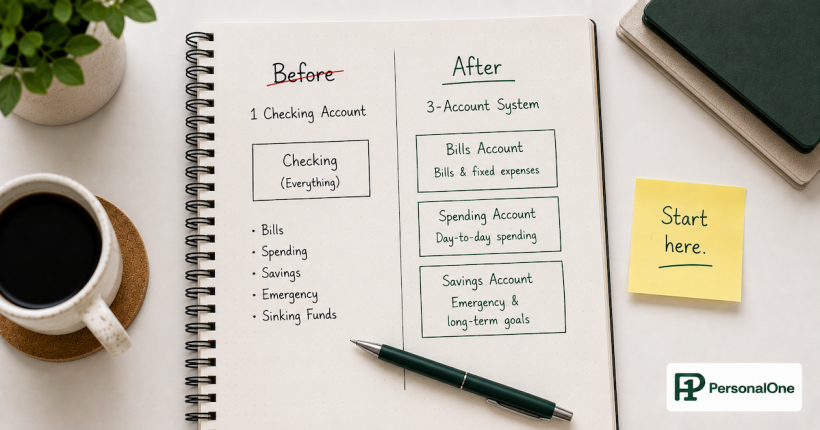
In the 3-account framework, checking is specifically the operational account that receives income and routes it outward — to the bills account, to the spending account, and to savings. It is not a savings vehicle. Money does not sit here. It flows through. For the step-by-step setup of how income gets routed from checking to each destination account — including the automation schedule that makes it happen automatically on payday — see the guide to building a banking system that supports your budget.
Layer 2: Savings — Where Money Actually Grows
The traditional savings account approach — open one at the same bank as checking, accept whatever minimal interest they offer, occasionally transfer money in and out — is functionally obsolete. It does not earn meaningfully, and its proximity to checking eliminates the structural separation that makes saving automatic.
In a modern stack, savings plays a defined structural role: it holds money that is not meant to be spent in the near term, earns competitive interest while it grows, and is deliberately less accessible than checking. High-yield savings accounts at online banks offer rates significantly higher than traditional bank savings accounts — which matters considerably when you are holding a three to six month emergency fund for years at a time.
Savings in the stack serves three purposes. Emergency funds: three to six months of essential expenses held in a high-yield account, accessible but not immediately accessible, at a different institution from checking. Sinking funds: money set aside for predictable irregular expenses like annual insurance premiums, car maintenance, and holiday spending, so these events do not destabilize the monthly budget when they arrive. Short-term goals: money you will need within one to three years that should earn interest but not be exposed to investment risk.
The behavioral shift that makes this layer work is that money moves into savings automatically and stays there. You are not manually deciding each payday whether to save. You are not borrowing from savings to cover overspending. The transfer is scheduled, the account is at a different institution, and the structural separation does the work that willpower cannot reliably sustain.
Layer 3: Apps — Visibility Across the System
When you are operating multiple accounts across multiple institutions, a financial aggregation tool becomes essential — not for budgeting in the traditional sense, but for maintaining visibility. You need to know what is happening across your entire financial system without logging into separate banking apps for each institution.
Good financial apps aggregate all accounts — checking, savings, credit cards — into one view. They categorize spending automatically so you know where money is going without logging transactions manually. They surface patterns you would never catch otherwise: the subscription that quietly renewed, the category where spending crept up over three months. And they send alerts that function as early warning systems — low balance notifications, unusual transactions, bills approaching their due date.
The key reframe is that apps in a well-designed banking stack are information tools, not discipline tools. You are not using an app to restrict spending or create guilt — you are using it to maintain accurate visibility into a system that largely runs itself. When you can see everything clearly across all accounts, occasional calibration decisions become simple rather than overwhelming.
Apps do not replace the account structure. They make it easier to monitor and maintain. The structure is the system. The app is the dashboard.
Layer 4: Automation — The Silent Operator
Automation is what transforms a collection of accounts into a functioning system. Without it, a multi-account setup requires constant manual management — remembering to transfer money to savings, tracking bill due dates, manually moving money before it gets spent on something else. That cognitive load is exactly what the stack is designed to eliminate.
With automation, the system runs itself. Automatic transfers from income to savings execute on payday before any spending decisions happen — the money moves to its intended destination before it registers as available to spend. Bill autopay from the bills account means fixed expenses are paid on time without tracking due dates or initiating individual payments. Scheduled transfers to the spending account create a natural boundary: when the balance drops, spending naturally slows, and it refills automatically on schedule.
The principle at work is that automation removes the decision point entirely. You are not choosing to save this month — it happens before you interact with the money. You are not deciding whether to pay the electric bill on time — it is already paid. Consistency stops being a function of motivation and becomes a function of the system’s architecture.
This is why the setup phase matters. The hours you invest configuring transfers, autopay, and account rules produce months and years of consistent behavior with almost no ongoing effort. A well-automated stack should feel boring — because it is working exactly as designed. For the specific mechanics of how each account’s transfer amount becomes the spending limit itself — without requiring any app or ongoing tracking — the guide on spending limits by account covers the calibration method in full.
Why the Stack Outperforms Single-Account Banking
Single-account banking — one checking account, one savings account at the same bank — creates a specific set of problems that no amount of mental tracking or budgeting discipline fully solves. The problems are structural, which means the solution must be structural too.
When all money lives in one account, the available balance is misleading. It includes rent money, savings, and spending money as a single number. Every transaction requires a mental calculation about what that dollar is actually allocated to. Over a month, that cognitive load compounds and eventually breaks down. Overspending does not happen because of poor values. It happens because the account structure creates impossible demands on human attention at scale.
Financial life is also more complex now than the single-account model was designed for. Freelance income arrives irregularly. Side hustles create multiple income streams. Subscriptions auto-renew across different accounts and payment methods. The traditional model of one checking account and one savings account at a local bank cannot handle this complexity without constant manual intervention.
The modern banking stack is modular precisely because financial life is modular. Variable income requires a buffer account and percentage-based transfers rather than fixed amounts. A side hustle may eventually warrant a separate business checking account. Larger emergency funds may need to be spread across multiple FDIC-insured institutions for full coverage. The stack adapts as your financial situation changes — you add components when the need exists, not before.
Common Mistakes When Building a Banking Stack
Trying to do everything at one bank. Traditional banks want consolidation — checking, savings, credit cards, loans, and investments all under one roof. This feels simpler but usually means accepting inferior products: lower savings rates, higher fees, and features designed for the bank’s convenience rather than yours. The stack model requires using the right tool for each job, which typically means multiple institutions.
Manually managing transfers. Setting up multiple accounts but continuing to manually move money on payday defeats the entire purpose. If you are still deciding each month whether to transfer to savings, the friction point remains. Automation is not optional — it is the mechanism that makes the system work without ongoing willpower. The fees that accumulate when this friction leads to structural errors — overdraft charges, missed savings, minimum balance penalties — are broken down in the guide on banking mistakes costing you money.
Keeping emergency savings too accessible. An emergency fund at the same bank with instant transfer capability is not structurally different from a second checking account. The one to three day transfer delay of a separate institution is the friction that protects the fund. Remove that friction and you remove the protection.
Overcomplicating before establishing habits. Seven accounts sounds more sophisticated than four, but complexity you cannot maintain is worse than simplicity that works. Start with the minimum viable structure, automate it fully, and add components only when a specific need requires them. The goal is a system that feels boring because it runs reliably — not one that requires constant attention.
The stack is the concept. The Banking Systems hub is the complete build guide.
Understanding the four layers is the first step. The complete Banking Systems framework covers account configurations, automation setup, allocation frameworks, and how to evolve the architecture as income and goals change.
Explore the Banking Systems Hub →More From Multi-Account Budgeting System
How to Build a Banking System That Supports Your Budget — Structure your accounts around your budget so the two systems reinforce each other
How to Build a Banking System Where Overspending Is Structurally Impossible — Account architecture that makes the right behavior the default
How to Fix Banking Mistakes That Are Quietly Costing You Money — The structural errors most people never notice and how to correct them
The Psychology of Account Separation — Why physical boundaries beat mental accounting every time
The 4-Bucket Money System — Advanced multi-account strategy for complete financial visibility
Why You Need a Separate Account for Bills — The single most impactful account separation most people can make
You are here: The Modern Banking Stack
Resources
FDIC Consumer News — Account Insurance and Banking Guidance
FDIC BankFind — Verify Institution Insurance Status
CFPB — Bank Account Tools and Consumer Resources
This article is part of the Banking Systems hub on PersonalOne — a complete framework for building the account structure and cash flow infrastructure that controls your financial outcomes automatically.
Frequently Asked Questions
How many accounts do I actually need to get started?
Three to four is the practical minimum for a functioning stack: one checking account for income and bills, one separate spending account with a debit card, and one high-yield savings account at a different institution for your emergency fund. A fourth account for short-term goals is worth adding once the first three are automated and running smoothly. Start with the simplest structure that works and add components only when a specific need requires them.
Is it safe to use multiple banks?
Yes. FDIC insurance covers up to $250,000 per depositor per institution, so spreading accounts across multiple banks actually increases your total insured coverage rather than reducing it. Verify any institution’s insurance status through the FDIC’s BankFind tool before opening an account.
What if my income is irregular or freelance?
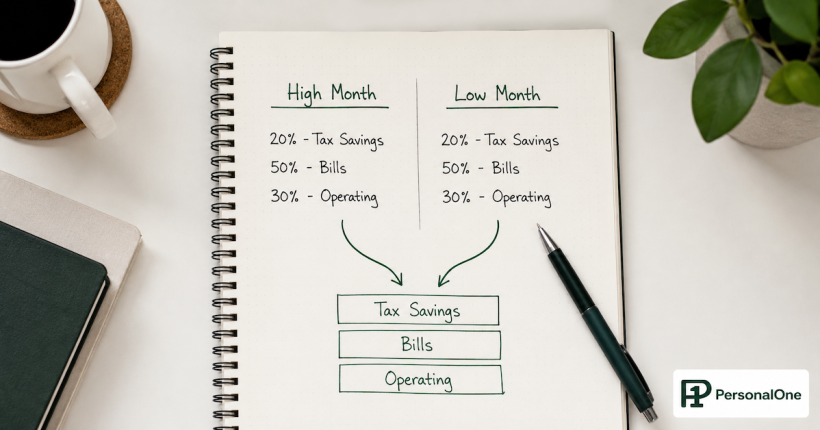
The stack still works with variable income — it requires one structural adjustment. Instead of fixed-dollar automatic transfers, use percentage-based transfers triggered by each deposit. Every incoming payment distributes by percentage to each account automatically. A buffer of one to two months of expenses in your income landing account smooths out low-income months and prevents the system from running short when payments arrive late or below average.
Do I need a budgeting app to make this work?
Not strictly. The account structure and automation provide most of the financial discipline without any app involvement. An aggregation tool becomes most useful once you are operating three or more accounts across multiple institutions and want visibility across all of them in one place. If you are starting with a simple setup at two institutions, the individual bank apps may be sufficient for the first several months while habits establish.
How long does it take to set up a banking stack?
The initial setup takes two to four hours spread across several days — most of that time is waiting for account approvals and transfer verifications rather than active work. Opening an online savings account typically takes three to five business days to verify and fund. A second checking account at your existing bank is often approved the same day. The automation setup — scheduled transfers and autopay configuration — takes roughly an hour once all accounts are open and connected. After initial setup, monthly maintenance runs about twenty minutes.
Disclaimer: This content is for educational purposes only and does not constitute financial advice. Account features, fees, and interest rates vary by institution and change over time — always review current terms and conditions before opening new accounts. FDIC insurance covers up to $250,000 per depositor per institution — verify insurance status through the FDIC’s BankFind tool before depositing funds.