Updated: March 18, 2026
Home › Banking Systems › Multi-Account Budgeting System › How to Build a Banking System That Supports Your Budget
How to Build a Banking System That Supports Your Budget
TL;DR
— Multiple accounts equal automatic budgeting — separate accounts for bills, spending, and savings create structural boundaries that do not require willpower to maintain.
— The 4-account foundation: Bills and Fixed Expenses (50 to 60%), Daily Spending (20 to 30%), Emergency Fund (10 to 15% until fully funded), Goals and Savings (10 to 15%).
— Automation is the enforcement mechanism — set up automatic transfers on payday so allocation happens before any spending decisions are made.
— Account friction is a feature, not a bug — savings at a separate institution with a one to three day transfer window protects your emergency fund from impulse withdrawals.
— Start simple and add complexity later — four accounts mastered beats seven accounts mismanaged every time.
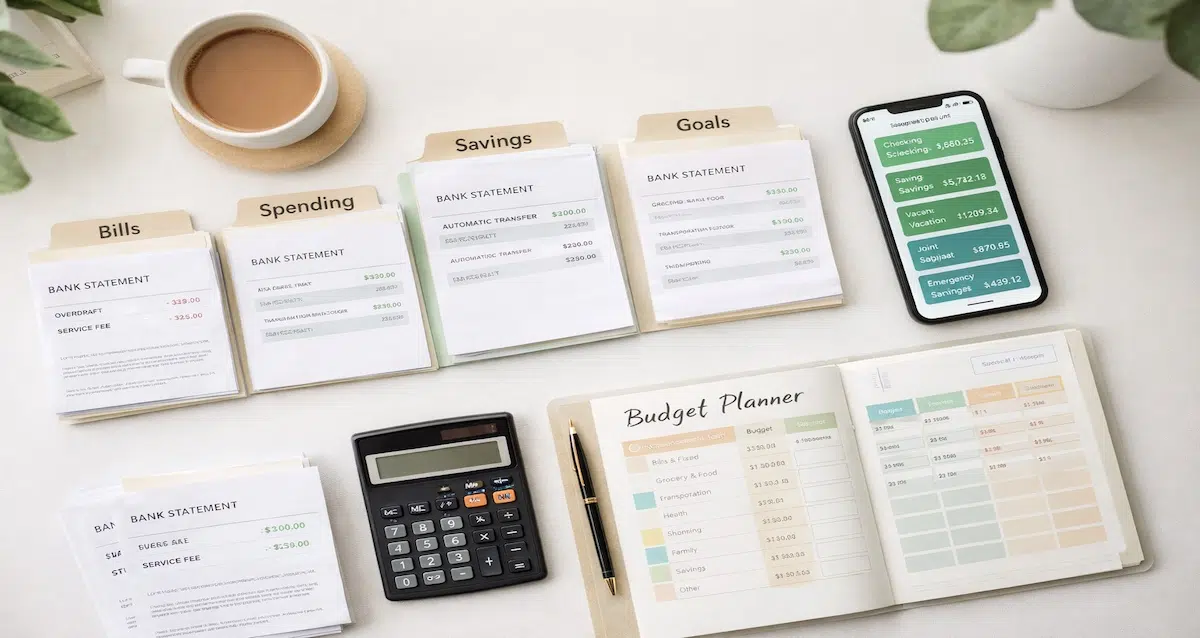
Most budgets fail not because people lack discipline, but because they are fighting against how a single checking account naturally works. When all your money sits in one place, every dollar competes for attention. Rent money looks identical to entertainment money. Emergency savings feel available for a weekend trip. Your budget becomes a mental exercise in ongoing self-control rather than a system that enforces its own structure.
The fix is not stricter budgeting. It is structural separation. When money is physically divided into accounts that each serve a specific purpose — and transferred there automatically on payday — budgeting stops being something you have to do and becomes something that happens to you.
This article covers the core framework for a banking system that supports your budget — why single-account banking works against you, how to build the 4-account foundation that covers every essential category, how to automate the money flow, and the most common setup mistakes to avoid. For the full architecture including advanced account structures, income allocation by life stage, and system optimization, the Multi-Account Budgeting System hub covers all of it.
Why Single-Account Banking Breaks Budgets
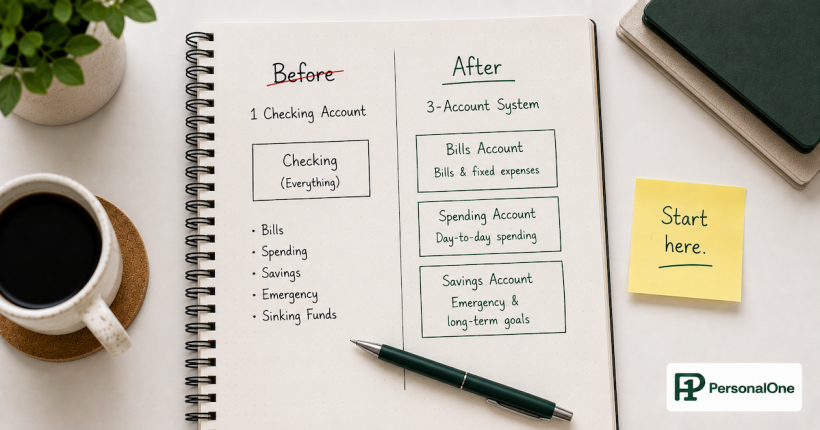
The traditional setup — one checking account, one savings account at the same bank — creates a specific set of problems that no amount of spreadsheet tracking or budgeting app discipline fully solves. The problems are structural, which means the solutions must be structural too.
When all money lives in one account, the available balance is misleading. It includes rent money, bill money, savings, and spending money all as a single number. Every purchase requires a mental calculation: can I actually spend this, or does this dollar belong somewhere else? Multiply that by every transaction in a month and the cognitive load becomes exhausting. Eventually the mental tracking breaks down and overspending happens — not from poor values, but from decision fatigue.
The second problem is savings accessibility. When your emergency fund is at the same bank with instant transfer capability, it is not really a separate fund — it is an overflow reserve that is psychologically indistinguishable from spending money. The friction between wanting to buy something and transferring from savings is nearly zero. That frictionlessness is the problem, not a convenience.
Overdraft risk compounds both issues. A missed mental calculation — spending more than you realized because rent was posting tomorrow — turns a budgeting mistake into a fee. The single-account structure converts normal human cognitive limitations into expensive financial events on a recurring basis.
The Psychology Behind Account Separation
Account-based budgeting works because it operates with human psychology rather than against it. Several well-documented cognitive patterns make physical account separation more effective than mental category tracking.
Mental accounting: People naturally think about money differently based on where it is stored. Separate accounts make mental categories concrete — when you open your spending account and see $340, you know exactly what is available without calculation. That number is real spending money, not a portion of a larger number you need to subtract from.
Friction as protection: Adding steps between you and your savings — a different institution, a one to three day transfer window, no debit card — creates a cooling-off period that intercepts impulse decisions. The same amount of money feels less accessible because functionally it is. That is not a limitation; it is the design.
Reduced decision fatigue: Automation eliminates hundreds of micro-decisions per month. Once transfers are scheduled, you do not decide how much to save on payday — it is already allocated before you have touched the money. The system decides; you spend what is in the spending account.
Loss aversion: People are more motivated to avoid depleting a labeled account than to stay within a category limit. Watching your vacation savings balance go backward because you raided it for everyday spending feels different — and worse — than going over a budget line in an app. The physicality of the account makes the consequence real.
The 4-Account Foundation
Start here. Four accounts covers every essential budget category with minimal complexity. Most people should operate this system for at least three months before adding more accounts — simplicity maintained is better than complexity abandoned.
Account 1 — Bills & Fixed Expenses (50 to 60% of income)
Purpose: Rent or mortgage, utilities, insurance premiums, loan payments, fixed subscriptions — any expense with a predictable monthly amount.
Location: Checking account with bill pay capability. Autopay connectivity required. No debit card needed.
How it works: Calculate your total monthly fixed expenses. That exact amount transfers automatically from your income account on payday. Everything in this account is already spoken for — it is not available to spend on anything else.
Account 2 — Daily Spending (20 to 30% of income)
Purpose: Groceries, gas, restaurants, entertainment, clothing, personal care — all variable day-to-day expenses.
Location: Separate checking account with a debit card. This is the only account your debit card is connected to.
How it works: Your budgeted spending amount transfers here automatically on payday. When the balance gets low, you know to slow down. The balance is your actual available spending money — no mental math required. When it is gone, it is gone until the next transfer. For a deeper look at how the account balance itself functions as a spending limit — without any app or category tracking — see the guide on spending limits by account.
Account 3 — Emergency Fund (10 to 15% of income until fully funded)
Purpose: Three to six months of essential living expenses for genuine emergencies — job loss, medical events, major unplanned repairs.
Location: High-yield savings account at a different institution from your primary bank. No debit card on this account.
How it works: Contribute consistently until you reach your three to six month target. The separate institution and transfer delay are features — they intercept impulse withdrawals that do not meet the definition of a genuine emergency. Once fully funded, redirect contributions to goals or investments.
Account 4 — Goals & Planned Future Expenses (10 to 15% of income)
Purpose: Vacation fund, home down payment, car replacement, annual expenses — anything planned and time-bound.
Location: Separate savings account. Many online banks allow sub-accounts or labeled buckets within one account — useful for tracking multiple goals without opening multiple accounts.
How it works: Identify your goals, set a target date, calculate the required monthly contribution, and automate it. When a goal is reached, redirect that contribution to the next priority. This account makes planned future expenses feel funded rather than stressful.
Income Allocation by Monthly Take-Home
| Monthly Income | Bills (55%) | Spending (25%) | Emergency (10%) | Goals (10%) |
|---|---|---|---|---|
| $3,000 | $1,650 | $750 | $300 | $300 |
| $5,000 | $2,750 | $1,250 | $500 | $500 |
| $7,500 | $4,125 | $1,875 | $750 | $750 |
| $10,000 | $5,500 | $2,500 | $1,000 | $1,000 |
Setting Up Automated Money Flow
The account structure provides the framework. Automation provides the enforcement. Without automation, you are still making allocation decisions on payday — which reintroduces decision fatigue and creates opportunities for the system to break down. With automation, money moves to its destination before any spending decisions happen.
Step 1: Map your current cash flow before touching anything. List every income source and when it deposits. Calculate your total monthly fixed expenses (the number going to Account 1). Review three months of spending to determine a realistic variable expense budget (Account 2). Identify all irregular annual expenses — car registration, insurance renewals, annual subscriptions — divide the annual total by 12, and include that in your bills allocation or create a fifth account for irregular expenses once you have mastered four. For a broader view of how checking, savings, and automation layer together as one integrated system, the modern banking stack guide covers the complete architecture.
Step 2: Open accounts in phases. Do not open all four accounts on the same day. Open the emergency fund savings account at an online bank first — it takes three to five business days to verify and fund. During that window, open a second checking account at your primary bank for daily spending. Week three: test transfers between accounts and confirm everything connects. Week four: set up your first automated transfers to coincide with your next payday. Add goal accounts in month two once the core system is running.
Step 3: Schedule transfers one to two days after payday. Set all automatic transfers to execute one business day after your paycheck deposits — not the same day. Same-day transfers occasionally fail if the deposit posts after the transfer window. A one-day buffer prevents transfer failures from cascading into overdrafts.
Example Automation Schedule — Paid Biweekly on the 1st and 15th
Day 1 / 15: Paycheck deposits to primary checking (income landing account)
Day 2 / 16: Automatic transfers execute — fixed amount to Bills Account, fixed amount to Spending Account, fixed amount to Emergency Fund at online bank, fixed amount to Goals savings
Result: By day two, income is fully allocated. Your spending account balance is your actual available money — nothing to calculate, no decisions to make.
Step 4: Move all bill autopay to Account 1. Once the bills account is funded automatically, update every fixed expense to autopay from that account — rent, utilities, insurance, loan payments, fixed subscriptions. Variable expenses like groceries, gas, and restaurants never autopay from the bills account. Those come from the spending account where you actively track the balance. Mixing the two defeats the purpose of the separation.
Five Pitfalls That Break New Banking Systems
Pitfall 1 — Overcomplicating at the Start
The mistake: Opening seven accounts before establishing consistent automation habits. The fix: Start with four. Run the system for three months. Only add accounts when you have a specific identified need — not because more complex sounds better in theory.
Pitfall 2 — Forgetting Irregular Expenses
The mistake: Budgeting only for monthly bills, then getting blindsided by annual insurance premiums, car registration, or holiday spending. The fix: List every expense you pay in a year — not just monthly ones. Total them and divide by 12. That monthly amount belongs in your bills allocation or a dedicated irregular expenses account.
Pitfall 3 — Emergency Savings at the Same Bank
The mistake: Keeping emergency savings at the same institution as checking with instant transfer capability. The fix: The separate institution and one to three day transfer window are not inconveniences — they are the mechanism that keeps the emergency fund intact. A savings account you can raid in 30 seconds is not structurally different from checking.
Pitfall 4 — Fixed Transfer Amounts on Variable Income
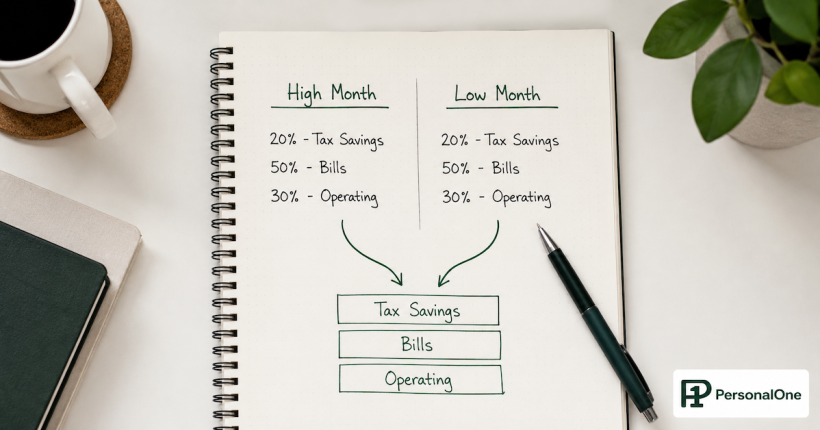
The mistake: Setting fixed dollar transfer amounts that work for a steady paycheck but break when income fluctuates from commissions, freelance, or gig work. The fix: Use percentages instead of fixed amounts. In low months contributions scale down proportionally; in high months they scale up automatically. For a complete breakdown of how to make this system structurally eliminate overspending regardless of income variability, see the guide on building a banking system where overspending is impossible.
Pitfall 5 — Abandoning the System After One Mistake
The mistake: Overspending the spending account once and concluding the system does not work. The fix: Overspending once is a calibration signal, not a system failure. Analyze why — was the budget unrealistic, or did you forget a category? Adjust the transfer amounts and continue. Systems improve through iteration, not abandonment. The fees and structural errors that quietly drain accounts during this calibration phase — and how to stop each one — are covered in detail in the guide on banking mistakes costing you money.
Monthly Maintenance: 20 Minutes
Once automated, this system requires minimal active management. Schedule one 20-minute monthly review to verify everything is working correctly and catch anything that needs adjustment before it becomes a problem. Check that all automatic transfers executed on schedule and for the correct amounts. Review the bills account for unexpected charges or missed autopays. Assess the spending account to determine whether the allocated amount is realistic or needs adjustment. Confirm the emergency fund is on track toward its three to six month target. Verify goals accounts are on track for their projected completion dates. Add any new irregular expenses to the bills allocation that were not there before.
This is the foundation. The full Banking Systems architecture goes further.
The 4-account system covers the essential structure. As income grows, goals multiply, or life circumstances change — freelance income, dual-income households, debt payoff phases, saving for a home — the system needs to evolve. The complete Banking Systems framework covers advanced account structures, variable income frameworks, and allocation strategies by life stage.
Explore the Banking Systems Hub →Resources
FDIC Consumer News — Account Insurance and Banking Guidance
CFPB — Bank Account Tools and Consumer Resources
FDIC — Deposit Insurance: How Your Accounts Are Protected
This article is part of the Banking Systems hub on PersonalOne — a complete framework for building the account structure and cash flow infrastructure that controls your financial outcomes automatically.
Frequently Asked Questions
How many bank accounts is too many?
The right number is the minimum needed to create clear separation between your spending categories. For most people starting out, four accounts is the right number. Seven or eight accounts can work for someone with complex financial goals and established automation habits — but complexity you cannot maintain defeats the purpose. If managing your accounts feels like a part-time job, you have too many.
Does this work if I am paid irregularly or freelance?
Yes, with one structural adjustment. Instead of automatic transfers tied to specific dates, use percentage-based transfers triggered by each deposit. Set each incoming payment to automatically distribute by percentage to each account. In low months the amounts are smaller; in high months larger. A buffer of one to two months of expenses in your income landing account smooths out months where income is significantly below average.
Do I need accounts at multiple banks?
For the emergency fund specifically, yes — a different institution with a transfer delay is strongly recommended. For the other three accounts, a second checking account at your primary bank combined with a separate savings account works. The critical separation is between your emergency savings and everything else. The more accessible your emergency fund is, the less structural protection it actually provides.
What if my fixed expenses already consume 70 percent or more of my income?
The percentages in this article are guideposts, not requirements. If your fixed expenses genuinely require 70 percent of income, your available amount for spending, savings, and goals is 30 percent — and that 30 percent still benefits from being split into separate accounts with clear purposes. Even a small automatic transfer to emergency savings each month builds the habit and the balance over time. The structure matters regardless of the percentages.
What happens when I have a genuine emergency and need the fund?
Initiate the ACH transfer the moment you confirm the expense is real and cannot be covered by the spending account. The one to three day transfer window is manageable for virtually all genuine emergencies — medical bills, car repairs, and unexpected job expenses almost never require immediate cash within minutes. After using the fund, resume contributions until it is rebuilt before redirecting money elsewhere.
Disclaimer: This content is for educational purposes only and does not constitute financial advice. Account structures and allocation percentages should be customized to your individual situation. FDIC insurance covers up to $250,000 per depositor per institution — consider this when distributing balances across accounts. Always verify current account terms with specific financial institutions before opening accounts.