Updated: May 19, 2026
Home › Banking Systems › The 3-Account System Explained › High-Yield Savings vs Money Market Accounts
Part of the 3-Account System Explained cluster — the complete framework for structuring your banking so every dollar has a job.
What You Need to Know
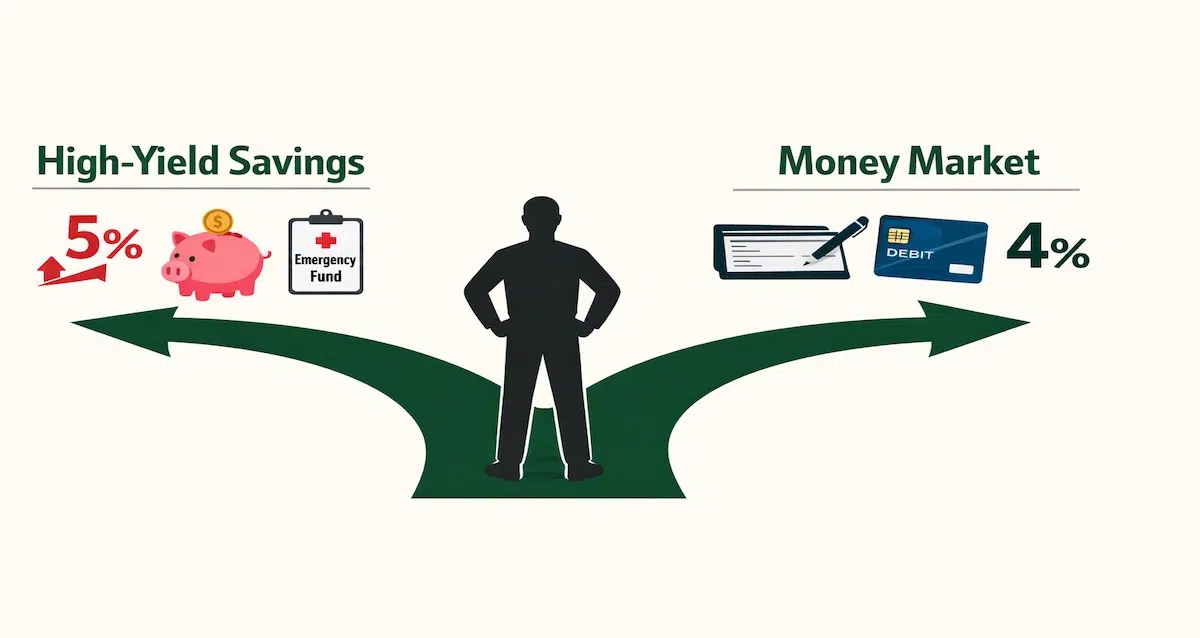
— High-yield savings accounts offer 4.00–5.00% APY in 2026 — significantly better than the national average of 0.38%.
— Money market accounts provide similar rates plus check and debit access — but often require higher minimum balances.
— High-yield savings wins for pure saving goals — emergency funds, down payments, short-term goals.
— Money market accounts win for flexible access — if you need to spend occasionally while earning interest.
— Both are FDIC-insured and safe — protected up to $250,000 per depositor per institution.
You have cash sitting somewhere — maybe an emergency fund, a down payment fund, or just money you are not ready to invest yet. The real question is not which account pays the most in a vacuum. It is which account fits the specific job your money needs to do inside a 3 account banking system where each account has a defined role and money flows automatically where it belongs.
In 2026, two accounts dominate the conversation for savings that is not being invested: high-yield savings accounts and money market accounts. Both significantly outperform the national average savings rate of 0.38%, but which one belongs in your financial structure depends on more than the headline APY. For the complete framework on how to structure your bank accounts — how savings connects to your checking and bills accounts — the Banking Systems hub covers the full architecture. This article focuses specifically on the HYSA vs MMA decision.
Here is the breakdown — what each account actually is, where each one wins, and how to decide which one belongs in your setup.
The 2026 Savings Landscape: Why Rates Still Matter
Despite three Federal Reserve rate cuts in 2025, top savings accounts still pay 4.00–5.00% APY as of May 2026. That is not the 5%+ peak of 2023, but it is still more than 10 times better than what traditional banks offer on standard savings. The Fed held rates steady at its April 29, 2026 meeting with the next decision scheduled for June 17, 2026.
Rates are trending down gradually — not plummeting overnight. Opening a high-yield account now captures current rates before they decline further. Even in a declining rate environment, the gap between online savings accounts and traditional bank savings remains substantial.
What Is Happening with Rates in 2026
— Fed held rates steady April 29, 2026 — next decision June 17, 2026.
— Rates will decline gradually, not suddenly.
— High-yield accounts will still vastly outperform traditional savings even at 3.5%.
— The gap between online banks and traditional banks remains substantial at any rate level.
High-Yield Savings Accounts: The Pure Savings Play
A high-yield savings account does one thing exceptionally well: grows your money while keeping it accessible. No check writing, no debit card, no complexity — just significantly better interest rates than traditional savings accounts with the same FDIC protection.
These accounts function exactly like traditional savings accounts but pay 10 times more interest. Most are offered by online banks that skip expensive branch infrastructure and pass those savings to customers through higher APYs. Park $10,000 in an account earning 4.00% APY and you earn approximately $400 over a year — versus just $38 in a traditional account at the national average of 0.38%.
High-Yield Savings — Pros
- Top rates: 4.00–5.00% APY in 2026
- Low or no minimums — many require $0–100 to open
- FDIC-insured up to $250,000
- No monthly fees at most institutions
- Easy transfers to linked checking accounts
- Simple structure — no confusing tiers or conditions
High-Yield Savings — Cons
- Online-only — most lack physical branches
- Transfer delays — 1–3 days to move money to checking
- No check writing or debit card access
- Variable rates — APY follows Fed policy
- Some accounts limit monthly withdrawals
Top High-Yield Savings Accounts in 2026
- Varo Savings: Up to 5.00% APY (on balances up to $5,000 with direct deposit)
- Axos Bank: 4.21% APY (no minimum to open)
- Newtek Bank: 4.20% APY (currently waitlist only — check site for availability)
- SoFi: Up to 4.00% APY (base rate plus boost with direct deposit)
- Ally Bank: Competitive APY, savings buckets, no fees
For a side-by-side comparison of the top high yield savings accounts — including which fits which saving style — the best savings accounts guide covers all leading picks with current rates and conditions. If you have already decided on a HYSA, the complete step-by-step process for opening one and setting up automated transfers is in the high yield savings account setup guide.
Money Market Accounts: The Hybrid Option
Money market accounts blend savings and checking features — earning competitive interest while offering check-writing and debit card access. Think of them as high-yield savings accounts with spending capabilities attached.
Many money market accounts use tiered interest rates: the more you deposit, the higher your APY. A $5,000 balance might earn 3.00% while a $25,000 balance earns 4.00%. This rewards larger deposits but complicates apples-to-apples comparisons. For a detailed breakdown of when a money market account is the right structural choice and how to size it within your banking system, the when to use a money market account guide covers the mechanics and sizing strategy in full.
Money Market Accounts — Pros
- Check writing — pay bills directly from account
- Debit card access — spend without transferring first
- Competitive rates — 3.75–4.25% APY common
- FDIC-insured up to $250,000
- Tiered rates can reward higher balances
- Some available at traditional banks with branch access
Money Market Accounts — Cons
- Higher minimums — often $1,000–10,000 to open
- Drop below minimum = monthly fees of $10–15
- Typically limited to 6 withdrawals per month
- Often 0.25–0.50% lower than top HYSA rates
- Tiered structures are harder to compare across banks
- Easy access can tempt spending from savings
Top Money Market Accounts in 2026
- Quontic Bank: 4.25% APY
- Leader Bank Zeugma Plus: 4.75% APY (with $1,000 direct deposit requirement)
- Vanguard Cash Plus: Competitive rates (institutional focus, exact rate varies)
- Capital One 360: Variable rates (with branch access benefit)
Head-to-Head: Which Account Wins?
| Feature | High-Yield Savings | Money Market Account | Edge |
|---|---|---|---|
| Interest Rates | 4.00–5.00% APY | 3.75–4.25% APY | HYSA |
| Minimum to Open | $0–100 | $1,000–10,000 | HYSA |
| Monthly Fees | Usually $0 | $0–15 (waived with minimums) | HYSA |
| Check Writing | No | Yes | MMA |
| Debit Card | Rare | Yes | MMA |
| Transaction Speed | 1–3 days to checking | Instant via check or debit | MMA |
| FDIC Insurance | Yes — up to $250,000 | Yes — up to $250,000 | Tie |
| Best For | Pure savings goals | Flexible access needs | Depends on your situation |
When to Choose High-Yield Savings
High-yield savings accounts are the clear winner when your priority is maximizing interest on money you do not need to touch frequently. The higher APYs and lower barriers to entry make them ideal for specific savings goals.
Emergency Fund
You need accessibility within days, FDIC insurance for safety, and the best possible return. High-yield savings checks all three boxes. The 1–3 day transfer time is acceptable for true emergencies, and you avoid the temptation to spend that comes with immediate debit card access. For the full framework on sizing and building an emergency fund correctly — how many months of expenses to target and where to keep it — the how to build an emergency fund guide covers the complete strategy.
Down Payment Savings
When saving for a house, car, or other major purchase 1–3 years away, you want maximum growth without market risk. High-yield savings keeps your timeline on track regardless of stock market volatility, and the superior APY compounds faster than money market alternatives.
Short-Term Goals
Vacation fund, wedding savings, holiday shopping money — any goal within 6–24 months benefits from high-yield savings. Set it, automate the transfers, let compounding interest do its work.
New Savers
Low or no minimum requirements make high-yield accounts accessible from day one. Many money market accounts requiring $5,000–10,000 minimums are not realistic when building from zero. Start with a HYSA and add the MMA layer later if your cash reserves grow to a size where the access features become relevant.
When to Choose Money Market Accounts
Money market accounts make sense when you need competitive interest but cannot afford to have your money unavailable — even for 1–3 days. The transactional flexibility justifies slightly lower APYs in specific situations.
Business Operating Funds
Small business owners who need to keep 3–6 months of operating expenses liquid benefit from money market accounts. Write checks to vendors, use a debit card for supplies, and earn competitive interest on capital that would otherwise sit idle in checking earning nothing.
Large Emergency Funds
If your emergency fund exceeds $25,000–50,000, money market accounts with tiered rates can match or beat high-yield savings APYs at the highest balance tiers. Immediate check and debit access also provides true emergency liquidity for large unplanned expenses.
Irregular Large Expenses
Property taxes, insurance premiums, quarterly tax payments — money market accounts let you earn interest while maintaining direct spending capability without a transfer delay. Keeps the money earning rather than sitting in checking waiting to be paid out.
Conservative Cash Reserves
Retirees or conservative savers who want a stock market alternative without giving up liquidity find money market accounts appealing. Significant cash reserves earn competitive interest with instant access when opportunities or needs arise.
The Math: How Much Extra You Actually Earn
$10,000 Sitting for One Year
Traditional savings at 0.38% APY (national average): Earns $38
Money market account at 4.00% APY: Earns $400
High-yield savings at 4.50% APY: Earns $450
Top high-yield savings at 5.00% APY: Earns $500
The verdict: High-yield savings earns $50–100 more annually than money market accounts on $10,000. Scale that to $50,000, and you are leaving $250–500 on the table by choosing the lower-rate option when access features are not needed.
What About Money Market Funds?
Money market funds are not the same as money market accounts, despite the similar names — and this distinction matters for how you evaluate safety.
Money market accounts: Bank deposit products, FDIC-insured, your principal is guaranteed.
Money market funds: Investment products (mutual funds), SIPC-insured but not FDIC-insured, slightly higher risk.
Money market funds invest in short-term debt securities and aim to maintain a $1.00 net asset value. They carry no FDIC protection. For most people building emergency funds or saving for short-term goals, the minimal yield difference does not justify losing deposit insurance. Unless you have specific reasons to need a money market fund, the FDIC-insured account versions are the appropriate choice for cash you cannot afford to lose.
Your Personal Decision Guide
Choose High-Yield Savings if:
— You are building an emergency fund under $50,000
— You have a specific savings goal — down payment, vacation, etc.
— You do not need instant access (1–3 days is fine)
— You want the absolute highest APY available
— You have less than $1,000 to start with
— You want to avoid monthly fees entirely
— You prefer simplicity over transactional features
Choose Money Market Account if:
— You need to write checks occasionally from your savings
— You want debit card access to your savings balance
— You have $10,000 or more and can meet minimum requirements comfortably
— You are managing business operating funds
— You value flexibility over maximizing every 0.25% of APY
— You want tiered rates that reward larger balances
The Hybrid Strategy: Why Not Both?
Many people use both account types strategically rather than choosing one. This aligns with how a properly structured banking system works — different accounts serve different functions and the combined approach often produces better outcomes than either alone.
A Common Two-Account Setup
High-yield savings: Your primary emergency fund and long-term savings goals — maximum $250,000 FDIC coverage, highest APY, set-it-and-forget-it growth.
Money market account: A buffer account with 1–2 months of expenses — check-writing for irregular large payments like insurance and taxes, debit access for true emergencies.
Example: $15,000 in high-yield savings at 4.50% = $675/year. $5,000 in money market at 4.00% = $200/year. Total: $20,000 earning $875/year vs. $76 in traditional savings at 0.38%.
Still Deciding Which Account Belongs in Your Setup?
The PersonalOne best bank quiz matches your income structure, saving habits, and goals to a specific account recommendation in under two minutes.
If you decide a high-yield savings account is the right choice, the next step is opening one. The complete step-by-step process is in the high yield savings account setup guide. If you choose a money market account instead, the when to use a money market account guide covers how to size it correctly within your banking structure.
Now Build the System Around Your Savings Account
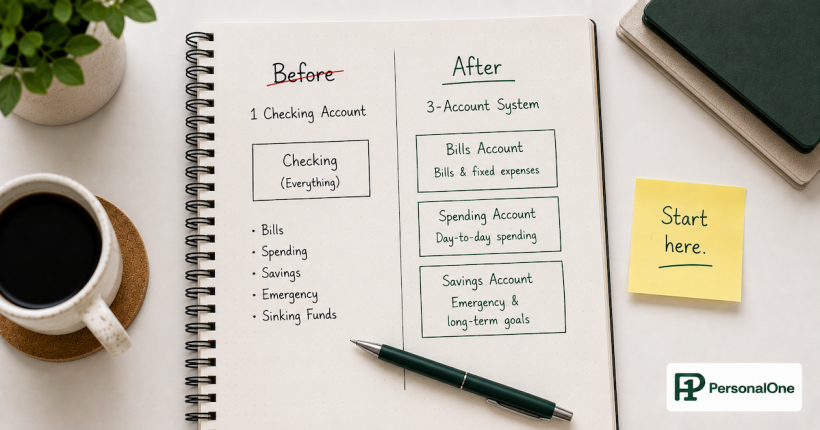
Choosing between HYSA and MMA is one decision. Building a system where your money automatically flows into whichever account you choose — from every paycheck, before it can be spent — is what makes saving consistent over time. The 3-account banking setup shows you exactly how to structure your checking, bills, and savings so every dollar has a destination. For the full architecture, see the complete banking system setup.
Framework-first. Less willpower. More infrastructure.
Official Sources
FDIC — Understanding Deposit Insurance Coverage
Continue Building Your System
This article is part of the 3-Account System Explained cluster. The full cluster covers how to structure your checking, bills, and savings accounts into one automated system where money flows correctly every pay period.
Frequently Asked Questions
Will high-yield savings rates keep dropping in 2026?
Yes, but gradually. The Fed held rates steady at its April 29 meeting. Additional cuts are anticipated later in 2026, which means savings rates will decline slowly — potentially dropping from current 4.00–5.00% to 3.50–4.50% by Q3 2026. The gap between high-yield accounts and traditional savings will remain substantial. Even at 3.50%, you are still earning nearly 10 times the national average of 0.38%.
Can I lose money in a high-yield savings account or money market account?
No, assuming your bank is FDIC-insured. Both account types guarantee your principal up to $250,000 per depositor per institution. Even if your bank fails, the FDIC reimburses you. The only loss possible is purchasing power loss if inflation exceeds your APY — but that is true of any cash savings. You cannot lose actual dollars from your balance at an FDIC-insured institution.
How long does it take to transfer from high-yield savings to checking?
Typically 1–3 business days for ACH transfers. Most online banks let you initiate transfers 24/7 via mobile app. Some banks offer expedited same or next-day transfers for a small fee ($5–10). This transfer window is the main practical limitation of HYSAs compared to money market accounts, which allow immediate spending via check or debit card.
Are online banks safe? What if I need to deposit cash?
Online banks are equally safe as traditional banks when FDIC-insured — your deposits have identical federal protection. For cash deposits, most online banks partner with retail networks where you can deposit cash via their mobile app. Alternatively, deposit cash at your local checking account and then transfer electronically to your online savings. If you regularly handle cash, maintaining a traditional bank account for that purpose alongside an online HYSA is the practical solution.
Should I move my entire emergency fund to high-yield savings right now?
Almost certainly yes — if your emergency fund is sitting in traditional savings earning 0.38%, you are leaving hundreds in potential interest behind annually. The only exception: keep 1–2 weeks of expenses in easily accessible checking for immediate needs. Move the rest to high-yield savings where it earns 10+ times more while remaining accessible within 1–3 days — a perfectly acceptable timeline for true emergencies.
This content is for educational purposes only and does not constitute financial advice. PersonalOne is not a licensed financial advisor, broker, or investment professional. Individual financial situations vary — consult a qualified financial professional for personalized guidance. Interest rates, APYs, and account terms are subject to change. Always verify current rates and FDIC insurance status directly with financial institutions before opening accounts.