Updated: March, 2026
Home › Side Hustles & Entrepreneurship › Side Hustle Foundations › From Paycheck to Profit: A Beginner’s Guide to Becoming an Entrepreneur
From Paycheck to Profit: A Beginner’s Guide to Becoming an Entrepreneur
TL;DR
— Entrepreneurship is not about quitting your job to chase a viral idea — it is about building systems that generate income independently of your direct labor.
— Most successful entrepreneurs start as side hustlers, testing business models while still employed. The bridge between employee and entrepreneur exists for a reason — use it rather than leap blindly.
— You do not need venture capital, a massive audience, or a groundbreaking idea. You need clarity on what you are building, who pays for it, and why the model works.
— Early-stage entrepreneurship requires more work, not less. The freedom comes after the systems are built, not before.
— The transition from side hustle to business happens when revenue becomes predictable, systems replace your direct input in parts of the operation, and you are optimizing rather than surviving.
Most people think entrepreneurship starts with an idea. It does not. It starts with a decision to stop trading time for money in someone else’s system.
That moment when you realize your paycheck — no matter how large — represents a ceiling? That is not failure. That is the beginning.
The gap most beginner resources skip is this: the space between “I want more income” and “I run a business” is filled with systems, not motivation. You do not become an entrepreneur by reading success stories. You become one by understanding what you are actually building — and being honest about the work required to make it profitable.
What Entrepreneurship Actually Looks Like in 2026
Real entrepreneurship in 2026 has three defining characteristics. You build something people pay for — not followers, not likes, but revenue. You own the risk, with no guaranteed paycheck and no safety net unless you build one. And you solve problems systematically, because one-off solutions do not scale but repeatable systems do.
Most people confuse entrepreneurship with freelancing (trading time for money as a contractor), content creation (building an audience is not the same as building a business), or passive income schemes (nothing profitable is truly passive at the start). The distinction that matters: entrepreneurs build assets that generate revenue independently of their direct labor.
A freelance writer gets paid per article. An entrepreneur builds a content agency that pays writers to fulfill client work while they manage systems. A YouTuber earns ad revenue based on views. An entrepreneur creates a course that sells whether they are filming or not. The shift is not glamorous. It is operational. You stop being the product and start building the machine.
The Employee → Side Hustler → Entrepreneur Bridge
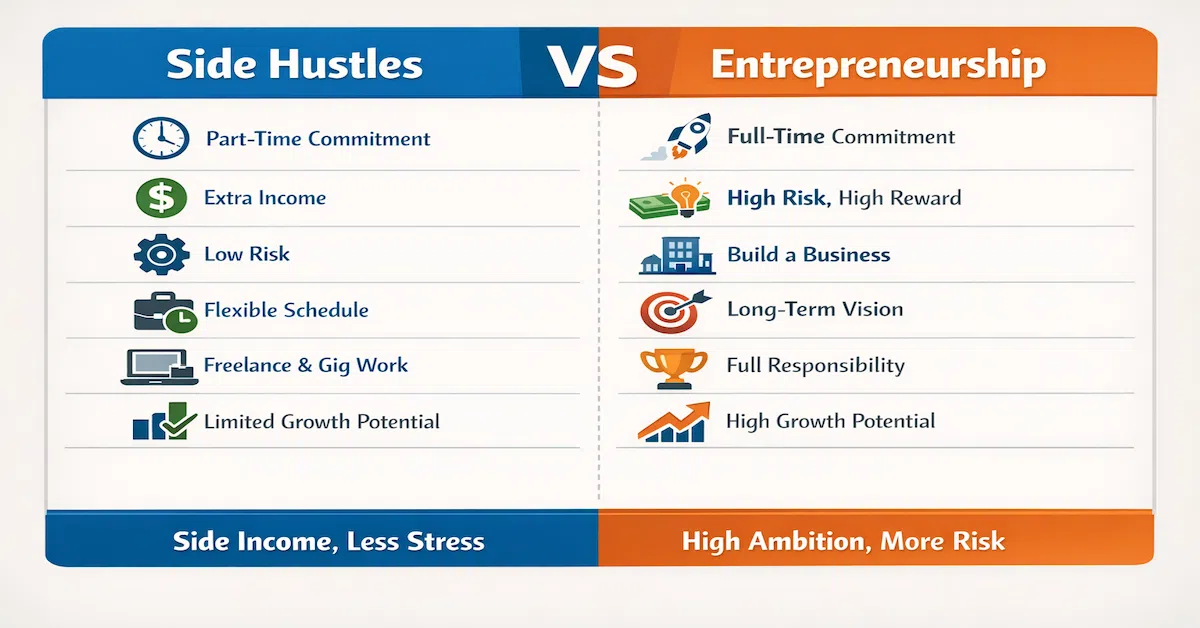
Most successful entrepreneurs do not leap. They bridge. Understanding the three phases of this progression — and where the best side hustle ideas for beginners fit within it — is what separates people who build something durable from those who quit when the initial excitement fades. The Side Hustle Foundations cluster covers the complete Phase 2 framework: how to choose a hustle, launch it, and reach first income within 30 days.
Phase 1: Employee. You trade time for a paycheck. Predictable, but capped. The advantage is stability — you can learn skills, build capital, and test ideas without risking rent money. The ceiling is that your income is tied directly to your hours with no leverage.
Phase 2: Side hustler. You start monetizing skills or ideas outside primary employment. This is not entrepreneurship yet — it is proof of concept. You might freelance on weekends, sell digital products, or run a small service business during evenings and weekends. The goal is not to replace your income. It is to answer one question: can you create value people will pay for independently of your employer? If yes, keep building. If no, adjust the model.
Phase 3: Entrepreneur. You have built systems that generate revenue without your constant presence. You might still work in the business, but it does not collapse if you step away for a week. Revenue is predictable enough to cover expenses. You are no longer testing — you are scaling.
Here is what most people miss: you do not need to quit your job to become an entrepreneur. You need to build something profitable enough that quitting becomes the logical next step, not a leap of faith. The bridge exists for a reason. Use it.
Common Myths That Stop Beginners Before They Start
Myth 1: “I need a groundbreaking idea.” You need a profitable idea that solves a real problem. Most successful businesses are not innovative — they are better-executed versions of existing solutions. Notion did not invent note-taking. Shopify did not invent e-commerce. They built better systems. Your advantage as a beginner is that you can start smaller. Local service businesses, niche digital products, and streamlined consulting work because they solve specific problems, not because they are revolutionary.
Myth 2: “I need venture capital.” VC funding is for businesses that require massive capital to scale. Most beginners need $500 and a clear monetization path, not $500,000. Bootstrapped businesses funded by their own revenue force you to get profitable fast — no vanity metrics, no burn rate, just: does this make money or not? If your business model requires investors before it can generate its first dollar, it is probably the wrong first business.
Myth 3: “I need a huge audience first.” Audience does not equal customers. You can have 100,000 followers and zero revenue without a product that solves a specific problem. You can have 100 email subscribers and $10,000 per month if they are the right people buying the right thing. Build for buyers, not viewers. The audience follows after you prove the business works.
Myth 4: “Entrepreneurship means freedom.” Early-stage entrepreneurship means more work, not less. You are building systems that do not exist yet — nights, weekends, and mental overhead your job never demanded. The freedom comes later when those systems run without you. The beginning is construction, not vacation. People who chase freedom without understanding the build phase quit the first time it gets hard.
What You Actually Need to Start
1. A clear problem you can solve. Not “people need help with marketing.” That is vague. Try: “Local real estate agents need more Instagram engagement but do not have time to create content.” The tighter the problem definition, the easier it is to build a solution people will pay for. Tight positioning attracts buyers. Vague positioning attracts no one.
2. A monetization method. How does money enter this business? Service (you do the work for clients), product (you create something once and sell it repeatedly), or platform (you connect buyers and sellers and take a cut). Choose one. Get profitable. Then expand. Businesses that fail in their first year almost always failed because the monetization method was unclear or untested before infrastructure was built.
3. Validation before scaling. Test your idea with real money before building infrastructure. Pre-sell a service. Launch a minimum viable product. Get ten paying customers before worrying about ten thousand. Validation is not theory — it is revenue. Until someone pays you, everything is a hypothesis.
4. Systems, not just hustle. If your business only works when you are working, you have a job you created for yourself, not a business. Build repeatable workflows for how you deliver value, customer acquisition systems for how new people find you, and revenue tracking for how you know what is working. These do not need to be complex. They just need to exist.
When a Side Hustle Becomes a Business
The shift is happening when three things are simultaneously true. Revenue becomes predictable — not necessarily consistent, but forecastable within a reasonable range based on current client relationships and pipeline. Systems replace you in parts of the operation — through a virtual assistant, automated client onboarding, or a product that sells without your direct involvement in each transaction. And you are optimizing rather than surviving — no longer asking whether this will work, but asking how to make it work better.
This typically happens somewhere around $3,000 to $5,000 per month in revenue — not because that is a magic number, but because it is enough profit to reinvest in systems without starving the business. At that point, you are not testing anymore. You are scaling.
The Real Risks and How to Manage Them
Entrepreneurship carries real risks. Being explicit about them and building deliberate mitigation strategies is what separates operators who last from those who burn out or lose money they could not afford to lose.
Financial risk
You might invest time and money into something that does not work. Mitigation: keep your job while testing, build your side business to profitability before quitting, and do not drain savings to fund a business that has not proven itself.
Time risk
You will spend nights and weekends building instead of resting — months or years of delayed gratification. Mitigation: decide upfront how many hours per week you can sustainably commit and treat that as a ceiling. Burnout kills more businesses than bad ideas.
Opportunity risk
Every hour on the business is an hour not spent elsewhere. Mitigation: be intentional about why you are building. “More money” is not a sufficient anchor — money for what? The clearer the underlying goal, the easier it is to endure the cost of the build phase.
You do not need to leap. You need to build the bridge.
The complete side hustles and entrepreneurship hub covers how income diversification, skill leverage, and scalable business structures work together to build long-term financial independence.
Explore Side Hustles & Entrepreneurship →Next Steps: What to Build First
Step 1: Choose one income stream. Do not build three businesses simultaneously. Pick the one idea that solves a problem you understand deeply, has clear monetization with evidence that people already pay for this type of solution, and fits your current time and energy capacity honestly assessed.
Step 2: Validate with real money. Get one paying customer. Then five. Then ten. Do not build the final version until people have paid for the rough draft. Real customer behavior tells you everything market research cannot.
Step 3: Systematize what works. Once the model is validated, document your delivery process. Turn one-off client work into repeatable workflows. A simple checklist of how you deliver value consistently is sufficient to begin building the machine.
Step 4: Scale or diversify. When the first income stream is profitable and systematic, either scale it (more customers through the same system) or diversify it (new income streams using the same infrastructure). Both work. Choose based on where leverage is highest given what the first income stream has taught you about your market and your own capacity.
Resources
SBA — 10 Steps to Start Your Business
SBA — Choose a Business Structure
IRS — Self-Employed Individuals Tax Center
FTC — Policy Statement on Enforcement Related to Gig Work
This article is part of the Side Hustles & Entrepreneurship system on PersonalOne — a complete framework for building income outside your primary job at every stage.
Frequently Asked Questions
How much money do I need to start a business?
It depends on the model. Service-based businesses can start for under $500 — a basic website, a few tools, and time invested in client acquisition. Product-based businesses may need $1,000 to $5,000 for inventory, design, or platform setup. The consistent principle: start small, prove the model with real revenue, then reinvest earnings to scale rather than funding infrastructure before demand is confirmed.
Should I quit my job to focus on my business full-time?
Not until the business generates enough income to cover your expenses with a three to six month buffer already saved. Most successful entrepreneurs build while employed, then transition once the business proves sustainable at a level matching or exceeding primary employment income for six to twelve consecutive months. The advantage of the side hustle phase is reduced financial risk — that advantage disappears if primary employment is abandoned before the alternative is proven.
How long does it take to become profitable?
Service businesses typically reach profitability in three to six months of consistent effort. Product businesses take six to twelve months. Platform businesses take twelve to twenty-four months. These averages vary based on execution quality, market demand, clarity of problem definition, and hours invested weekly. The most consistent predictor of timeline is consistent client acquisition effort in the first 60 days after launch — not idea quality.
What if I do not have a business idea?
Start with problems you notice repeatedly. What do the people around you complain about? What inefficiencies frustrate you professionally or personally? What do people ask you to help with because you are better at it than they are? Business ideas are not lightning strikes — they are observations turned into solutions. The most durable businesses solve problems that already exist rather than inventing problems to attach products to.
Can I start a business with no prior experience?
Yes. Most entrepreneurs do not have formal business training — they learn by doing. Start small enough that early mistakes are inexpensive, test quickly enough that feedback arrives before significant resources are committed, and treat failures as data rather than defeat. The SBA’s business guides cover the legal and operational fundamentals that new operators most commonly overlook.
Disclaimer: This content is for educational purposes only and does not constitute financial, legal, or tax advice. Entrepreneurship involves financial risk, and outcomes vary based on market conditions, execution quality, and individual circumstances. Consult a qualified professional before making business decisions that affect your financial situation.