Published: February 21, 2026
Home › Banking Systems › Where Your Paycheck Should Go First › How to Set Up a 3-Account Money Flow System That Actually Works
About the Author
Don Briscoe is a financial systems coach with more than 12 years of experience helping Millennials and Gen Z escape the paycheck-to-paycheck cycle. His framework-first approach focuses on building financial infrastructure that works automatically — less willpower, more systems. He founded PersonalOne.org to make structured, honest financial education free and accessible.
TL;DR — What You Will Learn
The 3-account money flow system separates your money into three dedicated accounts: one for bills, one for spending, and one for savings. This physical separation removes the mental burden of tracking categories and prevents you from accidentally spending money earmarked for bills or savings.
This guide gives you the complete implementation:
— Exactly which three accounts you need and why
— How to calculate the right funding amount for each account
— Step-by-step setup process you can complete in under two hours
— How to route income so money lands in the right places automatically
— Common setup mistakes and how to avoid them
Who this is for: Anyone tired of mentally tracking money across categories, constantly checking balances before spending, or worrying that bill money might get spent accidentally.
Here is what typical single-account banking looks like. Your paycheck lands. The balance looks good. You buy groceries. Then coffee. Then gas. The balance still looks okay. Then you remember rent is due tomorrow. And car insurance. And utilities. Suddenly you are doing mental math, trying to figure out what is actually safe to spend.
This is not budgeting. This is financial anxiety disguised as money management.
The 3-account system fixes this by answering one simple question at any given moment: what is safe to spend right now? When your spending account shows $400, you have $400 to spend. Not "maybe $400 if no bills come through." Not "$400 but you should probably save some of it." Just $400 that is yours to use however you want. Your bills are handled. Your savings are growing. Your spending is guilt-free.
How This Fits the Larger System
This guide walks through the full implementation of the 3-account setup — how to calculate each account's funding, route income correctly, and adjust over time. It is one component of the broader paycheck money flow system that determines where your income goes the moment it lands. If you want that strategic foundation before the step-by-step, start there first, then return here to set it up.
What the 3-Account System Actually Is
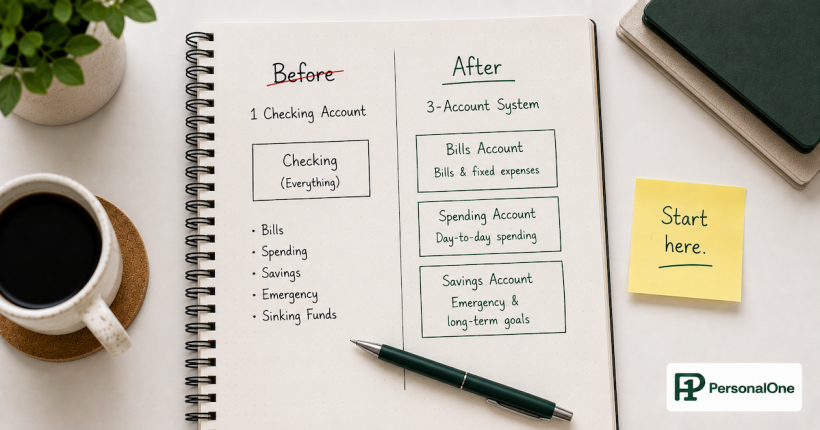
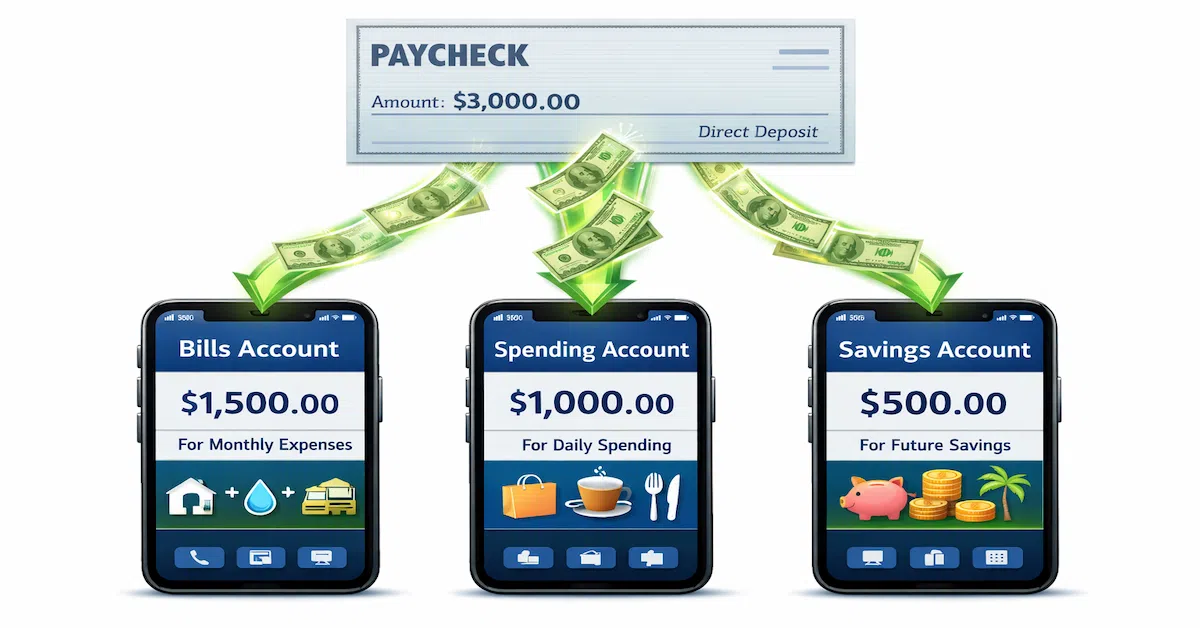
The 3-account money flow system creates physical separation between three types of money. Each account has one job and one job only — and money that belongs to another account never crosses that boundary.
Account #1: Bills Account
Purpose: Fixed monthly obligations only.
What lives here: Rent or mortgage, car payment, insurance, utilities, subscriptions, loan payments — anything that is a predictable monthly expense.
What never touches this account: Discretionary spending, variable purchases, anything that is not a fixed bill.
Account #2: Spending Account
Purpose: Daily life and discretionary purchases.
What lives here: Groceries, gas, restaurants, entertainment, clothing, personal care — anything that varies month to month.
What never touches this account: Bills, savings transfers, fixed obligations.
Account #3: Savings Account
Purpose: Emergency fund and long-term savings goals.
What lives here: Emergency fund, goal-based savings, money you do not plan to touch for at least three to six months.
What never touches this account: Daily spending, bill payments, regular expenses.
Why Physical Separation Works When Mental Accounting Fails
Most budgeting advice tells you to track spending by category. Bills are one category. Food is another. Entertainment is another. You are supposed to remember how much you allocated to each and stay within those invisible limits.
This fails because your brain does not work that way. When you see $3,000 in your checking account, your brain registers $3,000 available. The fact that $1,800 is allocated for bills and $400 for savings is intellectual knowledge that gets overridden by the visual reality of a large balance.
The 3-account system works because it creates visual reality that matches financial reality. When your spending account shows $600, your brain sees $600 — and that is not misleading you. That is actually what you have available. The bills are handled in a different account. The savings are growing in a different account. The $600 you see is genuinely spendable.
This eliminates three major failure points at once. Decision paralysis disappears — no more calculating whether you can afford something before every purchase. Bill anxiety disappears — no more wondering if upcoming bills will overdraft you. Savings guilt disappears — because savings already happened before you spent anything.
Step-by-Step Setup Process
You can set up the complete 3-account system in under two hours. Here is exactly how.
Step 1: Calculate Your Monthly Bill Total
List every fixed monthly expense: rent or mortgage payment, car payment, all insurance (auto, home or renters, health, life), utilities using a three-month average, phone bill, internet, subscription services, and minimum debt payments. Add them all up. This is your Monthly Bill Total.
Example: $1,600 rent + $300 car + $150 insurance + $100 utilities + $50 phone + $60 internet + $40 subscriptions = $2,300 Monthly Bill Total.
Step 2: Determine Your Savings Allocation
Decide how much you can consistently save per month. Start conservative — success at $200 per month beats failure at $500 per month. If you are building your first emergency fund, $200 to $300 per month is a strong starting point. If you already have an emergency fund, aim for 10 to 15% of take-home income. If you are paying off debt, start with the minimum that keeps savings moving while prioritizing the debt.
Example: $300 per month to emergency fund.
Step 3: Calculate Your Spending Allocation
The math is straightforward: Monthly Take-Home Income minus Monthly Bill Total minus Monthly Savings Goal equals Monthly Spending Allocation.
Example: $4,000 income minus $2,300 bills minus $300 savings equals $1,400 monthly spending.
Step 4: Open Your Three Accounts
Bills Account: A free checking account at your current bank. No minimum balance required.
Spending Account: Another free checking account at the same bank, or at a different bank if you want additional separation. No minimum balance required.
Savings Account: A high-yield savings account at an online bank. Online banks consistently offer significantly better interest rates than traditional branch banks. Opening all three accounts online typically takes 30 to 45 minutes total.
Step 5: Set Up Income Routing
Option A — Direct Deposit Splitting (Recommended): Contact your employer's HR or payroll department and request to split your direct deposit. Using the example above with biweekly pay: $1,150 per paycheck to the bills account, $150 per paycheck to savings, and the remainder ($700) to spending. Money lands where it belongs without a single manual transfer.
Option B — Automated Transfers: If your employer does not support deposit splitting, have the full paycheck go to one account, then set up automatic transfers to execute one to two days after payday — $1,150 to bills and $150 to savings, with whatever remains becoming your spending money.
Step 6: Move All Bill Payments to the Bills Account
Log into each biller's website and update the payment method to your bills account. Enable autopay wherever it is available. For any bills that cannot be automated, set calendar reminders to pay manually from the bills account only — never from spending. This step typically takes 30 to 60 minutes and only needs to be done once.
Step 7: Test the System for Two to Three Months
Do not expect perfection immediately. Monitor for two to three months and adjust based on what you observe. If the bills account is running low, increase the allocation slightly. If it is building excess, reduce it and redirect to savings or spending. If the spending account runs out too quickly, increase the spending allocation temporarily. Fine-tuning is normal — you are learning your actual spending patterns, not theoretical ones.
Common Setup Mistakes
Mistake #1: Spreading Accounts Across Too Many Banks Too Soon
The problem: You open the bills account at Bank A, spending at Bank B, and savings at Bank C for maximum separation. Then you cannot easily move money between accounts when you need to adjust, and transfers take two to three days to clear.
The fix: Start with bills and spending at the same bank. Keep savings at a high-yield online bank. Once the system has been stable for six or more months, add separation if it genuinely helps you.
Mistake #2: Not Adding a Buffer to the Bills Account
The problem: You calculate exactly $2,300 in monthly bills and fund exactly $2,300. Then an electric bill spikes $60 or an annual subscription hits and the account overdrafts.
The fix: Add a 10 to 15% buffer to your Monthly Bill Total. If bills are $2,300, fund $2,500. The extra $200 absorbs variations without requiring manual intervention.
Mistake #3: Raiding the Bills Account for Shortfalls
The problem: Your spending account runs low mid-month. You see $1,800 in the bills account and transfer $200 to spending. The following week, rent bounces because you forgot that money was already allocated.
The fix: The bills account is untouchable. Money goes in, bills get paid, that is the entire function. If you need to cover a shortfall, use savings and replace it the following month. Bills money is never available for spending.
Mistake #4: Saving Too Aggressively at First
The problem: You allocate $600 per month to savings. Two weeks in, an unexpected expense hits and you have to pull from savings, which defeats the purpose and discourages the system.
The fix: Start with a conservative savings amount you can maintain consistently for three months. Increase gradually after the system has proven stable.
Mistake #5: Optimizing Before Implementing
The problem: You spend hours researching the perfect checking account with the best rewards and cash back features. Meanwhile, your money is still sitting in one chaotic account.
The fix: Any free checking account works for bills and spending. Any high-yield savings account works for savings. Start with what is easy. Optimize later if the default setup leaves clear room for improvement.
How to Adjust the System Over Time
The 3-account system is not static. It should be reviewed every three to six months or after any significant financial change.
When bills increase — rent goes up, new subscription added, insurance premium increases — increase bills account funding accordingly.
When bills decrease — car loan paid off, subscriptions canceled, refinanced to a lower payment — reduce bills account funding and redirect the freed amount to savings or spending.
When income increases — raise, promotion, new job — split the increase intentionally. A 60/40 split favoring savings is a strong default until savings goals are fully funded.
After a major life change — marriage, kids, new city, career shift — recalculate the entire allocation from scratch rather than patching the existing numbers.
Build the Full Banking Architecture Around This Foundation
The 3-account system is the operational core. The PersonalOne guide on how to structure your bank accounts covers the complete architecture — how accounts connect, when to add additional layers, and how to design a system that scales with your financial life without adding complexity you do not need. Free, no signup required.
Framework-first. Less willpower. More infrastructure.
Frequently Asked Questions
Do all three accounts need to be at the same bank?
No, but starting at the same bank makes the system easier to test and adjust. Keep bills and spending at the same institution for instant transfers during the first few months. Your savings account should be at a high-yield online bank regardless. Once the system is stable, you can move accounts if a different setup makes more sense for your situation.
What if my income varies each month?
Base your bills account funding on your Monthly Bill Total regardless of income — bills stay constant even when income does not. For savings and spending, use your lowest typical income month as the baseline. In higher-income months, route the extra toward savings or a spending buffer. This approach keeps the system stable without requiring you to recalculate every month.
Should I count credit card spending as a bill or spending?
If you pay your credit card balance in full each month, the statement payment is a bill — it comes from the bills account. The purchases themselves come from your spending allocation. You are using credit for rewards or convenience, but the spending still draws down your spending account budget for the month.
What about irregular expenses like car maintenance or holiday gifts?
Two options: add a fourth account specifically for irregular expenses and fund it monthly with a set amount, or build a larger buffer in your spending account to absorb these when they hit. Most people start with the buffer approach and add a dedicated irregular expenses account later once the three-account foundation is stable.
How long until this feels automatic?
In the first week it feels manual and requires attention. By the end of month one you are actively monitoring and adjusting. By month three the system is stable and needs minimal intervention. By month six it is largely invisible — you rarely think about the structure because it is running itself. Give it three full months before deciding whether it is working for you.
What if I want to save more but cannot reduce spending further?
Your options are to increase income or decrease fixed bills. Spending is what is left after bills and savings are funded — if spending is already at a minimum and savings still feels inadequate, the math is telling you the bills-to-income ratio is too high, or income needs to grow. The system reveals this clearly, which is part of its value.
Can I use this system if I am paid weekly?
Yes. Divide your Monthly Bill Total by four instead of two. If bills are $2,000 per month, fund $500 per weekly paycheck. The same logic applies — the amounts are smaller and adjustments happen more frequently, which many people find makes the system even easier to manage.
What is the difference between this and the envelope method?
The envelope method uses physical cash divided into labeled envelopes for different spending categories. The 3-account system uses bank accounts for automatic separation. Both rely on the principle of pre-allocation, but bank accounts enable direct deposit splitting, autopay, and interest earnings that cash envelopes cannot provide — and they operate without any manual cash handling.
Resources
FDIC: How to Make the Most of Your Bank Accounts — Federal guidance on account types, deposit insurance limits, and evaluating banking options.
CFPB: What Is a Checking Account? — Official breakdown of checking account features, fees, and consumer protections.
CFPB: What Is a Savings Account? — How savings accounts work, what to look for in interest rates, and how they differ from checking.
Disclaimer: The content on PersonalOne.org is for informational and educational purposes only and does not constitute financial, legal, or tax advice. Optimal account structure depends on individual income sources, expense patterns, savings goals, and personal preferences. Before making significant changes to your banking setup, consider your complete financial situation. Account features and availability vary by financial institution. PersonalOne provides educational content and does not offer personalized financial planning services.