May, 2026
Home › Financial Stability › Financial Shock Absorption › The Worst-Case Scenario Budget: Designing a Lean Survival Plan
What You Need to Know
— A worst-case scenario budget is a pre-built plan for your financial floor — the minimum monthly amount required to survive a financial crisis without taking on debt
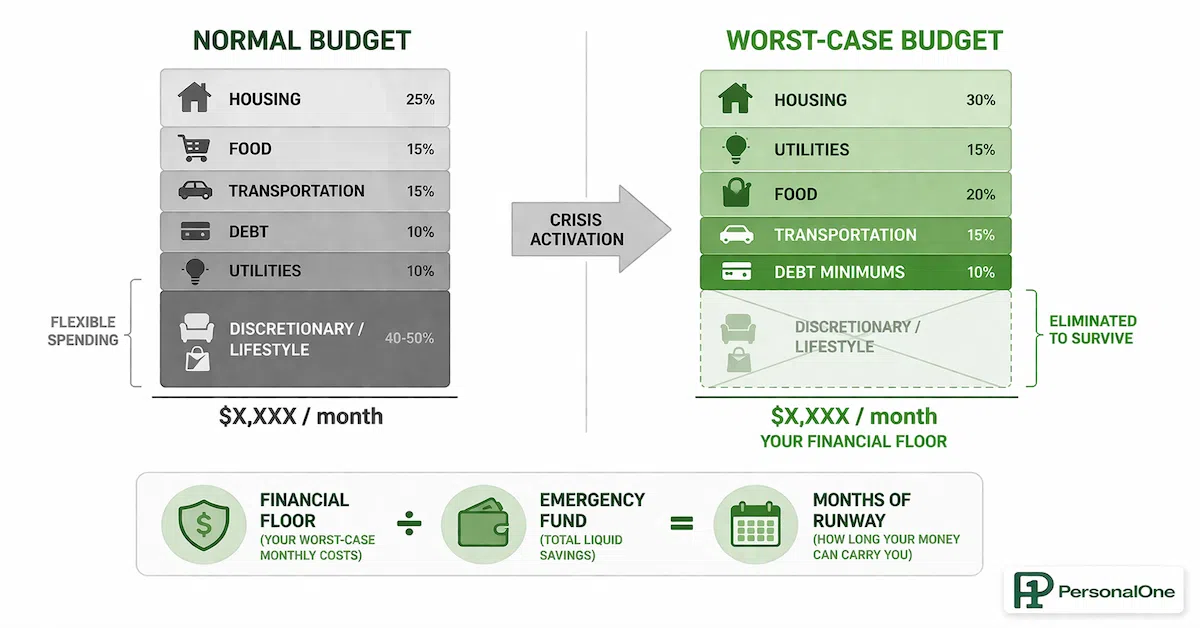
— The five survival categories are housing, utilities, food, transportation, and minimum debt payments — everything else is suspended in a true worst case
— Building this budget before a crisis gives you clarity, runway calculation, and a documented plan that removes emotional decision-making under pressure
— Most people discover their worst-case monthly number is 40 to 60 percent lower than their normal spending — this gap is your financial resilience margin
— The worst-case budget is a temporary tool with a specific exit trigger — not a permanent lifestyle, and not an identity
The worst-case scenario budget is one of the most powerful financial planning tools you can build — and almost nobody builds it until they are already in the worst case. At that point, it is being built under stress, with incomplete information, and with a sense of urgency that leads to mistakes. The purpose of building it now, when nothing is wrong, is exactly to avoid that scenario.
A worst-case scenario budget answers a specific question: if your income stopped today, what is the absolute minimum amount you need each month to maintain shelter, keep the lights on, eat, get around, and avoid credit default? That number — your financial floor — is the foundation of every crisis cash flow decision you will ever need to make. The crisis cash flow strategy built into the Financial Shock Absorption cluster starts with this number. Everything else in a financial crisis is calculated relative to it.
This guide walks through how to build the budget, how to use it, and how to calibrate your emergency fund and runway calculations against it.
What a Worst-Case Budget Is — and What It Is Not
A worst-case scenario budget is not a permanent spending plan. It is not a statement about how frugal you are or how little you need. It is a pre-designed crisis response that you activate only when income disruption makes it necessary, and that you exit the moment income recovery allows.
It is also not a deprivation exercise. The goal is not to see how little you can survive on. The goal is to know your exact financial floor — the number below which your situation becomes genuinely impossible to manage without debt — so that you can calculate runway, manage resources, and communicate with creditors from a position of accurate information rather than anxiety and guesswork.
People who have built their worst-case budget before they needed it consistently report the same experience: the number is lower than expected, the exercise itself is calming rather than stressful, and having the number removes a significant source of the ambient financial anxiety that comes from not knowing what the floor actually is. The financial stability guide frames this kind of pre-built contingency planning as one of the distinguishing characteristics of a financially resilient system.
The Five Survival Categories
A worst-case scenario budget includes exactly five categories. Nothing else. Every item in your current budget gets evaluated against these five and either kept or suspended. There is no partial inclusion, no blended category, and no exceptions that start as temporary and become permanent.
Category 1: Housing. Rent or mortgage minimum payment. For renters, this is the contractual monthly rent. For mortgage holders, this is the minimum required payment to avoid default — not the full payment if you typically pay extra principal. If you are in a housing situation where the payment exceeds 50 to 60 percent of your available income or benefits, proactive communication with your landlord or servicer about temporary arrangements is a parallel action item, not an alternative to including the full payment here.
Category 2: Essential utilities. Electricity, gas, water, and internet. Internet is included because it is required for job searching, remote work, and benefits access in the current environment. Phone at minimum plan cost is included. Streaming services, premium tiers, and non-essential add-ons are suspended. Use actual bill amounts from your lowest recent months as the estimates — these can typically be reduced further by reducing usage consciously.
Category 3: Groceries. Home cooking only. No dining out. No delivery. No convenience foods priced at a premium over their home-cooked equivalent. The USDA Thrifty Food Plan provides a research-backed minimum cost benchmark: approximately $200 to $280 per month for a single adult, $380 to $470 for a couple, using deliberate meal planning, lowest-cost protein sources, and minimal food waste.
Category 4: Transportation. The minimum required to maintain access to employment, job searching, or income generation. For car owners: fuel and the minimum required insurance to legally operate the vehicle. Public transit cost if applicable. Car payments are treated separately as debt minimums below. Non-essential driving reduces fuel cost and is an active tool in worst-case budget compression.
Category 5: Minimum debt payments. The contractual minimum payment on every debt: credit cards at minimum payment, auto loans at regular payment, student loans at minimum or income-driven payment, personal loans at minimum payment. This category prevents credit default, which would compound the financial crisis with damaged credit and penalty rates. If debt minimums collectively consume more than 30 to 35 percent of available resources, proactive creditor outreach for hardship arrangements is a necessary parallel action. The complete script and strategy for those conversations is in the guide to negotiating with creditors during financial hardship.
What Gets Suspended Immediately
Everything not in the five categories above is suspended on Day 1 of worst-case budget activation. No exceptions, no negotiations with yourself about this specific subscription or that particular expense being special. The suspension is total and immediate because partial suspension does not reduce the burn rate enough to meaningfully extend runway.
The suspended list includes: all streaming and entertainment subscriptions, dining out and food delivery, gym and fitness memberships, clothing purchases beyond genuine emergency replacement, personal care beyond basics, all savings contributions above what is required to maintain minimum balance requirements on accounts, all discretionary charitable giving (this resumes in recovery), non-essential insurance riders and add-ons, any recurring purchase that is a want rather than a survival need.
This is not the permanent elimination of these things. It is a deliberate temporary suspension with a defined exit trigger. The suspension ends when the exit trigger is met — not when you feel like the crisis is probably mostly over, and not when income partially recovers to a level that could maybe cover some of them. The exit trigger is defined in advance.
Defining Your Exit Trigger
A worst-case budget without a defined exit trigger tends to linger beyond its useful life, creating unnecessary financial restriction during recovery, or collapse prematurely before recovery is genuinely stable. The exit trigger must be specific, measurable, and defined before the crisis begins.
A standard exit trigger framework: the worst-case budget remains active until all three of the following are simultaneously true. First, replacement income covers 100 percent of the five survival categories without drawing on savings. Second, the emergency fund drawdown from the crisis has been restored to at least 50 percent of its pre-crisis balance. Third, there are no active creditor hardship arrangements in place — all payments are back on normal schedules.
When all three conditions are met simultaneously, the budget transitions from survival mode to recovery mode. Recovery mode means the bare-bones budget expands to include a small discretionary tier while maintaining accelerated emergency fund replenishment. It is not a full return to normal spending — that comes after the emergency fund is fully restored. The sequencing here connects directly to the emergency fund rebuild framework in the emergency fund strategy cluster.
How to Build Your Worst-Case Budget Now
Building this budget takes approximately 45 to 60 minutes using your last three months of bank and credit card statements. The output is a single document with five line items, an exact monthly total, and your calculated runway based on current liquid savings.
Open your statements. List every recurring expense in the past three months. Classify each as survival category or suspended. For survival categories, use actual monthly amounts — not estimates. For housing and debt minimums, use the contractual amounts. For utilities, use the highest month to build in a conservative buffer. For groceries, use your actual spending and then calculate whether it needs to be reduced to reach the USDA Thrifty Food Plan benchmark.
Total the five categories. That total is your worst-case monthly number. Divide your current liquid savings by that number. The result is your runway in months at the worst-case budget level. If your runway is less than 3 months, your emergency fund needs to be the immediate savings priority — the build target is 6 months of the worst-case budget number, not 6 months of your normal spending. The buffer account system covers how to structure the accounts that hold both your emergency fund and your operating cash so they are accessible when needed but protected from casual spending. And if you are preparing for a voluntary income disruption such as quitting a job, this same bare-bones number is the foundation of the runway calculation in the guide on how to prepare financially before you quit a job.
Know your floor before you need it.
The worst-case scenario budget is one part of the complete Financial Shock Absorption system. The full framework — including the 30-day income disruption plan, creditor communication strategy, and crisis sequencing — is in the cluster hub.
Financial Shock Absorption → Financial Stability Hub →Using the Budget to Calculate True Emergency Fund Targets
The conventional emergency fund target — 3 to 6 months of expenses — is ambiguous because it does not specify which expenses. Three months of your normal budget is a very different number than 3 months of your worst-case budget, and the latter is the correct calculation for an emergency fund that functions as intended.
Your emergency fund target should be 6 months of your worst-case monthly total for most employed individuals, and 9 to 12 months for self-employed, freelance, or variable income earners whose income disruptions tend to last longer and arrive without warning. Using the worst-case number rather than your normal spending number typically sets the target 30 to 50 percent lower, making it more achievable to build while ensuring it is calibrated to the actual scenario it is designed to cover.
This recalibration also changes how you think about emergency fund adequacy. A $20,000 emergency fund against a normal budget of $5,000 per month looks like 4 months of coverage. Against a worst-case budget of $2,800 per month, it is 7 months of coverage — a materially different resilience position. Know your real number. The complete framework for sizing your emergency fund around this number — including how household structure and income stability affect the calculation — is in the guide on how much emergency fund you actually need.
Resources
Official Sources
CFPB: Budgeting and Spending Tools — Consumer Financial Protection Bureau budget-building tools and guidance on building a spending plan calibrated to reduced income.
BLS: Consumer Expenditure Survey — Bureau of Labor Statistics data on average household spending by category — a useful benchmark for understanding which expense categories have the most room for compression.
USDA: Food Plans and Cost of Food Reports — Official USDA monthly data on the Thrifty Food Plan — the authoritative reference for minimum adequate food budgets.
Benefits.gov: Federal Assistance Programs — Official federal resource for identifying government assistance programs that may reduce survival category costs during financial hardship.
Continue Building Your Shock Absorption System
The 30-Day Income Disruption Plan — The worst-case budget is the first number you activate on Day 1 of income disruption — this guide shows you the complete day-by-day sequence.
How to Prepare Financially Before You Quit a Job — The bare-bones number from this budget is the foundation of every voluntary departure runway calculation.
Financial Stress Relief: The 4-Layer Money System — How the worst-case budget number connects to building the buffer layers that prevent you from ever needing to activate it.
The full Financial Stability framework is in the Financial Stability guide.
Frequently Asked Questions
How low can a worst-case budget realistically go?
For a single adult renting in a mid-cost city, a genuine worst-case budget typically falls between $1,800 and $2,800 per month covering the five survival categories. In lower-cost areas or with a roommate sharing housing costs, it can be lower. For a couple with no car payment and shared housing, $2,400 to $3,600 is a realistic range. The variation is driven primarily by housing cost, which is the largest and least compressible category in most budgets.
Should I include minimum 401(k) contributions in my worst-case budget?
No. 401(k) contributions are suspended in a worst-case scenario unless your employer match requires a contribution to receive it, in which case you contribute only enough to capture the full match. Retirement savings contributions beyond the employer match minimum are not a survival category and do not belong in the worst-case budget. They resume in recovery mode once the emergency fund drawdown is being replenished.
What if my housing cost alone exceeds my monthly income or benefits?
This is a structural problem that requires a parallel action, not a budgeting adjustment. If housing cost exceeds available income and benefits during a crisis, proactive communication with your landlord about temporary deferral or reduced payment is the immediate step. Moving to a lower-cost housing situation may be necessary if the crisis extends beyond 60 to 90 days. No budget adjustment on the other four categories can compensate for housing cost that exceeds total available resources.
How is the worst-case budget different from a regular emergency budget?
An emergency budget is a reduced version of your normal spending that acknowledges a financial challenge and cuts discretionary spending. A worst-case scenario budget is a structural minimum that excludes everything that is not survival-critical. The difference is degree and discipline. Most people build emergency budgets and then gradually re-expand them before the crisis is resolved. A worst-case budget has a defined activation trigger and a defined exit trigger, and it operates in a binary mode: fully active or fully exited.
Can I build this budget if I have variable income normally?
Yes, and it is especially important to do so. For variable income earners, the worst-case scenario is not a hypothetical — it is a recurring reality during low-income months. Your worst-case budget is essentially the budget you operate on during your lowest-income periods. Building it explicitly, giving it a name, and calculating your runway against your emergency fund provides the same clarity and removes the same anxiety that variable earners face every time income dips. The income volatility management framework for this is covered in the income volatility management cluster.
Disclaimer: This article is for informational and educational purposes only and does not constitute financial, legal, or tax advice. Individual financial situations, housing markets, and debt structures vary significantly. The budget ranges and benchmarks cited are illustrative and not universally applicable. Consult qualified professionals for guidance specific to your situation. PersonalOne is not a licensed financial advisor.