February 19, 2026
Home > Investing & Wealth Growth > Index Funds and ETFs for Beginners: What to Buy, What to Skip
TL;DR – Quick Takeaways
- Index funds and ETFs are the same thing with different wrappers – Both track market indexes. ETFs trade like stocks, mutual funds trade once daily.
- Total market index funds = instant diversification – VTI, FSKAX, SWTSX hold 3,000+ U.S. companies. Single purchase = entire market.
- Expense ratios compound over decades = $200K+ difference – 1% annual fee costs you 25-30% of wealth over 30 years. Use 0.03-0.20% funds only.
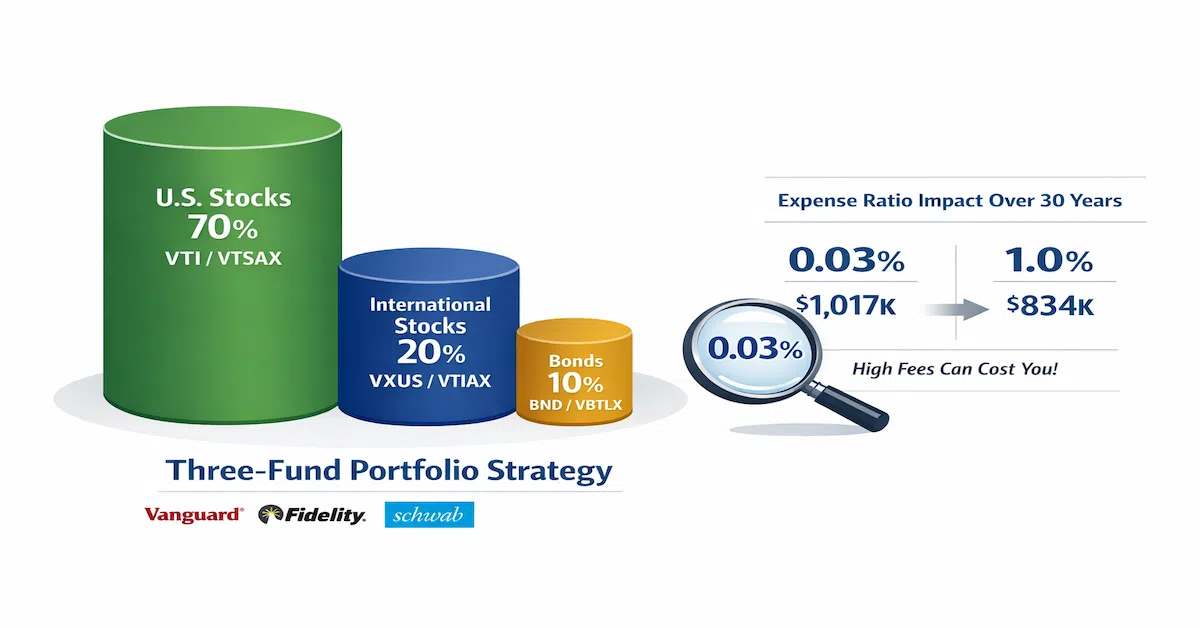
- Three-fund portfolio = simplest complete strategy – U.S. stocks (70%), International stocks (20%), Bonds (10%). Rebalance annually. Done.
- S&P 500 vs Total Market = negligible difference – S&P 500 = 500 largest companies (80% of market). Total market = 3,000+ companies. Performance nearly identical.
- Vanguard, Fidelity, Schwab = all excellent, minor differences – Vanguard invented index funds (lowest fees). Fidelity has zero-fee funds. Schwab is comparable. Pick one, stop overthinking.
- Individual stocks = gambling, not investing – 80% of professionals can't beat index funds. You won't either. Stick to indexes.
- Set and forget = best strategy – Buy total market funds. Hold forever. Rebalance annually. Ignore daily market noise. Get rich slowly.
The Paradox of Choice: Too Many Options, One Best Answer
Here's the problem: There are 10,000+ mutual funds and ETFs available to invest in. Financial media makes investing sound complex. Fund companies want you confused so they can sell expensive products.
Here's the truth: 95% of investors should own 1-3 index funds and never touch them. That's it. Everything else is noise designed to extract fees from you.
This article will tell you:
- What index funds and ETFs are (and why they beat everything else)
- Which specific funds to buy (ticker symbols included)
- How to build a three-fund portfolio that requires 30 minutes of maintenance per year
- Why expense ratios matter more than performance
- How to pick a brokerage (Vanguard vs Fidelity vs Schwab)
By the end, you'll know exactly what to buy and where to buy it. No confusion, no analysis paralysis.
Index Funds vs ETFs vs Individual Stocks: The Decision Framework
Individual Stocks:
Buying shares of single companies (Apple, Microsoft, Tesla, etc.). Verdict: Don't do this as a beginner.
- Why people think they should: "I'll pick winners and beat the market!"
- Reality: 80-90% of professional fund managers with PhDs, Bloomberg terminals, and research teams can't beat index funds over 10+ years. You won't either.
- Risk: Single company goes bankrupt (Enron, Lehman Brothers, Circuit City) = 100% loss
- Time required: Hours of research per stock, constant monitoring, quarterly earnings analysis
Index Mutual Funds:
Funds that own all companies in a specific index (S&P 500, Total Market, etc.). Trade once per day after market close.
- Examples: VTSAX (Vanguard Total Stock Market), FSKAX (Fidelity Total Market), SWTSX (Schwab Total Market)
- Pros: Instant diversification, low fees (0.03-0.20%), automatic dividend reinvestment, can set up automatic investments
- Cons: Trade only once daily, may have minimum investment ($1-3K for some funds)
ETFs (Exchange-Traded Funds):
Same as index mutual funds but trade like stocks throughout the day. Functionally identical for buy-and-hold investors.
- Examples: VTI (Vanguard Total Stock Market ETF), ITOT (iShares Core S&P Total U.S. Stock Market ETF)
- Pros: No minimum investment (buy 1 share for ~$200-300), slightly more tax-efficient, trade throughout day
- Cons: Must manually reinvest dividends (extra step), can't automate dollar-amount purchases easily
The Verdict:
Index mutual funds vs ETFs = doesn't matter for beginners. They track the same indexes, have similar fees, and produce identical long-term returns. Pick whichever your brokerage makes easiest to automate.
Individual stocks vs index funds = index funds win every time. Lower risk, better diversification, less time, better returns for 80-90% of investors over 10+ years.
What Index to Track: S&P 500 vs Total Market vs International
S&P 500 Index:
The 500 largest U.S. companies by market capitalization. Represents ~80% of total U.S. stock market value.
- Holdings: Apple, Microsoft, Amazon, Nvidia, Google, Meta, Tesla, Berkshire Hathaway, etc.
- Fund examples: VOO (Vanguard), SPY (State Street), IVV (iShares)
- Historical return: ~10% annually over 90+ years
- Best for: Simple one-fund portfolio, proven track record
Total U.S. Stock Market Index:
Every publicly traded U.S. company (~3,000-4,000 companies). Includes S&P 500 plus mid-caps and small-caps.
- Holdings: All S&P 500 companies + 2,500 smaller companies
- Fund examples: VTI (Vanguard ETF), VTSAX (Vanguard mutual fund), FSKAX (Fidelity), SWTSX (Schwab)
- Historical return: ~10% annually (nearly identical to S&P 500)
- Best for: Slightly broader diversification, "own the entire market" mentality
International Stock Index:
Companies outside the U.S. (developed markets like Europe/Japan + emerging markets like China/India).
- Holdings: Nestle, Samsung, Toyota, TSMC, Alibaba, etc.
- Fund examples: VXUS (Vanguard Total International), FTIHX (Fidelity Total International), SWISX (Schwab International)
- Historical return: ~7-8% annually (lower than U.S., higher volatility)
- Best for: Geographic diversification, hedge against U.S.-only risk
The key question: S&P 500 or Total Market?
S&P 500 vs Total Market performance over 30 years: 99.8% correlated.
The difference in returns over decades is typically 0.1-0.3% annually. On a $500K portfolio, that's $500-1,500/year difference.
Verdict: Pick either one. Stop overthinking. Both are excellent. If forced to choose, Total Market is slightly broader (includes small/mid-caps), but S&P 500 has longer historical data. Flip a coin.
Expense Ratios: The Silent Wealth Killer
Expense ratio = annual fee charged by the fund, expressed as a percentage of your investment.
Why this matters more than you think:
Scenario 1: Low-cost index fund (0.03% expense ratio)
Invest $500/month for 30 years at 10% gross return
Expense ratio cost: 0.03% annually
Final balance: $1,017,000
Scenario 2: Average actively managed fund (1.0% expense ratio)
Invest $500/month for 30 years at 10% gross return
Expense ratio cost: 1.0% annually
Final balance: $834,000
Difference: $183,000 stolen by fees over 30 years.
That 1% "small" fee compounds against you for three decades. It's not 1% of your contributions—it's 1% of your entire growing balance every single year.
Expense ratios of common fund types:
- Low-cost index funds: 0.03-0.20% (keep 99.7-99.97% of returns)
- Average mutual funds: 0.50-1.00% (lose 0.5-1.0% annually)
- Actively managed funds: 1.00-2.00% (lose 1-2% annually + usually underperform anyway)
- Fidelity ZERO funds: 0.00% (literally free, no catch)
Target expense ratio: Under 0.20%. Ideal: 0.03-0.10%.
How to check expense ratio: Every fund lists it in the prospectus. Vanguard, Fidelity, and Schwab show it prominently on fund pages. If you can't find it easily, the fund is hiding something—run away.
The Three-Fund Portfolio: Simplest Complete Strategy
Invented by Vanguard founder Jack Bogle. Used by millions of successful investors. Requires 30 minutes of maintenance per year.
The framework:
- U.S. Total Stock Market (or S&P 500): 60-80% of portfolio
- International Total Stock Market: 20-30% of portfolio
- U.S. Total Bond Market: 10-30% of portfolio (increases with age)
Sample allocations by age:
Age 25-35 (aggressive growth):
70% U.S. Total Stock Market
20% International Total Stock Market
10% U.S. Total Bond Market
Age 40-50 (moderate growth):
60% U.S. Total Stock Market
20% International Total Stock Market
20% U.S. Total Bond Market
Age 55-65 (approaching retirement):
50% U.S. Total Stock Market
20% International Total Stock Market
30% U.S. Total Bond Market
Specific funds for three-fund portfolio:
Vanguard Three-Fund Portfolio:
1. VTSAX (Total Stock Market) or VTI (ETF version) - 0.04% expense ratio
2. VTIAX (Total International) or VXUS (ETF version) - 0.11% expense ratio
3. VBTLX (Total Bond Market) or BND (ETF version) - 0.05% expense ratio
Fidelity Three-Fund Portfolio:
1. FSKAX (Total Market Index) - 0.015% expense ratio
2. FTIHX (Total International) - 0.06% expense ratio
3. FXNAX (U.S. Bond Index) - 0.025% expense ratio
Schwab Three-Fund Portfolio:
1. SWTSX (Total Stock Market) - 0.03% expense ratio
2. SWISX (International Index) - 0.06% expense ratio
3. SWAGX (U.S. Aggregate Bond) - 0.04% expense ratio
How to maintain:
- Set up automatic monthly contributions split across three funds according to target allocation
- Once per year (January is common), check if allocation has drifted more than 5%
- If yes, sell overweight funds and buy underweight funds to rebalance back to target
- Otherwise, do nothing and let it compound
That's it. 30 minutes per year. No daily monitoring. No CNBC. No panic selling. Just boring compound growth.
Ready to Implement Your Complete Investment Strategy?
Now you know what to invest in. Learn the complete Stage 7 wealth-building system including retirement accounts, tax optimization, and long-term strategy:
→ Master the complete Investing & Wealth Growth system
→ Where to invest: 401(k), IRA, Roth IRA priority framework
→ Investment fundamentals: Risk, diversification, time horizon
Vanguard vs Fidelity vs Schwab: Which Brokerage to Choose
All three are excellent. The differences are minor. Pick one and move on.
Vanguard:
- Pros: Invented index funds, client-owned (profits returned to investors via lower fees), rock-bottom expense ratios, investor-first culture
- Cons: Website/app interface is dated, customer service can be slow, $1-3K minimums for some mutual funds
- Best for: Purists who want the lowest fees and don't care about fancy interfaces
Fidelity:
- Pros: Zero expense ratio funds (FZROX, FZILX - literally free), best customer service, excellent mobile app, no account minimums, fractional shares
- Cons: Slightly more emphasis on upselling other products (credit cards, managed accounts)
- Best for: Beginners who want ease of use and excellent support
Schwab:
- Pros: Great interface, excellent customer service, competitive expense ratios, strong banking integration, no account minimums
- Cons: Slightly higher expense ratios than Vanguard/Fidelity (0.03% vs 0.015-0.04%)
- Best for: People who want banking + investing in one place
The honest truth: All three will make you wealthy if you invest consistently in low-cost index funds.
The difference between Vanguard's 0.04% and Fidelity's 0.015% on a $500K portfolio = $125/year. Not nothing, but not worth losing sleep over.
Just pick one, open an account, and start investing. Paralysis by analysis costs you more than choosing the "wrong" brokerage.
Rebalancing: Annual Maintenance in 15 Minutes
Why rebalance: Over time, stocks grow faster than bonds. Your 70/20/10 allocation drifts to 78/22/5 because stocks outperformed. This increases risk beyond your target.
How to rebalance:
- Check allocation once per year (January 1st is easy to remember)
- If any fund drifted 5%+ from target, rebalance
- Target: 70% stocks, 20% international, 10% bonds
- Actual: 75% stocks, 22% international, 3% bonds
- Stocks and international are overweight, bonds underweight
- Two rebalancing methods:
- Method A (easier): Direct new contributions to underweight funds until allocation corrects
- Method B (faster): Sell overweight funds, buy underweight funds
- In tax-advantaged accounts (401k, IRA): Use Method B. No tax consequences for selling.
- In taxable accounts: Use Method A to avoid triggering capital gains taxes.
How often to rebalance: Once per year is optimal. More frequent = unnecessary trading costs and taxes. Less frequent = drift gets worse. Annual rebalancing is the sweet spot backed by research.
Common Index Fund Mistakes (And How to Avoid Them)
Mistake #1: Paying high expense ratios
Your 401(k) offers an S&P 500 fund with 0.80% expense ratio. Problem: Over 30 years, that extra 0.75% costs you $80K+ on a $300K balance. Solution: Choose funds under 0.20%. If your 401(k) only has expensive options, contribute to match only, then max Roth IRA with low-cost funds.
Mistake #2: Over-diversifying (diworsification)
Owning 10 different index funds: Large-cap growth, large-cap value, mid-cap, small-cap, international developed, emerging markets, sector funds, etc. Problem: Complexity with no benefit. You've recreated a total market fund with extra fees and effort. Solution: Three-fund portfolio. Stop there.
Mistake #3: Timing the market with index funds
"Market is at all-time high, I'll wait for a crash to invest." Problem: Time in market beats timing the market. Waiting costs you gains. Solution: Dollar-cost averaging. Invest same amount monthly regardless of market conditions.
Mistake #4: Rebalancing too frequently
Checking portfolio daily, rebalancing monthly. Problem: Trading costs (even commission-free trades have bid-ask spreads), tax consequences in taxable accounts, unnecessary stress. Solution: Rebalance once per year maximum. Quarterly if you really can't help yourself.
Mistake #5: Chasing performance
"Small-cap value beat the market last 3 years, I should switch to that!" Problem: Past performance doesn't predict future returns. You're buying high after the run-up. Solution: Set allocation based on age/risk tolerance, then ignore performance chasing.
Mistake #6: Not automating investments
Manually remembering to invest each month. Problem: You forget, procrastinate, or panic during market drops and stop investing. Solution: Set up automatic monthly transfers from checking to brokerage, automatic purchases of index funds. Set it and forget it.
Frequently Asked Questions
Should I buy the mutual fund or ETF version of the same index?
For beginners: Mutual funds are easier. You can set up automatic investments of exact dollar amounts ($500/month). ETFs require buying whole shares, so $500 might only buy 2.3 shares and you have $50 left over. ETFs are slightly more tax-efficient, but inside 401(k) or IRA it doesn't matter. Pick mutual funds unless you have specific reasons to prefer ETFs.
Is a target-date fund better than a three-fund portfolio?
Target-date funds (Vanguard Target 2060, Fidelity Freedom 2065, etc.) are three-fund portfolios that automatically rebalance and adjust allocation as you age. They're perfect for hands-off investors. Slightly higher expense ratios (0.08-0.15% vs 0.03-0.06% for DIY) but worth it for automation. If you don't want to rebalance annually, use target-date funds. If you want maximum control and lowest fees, use three-fund portfolio.
Do I need international stocks or is U.S. enough?
Reasonable people disagree. U.S.-only: Simpler, historically higher returns, many U.S. companies already global (Apple, Microsoft get 40%+ revenue internationally). Adding international: Geographic diversification, hedge against U.S. underperformance, access to companies not in U.S. Recommendation: 20-30% international provides diversification without over-complicating. But if you want 100% U.S., you'll probably be fine too.
When should I sell my index funds?
Almost never. Reasons to sell: (1) Rebalancing to target allocation, (2) You need the money in retirement, (3) Major life change requiring funds (home down payment, emergency). Never sell because: Market dropped 20%, CNBC said recession is coming, friend told you about hot stock, you're "locking in gains." Buy and hold for decades. That's the entire strategy.
Can I just buy one total world stock fund instead of U.S. + International?
Yes. VT (Vanguard Total World Stock ETF) or VTWAX (mutual fund version) hold ~8,000 companies across 50+ countries. One fund = entire global stock market. Slightly less control over U.S. vs international allocation (it's market-cap weighted, currently ~60% U.S. / 40% international). But perfectly valid single-fund approach. Add a bond fund and you have a two-fund portfolio.
What if my 401(k) doesn't offer these low-cost index funds?
Contribute enough to get full employer match (free money), then prioritize Roth IRA where you can choose any funds. If all 401(k) options have 0.50%+ expense ratios, your priority becomes: (1) 401(k) to match, (2) Max Roth IRA with low-cost funds, (3) Return to 401(k) and choose "least bad" option (usually S&P 500 or target-date fund with lowest expense ratio available).
Continue Learning: Index Fund Investing
Each article in this cluster breaks down a specific piece of the index fund investing framework — from how markets work to which investment vehicles fit your goals and timeline.
How Stock Markets Actually Work
How exchanges operate, why prices move, what bull and bear markets mean, and what all of it tells you about building long-term wealth through the market.
Stock Market for Beginners
A plain-language starting point for anyone new to investing — what stocks are, how to start, and how to avoid the mistakes most beginners make in the first year.
Index Funds vs. ETFs: Which Is Better?
A direct comparison of two of the most popular long-term investment vehicles — how they differ in structure, cost, flexibility, and which one fits different investor situations.
Everything You Need to Know About Mutual Funds
How mutual funds work, why they remain one of the most common starting points for long-term investors, and how to pick your first one without overthinking it.
Official Sources
SEC — Mutual Funds and ETFs — U.S. Securities and Exchange Commission guidance on fund structure, risks, fees, and what investors should understand before buying.
Investor.gov — Mutual Funds and ETFs — Plain-language overview of how both investment vehicles work, what investors own, and how costs affect long-term returns.
FINRA — Mutual Funds — Investor education on share classes, expense ratios, and how to evaluate fund costs before investing.
Brokerage Resources
Vanguard — Index Fund List — Full list of Vanguard index funds and ETFs with expense ratios, minimum investments, and performance data.
Fidelity — Index Funds Overview — Fidelity's index fund lineup including zero-expense-ratio options and tools for comparing fund performance.
Schwab — Index Funds — Charles Schwab index fund options with low minimums and resources for first-time index fund investors.
Continue Learning About Investing
Index fund investing is one part of the broader Index Fund Investing cluster. For the complete framework connecting investment vehicles to long-term wealth building and portfolio growth, continue into the Investing & Wealth Growth hub.
Disclaimer: The information provided in this article is for educational purposes only and does not constitute financial, investment, or tax advice. PersonalOne and its content creators are not licensed financial advisors or registered investment advisors. Specific fund recommendations (VTI, VTSAX, FSKAX, etc.) are examples for educational purposes only, not personalized investment recommendations. Index fund investing involves risk, including potential loss of principal. Past performance does not guarantee future results. Expense ratios, fund availability, and investment minimums are subject to change. Before investing, review fund prospectuses, understand risks, consider your investment objectives and risk tolerance, and consult with a licensed financial advisor or investment professional who can assess your specific situation. The three-fund portfolio framework is a general strategy—your optimal allocation depends on factors including age, risk tolerance, time horizon, income, existing assets, and financial goals. Never invest money you cannot afford to lose.