March, 2026
Home › FinTech & Modern Money Tools › Open Banking & AI FinTech
PersonalOne Money System
This resource is part of the PersonalOne framework for building financial systems that run automatically — covering the tools, strategies, and infrastructure that replace willpower with structure. PersonalOne provides free financial education for Millennials and Gen Z.
What This Guide Covers
— Open banking is the infrastructure behind every financial app you connect to your bank — understanding how it works helps you make smarter decisions about which tools to trust and what data you are sharing
— AI is already inside the apps most people use daily — fraud detection, smart categorization, predictive budgeting, and personalized insights are all AI-powered right now
— Cybersecurity is a financial system skill, not an IT concern — knowing how to protect your accounts is as important as knowing how to open them
— Blockchain and DeFi have moved from speculative to operational — real infrastructure decisions at major financial institutions are being made on these rails today
— Emerging FinTech moves faster than regulation — understanding which tools are safe, which are speculative, and which are genuinely useful is what protects you
Understanding how open banking and AI are changing FinTech is not optional background knowledge for people building a modern financial system — it is operational knowledge that affects every app connection you authorize, every credit decision that gets made about you, and every fraud protection system working on your behalf. Every time a budgeting app pulls your transaction history, an AI flags an unusual charge, or a bank offers a personalized savings recommendation, there is a technology layer making it possible. How this infrastructure connects to the complete modern money tool stack is covered in the FinTech & Modern Money Tools guide.
That knowledge gap matters practically. Open banking gives third-party apps access to your financial data — and understanding how that access works helps you make smarter decisions about which tools to trust, what permissions to grant, what data you are sharing, and how to audit and revoke that access when you stop using an app. AI-powered financial tools are increasingly making recommendations that affect real money — understanding their limitations is as important as understanding their capabilities. Cybersecurity is not a background concern for technical people; it is a first-tier personal finance skill for anyone who has moved their financial life into digital infrastructure.
This cluster covers the full technology infrastructure of modern personal finance: open banking and real-time payments, AI-powered budgeting and financial management tools, blockchain and DeFi as operational infrastructure, digital banking for Gen Z, ESG and values-aligned banking, cybersecurity and data privacy, and the micro-investing and automation tools that complete the picture.
What Is Open Banking?
Open banking is the regulatory and technology framework that allows consumers to securely share their financial data with authorized third-party applications. When you connect your bank account to a budgeting app, an investment platform, or a financial dashboard, you are using open banking. The connection happens through APIs — Application Programming Interfaces — that allow apps to request specific data from your bank with your permission. You control what data is shared, with which apps, and you can revoke access at any time.
How Open Banking Works in Practice
1. You Grant Permission
You connect your bank account to a third-party app and authorize specific data access — typically read-only transaction history.
2. Secure Data Transfer
An aggregator like Plaid or MX retrieves your transaction data using tokenized credentials — your password is never stored by the third-party app.
3. App Receives Data
The budgeting app, investment platform, or financial dashboard receives your transaction data and displays it — categorized, analyzed, and actionable.
4. You Stay in Control
You can revoke access at any time through the app or your bank’s connected apps settings. The data connection is immediately terminated.
The most important thing to understand about open banking: reputable apps use read-only access. They can see your transactions but cannot initiate transfers, move money, or make changes to your accounts. If an app requests more than read access without a clear functional reason, that is a red flag worth taking seriously before authorizing the connection.
How AI Is Already Inside Your Financial Life
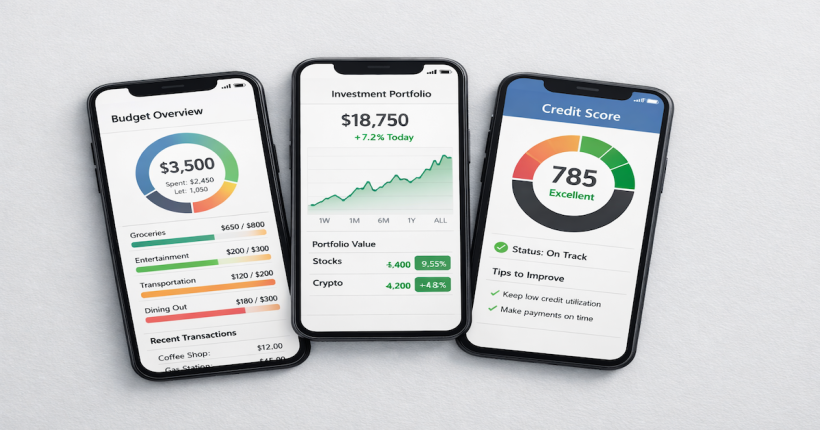
Artificial intelligence in personal finance is not a future development — it is already operational inside the apps most people use daily. The fraud detection that stopped an unauthorized charge before it posted. The automatic transaction categorization that sorted your Chipotle purchase into Dining without manual input. The cash flow projection that warned you spending was trending above plan before the month ended. The personalized alert that caught a forgotten subscription charging for the fifth month. All of these are AI systems already running on your behalf.
Smart Categorization
AI reads transaction descriptions and automatically assigns spending categories. The more you use the app, the more accurate it becomes as the model learns your specific patterns.
Predictive Budgeting
AI analyzes spending history to predict upcoming expenses — flagging that your quarterly insurance payment is due before it hits, or warning that grocery spending is trending above plan.
Fraud Detection
Banks and FinTech apps use AI to flag transactions that do not match your normal patterns — unusual locations, large overnight purchases, rapid small charges from unfamiliar merchants.
Personalized Insights
AI identifies patterns you would miss manually — subscription spending up 40% over 12 months, dining costs spiking on specific days, or a free trial still charging six months in.
The important caveat: AI financial tools make recommendations based on your data — but they do not know your full context, your values, or your goals unless you have explicitly provided them. Use AI insights as a starting point for decisions, not as the decision itself. The deep guides on how AI financial tools work and how to evaluate them are in the Continue Learning section below.
Financial Cybersecurity: The Non-Negotiable Basics
Digital banking creates digital vulnerabilities. Most financial account breaches do not happen because of sophisticated hacking — they happen because of weak passwords, reused credentials across sites, phishing messages, and accounts without two-factor authentication. The protection layer for your financial system is straightforward to build and takes less than an hour to set up correctly.
Two-Factor Authentication
Enable 2FA on every financial account without exception. Use an authenticator app (Google Authenticator, Authy) rather than SMS codes — SIM-swapping attacks can intercept text message codes.
Password Management
Use a password manager (1Password, Bitwarden) to generate and store unique passwords for every financial account. Reusing passwords means one breach can expose every account that shares it.
Phishing Recognition
Banks and FinTech apps will never ask for your password via email or text. Any message creating urgency around account access is a phishing attempt. Go directly to the app or website, never through a link in a message.
App Permission Audits
Review which third-party apps have access to your bank accounts every 90 days. Most banks have a connected apps section in settings. Revoke access for any app you no longer actively use.
Open banking and AI are already inside the apps you use every day.
The difference between people who benefit and people who don’t is whether they have set the tools up intentionally. The complete framework lives in the FinTech & Modern Money Tools guide.
Resources
Official Sources
CFPB — Personal Financial Data Rights Rule — The 2024 rule establishing consumer rights to access and share financial data held by banks and financial institutions — the regulatory backbone of open banking in the U.S.
Federal Reserve — FedNow Service — Official information on the Federal Reserve’s real-time payment infrastructure, participating institutions, and how instant settlement works.
FTC — Financial Privacy — Consumer rights when sharing financial data with third-party apps, including how data can be used and what protections apply.
FDIC.gov — Verify deposit insurance for any FinTech banking partner before connecting accounts or holding balances.
The Bigger Picture
Open banking and AI are the infrastructure layer underneath the entire modern financial tool stack. The complete framework for how they connect to neobanks, payment apps, budgeting tools, and financial automation lives in the FinTech & Modern Money Tools guide.
Continue Learning: Open Banking & AI FinTech
Every article in this cluster covers a specific layer of the open banking and AI FinTech infrastructure — from how Plaid connects apps to your bank, to how AI financial assistants work, to whether your banking app is selling your data.
Open Banking & Real-Time Payments
Open Banking Explained: How Real-Time Payments Will Reshape Your Wallet
How API-driven financial data sharing works, what real-time payment rails mean for consumers, and how the shift away from 2–3 day ACH transfers is changing the speed of money for everyday users.
What It Means When the Federal Reserve Cuts Interest Rates
How Federal Reserve rate decisions flow through the financial infrastructure — from savings account APYs and mortgage rates to credit card interest and the real-time payment rails that connect your accounts.
AI-Powered Finance
How AI Is Changing Banking and Finance: What It Means for Your Money
AI fraud detection, alternative-data credit underwriting, robo-advisors, AI customer service — six ways artificial intelligence is already operating inside the financial products and accounts most people use daily.
AI in Finance: How FinTech Is Using Artificial Intelligence to Budget Smarter
How AI-powered budgeting tools categorize spending automatically, predict upcoming bills, flag unusual charges, and deliver personalized financial insights — turning reactive money management into proactive financial intelligence.
Blockchain & DeFi
What Is Blockchain? How It Works and Why It Matters for Your Money
How blockchain evolved from the database behind Bitcoin into operational infrastructure for healthcare, supply chains, financial settlement, and digital identity — and what that shift produces for everyday financial life.
DeFi Explained: Institutional Adoption and What It Means for You
How decentralized finance has shifted from a retail-driven speculative market to institutional-grade infrastructure — real-world asset tokenization, stablecoin enterprise payments, and what the corporate DeFi buildout produces for everyday consumers.
Digital Banking & Gen Z
Banking Apps and Credit Cards for Gen Z: What Actually Works in 2026
The banking apps and starter credit cards that work best for Gen Z — how to evaluate no-fee checking, high-yield savings, and credit-building products without the traps that traditional banks built in.
Best Free Mobile Banking Apps You Should Try Today
The top zero-fee mobile banking apps in 2026 — AI-powered features, account aggregation capabilities, real-time alerts, and the specific tools that make each app worth downloading.
ESG & Values-Aligned Banking
How AI, ESG, and Open Banking Are Reshaping Finance in 2026
The three simultaneous forces reshaping financial services — artificial intelligence, ESG investing, and open banking data sharing — and how they intersect to create a fundamentally different financial system than the one previous generations used.
Green Banking Is Here: What ESG-Friendly Banks Mean for Your Money
How ESG-aligned banks and financial products let your deposits fund environmentally and socially responsible projects without sacrificing competitive rates or FDIC protection — and what green banking actually means versus what it is marketed as.
Cybersecurity & Micro-Investing
Cybersecurity Checkup: How to Keep Your Money Safe in a Digital World
The essential cybersecurity practices for anyone using digital banking, budgeting apps, or investment platforms — two-factor authentication, password management, phishing recognition, and what to do immediately if you suspect a breach.
Best Apps to Automatically Invest Spare Change
Round-up investing apps — Acorns, Stash, and similar platforms — that automatically invest small amounts from everyday purchases. How the math works, what the fees cost at scale, and when micro-investing is a useful starting point versus a distraction from real investing.
Frequently Asked Questions
Is it safe to connect my bank accounts to third-party apps through open banking?
Yes, when done through reputable apps using established aggregators like Plaid or MX. These connections use read-only tokenized access — the app can see your transactions but cannot move money or make account changes. Look for apps that explicitly state read-only access, use 256-bit encryption, and have a privacy policy that prohibits selling your financial data. Audit your connected apps every 90 days and revoke access for any app you no longer actively use.
Can AI replace a financial advisor?
For routine financial guidance — budgeting, basic investing, expense tracking — AI-powered tools handle the work effectively at a fraction of the cost. For complex situations — estate planning, tax strategy, business finances, major life transitions — human advisors bring judgment, context, and accountability that AI tools cannot currently replicate. For most Millennial and Gen Z users: AI-powered tools for day-to-day financial management, with a human advisor for major decisions.
What is real-time payment and how is it different from ACH?
Traditional ACH (Automated Clearing House) transfers take 1–3 business days to settle because they are processed in batches overnight. Real-time payment systems — like the FedNow Service launched by the Federal Reserve — settle transactions in seconds, 24 hours a day, 7 days a week, including weekends and holidays. For consumers, real-time payments mean faster access to funds, immediate bill payment confirmation, and elimination of the processing limbo that ACH creates.
What does ESG mean in banking?
ESG stands for Environmental, Social, and Governance — a framework for evaluating how institutions operate beyond pure financial performance. ESG-aligned banks use deposits to fund environmentally responsible projects, avoid financing industries that conflict with stated values, and operate with greater governance transparency. ESG banking lets your deposits support projects aligned with your values while earning competitive, FDIC-insured returns. The key is verifying actual practices rather than marketing claims.
How do I know if a FinTech app is trustworthy?
Four checks before connecting any financial app: verify FDIC insurance if it holds deposits; confirm read-only data access, not write access; read the privacy policy specifically for data-selling language; and check the aggregator they use — Plaid and MX are established and regulated. Avoid apps that ask for your actual bank login credentials rather than connecting through a secure aggregator, apps with no clear privacy policy, and apps from developers you cannot verify through independent sources.
Disclaimer & Affiliate Disclosure: This page contains affiliate links to Monarch Money. PersonalOne may earn a commission when you use links marked “(affiliate)” at no additional cost to you. FinTech app features, open banking regulations, AI capabilities, and data privacy policies change — verify current terms directly with each provider. This content provides financial education only and does not constitute personalized financial advice. Cybersecurity practices described are general recommendations; consult a security professional for institution-specific guidance.