August, 2026
Home › FinTech & Modern Money Tools › Neobanks & Digital Banking Platforms › Chime Bank Review
This review is part of our Neobanks & Digital Banking Platforms cluster, covering how digital-first banking platforms compare so you can build the right structure for your money.
About the Author
Don Briscoe has spent 20 years in banking and finance, the last 12+ of which have been focused on helping Millennials and Gen Z build income and financial stability. He founded PersonalOne to provide the financial education he wished existed -- structured, honest, and free.
What You Need to Know -- Chime at a Glance
Chime is one of the most widely used neobanks in the U.S., built around a straightforward no-fee checking account with early direct deposit and an optional high-yield savings account. It is not a full-service bank -- it does not offer loans, investing, or a broad financial product suite -- but for everyday spending and automatic saving, it does those things cleanly.
-- Best for: People who want simple, no-fee checking with automatic saving features and early paycheck access
-- Not ideal for: Anyone who needs cash deposits, full-service banking, or a high savings yield as the primary goal
-- Savings APY: Available on the high-yield savings account -- verify current rate at Chime.com
-- Fees: No monthly fees, no minimum balance, no overdraft fees with SpotMe
-- FDIC insured: Yes -- through Chime's banking partners, The Bancorp Bank and Stride Bank, N.A.
-- Affiliate disclosure: PersonalOne is not an affiliate of Chime. This review is independent and not compensated.
This Chime bank review breaks down what changed since the platform launched in 2013 and grew into one of the most recognizable names in digital banking, with tens of millions of account holders making it one of the largest neobanks in the country. Its growth was driven largely by two things: eliminating fees that traditional banks charged routinely, and making early direct deposit standard when most banks were still holding funds for days.
Chime is not a bank in the technical sense -- it is a financial technology company that offers banking services through its banking partners, The Bancorp Bank and Stride Bank, N.A. Both are FDIC-insured institutions, which means deposits held through Chime carry FDIC insurance coverage. The distinction matters less for most everyday users but is worth understanding when evaluating where Chime sits relative to institutions with their own bank charters.
This review focuses on Chime's core banking products -- the checking account, the high-yield savings account, and the features that define the day-to-day experience -- to help you evaluate whether Chime belongs in your banking structure and, if so, in what role. If you're comparing options as a student specifically, Best Neobanks for Students in 2026 covers how Chime stacks up against other platforms built for that stage of life.
How Chime Fits Into a Modern Banking Structure
Chime is one of several digital-first banking platforms worth evaluating against the rest of your financial structure. The FinTech & Modern Money Tools hub covers the broader landscape -- neobanks, budgeting apps, and robo-advisors -- and how to decide which type of tool belongs in each role of your system.
A banking system works best when each account has a specific job. Chime works well in certain roles -- and poorly in others. Understanding which role it fits changes how valuable it is.
Chime Checking and Savings: How the Accounts Work
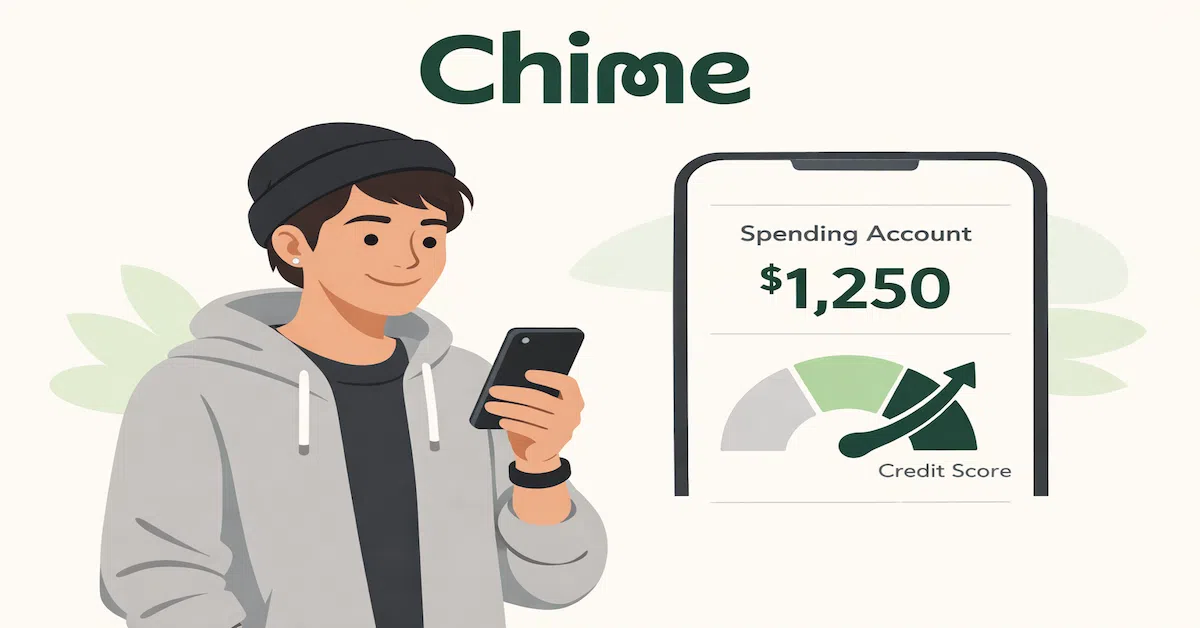
Chime offers a spending account (its version of a checking account), a high-yield savings account, and a secured credit builder card. The checking and savings accounts are opened together and managed from the same app dashboard. Transfers between them are instant.
Spending Account: No Fees, No Minimums, No Surprises
Chime's spending account has no monthly maintenance fee, no minimum balance requirement, and no overdraft fees when using SpotMe -- Chime's fee-free overdraft feature for members who receive qualifying direct deposits. SpotMe covers small overdrafts on debit card purchases, with the overdrawn amount recovered from the next deposit. The coverage limit starts at $20 and can increase based on account history and deposit patterns.
Early direct deposit is available up to two days ahead of the standard settlement date, which is now standard across most neobanks but remains an advantage over traditional banks that still hold deposits to the scheduled date.
ATM access runs through the MoneyPass and Visa Plus Alliance networks -- approximately 60,000 fee-free ATMs across the U.S. Out-of-network ATM withdrawals carry a $2.50 fee from Chime in addition to any fee charged by the ATM operator.
High-Yield Savings Account: Automatic Saving Features
Chime's high-yield savings account pays interest on balances and offers two automatic saving features that make it distinctly useful for people who struggle to save manually. Round Ups automatically rounds each debit card purchase to the nearest dollar and transfers the difference to savings. Save When I Get Paid automatically transfers a percentage of each direct deposit to savings at the moment the deposit arrives.
These automation features are Chime's strongest differentiator in the savings space. The yield itself is competitive for a neobank but not consistently at the top of the high-yield savings market. Platforms like Current take a similar automatic-saving approach through a different structure -- see our Current Bank Review for how its Savings Pods compare. For members whose primary goal is accumulating savings consistently rather than maximizing yield, the behavioral infrastructure Chime builds around saving is more valuable than a slightly higher APY at a platform without those automation features.
Credit Builder Card: A Genuine Credit Building Tool
Chime's Credit Builder is a secured credit card with no annual fee, no interest charges, and no credit check to apply. It works by moving money from your spending account into a secured account that becomes your credit limit. You spend against that limit, and Chime reports your payments to all three credit bureaus monthly. Because there is no hard inquiry and no minimum deposit requirement beyond what you choose to move, it is one of the more accessible credit building tools available to someone starting with no credit or rebuilding from a damaged file.
The credit builder is optional and separate from the banking products -- but it is worth noting because it adds a meaningful capability that makes Chime more than just a spending account for users who also need to build credit.
Cash Deposits: A Shared Limitation
Like most neobanks, Chime does not accept cash deposits directly. Cash can be deposited through Walgreens, Walmart, and other participating retailers via Chime's cash deposit network -- but fees apply at most locations and are set by the retailer rather than Chime. For anyone who handles cash regularly, this limitation creates operational friction that a traditional bank or credit union does not.
Where Chime Performs Well
Removing Friction From Everyday Banking
No fees, no minimums, SpotMe overdraft protection, and early direct deposit together eliminate the most common sources of frustration and unexpected charges in traditional checking accounts. For anyone who has ever been hit with a $35 overdraft fee on a $4 purchase, or watched a $12 monthly maintenance fee drain a low balance, Chime's structure is a genuine improvement in day-to-day banking experience.
Automated Saving Infrastructure
The Round Ups and Save When I Get Paid features are built around the same principle PersonalOne applies across all financial systems: remove the decision from the moment. When saving is automatic and happens at the point of income rather than at the end of the month, the savings rate improves because the decision is taken out of human hands. These features are simple in design but effective in practice for users who have struggled to save manually.
Credit Builder Access With No Barrier to Entry
The Credit Builder card requires no credit check, no annual fee, and no minimum deposit beyond what the user controls. For someone in the early stages of credit building who cannot qualify for a standard unsecured card, this is a meaningful access point that combines with the banking account rather than requiring a separate application elsewhere.
Where Chime Falls Short
No Bank Charter -- Partner Bank Dependency
Chime is not a bank. FDIC insurance flows through its partner banks, The Bancorp Bank and Stride Bank, N.A. For the vast majority of users this distinction makes no practical difference -- deposits are still federally insured. But it does mean that Chime's ability to operate depends on those banking relationships remaining intact, and that regulatory changes affecting those partner banks can affect Chime customers.
Account Freezes and Closures
Chime has a documented history of account freezes and closures triggered by automated fraud detection systems. Large or unusual transfers, activity inconsistent with prior patterns, and disputes have all been cited in user reports of unexpected account actions. In some cases, access to funds was delayed for extended periods during review. This is an industry-wide pattern with neobanks, not a Chime-specific anomaly -- but the volume of reports associated with Chime is worth noting for anyone considering it as their sole banking institution.
Limited Product Breadth
Chime offers checking, savings, and a credit builder card. It does not offer loans, investing accounts, or a broader financial product suite. For users who want a single platform to handle banking and other financial needs, Chime requires supplementing with other institutions or apps -- our SoFi Bank Review covers a neobank built around exactly that broader product range. This is not a flaw in Chime -- it is a deliberate product focus -- but it matters when comparing platforms.
Who Chime Is Right For
Chime Is a Strong Fit If:
You want no-fee checking with automatic saving built in. The combination of zero fees and behavioral saving automation makes Chime well-suited as a primary spending and saving account for people who want simplicity over breadth.
You are building credit from scratch or recovering. The Credit Builder card's no-hard-pull, no-fee structure makes it one of the most accessible credit building tools available through a banking platform.
You receive regular direct deposits and want early access. Early direct deposit combined with SpotMe overdraft protection makes Chime a functional primary checking account for salaried or hourly employees paid via direct deposit.
You want to automate saving without thinking about it. Round Ups and Save When I Get Paid remove saving decisions from moments of low motivation and make accumulation happen automatically.
Chime Is Not the Right Fit If:
You deposit cash regularly. The cash deposit process through retail partners involves fees and inconvenience that make Chime a poor fit for cash-heavy income situations.
You want the highest possible savings yield. Chime's savings rate is competitive but not consistently at the top of the high-yield market. If maximizing APY is the primary goal, compare current rates across dedicated high-yield savings accounts before deciding.
You need loans, investing, or full-service banking in one place. Chime does not offer these products. Users who want a unified financial platform will need to supplement Chime with other institutions.
You cannot afford a disruption in account access. Given the volume of account freeze reports, anyone for whom a temporary loss of account access would create immediate financial hardship should maintain a backup account at a separate institution regardless of which neobank they use.
Build a Banking Structure That Works
Chime is one option in a broader digital banking landscape. The FinTech & Modern Money Tools hub covers how to evaluate neobanks, how to structure multiple accounts for maximum function, and how to decide which institution belongs in each role of your banking system.
Explore the FinTech & Modern Money Tools Hub →Frequently Asked Questions
Is Chime a real bank? Chime is a financial technology company, not a bank. It provides banking services through its partner banks -- The Bancorp Bank and Stride Bank, N.A. -- both of which are FDIC-insured. Your deposits are federally insured up to $250,000, but the insurance flows through those partner institutions rather than through Chime directly. Chime does not hold a bank charter of its own.
What is SpotMe and how does it work? SpotMe is Chime's fee-free overdraft feature for qualifying members. When your spending account balance falls below zero on a debit card purchase, SpotMe covers the shortfall up to your personal limit -- starting at $20 and potentially increasing based on account history. The overdrawn amount is recovered from your next deposit, not charged as a fee. SpotMe requires qualifying direct deposit activity to activate and applies only to debit card transactions, not ACH transfers or checks.
Can I use Chime as my only bank account? Many people do. However, the PersonalOne recommendation is to maintain a backup account at a separate institution -- a credit union or traditional bank -- regardless of which neobank you use as primary. Given the volume of account freeze reports associated with Chime and neobanks generally, having a secondary account protects you from a temporary disruption becoming a financial crisis. The backup account does not need significant funds -- it needs to be accessible when your primary account is not.
Does the Chime Credit Builder card affect my credit score? Yes -- positively, when used correctly. Chime reports Credit Builder payments to Equifax, Experian, and TransUnion monthly. On-time payments build payment history, which is the most heavily weighted factor in your FICO score. Because there is no hard inquiry to apply and no interest charges, the Credit Builder is a low-cost, low-risk way to establish or rebuild credit history while banking with Chime.
How does Chime make money if it charges no fees? Chime's primary revenue source is interchange fees -- the small percentage charged to merchants each time a Chime debit card is used for a transaction. This model aligns Chime's revenue with member spending activity rather than member account balances, which is why eliminating maintenance fees and overdraft fees does not eliminate Chime's business model. The more members use the debit card for everyday purchases, the more interchange revenue Chime generates.
Resources
- Chime -- Official Banking Products Page
- FDIC -- Deposit Insurance Information
- CFPB -- Bank Accounts and Services
- Federal Reserve Bank of St. Louis (FRED) -- Federal Funds Rate Historical Data
Continue Learning About Modern Banking Tools
Chime is one piece of a larger banking and FinTech toolkit. The complete framework for evaluating neobanks, budgeting apps, and robo-advisors is in the FinTech & Modern Money Tools guide.
Disclaimer: This review provides independent educational information about Chime's products and features. PersonalOne is not an affiliate of Chime and has not received compensation for this review. Product features, APY rates, and terms referenced in this article are subject to change. Always verify current rates, fees, and terms directly at Chime.com before making any banking decision. This content is not personalized financial advice. PersonalOne provides educational content and does not offer personalized financial planning services.