Updated: March, 2026
Home › Side Hustles & Entrepreneurship › Income Scaling Strategies
TL;DR
— This is the wealth-building cluster. It covers how to scale your income beyond a side hustle — through passive income, leveraged systems, AI tools, and the marketing strategies that grow revenue without proportional time investment.
— Scaling means building income mechanisms that produce revenue without requiring additional hours in direct proportion to earnings.
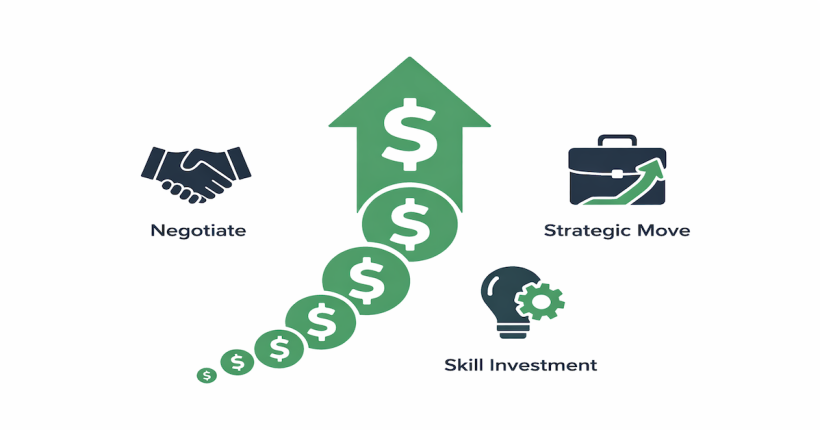
— The three scaling mechanisms available to most side hustle operators are rate increases, income stream multiplication, and automation — AI and digital tools are now making all three more accessible than at any prior point.
— Scaling requires the business finance structure from Cluster 3 to be in place — you cannot measure income you cannot track, and you cannot reinvest in scaling without clean financial visibility.
— This cluster also covers the future of income: how AI, automation, and digital transformation are reshaping the income landscape for Millennial and Gen Z earners.
Knowing how to scale your income beyond a side hustle is the transition from trading time for money to building systems that generate revenue independently of the hours directly invested. It is the most consequential shift in an entrepreneurial income strategy — and it is where the side hustles and entrepreneurship framework moves from income replacement to wealth building. This cluster covers the full scaling toolkit: passive income streams, income multipliers, AI and automation leverage, marketing strategies, and the business trend landscape that determines which scaling bets are most likely to pay off in the current environment.
Passive Income and Income Stream Multiplication
The distinction between passive vs active income is the conceptual foundation of the scaling layer. Active income requires time in proportion to earnings. Passive income produces earnings after an upfront investment of time, money, or both, with minimal ongoing maintenance. The money multipliers framework covers how to stack income streams so each one reduces dependence on the others — the diversification strategy that produces both income growth and income resilience simultaneously.
The most accessible passive income tools for individual earners — covered in top passive income apps and how to start earning while you sleep — range from cashback and micro-investment platforms to digital products and content monetization. The right mix depends on available upfront capital, existing audience, and how much initial active investment of time is feasible before passive returns begin.
AI and Automation: The Scaling Leverage Most People Are Underusing
AI tools represent the most significant productivity multiplier available to individual earners and small business operators today. AI for small business, AI in business, and top AI tools for small business cover the specific tools and implementation approaches that increase output quality and speed without proportional labor cost. The operators who learn to use these tools effectively increase their effective hourly yield significantly — which is the most direct form of income scaling available without building a team.
Digital transformation for small business covers the broader infrastructure shift that AI tools are part of — the transition from manual, labor-intensive operations to automated, system-driven ones that scale output without scaling headcount. And AI, automation, and the labor economy provides the macro context for understanding how these changes are reshaping income and employment for the entire generation.
Marketing Without a Budget: The Free Growth Engine
Revenue growth without marketing investment is possible at every stage of a side hustle or small business — but only with the right strategy. How to market your business for free and 35 free marketing strategies together cover the organic growth approaches that have the highest return at the lowest cost: direct outreach, referral systems, content leverage, and community building. These are the scaling tools most accessible to solo operators and early-stage businesses that cannot afford paid acquisition before proving the revenue model.
Scaling is not about working harder. It is about building the systems that work when you are not.
The complete side hustles and entrepreneurship hub connects every stage from first dollar to scaled income — in the sequence that produces durable results.
Explore Side Hustles & Entrepreneurship →Resources
IRS — Self-Employed Individuals Tax Center
Federal Reserve — Survey of Consumer Finances
FTC — Gig Economy Guidance for Workers
This cluster is part of the Side Hustles & Entrepreneurship system on PersonalOne — a complete framework for building income outside your primary job at every stage.
Continue Learning — Income Scaling Strategies
Money Multipliers — How to stack income streams so each one reduces dependence on the others
Passive Income vs Active Income — Which builds wealth faster and how to build the right mix for your situation
Top Passive Income Apps — The apps and platforms that generate passive income with minimal ongoing effort
How to Start Earning While You Sleep — The passive income tools and digital systems that generate revenue outside active working hours
AI for Small Business — How to use AI tools to increase output quality and speed without proportional labor cost
Digital Transformation for Small Business — The infrastructure shift from manual operations to automated, system-driven business models
Top AI Tools for Small Business — The specific AI tools producing the highest leverage for solo operators and small teams
Business Trends Shaping the Future — The macro trends determining which income and business bets are most likely to pay off
AI, Automation, and the Labor Economy — How AI is reshaping income and employment for the Millennial and Gen Z workforce
How to Market Your Business for Free — The highest-return organic growth approaches for side hustles and small businesses with no ad budget
35 Free Marketing Strategies — A complete playbook of zero-cost marketing tactics ranked by effort and impact
Frequently Asked Questions
When am I ready to start scaling?
Three indicators: consistent demand that exceeds your current capacity, a delivery process systematized enough to maintain quality at current volume, and financial visibility clear enough to know your actual profit margin. If all three are present, scaling accelerates what is already working. If any one is missing — especially financial clarity — scaling accelerates the existing problems rather than the existing gains.
Should I build passive income or scale my active income first?
Scale active income to a stable baseline first. Passive income streams built from existing expertise — digital products, templates, content — leverage active income skills and existing client relationships. They produce better results when built on top of an established practice than when built from scratch before the active income foundation exists. The sequence is: stable active income, then passive streams that extend existing expertise, then investment income funded by the combined active and passive earnings.
How do AI tools actually help with income scaling?
AI tools increase the effective output per hour of active work — which is the most direct form of scaling available without adding headcount. A writer who uses AI assistance produces more content per hour. A consultant who uses AI for research delivers more thorough analysis in less time. A marketer who uses AI for content generation produces more distribution volume from the same labor input. The income impact comes from either serving more clients at the same rate, or delivering higher quality that justifies higher rates — both of which scale revenue without scaling hours.
PersonalOne Money System
This content is researched, written, and owned by PersonalOne — a free financial education platform built to help Millennials and Gen Z build real financial systems.
Disclaimer: This content is for educational purposes only and does not constitute financial advice. Individual financial situations vary — consult a qualified financial professional for personalized guidance.