October, 2026
Home › FinTech & Modern Money Tools › Open Banking & AI FinTech › AI Personalized Financial Advice
How AI Is Personalizing Your Financial Advice in 2026
What You Need to Know
— AI financial tools have shifted from reactive reporting (“here is what you spent”) to proactive guidance (“here is what to do next”) — a meaningful upgrade in practical utility
— AI personalization in finance works by analyzing your transaction history, income patterns, and financial behaviors to surface insights specific to you
— The limit of AI financial advice is context: AI knows your numbers but not your goals, values, risk tolerance, or life circumstances unless you provide them explicitly
— AI advice is most valuable for identifying patterns, flagging anomalies, and surfacing actions — the decision still belongs to you
— For complex financial decisions, a human advisor who operates as a fiduciary provides judgment that no current AI tool can replicate
From Reactive to Proactive: How AI Financial Advice Has Evolved
AI personalized financial advice has fundamentally changed what personal finance apps can do. The earliest personal finance apps were reactive: they showed you what happened to your money after the fact. You spent $800 on dining last month. Your utilities were $140. Your net cash flow was negative $200. Useful data, but entirely backward-looking. The shift driven by how open banking and AI are changing FinTech is a move from reporting to guidance — AI that tells you what is likely to happen and what you should do before the outcome is already fixed. The full context for how AI connects to open banking infrastructure and the modern financial tool stack is in the Open Banking & AI FinTech guide.
Monarch Money’s cash flow forecasting projects your account balance forward based on known upcoming expenses and typical spending patterns. Betterment’s goal-based advice system identifies whether you are on track for each financial goal and suggests specific contribution adjustments. Credit Karma’s approval odds engine analyzes your credit profile and predicts approval likelihood before you apply, preventing unnecessary hard inquiries. Each of these is AI moving from describing the past to shaping what happens next. How these tools connect to the broader FinTech landscape is covered in the FinTech & Modern Money Tools guide.
What AI Financial Personalization Actually Does
Pattern recognition at scale. AI can analyze 24 months of transactions across multiple accounts simultaneously and identify patterns that would take a human hours to find manually — or that would simply never be noticed without systematic analysis. Subscription creep, seasonal spending spikes, category drift, income variability, and cash flow timing issues are all things AI surfaces reliably that most people miss entirely when reviewing their finances manually.
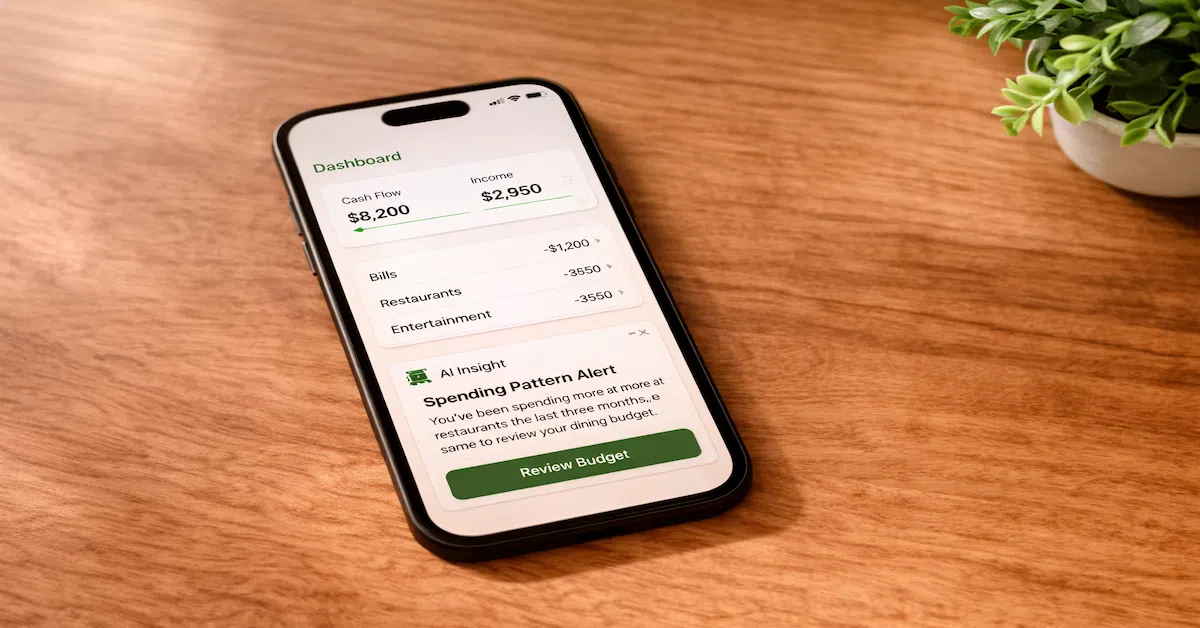
Anomaly detection. When something deviates from your established baseline, AI flags it. A charge from a merchant you have never used. A transaction amount significantly higher than your typical spend in a category. A new recurring charge appearing on your account. These anomaly alerts are valuable both for fraud detection and for catching behavioral patterns — the forgotten subscription, the vendor who quietly raised their rate, the expense that slipped through the budget.
Predictive cash flow. AI combines your known recurring expenses (rent, subscriptions, insurance payments), your historical variable spending patterns, and your income schedule to project your account balance forward. This turns a static bank balance into a dynamic forward-looking tool — showing you whether you will be cash-flow positive or negative in 30 days based on how you are currently spending.
Personalized product matching. Credit Karma, NerdWallet, and similar platforms use AI to match your credit profile and financial situation to specific financial products — credit cards with approval odds, loan rates based on your likely eligibility, savings accounts with competitive rates. The personalization here is genuinely useful for avoiding hard inquiries on applications likely to be declined.
Where AI Financial Advice Falls Short
AI financial tools know your numbers. They do not know your goals unless you have explicitly entered them. They do not know your values — whether you prioritize financial security over lifestyle, whether you are building wealth for generational transfer or personal freedom, whether you have significant non-financial constraints on your decisions. They do not know your risk tolerance beyond what a questionnaire measures. And they do not know the life context that makes financial decisions complex: the job change you are considering, the family situation affecting your housing decisions, the health factors influencing your insurance needs.
The practical implication: AI financial tools are excellent at the analytical layer — identifying patterns, flagging issues, projecting outcomes. They are not equipped to make the judgment calls that require weighing multiple competing priorities in the context of a full human life. For decisions that are primarily analytical — should I increase my 401(k) contribution rate, am I on track for my emergency fund target, is this subscription worth keeping — AI guidance is genuinely valuable. For decisions that are primarily judgment-based — how to sequence financial priorities during a career transition, how to structure finances around a major life change, how to optimize a complex tax situation — a human advisor who operates as a fiduciary is the appropriate resource.
AI provides the pattern. You provide the judgment.
The complete guide to AI financial tools and how they connect to the modern financial system is in the Open Banking & AI FinTech guide.
Explore Open Banking & AI FinTech →Resources
Official Sources
CFPB — AI/ML in Financial Decisions — Consumer protection requirements and your right to explanations when AI models influence credit or financial product decisions made about you.
FTC — Financial Privacy — Your rights regarding how AI financial tools collect, store, and use your financial data for personalization.
The full framework lives in the FinTech & Modern Money Tools guide.
Frequently Asked Questions
Can AI replace my financial advisor?
For routine analytical tasks — budgeting, investment portfolio management, expense tracking, basic goal progress — AI tools handle the work effectively at a fraction of the cost. For complex planning decisions that require judgment about competing priorities in the context of a full financial life, a qualified human advisor who operates as a fiduciary provides capabilities no current AI tool replicates. Most people benefit from AI tools for daily management and human advisors for major decisions.
How does AI know what advice to give me?
AI financial tools analyze your transaction history, income patterns, account balances, and goal inputs to identify patterns and surface relevant guidance. The advice is only as good as the data the AI has access to — an AI tool connected to all your accounts provides better personalization than one connected to only one account. The AI does not know your goals, values, or life context unless you explicitly provide them through the app’s goal-setting features.
Is AI financial advice biased?
AI financial tools can reflect biases present in their training data and design. The CFPB has documented concerns about AI credit underwriting models perpetuating historical lending disparities. For personalized financial management tools (budgeting, savings tracking), bias is less of a concern than for AI models that make decisions about loan approvals or credit terms. Be aware that product recommendations from AI-powered platforms may be influenced by business relationships, not purely by what is optimal for your situation.
Disclaimer: This article is for informational and educational purposes only. AI financial tool capabilities change rapidly — verify current features with each specific platform. This content does not constitute financial advice. Consult a qualified financial advisor for decisions requiring personalized guidance.