Nov, 2026
Home › Financial Stability › Expense Compression › How to Cut $500 From Your Budget Without Touching Necessities
How to Cut $500 From Your Budget Without Touching Necessities
What You Need to Know
— Five hundred dollars per month in budget reduction is achievable for most households without cutting housing, utilities, insurance, or minimum debt payments
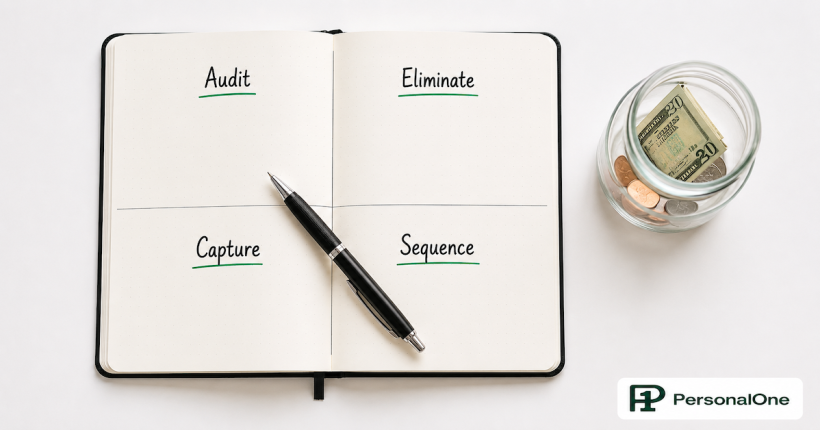
— The cuts come from four non-necessity categories: subscriptions, food spending, convenience habits, and negotiated fixed costs — in that order of ease
— Subscriptions alone generate $80 to $200 per month in recoverable spending for the average household with minimal lifestyle impact
— Food spending — specifically delivery apps, convenience eating, and unplanned grocery purchases — typically yields $150 to $250 more
— The remaining gap closes through negotiation: cell phone plans, insurance rates, and internet bills are all negotiable with a single phone call
Cutting $500 from a monthly budget sounds like a significant sacrifice. In practice, for most households, it is not — because $500 of non-necessity spending is hiding in plain sight across three or four categories that feel normal until they are audited. Survival mode budgeting is not about eliminating everything enjoyable. It is about recovering spending that is happening without producing value proportional to its cost.
This guide works through the four specific category areas where $500 is most commonly recoverable without touching housing, utilities, groceries at a baseline level, transportation necessities, health insurance, or minimum debt payments. Every cut identified here comes from non-necessity spending that most households are carrying without actively choosing it. The survival mode budgeting framework in the Expense Compression cluster starts with exactly this kind of targeted reduction before any structural financial change.
What Counts as a Necessity — and What Does Not
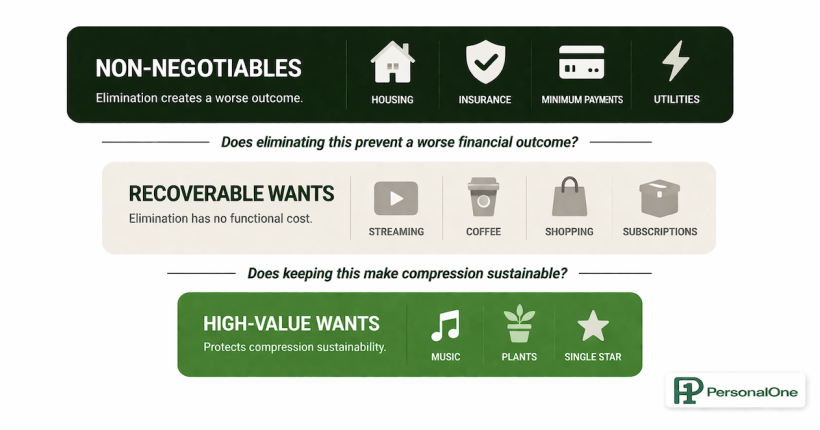
Before working through the cuts, the definition of necessity needs to be precise. A necessity is any expense that, if eliminated, would directly threaten shelter, health, employment, or the ability to meet contractual debt obligations. This means: rent or minimum mortgage payment, electricity and gas at functional levels, water, minimum debt payments, health insurance, transportation required to get to work, groceries at a basic level, and phone at minimum plan cost required for work and emergency contact.
Everything else is a non-necessity. This includes the premium tier of a service that has a free or lower tier, the convenience version of something available more cheaply with slightly more effort, any subscription that has not been actively used in 30 days, dining out and delivery beyond groceries, clothing beyond genuine need replacement, entertainment and streaming, and the lifestyle add-ons that accumulated over time without deliberate decisions. The $500 target lives entirely within non-necessity territory for most households. Use the income calculator to confirm your actual take-home before mapping cuts against it — knowing your real monthly number changes the math on what $500 represents as a percentage of available income.
Category 1: Subscriptions — Target $80 to $200
Start here because subscription cuts are the fastest to execute and the most immediately recurring in impact. A single cancellation produces monthly savings indefinitely without any ongoing behavioral change required.
Pull every recurring charge from the last three months of bank and credit card statements. List every one — streaming services, music, cloud storage, software, news, fitness apps, meal kits, beauty boxes, gaming, and any other subscription product. For each charge, determine: have you actively used this in the last 30 days? If no, cancel it today. If yes, can a lower tier provide the same function? If yes, downgrade today.
Common findings in a subscription audit: two or three streaming services where one is rarely used, a gym membership used fewer than twice per month, a software subscription for a tool used occasionally when a free alternative exists, a meal kit or subscription box that renewed by default after a trial. These charges often total $80 to $150 per month for households with moderate subscription accumulation and $150 to $200 for households with higher accumulation. Cancel everything that does not pass the active-use test. Resubscribe after 60 days if you genuinely missed it — most people do not.
Category 2: Food Spending Beyond Groceries — Target $150 to $250
Food spending is where the most budget leakage occurs for Millennial and Gen Z households, specifically because delivery apps, coffee subscriptions, and convenience eating are not mentally categorized as food spending by most people — they are categorized as lifestyle or convenience, which means they escape the scrutiny applied to the grocery budget.
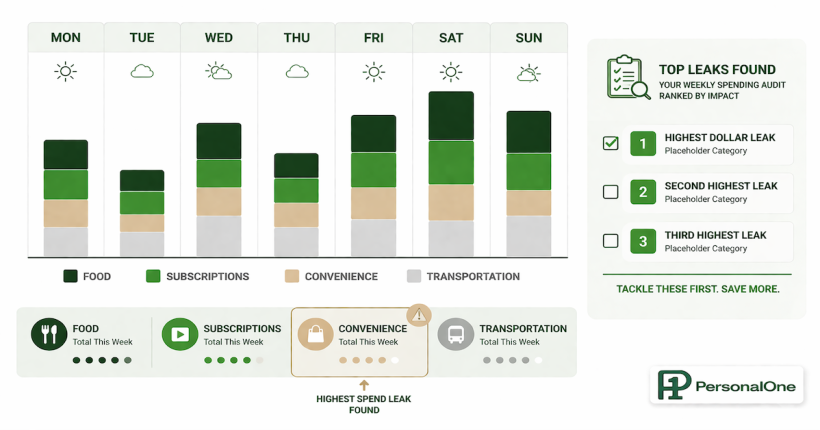
Add up every food-related charge that is not a grocery store receipt: delivery app orders, restaurant meals, coffee shop visits, convenience store food purchases, work lunches, and snacks purchased outside of grocery shopping. For many households, this total is $200 to $400 per month — a significant additional food budget that is being spent without the planning or value optimization applied to groceries.
The compression target is not zero. It is a defined ceiling that replaces an undefined default. Decide how many delivery orders per month are genuinely worth the cost and set that as your number. Decide how many restaurant meals are planned and valued versus unplanned and habitual. The unplanned, habitual food spending is almost entirely compressible because it was never deliberately chosen. Eliminating delivery apps from your phone during a compression period removes the friction-free path to impulse food orders and typically reduces this category by 60 to 80 percent without any significant lifestyle impact.
Category 3: Convenience Costs — Target $50 to $100
Convenience costs are the premium paid for the easier, faster, or more accessible version of something available more cheaply with slightly more effort. They accumulate across dozens of small decisions that individually seem insignificant but collectively represent a meaningful monthly total.
Common convenience costs with compressible alternatives: ATM fees from using out-of-network ATMs when your bank's network is accessible with slightly more planning; expedited shipping charges when standard shipping with earlier ordering works equally well; premium versions of apps with full-featured free alternatives; single-serve convenience products at a significant per-unit markup versus their bulk equivalents; parking in the most convenient lot rather than a cheaper option two blocks away. These costs are individually small — $2 here, $8 there — but they are also entirely driven by friction avoidance rather than genuine value, which means they compress cleanly with minimal behavioral adjustment.
Category 4: Negotiated Fixed Costs — Target $50 to $100
Several fixed-cost categories that feel locked are actually negotiable with a single phone call. This is the most underutilized compression lever because it requires proactive outreach rather than passive cancellation, but it produces recurring monthly savings on expenses you are keeping — not eliminating.
Cell phone plan. Call your carrier and ask specifically what lower-cost plans are available on your current network. Switching from a legacy plan to a current equivalent plan at the same carrier frequently produces $20 to $40 per month in savings for the same coverage. Alternatively, switching to a prepaid carrier on the same underlying network often produces $40 to $70 per month in savings.
Internet service. Call your internet provider and ask what retention offers are available. State that you are reviewing your expenses and considering your options. Most providers have promotional rates available that they do not advertise but will apply when asked. This call typically produces $15 to $30 per month in savings for the same service level.
Auto and renters insurance. Get one competing quote from a different insurer and call your current provider with that number. Ask them to match it or explain the difference. Insurance premiums are more negotiable than most people assume, and the threat of switching — or actual switching — frequently produces $20 to $50 per month in savings for equivalent coverage. This connects directly to the financial stability framework principle of reviewing all fixed costs annually rather than allowing them to auto-renew at increasing rates without examination.
$500 less per month. Same life.
These cuts are the starting point for the complete Expense Compression system. The full framework for cutting spending without lifestyle destruction is in the cluster hub.
Expense Compression Strategy →Tracking the $500 Target
As you work through each category, keep a running total of the monthly savings each action produces. This total is the evidence that the compression is working and the motivation to continue when the process feels tedious. Most households reach the $500 target before exhausting all four categories — subscriptions and food spending alone often exceed it.
Once you have identified $500 or more in monthly compression, the decision about where those funds go matters. If you are in a financial recovery situation, the freed cash flow goes directly to stabilization: building or replenishing your emergency fund, covering a current shortfall, or reducing high-interest debt. Use the debt paydown calculator to see exactly how applying your recovered $500 per month to outstanding balances changes your payoff timeline. The numbers are often more motivating than any general advice about paying down debt. If you are not in an acute financial situation, the compression creates the surplus margin that funds whatever financial goal comes next in your system. The worst-case scenario budget shows you what your compressed spending floor looks like as a complete survival plan in the event of a financial disruption.
Resources
Official Sources
CFPB: Budgeting and Spending Tools — Consumer Financial Protection Bureau tools for identifying spending patterns and building a budget that reflects actual household expenses.
BLS: Consumer Expenditure Survey — Bureau of Labor Statistics data on average household spending by category — useful for benchmarking whether your category totals are above national averages.
FTC: Consumer Information — Federal Trade Commission guidance on your rights when negotiating with service providers and canceling subscription services.
Continue Building Your Expense Compression System
These targeted cuts are one part of the complete Expense Compression framework. The full system — including the 7-day spending audit, needs vs wants framework, and lean living without lifestyle destruction — lives in the Expense Compression cluster hub inside the Financial Stability authority hub.
Frequently Asked Questions
What if I already cut subscriptions and I still can't find $500?
Move to food spending next and be granular. Most people who say they have cut subscriptions have only addressed streaming services and missed the category of recurring charges that feel like services rather than subscriptions: cloud storage, app subscriptions, software trials that converted to paid, and membership programs at retailers. Pull three months of statements and search for every charge under $30 that recurs monthly or annually. The sub-$30 range is where the most frequently overlooked recurring charges live.
How do I negotiate with my internet or phone provider without getting put on hold forever?
Call during off-peak hours — weekday mornings between 8am and 10am typically have shorter wait times. When connected, say specifically: "I am reviewing my monthly expenses and looking at my options. What is the best rate you can offer me for my current service level?" This framing communicates that you are actively considering your options without creating confrontation. Retention departments have authority to apply discounts that front-line customer service agents do not. If the first agent cannot help, ask to speak with the retention or cancellation department.
Should I cut my gym membership?
Evaluate based on actual usage, not intended usage. If you are using the gym consistently and value the access, keep it — it is a legitimate non-necessity that is producing genuine value. If you are going fewer than twice per month, the per-visit cost is significant and the membership is a candidate for compression. Many gyms offer a freeze option that suspends billing without full cancellation, which can serve as a test period before permanent cancellation.
Can I get to $500 in cuts without changing how I eat?
Possibly, but food spending is where most households find the largest recoverable amounts. If subscriptions plus negotiated fixed costs plus convenience costs reach $500 without requiring any food changes, you are done. If not, some food spending adjustment is likely necessary to reach the target. The most painless food adjustments are eliminating delivery app fees and service charges rather than the food itself — picking up rather than delivering from the same restaurant often saves $8 to $15 per order in fees alone.
What do I do with the $500 once I have freed it up?
That depends entirely on your current financial situation. In a financial recovery situation, it goes to stabilization in this order: emergency fund starter ($500 to $1,000), then high-interest debt reduction. In a stable financial situation, it becomes the surplus that funds your next savings or investment goal. In either case, the freed funds should be intentionally directed somewhere specific the same month they are recovered — unallocated surplus has a tendency to disappear into the same non-necessity spending it replaced.
Disclaimer: This article is for informational and educational purposes only and does not constitute financial or legal advice. Individual financial situations vary. Consult a qualified financial advisor before making significant financial decisions. PersonalOne is not a licensed financial advisor.