July, 2026
Home › Financial Stability › Expense Compression Strategy › How to Start Building Wealth When Money Is Tight
What You Need to Know
— Building wealth when money is tight is not about finding more money. It is about finding the money that is already leaving your accounts without delivering meaningful value — and redirecting it deliberately.
— The expense compression framework has four phases: audit (identify every leak), eliminate (cut fixed costs permanently), capture (redirect freed margin automatically), and sequence (deploy it in the correct order to build lasting stability).
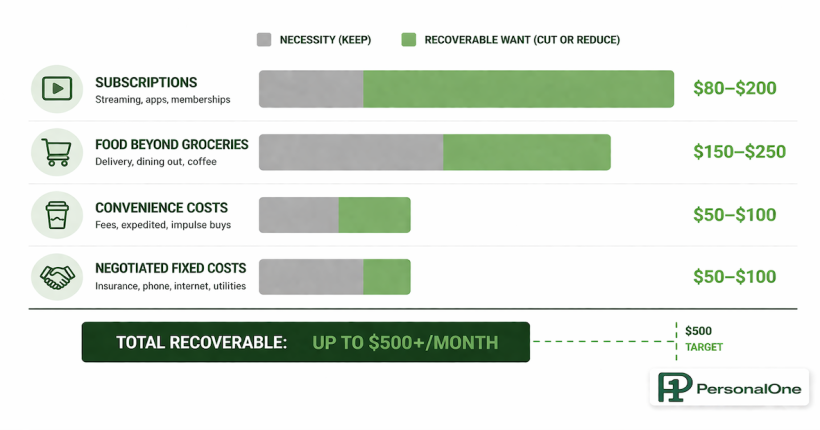
— Most households have $200–$600 per month in compressible spending they cannot see without a structured audit. That number, found and redirected, is enough to build a $1,000 emergency fund in 60–90 days from a standing start.
— The wealth-building sequence from a compressed base is non-negotiable: $1,000 emergency starter fund first, then high-interest debt, then full emergency fund, then investment contributions. The order matters more than the amounts.
— Expense compression is a sprint, not a permanent lifestyle. It ends when the structural goals are achieved. The gains it creates — cancelled subscriptions, lower fixed costs, automated transfers — remain permanently after the sprint is over.
The most common reason people say they cannot figure out how to build wealth when money is tight is that there is nothing left over after the bills are paid. That feeling is real. But in most cases the underlying math is wrong — not because the person is mistaken about how hard things are, but because the standard view of a budget does not surface where money is actually going. It shows the large categories. It does not show the structural leaks.
An expense compression strategy is built on a different starting point. Instead of asking how to make the budget stretch further, it asks where money is currently flowing without delivering a meaningful return — and whether that flow can be permanently redirected. The answer, for almost every household, is yes. The margin is already there. The compression framework is how you find it, free it, and put it to work.
This article covers the complete four-phase expense compression strategy in full — the compression audit, the fixed cost elimination moves, the margin capture mechanism, and the wealth-building sequence that turns temporary sacrifice into permanent financial progress. The complete framework for how this cluster fits within the broader financial stability system is in the Financial Stability hub.
Why Tight Money Feels Tighter Than It Is
There is a specific financial trap that most households fall into not through recklessness but through inattention. Income grows over time. Each time it does, spending expands to fill the new space — not dramatically, but quietly. A slightly nicer grocery brand. A new subscription added during a free trial that never got cancelled. A phone plan upgraded two years ago that has never been revisited. An insurance rate that has increased by $15 per month for three consecutive years without a competing quote ever being run.
None of those individual decisions feels significant. Together they represent $200, $400, sometimes $600 per month in spending that is delivering little to no measurable return in quality of life — and that is invisible because it was never added all at once. It accumulated gradually, which means it never triggered the kind of deliberate review that a large new expense would.
The compression audit makes that accumulation visible in one structured pass. Once it is visible, the decisions about what to keep and what to eliminate become straightforward. Most people do not need to be convinced to stop paying for a streaming service they have not opened in four months. They just need to know they are paying for it.
Phase 1 — The Compression Audit
The compression audit is a single structured pass through the last 30 days of spending. Pull every transaction from every account — checking, credit cards, savings. Categorize each one into four buckets:
The Four Audit Categories
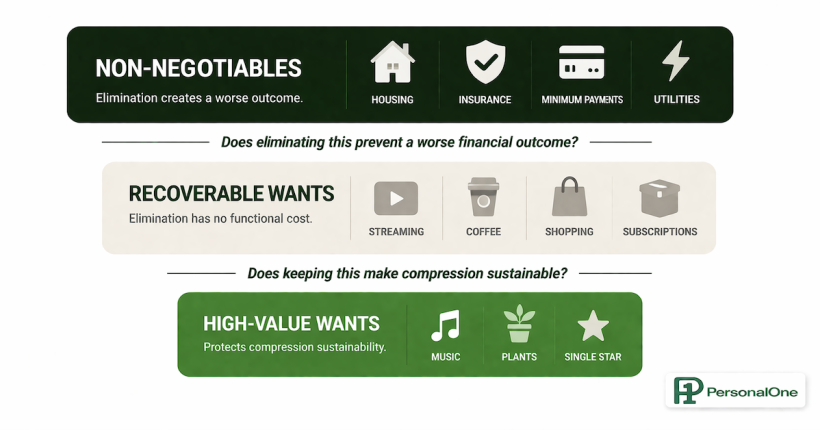
Fixed Essentials: Rent or mortgage, insurance minimums, utility bills, minimum debt payments. These are obligations. They cannot be cut today. Some can be restructured in Phase 2. For now, total them and set them aside.
Variable Essentials: Groceries, transportation, phone, healthcare. These are genuinely necessary but the dollar amounts are flexible. A $600 monthly grocery bill can typically compress to $380–$420. A $130 phone plan can often become $50 on a competitive MVNO. The category is essential. The current spend is not.
Fixed Discretionary: Every subscription, membership, and recurring charge. Streaming platforms, software, gym memberships, box subscriptions, cloud storage, apps, club memberships. These charge automatically whether you use them or not. This category is almost always the densest source of compression candidates. List every single one — amount, billing date, and last date used.
Variable Discretionary: Dining out, entertainment, shopping, personal spending, impulse purchases. This is what most budgets focus on. It is rarely where the largest permanent savings live — but it matters for the 30-day sprint period where aggressive compression creates the initial margin.
After categorizing, apply the value test to every line item in Fixed and Variable Discretionary: if this expense disappeared tomorrow, would I notice its absence within 30 days in a way that genuinely affects my quality of life? If the honest answer is no or probably not, it is a compression candidate.
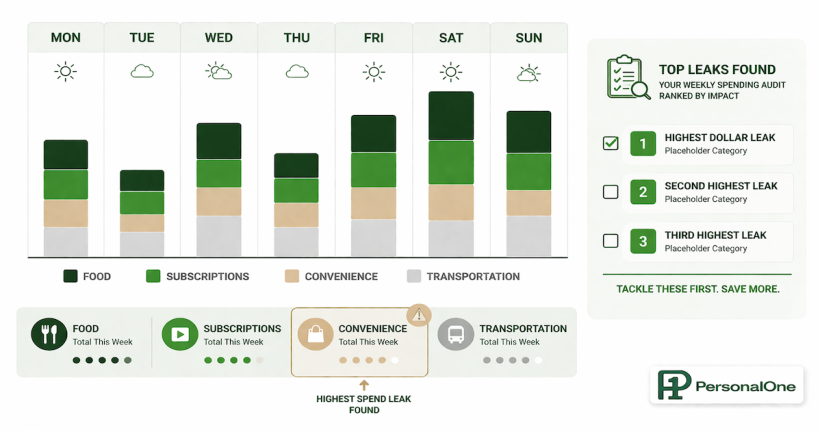
Write down the total of all compression candidates with their dollar amounts. That number is your compression opportunity — the margin that is currently flowing out without purpose and can be redirected. For the seven-day intensive version of this process, the 7-day spending audit covers the same exercise with a tighter execution timeline and a subscription-by-subscription framework for the fixed discretionary category specifically.
Phase 2 — Fixed Cost Elimination
The most important distinction in expense compression is between variable cuts and structural cuts. Cutting dining out produces savings as long as the discipline holds. Cancelling an unused subscription produces savings permanently, without any ongoing effort. Phase 2 focuses entirely on structural cuts — the moves that stay made.
Subscription and Membership Elimination
Every subscription that did not pass the value test gets cancelled today — not paused, cancelled. Pausing creates a resumption date that arrives automatically and the cost returns. Cancellation is permanent until you make a deliberate decision to reinstate.
Work through the fixed discretionary list from the audit in a single sitting. For each one: open the account, cancel the subscription, confirm the cancellation by email. This takes 15–20 minutes for most people and produces $80–$200 in monthly savings from subscriptions alone.
For streaming services: keep the one or two that account for the majority of your actual watching hours. The content on the cancelled services will still be available if you return. You are not losing it permanently — you are deferring it until the financial sprint is complete.
Insurance and Service Renegotiation
Auto insurance, renter's insurance, internet service, and phone plans are all negotiable or shoppable. Most households have not renegotiated any of these in two or more years. Rates available now are almost certainly lower than what is currently being paid.
Call each provider. State that you are reviewing your expenses and considering switching. Ask what retention offers are available. Most providers have unpublished retention rates they will offer rather than lose a customer. If no meaningful offer is made, get a competing quote and either switch or use it as leverage.
Phone plan specifically: the major carriers' prepaid plans and MVNOs (Mint Mobile, Visible, Cricket, Google Fi) run on the same towers as the premium plans at 30–60% of the cost. A household paying $130–$160 for two lines on a major carrier can typically move to $60–$80 for equivalent service. That is a permanent $70–$100 monthly saving from a single switch.
Variable Essential Compression
Groceries are the highest-leverage variable essential. The compression move is not buying less food — it is buying differently. Store-brand equivalents on staples (pasta, canned goods, cooking oils, cleaning products) produce 20–40% savings with no quality difference. Meal planning that eliminates waste reduces the effective per-meal cost significantly. Reducing convenience-format purchases (prepared foods, pre-cut produce, single-serve packaging) compresses the bill further.
A household spending $600–$700 monthly on groceries can typically reach $380–$420 within two weeks of implementing these changes without reducing the quantity or nutritional quality of food purchased. That compression is permanent as long as the buying patterns hold.
If you need to execute these moves under time pressure — a financial shock, a job transition, or a month where cash flow is already critical — the how to compress expenses fast guide covers the same fixed cost elimination moves prioritized by speed and impact, with a same-week execution framework for households that cannot wait 30 days for the full audit cycle.
Phase 3 — Margin Capture
This phase is where most compression efforts fail. The audit finds the money. Phase 2 frees it. And then it quietly gets reabsorbed into general spending over the following weeks because no mechanism existed to capture it before it disappeared.
Margin capture is a single action executed on the same day as each elimination move: set up an automatic transfer for the exact freed dollar amount to a designated account. If a subscription costing $47 per month gets cancelled today, a $47 automatic transfer gets set up today — on the same billing date, to a separate savings or debt payoff account. The cash flow pattern is identical. The destination changes from an expense to an asset.
The timing of this transfer matters. The behavioral window for capturing freed margin is widest immediately after the compression action. A transfer set up in the same session as the cancellation will run automatically and permanently. A transfer you plan to set up later will face more friction, will get deprioritized, and in most cases will not get set up at all. Do it in the same session. Every time.
The capture account should be at a different bank from your daily checking account. Physical and psychological separation from the account you spend from is what prevents the freed margin from being reabsorbed into lifestyle spending. Even a one to two business day transfer delay creates enough friction to protect the captured amount from impulse spending decisions.
Where This Usually Fails
Phase 3 is where I see the most compression efforts collapse. The audit is done, the subscriptions are cancelled, $180 or $240 in monthly margin has been freed — and then nothing happens to it. The person intends to set up the transfer later that week. Later that week becomes later that month. The money disperses into general spending within three pay cycles and the compression effort produced no structural change at all. The failure is not discipline. It is timing. The transfer has to be set up in the same session as the cancellation — within minutes, not days. Every client I have seen execute Phase 3 correctly did it same-day. Almost every client who planned to do it later did not do it at all.
Phase 4 — The Wealth-Building Sequence
Captured margin deployed in the wrong order produces worse outcomes than the sequence below almost every time. The most common mistake is routing freed expense money into investments while carrying high-interest debt and no emergency fund — a structure where one unexpected expense reverses everything the compression effort built. The sequence exists to prevent that.
The Four-Step Deployment Sequence
Step 1 — $1,000 Emergency Starter Fund. Every dollar of captured margin goes here first until $1,000 is held in a separate account. This single step stops the debt spiral — the pattern where every small unexpected expense becomes a credit card charge because there is no buffer. With $1,000 protected, the most common financial emergencies stop producing new debt. Car repair, urgent care visit, appliance failure, vet bill — all of these land in the $400–$900 range where $1,000 covers the hit without touching credit. At $300 per month in captured margin, this step takes approximately three months. At $500 per month, approximately two months.
Step 2 — High-Interest Debt Elimination. Once the starter fund is in place, all captured margin redirects to the highest-interest debt. Any debt above 15% APR is producing a guaranteed negative return that no investment reliably outperforms. The approach is avalanche: minimum payments on everything, every available dollar attacking the highest-rate balance until it is gone, then moving to the next. Each eliminated balance frees its minimum payment, which adds to the avalanche and accelerates every subsequent payoff.
Step 3 — Full Emergency Fund. With high-interest debt cleared, captured margin rebuilds the emergency fund to the three to six month survival expense target. This is the protection layer that makes investing genuinely safe — without it, a job loss or major medical expense forces asset liquidation at the worst possible time, eliminating months or years of investment growth in a single event. The full emergency fund is what separates investing as wealth building from investing as financial risk.
Step 4 — Investment Contributions. With a funded emergency buffer and no high-interest debt, captured margin flows into investment accounts. Employer-matched 401(k) contributions come first — the match is a guaranteed immediate 50–100% return on contributions that no other investment vehicle can match. Roth IRA contributions follow. After these are established, additional compressed margin deploys based on individual goals, timeline, and tax situation.
The sequence works because each step eliminates a structural vulnerability before building the next layer. A household that completes all four steps from a standing start using $300–$400 per month in captured margin will typically complete Steps 1 and 2 within 12–18 months and have the full emergency fund established within 24–30 months. That timeline feels long in the abstract. In practice, 24 months from now will arrive regardless of whether the sequence was started. The question is only whether it will arrive with the work done or with the same starting position still in place.
When the Sprint Ends and What You Keep
The compression sprint ends when Step 3 is complete — full emergency fund funded, high-interest debt eliminated, investment contributions automated. At that point, spending that was compressed during the sprint can be selectively restored based on genuine value.
The key word is selectively. The subscriptions that were cancelled and genuinely missed can be reinstated. The social spending that contributes real value to daily life gets a meaningful budget allocation. But the expenses the audit revealed were running on autopilot without delivering anything — those do not come back. Their absence has been demonstrated over months. Keeping them gone is not sacrifice. It is the result of a more deliberate relationship with spending that the compression sprint installed.
What remains after the sprint is a budget where every dollar has a deliberate assignment, the emergency fund runs automatically, and investment contributions fire without any monthly decision required. That budget produces more financial progress with less ongoing effort than the pre-compression version — not because income increased, but because the structural leaks were permanently sealed and the freed margin was put to permanent work.
The Margin Is Already There. The Framework Is How You Find It.
Expense compression is one cluster in the complete financial stability framework. Emergency funds, buffer accounts, income protection, and long-term resilience all build on the margin this process creates. See the full system at the Financial Stability hub.
Frequently Asked Questions
What if I run the audit and genuinely find nothing to compress?
Run it before concluding that. Almost every household that believes it has no compression room finds $50–$150 per month on the first pass. That said, households at the genuine income floor — where every dollar covers a non-negotiable essential — may need to pursue income expansion alongside compression. The audit still has value in that case because it confirms exactly how much additional income is needed and what margin that income needs to produce before the wealth-building sequence becomes viable.
How long does the compression sprint typically take from start to investment contributions?
It depends on how much compression is available and how aggressively it is deployed. A household that finds $300 per month in captured margin and carries $2,400 in high-interest debt can complete Steps 1 and 2 in approximately twelve months. At $500 per month in captured margin, the same household completes them in seven to eight months. Step 3 (full emergency fund) typically adds twelve to eighteen months on top of that. The timeline is real but finite — and each milestone produces immediate, tangible financial relief that makes the next step easier to sustain.
Should I pause retirement contributions to accelerate the compression sequence?
One exception applies: if your employer matches 401(k) contributions, contribute enough to capture the full match before directing margin elsewhere. The match is a guaranteed 50–100% immediate return — no debt payoff rate and no investment return reliably exceeds it. Beyond the employer match, pause additional retirement contributions until Step 2 (high-interest debt) is complete. The mathematical case for eliminating 20%+ APR debt before investing in assets returning 7–10% annually is clear.
What stops compressed spending from creeping back up after the sprint?
Three structural mechanisms. First, execute eliminations permanently — cancel, not pause. Second, set up automatic captures immediately so freed margin moves before it can be spent. Third, schedule a quarterly expense review — 30 minutes every three months to audit for new subscriptions, rate increases, and spending that has quietly expanded. The original sprint is intensive and one-time. The maintenance is minimal. Most households find the quarterly review takes 20 minutes once the initial compression has been done.
Can I do this while also dealing with an active financial emergency?
Yes — and if anything, the compression audit is more urgent during a financial emergency than at any other time. An active shock is exactly the moment when knowing precisely where every dollar is going matters most. Run the audit immediately. Execute the fixed cost eliminations the same day. The freed margin does not go into the wealth-building sequence during an active emergency — it goes toward covering the immediate shortfall. The sequence begins once the emergency is resolved and income is stabilized. The financial shock absorption cluster covers the crisis cash flow response in full.
Official Sources
CFPB — Budget and Spending Tools
CFPB — Building Emergency Savings
Federal Reserve — Dealing with Unexpected Expenses
More From This Cluster
Return to Expense Compression Strategy for the complete framework — the audit, fixed cost elimination, margin capture, and the full wealth-building sequence from a compressed expense base.
This content is for educational purposes only and does not constitute financial advice. PersonalOne is not a licensed financial advisor, broker, or investment professional. Expense compression strategies, debt payoff approaches, and savings targets should be tailored to your individual circumstances. Consult a qualified financial professional before making significant changes to your financial approach.