August 2026
Home › Credit Building & Protection › Authorized User Credit Strategy › How Long Does It Take for Authorized User Status to Affect Your Credit Score?
What You Need to Know
— Authorized user status typically appears on your credit report within one to two billing cycles — 30 to 45 days in most cases. Some issuers report in 7 to 14 days. A small number of issuers don't report authorized user status to the bureaus at all.
— The timeline depends on five variables: the issuer's reporting policy, which bureau receives the data first, which FICO model version is calculating your score, the quality of the primary account, and your existing credit profile.
— If you see no score movement after two billing cycles, the most likely cause is one of four specific diagnostic failures — not a timing issue. Waiting longer won't fix a reporting problem.
— Not all issuers report authorized user accounts to all three bureaus. Some report to only one or two. Some don't report AU status at all — meaning no account appears on your report regardless of how long you wait.
— When AU status is removed, the score improvement reverses. AU status is a bridge tool — it improves your score while you build independent credit history, not a permanent foundation.
How long does authorized user take to affect credit score — this is the question every person asks within days of being added to someone else's credit card. The standard answer you'll find everywhere is "30 to 60 days." That answer is technically accurate as an average and practically useless as a guide, because it doesn't tell you what determines whether you land at the fast end of that range, the slow end, or outside it entirely. Two people added to the same card on the same day can see completely different outcomes — one sees a 40-point improvement in three weeks, the other sees nothing after two months. The difference isn't luck. It's five specific variables, and once you know which one applies to your situation you can either wait with confidence or take action instead of waiting.
This guide maps the full timeline — from the moment you're added as an authorized user to the moment your score reflects the change — and gives you a diagnostic framework for every scenario where the expected improvement doesn't show up on schedule.
The Five-Stage Pipeline: From Account Addition to Score Change
The timeline from being added as an authorized user to seeing your score change is not a single event — it's a five-stage pipeline, and each stage has its own timeline. Understanding the pipeline is what makes the wait predictable rather than mysterious.
Stage 1 — The issuer processes the addition. When the primary cardholder adds you as an authorized user — online, by phone, or through the app — the issuer updates their internal account records. This processing is typically same-day or next-day for most major issuers. Some issuers require a physical card to be issued before the account is fully reflected in their system, which can add a few days.
Stage 2 — The issuer transmits data to the bureaus. Your card issuer reports account data to the credit bureaus on their own monthly schedule — typically within one to three days after your statement closes. For authorized user accounts, the reporting includes your name as an authorized user, the account's open date, credit limit, current balance, and payment history. This is the stage that determines whether the account appears on your credit report at all — and it's entirely controlled by the issuer. Some issuers report AU status to all three bureaus. Some report to only one or two. Some don't report AU status to any bureau. If the issuer doesn't report, no amount of waiting produces a result.
Stage 3 — The bureau processes and updates your file. After receiving the issuer's data, the bureau updates your credit report file. This processing typically takes one to five business days. During this window your report at one bureau may show the new account while another bureau hasn't received or processed it yet. The complete mechanics of this reporting pipeline — how data moves from issuer to bureau and why the same account can show different information at different bureaus — is covered in the article on how credit card payments are reported to the bureaus.
Stage 4 — Your credit score recalculates. Your score is not a standing number — it's calculated fresh each time it's requested, from whatever data is in your credit report at that moment. Once the bureau has updated your file with the authorized user account, the next score calculation reflects it. Free monitoring apps typically recalculate scores daily or weekly. Lender-pulled scores calculate at the moment of the pull.
Stage 5 — The impact appears in your monitoring tool. The score improvement becomes visible to you when your monitoring app or score dashboard updates with the new calculation. This is the stage most people focus on — but it's the last stage in a five-stage process. If the improvement isn't showing up, the delay is almost always in Stage 2 or Stage 3, not Stage 4 or Stage 5.
What I've Seen
The most frustrating version of this I see is someone who was added to a parent's card with a 20-year history, a $15,000 limit, and a perfect payment record — and saw absolutely no score movement after six weeks. They assumed the strategy wasn't working. The actual problem was that the issuer — a regional bank — didn't report authorized user status to the credit bureaus at all. The account never appeared on the report. No amount of waiting would have changed the outcome. The fix took ten minutes: the parent called their issuer, confirmed they don't report AU status, and transferred the strategy to their American Express card, which reports AU status to all three bureaus within two weeks. The score improvement appeared within the next billing cycle. The strategy worked perfectly — it was just on the wrong card.
The Five Variables That Determine Your Timeline
The 30 to 45-day average is real — but it's an average across a wide range of outcomes driven by five distinct variables. Knowing which variable is operating in your situation tells you whether to wait, check, or act.
Variable 1 — Issuer Reporting Policy
The single most important variable is whether your issuer reports authorized user accounts to the bureaus at all — and to which ones. Most major issuers do report AU status to all three bureaus: American Express, Chase, Capital One, Discover, Citi, and Bank of America all report AU accounts consistently. Some regional banks, credit unions, and smaller issuers do not report AU status. If the issuer doesn't report, the account never appears on your credit report — the strategy produces zero score movement regardless of how long you wait or how perfect the primary account is. Before being added to any account, the primary cardholder should call their issuer and ask directly: "Do you report authorized user accounts to all three credit bureaus?" This takes two minutes and prevents weeks of unproductive waiting.
Variable 2 — Billing Cycle Timing
Issuers report account data on their monthly billing cycle schedule — typically within a few days after the statement closes. If you're added as an authorized user three days before the statement closes, the account may appear in your credit report within a week. If you're added the day after the statement closes, you wait nearly a full billing cycle — 28 to 31 days — before the issuer's next reporting window. The timing of when within the billing cycle you're added determines whether you're at the fast end (one week) or the slow end (five to six weeks) of the typical timeline, with no other variable changing.
Variable 3 — Bureau Processing Speed
Each credit bureau processes incoming issuer data on its own schedule. Experian typically processes new account data faster than Equifax and TransUnion. This means your authorized user account may appear at Experian a week before it appears at the other two bureaus. If you're monitoring your score through Credit Karma — which uses TransUnion and Equifax — and the improvement hasn't appeared yet, it may already be reflected at Experian. Pull a full three-bureau report from AnnualCreditReport.com to check all three files simultaneously rather than relying on one monitoring app that may be looking at the slower bureaus.
Variable 4 — FICO Model Version
Not all FICO models treat authorized user accounts identically. FICO 8 — the most widely used model — includes authorized user accounts and treats them similarly to accounts you own. FICO 9 and FICO 10 also include AU accounts. Older FICO model versions, and some industry-specific models, may weight AU accounts differently or treat them with less scoring impact. The free score you see in a monitoring app is typically a VantageScore — a different scoring model entirely — which also includes AU accounts but calculates their impact differently than FICO. The score that matters for most credit applications is FICO 8 or a lender-specific FICO variant. If your VantageScore in a monitoring app isn't moving, the impact may still be appearing in your FICO score — or vice versa.
Variable 5 — Your Existing Credit Profile
The impact of an authorized user account on your score — and how quickly that impact appears — depends heavily on what's already in your credit file. For someone with no credit history at all, being added to an account gives the scoring model something to calculate from, but FICO requires at least one account that has been open for at least six months to generate a score at all. If the primary account is less than six months old or if it's the only account in your file, you may not generate a FICO score even after the account appears. For someone with an existing thin file, the impact is typically larger and faster than for someone with an established credit history where one additional account produces only a marginal change. The complete framework for using AU status as a starting point for building credit from nothing is covered in the article on how being an authorized user actually builds credit.
The Diagnostic: What to Do When the Improvement Doesn't Show Up
If two full billing cycles have passed — approximately 60 days — and your score hasn't moved, the problem is almost certainly in one of four specific places. Work through this diagnostic in order before concluding the strategy isn't working.
Diagnostic Step 1 — Check whether the account appears on your credit report. Pull your full credit reports from all three bureaus at AnnualCreditReport.com. Look for the account by the primary cardholder's card issuer name. If the account doesn't appear at any bureau after 60 days, the issuer almost certainly doesn't report AU status. Contact the primary cardholder and have them call the issuer to confirm their AU reporting policy. If they don't report, the only fix is to use a different card from an issuer that does.
Diagnostic Step 2 — Check whether the account appears at all three bureaus. If the account appears at one or two bureaus but not the third, the issuer may only report to certain bureaus. Your score at the bureau that doesn't have the account won't reflect the AU addition. This isn't a problem that resolves with time — it's the issuer's permanent reporting policy. Monitoring apps that pull from the bureau missing the account will show no change indefinitely.
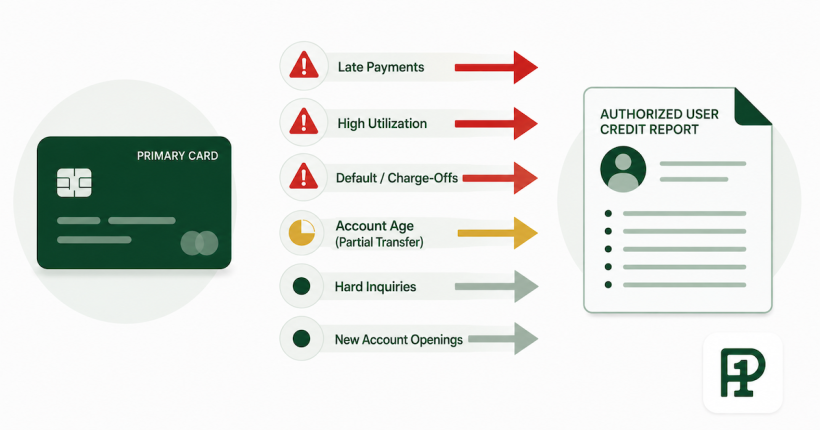
Diagnostic Step 3 — Check the account quality on the primary card. If the account is appearing on your report but your score hasn't improved — or has gotten worse — check the payment history, utilization, and account standing on the primary card. A high utilization rate on the primary card transfers to your utilization calculation. A late payment in the primary card's history appears in your payment history. Being added to a poorly managed account can suppress your score rather than improve it. The full risks of AU status on accounts with negative history are covered in the article on can being an authorized user hurt your credit score.
Diagnostic Step 4 — Check whether you have a scoreable file. If you have no other credit accounts and the AU account is the only thing in your credit file, confirm the account has been open for at least six months. FICO requires at least one account aged six months or more and at least one account reported within the last six months to generate a score. If the primary card is newer than six months, you may have an account appearing on your report without yet meeting the minimum threshold for a FICO score to calculate.
Realistic Score Impact Ranges by Starting Profile
The score impact of authorized user status varies significantly based on where your score starts and what's in your existing credit file. These ranges reflect documented outcomes — not guarantees — and help set accurate expectations before you begin.
No credit file (thin file or no score): Being added to a well-managed account with 10 or more years of history, a high credit limit, and low utilization can generate a starting FICO score in the 650 to 720 range within one to two billing cycles — provided the account meets the six-month age requirement. The score generated reflects the primary account's quality more than any independent credit behavior. This is the highest-impact scenario for AU strategy because you're going from nothing to something in a single account addition. The comparison between AU strategy and other thin-file tools — specifically the secured card — is covered in the article on authorized user vs secured card for building credit faster.
Fair credit (580 to 669): Someone in this range typically has some credit history — possibly with high utilization, a few late payments, or a short account history. Being added to a strong primary account can produce 20 to 60 point improvements within one to two billing cycles, primarily from the utilization reduction effect of the new available credit and the positive payment history transferring from the primary account. The improvement is larger when the existing profile's primary drag is utilization — because the new available credit immediately lowers the overall utilization ratio.
Good credit (670 to 739): At this range, most of the major score improvements available through payment history and utilization management are already captured in the existing profile. AU status on an exceptional primary account — 800+ score, 20-year history, very low utilization — can add 10 to 25 points. The impact is smaller because the score is already in a range where marginal improvements require significant additional positive factors.
Very good credit (740+): AU status produces minimal impact at this score level. The scoring model has sufficient data from the existing profile, and additional accounts with similar characteristics add only marginal information. AU strategy is most valuable at the lower end of the score range where the gap between current score and a meaningful threshold is large and where limited credit history leaves room for significant improvement.
What Happens to Your Score When AU Status Is Removed
Authorized user status is not permanent. When you're removed from the account — or when the primary cardholder closes the account — the account's history typically disappears from your credit report within one to two billing cycles. The score improvement that came from being an authorized user reverses when the account is removed. This is the most important limitation of the AU strategy and the reason it should always be treated as a bridge tool rather than a permanent credit-building solution.
The reversal happens because your score was calculated in part from that account's history — its age, its available credit, its payment history. When those contributions are removed, your score recalculates without them. If your underlying independent credit history hasn't grown during the period you were an authorized user, the score can return close to where it started. The complete process for removing yourself and understanding the score consequences is covered in the article on how to remove yourself as an authorized user and what happens next.
The strategic implication: use the score improvement from AU status to open your own credit accounts while the improvement is active. A credit card application submitted with the benefit of a 30 to 50-point AU improvement that produces an approval gives you an independent account that builds credit on its own — independent of the AU relationship. That independent account's history persists even after the AU status ends. For the full timeline of how long each phase of credit building takes and when to make each move, the article on how long it takes to build a 700 credit score maps the realistic milestones from starting score to target score.
Build Your Complete Authorized User Strategy
Timeline is one piece. The Authorized User Credit Strategy cluster covers every dimension of the AU approach — who to add, when it backfires, how to remove yourself, and how to use the score improvement strategically before it reverses.
Explore the Full StrategyGovernment Resources
CFPB — Credit Reports and Scores — Official guidance on how authorized user accounts appear on credit reports and your rights as a consumer.
AnnualCreditReport.com — Free weekly reports from all three bureaus — the only way to verify whether an authorized user account has appeared and at which bureaus.
FTC — Understanding Your Credit — Federal overview of credit scoring factors and how account additions affect your credit profile.
Return to the full credit building and protection guide for a complete overview of every credit strategy covered on PersonalOne.
Frequently Asked Questions
How long does it take for authorized user status to show on your credit report?
Typically one to two billing cycles — 30 to 45 days for most major issuers. American Express and some other issuers report in 7 to 14 days. Some regional banks and credit unions don't report authorized user status at all, in which case the account never appears regardless of how long you wait. The fastest way to verify is to pull your reports from all three bureaus at AnnualCreditReport.com after one full billing cycle has passed from the date you were added.
Why hasn't my credit score changed after being added as an authorized user?
The four most common reasons in order of frequency: the issuer doesn't report authorized user accounts to the bureaus, the account hasn't completed a full billing cycle since you were added, the account is appearing at one bureau but not the one your monitoring app checks, or the primary account has high utilization or negative history that is transferring to your report and suppressing rather than improving your score. Pull your full three-bureau reports to diagnose which scenario applies before concluding the strategy isn't working.
Do all credit card issuers report authorized users to the credit bureaus?
No. Most major national issuers do — American Express, Chase, Capital One, Discover, Citi, and Bank of America all report AU status to all three bureaus consistently. Many regional banks, credit unions, and some smaller issuers do not report authorized user accounts. Before agreeing to be added to any account specifically for credit-building purposes, have the primary cardholder call their issuer and confirm AU reporting policy. This is the most important single verification step in the entire strategy.
How much will my score improve as an authorized user?
It depends on your starting score and what's currently in your credit file. Someone with no credit history being added to a strong 15-year-old account with low utilization can generate a starting FICO score in the 650 to 720 range within one to two billing cycles. Someone in the fair credit range (580 to 669) can typically see 20 to 60 point improvements. Someone with good credit (670+) typically sees 10 to 25 points from a strong primary account. The improvement reflects the primary account's quality — account age, utilization, and payment history are all factors that transfer to your credit report.
What happens to my credit score when I'm removed as an authorized user?
The account's history typically disappears from your credit report within one to two billing cycles after removal. The score improvement that came from that account reverses. This is why authorized user status should always be used as a bridge — the period when your score is improved should be used to open your own independent credit accounts. Those independent accounts build history that persists after the AU relationship ends, so your score doesn't return to its starting point when you're removed.
Can I check if an authorized user account has appeared on my credit report?
Yes — pull your full credit reports from all three bureaus at AnnualCreditReport.com, which provides free weekly access. Look for the account by the card issuer's name in the accounts section of each report. Check all three bureaus separately because the account may appear at one before the others. If the account appears at one bureau but not another after 60 days, the issuer may only report to certain bureaus. If it doesn't appear at any bureau after two full billing cycles, call the issuer to confirm their AU reporting policy.
This article is for educational purposes only and does not constitute financial or credit advice. Credit score outcomes from authorized user status vary based on individual credit profiles, issuer reporting policies, scoring models, and account characteristics. Verify issuer reporting policies directly with your card issuer. PersonalOne is a free financial education platform.