By Don Briscoe, a personal finance educator with over 12 years of experience guiding everyday people through smarter banking, credit, and money decisions.
TL;DR — Get Out of Debt Quickly
- Face the numbers first: List every debt with balance, interest rate, and minimum payment—clarity eliminates overwhelm and creates an action plan
- Income beats cutting expenses: Side hustles accelerate debt payoff 2-3x faster than extreme frugality—aim for an extra $300-500/month
- Choose your method strategically: Avalanche (highest interest first) saves money, Snowball (smallest balance first) builds momentum—pick what you'll stick with
- Negotiate everything: Call creditors for lower rates, hardship programs, or settlements—success rate is 50-70% if you ask
- Know when DIY isn't enough: If minimums exceed 40% of income or you're getting collection calls, professional debt relief may be faster than DIY
Debt can be a heavy burden, affecting your financial health, mental well-being, and future opportunities. Whether you're dealing with credit card balances, student loans, medical bills, or personal loans, the weight of debt creates constant stress and limits your financial freedom.
The good news? With the right strategies and dedication, it's possible to get out of debt faster than you might think. This isn't about gimmicks or "one weird trick"—it's about proven methods that work when applied consistently.
This comprehensive guide walks you through practical, actionable steps to accelerate your journey to debt freedom, from assessment and strategy selection to income optimization and knowing when to seek professional help.
For a complete overview of all debt relief options and how they compare, visit our debt relief and credit repair hub. Then return here for specific quick-payoff tactics.
Step 1: Assess Your Complete Debt Situation
Before you can tackle your debt effectively, you need to know exactly what you're dealing with. Avoidance makes debt feel bigger—facing it with real numbers makes it manageable.
Create Your Debt Inventory
Open a spreadsheet or grab a notebook and list every single debt you have. For each one, record:
- Creditor name: Who you owe (Chase, Discover, federal student loan, medical provider)
- Current balance: Total amount owed right now
- Interest rate (APR): Find this on statements or online accounts
- Minimum monthly payment: What they require each month
- Due date: When payment is due
- Account status: Current, past due, in collections
Example debt inventory:
- Chase Freedom: $5,200 @ 22% APR, $156 minimum, due 15th - Current
- Discover: $3,800 @ 18% APR, $114 minimum, due 5th - Current
- Capital One: $2,100 @ 24% APR, $63 minimum, due 20th - Current
- Personal loan (Marcus): $8,000 @ 12% APR, $267 minimum, due 1st - Current
- Medical collection: $1,200 @ 0% (payment plan), $100 minimum, due 10th - Collections
- Total debt: $20,300, $700 in minimums per month
Pull Your Credit Report
Go to AnnualCreditReport.com and pull reports from all three bureaus (Experian, Equifax, TransUnion). This ensures you're not missing any debts—sometimes old accounts, collections, or medical bills only appear on your credit report.
What to look for:
- Accounts you forgot about
- Collections you weren't aware of
- Errors that could be disputed
- Accurate current balances
Calculate Your Debt-Free Date
Use our debt paydown calculator to see how long it will take to pay off your debt at different payment amounts. This gives you realistic expectations and shows how extra payments dramatically accelerate your timeline.
Step 2: Create a Zero-Based Budget
A clear budget is the foundation of accelerated debt payoff. Without knowing exactly where your money goes, you can't maximize debt payments.
The Zero-Based Budget Method
How it works: Every dollar of income gets assigned a specific job before the month begins. Income minus all expenses and debt payments should equal zero.
Categories to include:
- Fixed essentials: Rent/mortgage, utilities, insurance, minimum debt payments
- Variable essentials: Groceries, gas, basic phone plan
- Debt acceleration: Extra payments beyond minimums
- Small emergency buffer: $50-100 monthly until you have $500-1,000 saved
- Minimal discretionary: $50-100 for sanity (prevents burnout)
Track Your Spending for 30 Days
Before creating your budget, track every expense for one month. This reveals:
- Subscription creep: Services you forgot you're paying for
- Invisible spending: Daily $5 coffees that add up to $150/month
- Emotional triggers: What causes impulse purchases
- Realistic baselines: What you actually spend on groceries vs. what you think you spend
Tools for tracking:
- YNAB (You Need A Budget) - $14.99/month, worth it for debt payoff
- Mint - Free, connects to all accounts
- Simple spreadsheet - Free, maximum control
Budget Reallocation Example
Before tracking: Jordan thought he had no money for extra debt payments
After 30-day tracking, he found:
- $45/month in forgotten subscriptions (streaming, apps) → Cancelled
- $120/month eating lunch out → Meal prep for $40/month = $80 saved
- $60/month unused gym membership → Home workouts = $60 saved
- $85/month impulse Target runs → Shopping list discipline = $50 saved
Result: Found $235/month for extra debt payments without feeling deprived
Step 3: Increase Your Income (The Fastest Path to Debt Freedom)
Cutting expenses has a floor—you can only reduce spending so much before hitting necessities. Income has no ceiling. Even a small income increase dramatically accelerates debt payoff.
The Income vs. Expense Math
Scenario: $15,000 credit card debt at 20% APR
- Minimum payments only ($450/month): 14+ years to payoff, $20,000+ in interest
- Cut $200 in expenses → $650/month: 2.5 years to payoff, $4,200 in interest
- Add $400 side income → $850/month: 1.75 years to payoff, $2,800 in interest
- Both ($200 cut + $400 income) → $1,050/month: 1.4 years to payoff, $2,100 in interest
Takeaway: Increasing income by $400/month cuts payoff time by over a year compared to just cutting expenses.
Realistic Side Hustles for Quick Debt Payoff
Start this week (low barrier, fast cash):
- Food delivery (DoorDash, Uber Eats): $15-25/hour, flexible schedule, same-day pay options available. Target 10 hours/week = $150-250/week extra
- Rideshare (Uber, Lyft): $18-30/hour depending on market, weekends pay better
- Task services (TaskRabbit, Handy): $20-40/hour for handyman work, moving help, cleaning
- Sell unused items: Electronics, clothes, furniture on Facebook Marketplace, OfferUp. Target $500-1,000 one-time boost
Build up (higher pay, 2-4 weeks to start):
- Freelance services (Upwork, Fiverr): Writing, design, coding, virtual assistance. $25-100/hour depending on skill
- Online tutoring: $20-60/hour for academic subjects or test prep. Evenings and weekends
- Pet sitting/dog walking (Rover): $25-50/night for boarding, $15-30 per walk
Primary job optimization:
- Ask for a raise (prepare specific accomplishments and market rate data)
- Take on overtime if available
- Apply for internal promotions or higher-paying positions at other companies
Step 4: Choose Your Debt Repayment Strategy
Two proven methods dominate debt payoff: Avalanche and Snowball. Both work—the best one is whichever you'll actually stick with for months or years.
Debt Avalanche: Math-Optimal Method
How it works: List all debts by interest rate (highest to lowest). Pay minimums on everything, then throw all extra money at the highest-rate debt first. Once that's paid off, move to the next highest rate.
Why it works: You pay the least total interest. On $20,000 of mixed debt, avalanche can save you $1,000-2,500 in interest compared to other methods.
Example using the debt inventory above:
- Capital One ($2,100 @ 24% APR) ← All extra payments go here first
- Chase Freedom ($5,200 @ 22% APR)
- Discover ($3,800 @ 18% APR)
- Marcus personal loan ($8,000 @ 12% APR)
- Medical collection ($1,200 @ 0%)
Best for: People motivated by math and optimization, strong willpower, significant high-interest debt.
Debt Snowball: Momentum Method
How it works: List all debts by balance (smallest to largest). Pay minimums on everything, then throw all extra money at the smallest balance first. Once that's paid off, roll that payment into the next smallest.
Why it works: Quick wins build psychological momentum. Paying off a $1,200 medical bill in 2-3 months feels amazing and motivates you to keep going.
Example using the debt inventory above:
- Medical collection ($1,200) ← All extra payments go here first
- Capital One ($2,100)
- Discover ($3,800)
- Chase Freedom ($5,200)
- Marcus personal loan ($8,000)
Best for: People motivated by visible progress, those who've quit debt plans before, anyone who needs regular encouragement.
Which Method Should You Choose?
Choose Avalanche if:
- You're disciplined and math-motivated
- You have significant high-interest debt (20%+ APR credit cards)
- Saving money on interest is your top priority
- You can stay motivated without quick wins
Choose Snowball if:
- You need psychological wins to stay motivated
- You've tried and quit debt payoff plans before
- Your debt is spread across many small accounts
- The interest difference between methods is small (under $500)
For more detailed comparison of these methods with real examples, see our complete debt payoff guide.
Step 5: Negotiate with Creditors
Most people don't realize credit card companies and creditors will negotiate—especially if you're struggling or have decent payment history. One phone call can save you thousands.
What to Negotiate and How to Ask
Lower interest rates:
- Script: "I've been a customer for [X years] and have maintained good payment history. I'm currently evaluating balance transfer offers at lower rates. Can you reduce my APR to help me stay with you?"
- Success rate: 50-70% if you have decent payment history
- Potential savings: Reducing from 22% to 16% on $5,000 saves about $300/year
Hardship programs:
- When to use: Job loss, medical emergency, income reduction
- Benefits: Reduced interest (sometimes to 0%), lower minimums, waived fees for 6-12 months
- Trade-off: Account typically closes, can't make new charges
- Script: "I'm experiencing financial hardship due to [reason]. Do you have hardship programs that could temporarily reduce my interest rate and payment?"
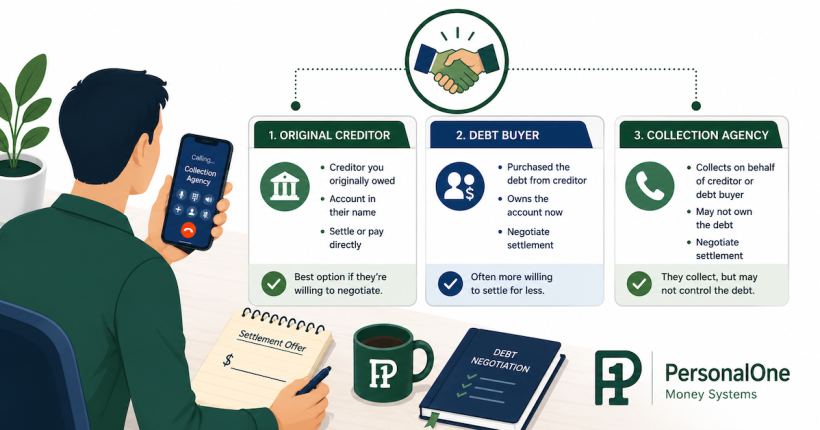
Debt settlement (for accounts in collections):
- How it works: Offer a lump sum payment for less than the full balance (typically 40-60%)
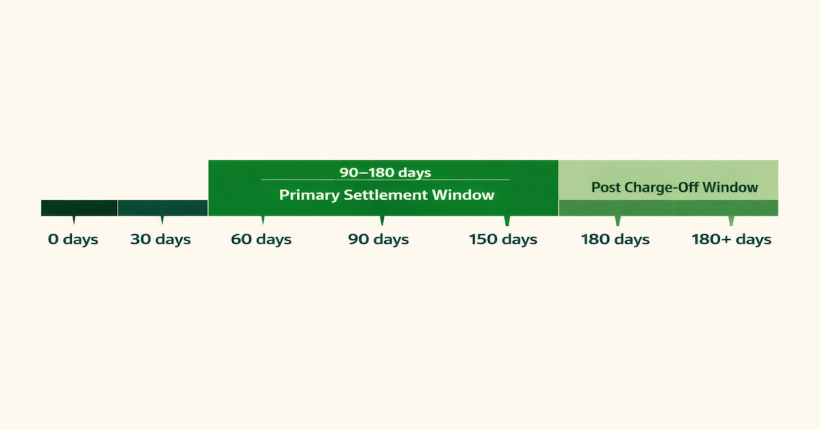
- When to use: Debt in collections, you have lump sum available, account is severely delinquent
- Script: "I owe $3,000 but I can only pay a portion. Would you accept $1,500 as settlement in full if I pay today?"
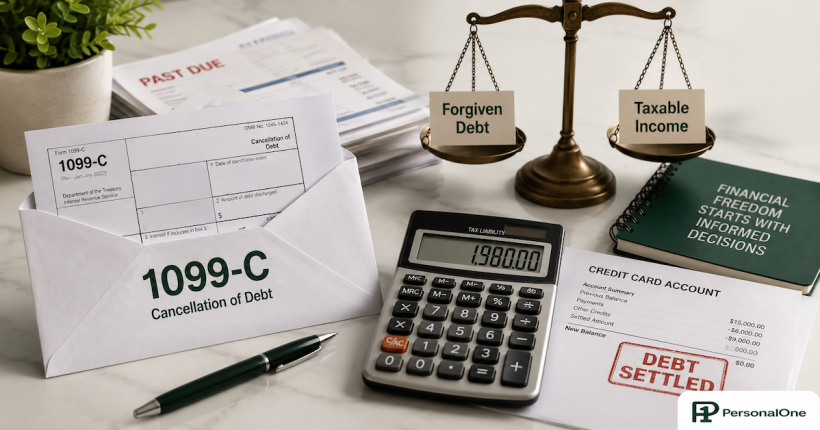
- Get it in writing: Never pay without written confirmation that settlement satisfies the debt in full
For comprehensive guidance on when to settle debt versus other options, see our debt settlement, bankruptcy, and counseling comparison.
Step 6: Stop Accumulating New Debt
You can't bail water from a sinking boat if you're also drilling new holes. While paying off existing debt, you must stop adding new debt.
Break the Debt Cycle
Immediate actions:
- Remove saved card info: Delete credit cards from Amazon, Uber, DoorDash, etc.
- Freeze cards in ice: Literally freeze them in a block of ice—creates decision friction
- Switch to cash/debit: Use cash envelopes for discretionary categories
- Unsubscribe from marketing: Retailer emails trigger impulse purchases
Build a small emergency fund:
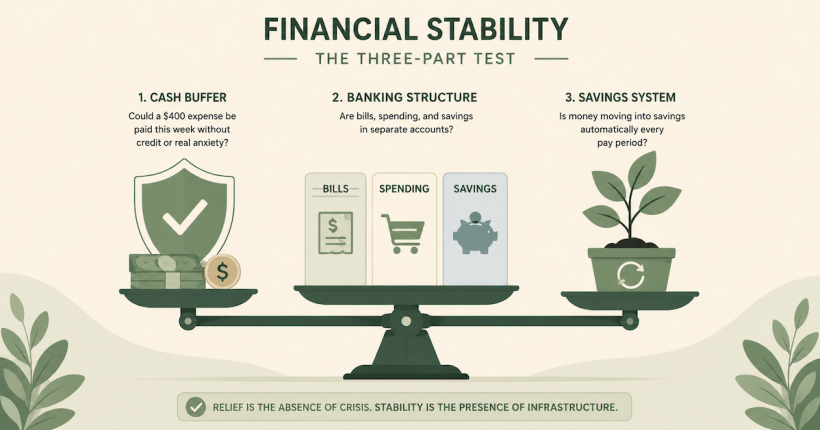
Without a buffer, car repairs or medical bills go right back on credit cards, undoing your progress. Save $500-1,000 before aggressively attacking debt—this breaks the cycle of new debt during emergencies.
Address the root cause:
- If debt came from income loss → Side hustle or job change
- If debt came from overspending → Budget and spending tracking
- If debt came from emergency → Build proper emergency fund after debt is gone
- If debt came from lifestyle inflation → Reset expectations and priorities
Step 7: Stay Motivated Through the Journey
Debt repayment is a marathon, not a sprint. Maintaining motivation for months or years requires intentional strategies.
Celebrate Milestones
Don't wait until you're 100% debt-free to celebrate. Mark these moments:
- First debt paid off (even if small)
- Every $5,000 milestone
- Six months of consistent extra payments
- Under 50% of original debt balance
- First month of three-figure progress
Small rewards that don't derail progress: Dinner out, movie night, small purchase under $50, day trip to somewhere free.
Visualize Progress
Visual tracking methods:
- Debt thermometer on wall (color in as you pay down)
- Chain method (X each day you don't add new debt)
- Monthly net worth tracker (watch debt decrease, assets stay stable or increase)
- Payoff calculator showing months removed from timeline
Find Your Support System
- Accountability partner who's also paying off debt
- Online communities (Reddit's r/debtfree, Facebook groups)
- Financial peace or debt-free meetup groups
- Trusted family member who knows your goals
For quick motivation boost and structured action plan, try our 30-day debt detox challenge.
When to Consider Professional Debt Relief
Sometimes self-directed debt payoff isn't realistic. That doesn't mean failure—it means you need different tools.
Signs You Need Professional Help
- Minimums exceed 40% of income: Not mathematically sustainable
- Only paying minimums, balances aren't dropping: Interest trap
- Creditors calling constantly: Accounts are delinquent or in collections
- Legal threats: Garnishment, lawsuits, repossession notices
- Mental health impact: Debt stress affecting sleep, relationships, work performance
- No progress after 6 months DIY: Current approach isn't working
Professional Debt Relief Options
Credit counseling (non-profit):
- Negotiates lower interest rates, creates debt management plan
- You make one monthly payment, they distribute to creditors
- Typical cost: $25-50/month
- Timeline: 3-5 years to complete
- Credit impact: Minimal to moderate
Debt settlement:
- Companies negotiate to settle debts for 40-60% of balance
- You stop paying creditors, save money in account
- Typical cost: 15-25% of enrolled debt
- Timeline: 2-4 years
- Credit impact: Significant but temporary
Bankruptcy:
- Chapter 7: Wipes most unsecured debt in 3-6 months
- Chapter 13: Court-approved payment plan over 3-5 years
- Cost: $1,500-3,500 in attorney fees
- Credit impact: Severe (7-10 years on report) but provides fresh start
For detailed reviews and guidance on when each option makes sense, see our CuraDebt review and best debt relief services guide.
Ready to Get Out of Debt Quickly?
Start with the debt inventory today. List every balance, rate, and payment. Then choose avalanche or snowball and make your first extra payment this week.
Explore All Debt Relief OptionsFrequently Asked Questions
How long will it realistically take to get out of debt?
Most people can become debt-free in 2-4 years with dedicated effort, but timeline depends on debt amount, income, and extra payment capacity. Quick math: If you have $20,000 in debt and can pay $800/month (minimums plus extra), you'll be free in about 2.5-3 years depending on interest rates. If you can only pay minimums ($500/month), it could take 10+ years. The biggest variable is how much extra you can throw at debt beyond minimums. Side hustle income is the fastest accelerator—an extra $400/month can cut your timeline in half. Use our debt paydown calculator to see your specific timeline.
Should I use my savings or emergency fund to pay off debt?
Keep at least $500-1,000 in savings even while aggressively paying off debt, but beyond that, it often makes sense to use savings for high-interest debt. Here's the logic: If your credit cards charge 22% APR and your savings earns 4%, you're losing 18% by keeping that money in savings instead of paying down debt. However, without any emergency buffer, the next car repair or medical bill goes right back on credit cards at 22%, undoing your progress. Best approach: Build $500-1,000 emergency buffer first, then throw everything extra at debt. Once debt is gone, build full 3-6 month emergency fund. Exception: If you have low-interest debt (like a 3% auto loan), keep more in savings rather than paying it off early.
Is debt consolidation a good idea?
Debt consolidation can be helpful if it lowers your overall interest rate AND you're committed to not accruing new debt—but it's not a magic solution. Consolidation works best when: (1) You can qualify for a lower interest rate than your current debts (usually need 650+ credit score), (2) The monthly payment is actually manageable (don't extend timeline just to lower payment), and (3) You address the root cause of debt (otherwise you'll run up new balances on the freed-up cards). Common consolidation methods: Balance transfer card (0% APR for 12-18 months), personal loan (fixed rate, fixed term), home equity loan (lowest rates but risky—your house is collateral). Warning: Consolidation doesn't reduce what you owe—it just reorganizes it. Many people consolidate, feel relieved, then accumulate new debt and end up worse off.
What's the fastest way to pay off $10,000 in credit card debt?
Combination of increased income, lower interest rate negotiation, and aggressive payments using debt avalanche method—realistic timeline is 12-18 months. Here's a proven fast-track plan: (1) Call credit card company and negotiate lower interest rate (can reduce from 22% to 16% if you ask), (2) Start a side hustle to generate extra $400-500/month (food delivery, freelancing, selling items), (3) Cut $200/month in expenses (subscriptions, dining out, unused services), (4) Apply all extra money ($600-700/month) to highest-interest card first while making minimums on others, (5) When first card is paid off, roll that payment into next card (snowball effect). With $700/month extra payments, you can pay off $10,000 in about 15 months instead of 10+ years with minimum payments. For step-by-step guidance, see our credit card debt escape plan.
Can I negotiate my debt down if I pay a lump sum?
Yes, especially if the debt is in collections or severely delinquent—creditors often accept 40-60% of the balance for immediate payment. How it works: Creditors would rather get something now than chase you for years or get nothing if you declare bankruptcy. Best negotiation leverage: (1) Debt is old (6+ months delinquent), (2) Account is in collections (original creditor sold it for pennies), (3) You have lump sum available to pay immediately, (4) You're willing to walk away if they don't accept. Process: Call and offer 50% as "settlement in full" in exchange for immediate payment. They'll likely counter at 70-80%—negotiate down. Critical: Get written confirmation before paying that the settlement amount satisfies the debt in full and will be reported as "settled" or "paid" to credit bureaus. Never give access to your bank account—pay by certified check or money order.
Will paying off debt hurt my credit score?
No—paying off debt improves your credit score in almost all cases, especially if you keep accounts open afterward. Here's what happens: As you pay down credit card balances, your utilization ratio improves (30% of FICO score). Your payment history continues to build positively (35% of FICO score). The only scenario where paying off debt could temporarily hurt your score: if you close old accounts after paying them off, reducing your available credit and average account age. Best practice: Pay off credit cards but keep them open with a small recurring charge on autopay ($5-20/month). This maintains your available credit, keeps utilization low, and shows continued positive payment history. Paying off installment loans (car, personal loan) closes the account but typically has minimal score impact. Overall, the credit score boost from lower utilization far outweighs any small ding from account closure.
How can I stay out of debt once I've paid it off?
Build a 3-6 month emergency fund, maintain your budget, live below your means, and use credit strategically rather than emotionally. Why people fall back into debt: (1) No emergency fund—unexpected expenses go back on credit cards, (2) Lifestyle inflation—income increases but spending increases faster, (3) Emotional spending—using purchases to cope with stress, boredom, or social pressure, (4) Losing budget discipline once debt is gone. Prevention strategy: Keep using the budget system that got you out of debt (YNAB, Mint, zero-based budget), redirect debt payments to building a full emergency fund (aim for 6 months expenses), automate savings so it happens before spending, use credit cards for rewards only—pay statement balance in full every month, practice 48-hour rule for non-essential purchases over $100, address emotional spending triggers with non-financial coping mechanisms. Remember: The habits that got you out of debt are the same habits that keep you out.
Resources
Related PersonalOne Articles:
- Debt Relief and Credit Repair Hub – Complete overview of all debt strategies
- Pay Off Debt Without Losing It – Comprehensive debt payoff framework
- Break Free from Credit Card Debt – Specific tactics for credit card payoff
- Debt Settlement vs Bankruptcy vs Credit Counseling – Compare professional options
- 30-Day Debt Detox – Quick-start challenge
- CuraDebt Review 2025 – Professional debt settlement review
- Credit Repair Guide – Rebuild credit while paying off debt
PersonalOne Calculators & Tools:
- Debt Paydown Calculator – Calculate your exact payoff timeline
- Interest Comparison Calculator – Compare interest costs across strategies
External Resources:
- National Foundation for Credit Counseling – Non-profit credit counseling
- Consumer Financial Protection Bureau – Government consumer protection
- Consumer.gov – Making a Budget – Government budgeting resource
Disclaimer: The information provided in this article is for educational and informational purposes only and should not be construed as financial advice. PersonalOne.org is not a financial advisor, credit counselor, or debt settlement company, and we do not provide personalized financial, credit, or legal advice.
Debt repayment strategies can affect your credit score and financial situation. Before making any decisions about debt settlement, bankruptcy, consolidation, or other debt relief options, we strongly recommend consulting with a qualified financial advisor, credit counselor, or attorney who can evaluate your specific circumstances.
Individual results may vary based on your unique financial situation, debt amounts, interest rates, income, and other factors. The timelines, savings amounts, and outcomes mentioned in this article are for illustration purposes only and do not guarantee specific results.
PersonalOne.org may earn affiliate commissions from some of the products or services mentioned in this article. However, our editorial content is independent and objective, and we only recommend products or services we believe may benefit our readers. For more information, please see our Privacy Policy and Terms of Service.