Updated: May 8, 2026
Home › Credit Building & Protection › Credit Score Building Strategies › How Your Credit Score Works: The Complete Guide
Don Briscoe is a Financial Systems Strategist with 12+ years helping Millennials and Gen Z escape paycheck-to-paycheck cycles. He has worked with hundreds of people to build emergency funds, eliminate debt, and start investing using framework-first strategies that require less willpower and more infrastructure. He founded PersonalOne to provide the financial education he wished existed -- structured, honest, and free.
TL;DR -- How credit scores work is not complicated once you see the formula. Your score is a calculated number built from five specific inputs -- and once you understand what those inputs are, you can move the number deliberately rather than hoping it improves on its own.
This guide covers: what a credit score actually is and how it gets calculated -- the five FICO factors and exactly how much weight each one carries -- what the score ranges mean in practical terms for borrowing -- the difference between FICO and VantageScore -- the most common things that damage scores and how to avoid them -- how to start moving your score in the right direction immediately.
Understanding how credit scores work is one of the highest-leverage things you can do for your financial life. Most people know the number matters. Far fewer understand what actually goes into it -- what damages it, what moves it up, and why a 100-point difference can mean tens of thousands of dollars in extra interest over a lifetime of borrowing.
The good news is that the score is not arbitrary. It is calculated from a defined set of inputs using a published formula. Once you understand those inputs and how much weight each one carries, managing your credit score becomes less about luck and more about deliberate action.
This guide covers everything from the ground up -- not at a surface level, but well enough to make informed decisions about every financial move that affects it.
Start Here, Then Go Deeper -- This guide gives you the foundation. The full credit score building strategies cluster goes deeper on every lever -- from how long it takes to build a 700+ score from zero, to the FICO vs VantageScore distinction, to exactly how secured cards and credit builder loans work as building tools.
Understanding the score is step one. Building it deliberately is what comes next.
What a Credit Score Actually Is
A credit score is a three-digit number that summarizes your credit risk to a lender at a specific point in time. It is calculated by a scoring model -- most commonly FICO -- using data from your credit report. The score tells a lender how likely you are to repay a debt based on your track record with previous debts.
FICO scores range from 300 to 850. The higher the score, the lower the perceived risk, and the more favorable the terms a lender will typically offer. The score is not a permanent judgment -- it recalculates every time your credit report data changes, which happens as creditors report new information to the bureaus each month.
Your credit report and your credit score are not the same thing. Your credit report is the full record -- every account, every payment, every inquiry, every public record associated with your name and Social Security number across three separate bureaus: Equifax, Experian, and TransUnion. Your credit score is a number derived from that report. You can have different scores from different bureaus because each bureau may have slightly different information on file.
Most lenders use the FICO 8 model as their primary scoring tool, though mortgage lenders typically use older FICO versions (FICO 2, 4, and 5) and some lenders use newer models. The score you see through free monitoring tools is often a VantageScore or a consumer FICO product -- useful for tracking trends, but not always identical to the score a specific lender will pull when you apply.
How credit scores work connects directly to broader decisions about building and protecting your credit over time. The full Credit Building and Protection hub covers the complete system -- from monitoring your file to optimizing your score before a major loan application.
What the Score Ranges Mean in Practice
Score ranges are guidelines, not hard cutoffs. Every lender sets its own thresholds, and the same score can produce different outcomes at different institutions. That said, the general ranges below reflect how most lenders evaluate FICO scores.
FICO Score Ranges and What They Unlock
800-850 -- Exceptional. Access to the best rates available. Lenders compete for borrowers in this range. Mortgage rates, auto loan APR, and credit card terms are all at or near their most favorable.
740-799 -- Very Good. Near-best rates on most products. The practical difference between 740 and 800 is small -- both score ranges unlock strong loan terms. This is the target range for major purchases like mortgages.
670-739 -- Good. Approved for most products, but not always at the best rate. Auto loans and credit cards are accessible. Mortgage qualification is achievable but rates are not optimal.
580-669 -- Fair. Approval is possible but terms become significantly less favorable. Higher interest rates, lower credit limits, and more frequent denials. This range is where the cost of poor credit becomes most visible in monthly payment amounts.
300-579 -- Poor. Most mainstream lenders will decline applications in this range. Credit products that are available carry very high APR. Secured cards and credit builder loans are the primary tools for people starting here.
The practical implication of these ranges is that the difference between a 620 score and a 740 score on a 30-year mortgage can amount to $50,000-$100,000 in total interest paid over the life of the loan. This is why building credit before a major purchase -- not during or after -- is the financially sound sequence. For a deeper look at what these thresholds mean when you actually apply, see the guide on how your credit score affects approvals and borrowing.
The Five Factors That Determine Your FICO Score
FICO calculates your score from five factors. The percentages below represent the approximate weight each factor carries in the overall score calculation.
Payment History -- 35%
The single most important factor. Every on-time payment builds positive history. Every late payment -- defined as 30 or more days past due -- creates a negative mark that can remain on your report for seven years. The impact of a late payment is largest on high scores (a single 30-day late can drop an 800-score 60-110 points) and smallest on already-damaged scores. Recent late payments hurt more than older ones, and the damage fades gradually over time.
Autopay on every account is the infrastructure solution to this factor. Setting every credit account to autopay the minimum eliminates the risk of accidental late payments caused by oversight or a busy week. If you are starting from zero or recovering from past damage, understanding how to build your credit the right way from the start gives you the full sequence for doing this correctly from day one.
Credit Utilization -- 30%
Utilization measures how much of your available revolving credit you are using. It is calculated both per account and in total across all revolving accounts. A card with a $5,000 limit and a $4,000 balance has 80% utilization -- which significantly damages this factor regardless of what your other cards show. The way you use your cards day to day has a direct and ongoing effect on this number -- something covered in detail in the guide on how credit cards impact your credit score over time.
The commonly cited guideline is to keep utilization under 30%. That is the floor, not the target. Scores in the excellent range typically show utilization under 10%. Unlike payment history, utilization has no memory -- pay down a balance today and the improvement shows up within one billing cycle. It is the fastest-moving factor in the model.
Length of Credit History -- 15%
This factor looks at the age of your oldest account, the age of your newest account, and the average age of all your accounts. Longer is better. A 10-year-old account that has never missed a payment is a significant positive presence in your file. This is why closing old paid-off cards is almost always a mistake -- removing a long-standing account shortens your average age and reduces your total available credit simultaneously.
This factor improves entirely through time. The most effective way to manage it is to avoid actions that shorten your history -- closing accounts, letting accounts close due to inactivity, or applying for many new accounts in a short period.
Credit Mix -- 10%
Having both revolving credit (credit cards, lines of credit) and installment credit (auto loans, student loans, mortgages, personal loans) demonstrates that you can manage different types of debt responsibly. A file with only credit cards or only installment loans has a thinner mix than one with both. This factor is worth pursuing only when it fits your actual financial needs -- taking on a loan purely to improve credit mix is not a sound strategy unless the loan serves another legitimate purpose.
New Credit Inquiries -- 10%
Hard inquiries -- generated when you apply for new credit -- appear on your report and temporarily lower your score by approximately 5-10 points each. They remain on your report for two years but only affect your score for the first twelve months. Multiple inquiries for the same type of loan (mortgage shopping, auto loan comparison) within a short window are typically treated as a single inquiry by scoring models. Avoid applying for multiple credit products in a short period unless you have a specific strategic reason.
FICO vs. VantageScore: Which One Matters
FICO and VantageScore are the two dominant credit scoring models. Both use the same underlying credit report data but weight the factors differently and use slightly different score bands.
FICO is used by the vast majority of lenders for credit decisions -- approximately 90% of top lenders use FICO scores when evaluating applications. VantageScore is commonly used by free credit monitoring services including many bank apps and third-party tools. This is why the score you see in your banking app or a free monitoring service may differ from the score a lender pulls when you apply.
For monitoring trends and tracking whether your score is moving in the right direction, VantageScore tools are useful and free. For understanding exactly what a lender will see when you apply for a mortgage or auto loan, you need your FICO score -- available directly from MyFICO.com, typically for a fee. The gap between your VantageScore and your FICO is usually small, but can be meaningful enough to affect loan approval decisions at key thresholds.
The Most Common Things That Damage Credit Scores
Most credit score damage comes from a small number of repeating patterns. Understanding them lets you avoid the mistakes that set people back months or years. If your score has already taken hits, the guide on how to fix your credit step by step covers the recovery sequence in full.
Missing a Payment by 30 or More Days
A payment that is 1-29 days late may trigger a late fee from the creditor but does not appear on your credit report as a negative mark. Once you cross the 30-day threshold, the late payment is reportable and can drop your score significantly. The solution is autopay on every account -- not just credit cards but any account that reports to the bureaus.
Carrying High Balances Relative to Credit Limits
Using more than 30% of any individual card's limit -- or more than 30% of your total available revolving credit -- suppresses your utilization factor. The damage is real-time: high balances reported at statement close lower your score immediately. Pay balances down before the statement closing date, not just before the due date, to keep the reported balance low.
Closing Old Credit Card Accounts
Closing a credit card removes its available limit from your total credit pool -- which raises your overall utilization -- and can shorten your average account age. Both effects lower your score. If you want to stop using a card, put it in a drawer and make one small purchase per year to keep it active. Do not close it unless there is a specific fee or risk reason that outweighs the credit impact.
Applying for Multiple New Credit Products at Once
Each application generates a hard inquiry and temporarily lowers your score. Opening multiple new accounts in a short window also lowers your average account age. Space credit applications at least six months apart when possible. If you are planning a major credit application -- mortgage, auto loan -- avoid applying for any other credit products in the six months prior.
How to Start Moving Your Score in the Right Direction
You do not need a perfect credit history to start improving your score. You need consistent action on the two factors that move the fastest: payment history and utilization.
Set every credit account to autopay the minimum immediately. This single action protects payment history -- the most heavily weighted factor -- from accidental damage going forward. It does not pay off debt, but it prevents the score from going backward while you work on everything else.
Pull your credit reports from AnnualCreditReport.com and read them line by line. Look for errors -- accounts you do not recognize, late payments that you believe were made on time, balances that do not match current statements. Dispute any inaccuracies directly with the bureau that shows the error. A successful dispute that removes a negative mark can move your score significantly within 30-60 days.
Then focus on reducing utilization on any card above 30%. Pay the highest-utilization card first. Once every card is below 30%, work toward getting each one below 10%. Utilization improvements show up within a single billing cycle -- making it the fastest visible win available in credit building.
It is also worth knowing that newer tools like Experian Boost and UltraFICO allow you to add on-time utility, phone, and streaming payments to your credit file. These are not replacements for the fundamentals above, but for someone with a thin file or a score sitting just below a key threshold, they can provide a meaningful lift with minimal effort.
Ready to Build Your Credit Deliberately?
Understanding how credit scores work is the foundation. The Credit Building and Protection hub maps the complete system -- from monitoring and protection to utilization strategy, authorized user tactics, card selection, and optimizing your score for mortgage and loan approvals.
Explore the Credit Building and Protection Hub →Frequently Asked Questions
How often does my credit score change?
Your score recalculates every time your credit report data changes. Since creditors typically report to the bureaus once per billing cycle, your score can technically change monthly. Free monitoring tools may update your displayed score daily or weekly based on the most recently available data. A single significant event -- a missed payment, a large paydown, a new account opening -- can trigger a meaningful score change within days of being reported.
Does checking my own credit score hurt it?
No. Checking your own credit -- whether through a free monitoring service, AnnualCreditReport.com, or a paid FICO product -- generates a soft inquiry. Soft inquiries do not affect your score in any way. Only hard inquiries from lender applications affect your score, and only temporarily. You can check your own score as often as you want without any negative consequences.
How long does negative information stay on my credit report?
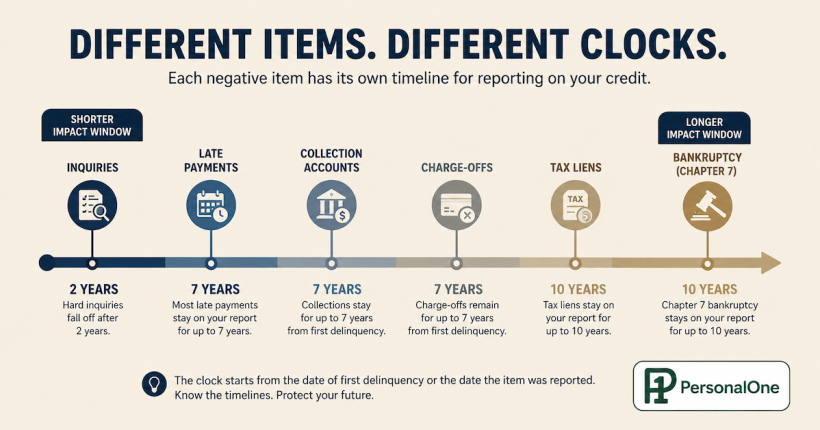
Most negative items -- late payments, collections, charge-offs -- remain on your report for seven years from the date of the original delinquency. Bankruptcies can remain for seven to ten years depending on the type. Hard inquiries stay for two years but only affect your score for the first twelve months. The impact of negative items fades over time even before they fall off -- a late payment from five years ago does far less damage than one from six months ago.
Is a 700 credit score good enough?
A 700 score falls in the good range and qualifies you for most credit products. For a standard auto loan or credit card, 700 is sufficient. For a mortgage at the most competitive rates, 740 or above is generally where the best terms begin. If a major purchase is 12-24 months out, continuing to build from 700 toward 740+ is worth the effort -- the rate difference on a mortgage at those score thresholds can add up to meaningful savings over the loan term.
Can I build a credit score with no credit history at all?
Yes. The standard starting tools are a secured credit card -- where you deposit collateral equal to your credit limit -- and a credit builder loan from a credit union or CDFI. Both report to the bureaus monthly and establish payment history. Being added as an authorized user on a family member's long-standing account can also immediately add credit history to your file without requiring a new application. With consistent on-time payments, most people can build a scoreable file within six months.
What is the fastest way to raise a credit score?
Paying down high credit card balances is the single fastest action because utilization updates within one billing cycle. Disputing and successfully removing inaccurate negative items can also produce rapid improvement. Being added as an authorized user on a clean, long-standing account can add years of positive history to your file within 30-60 days. Combining all three -- when applicable -- can produce substantial score movement within 60-90 days.
Resources
AnnualCreditReport.com -- Free Official Credit Reports from All Three Bureaus
MyFICO -- Credit Education Center
CFPB -- Credit Reports and Scores
FTC -- Fair Credit Reporting Act
Continue Building: This article is part of the Credit Score Building Strategies cluster inside the Credit Building and Protection authority hub.
Disclaimer: This guide provides general educational information about credit scores and credit reporting. It is not personalized financial advice. Credit score calculations vary by scoring model and individual circumstances. Results from implementing strategies discussed here will vary based on your specific credit profile, payment history, and the creditors and bureaus involved. Always verify your credit information directly with the bureaus. PersonalOne provides educational content and does not offer personalized financial planning services.