Last updated: April 23, 2026
Home › Financial Stability › Financial Shock Absorption › Why Organizing Your Key Financial Documents Is a Smart Move
Why Organizing Your Key Financial Documents Is a Smart Move
What You Need to Know
— A financial emergency does not wait for you to locate your documents — when a job loss, medical crisis, or family emergency hits, the speed at which you can act depends entirely on whether your financial records are organized before the crisis begins
— The core documents to organize fall into five categories: identity and legal records, insurance policies, account and banking information, tax and income records, and estate planning documents
— Both physical and digital organization matter — a physical binder for emergency access and a secure digital system for backup and remote retrieval
— Document organization is not a one-time task — it requires a maintenance schedule, at minimum an annual review and an update after any major life event
— Organized documents reduce the financial cost of emergencies: faster insurance claims, faster benefit applications, faster account access, and fewer costly mistakes made under pressure with incomplete information
Most financial emergencies do not announce themselves in advance. A job loss, a medical crisis, the death of a spouse, a natural disaster that forces you out of your home — these events arrive without warning, and they arrive with immediate financial demands. You need to file an insurance claim. You need to apply for unemployment benefits. You need to access accounts that are in someone else's name. You need to find the life insurance policy you know exists somewhere.
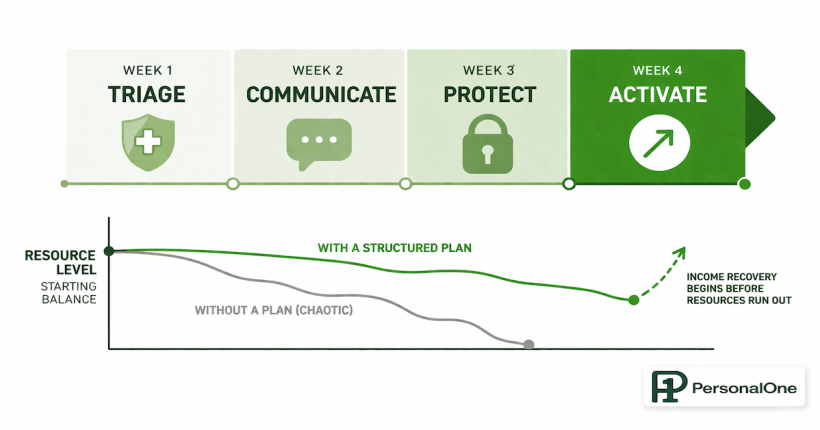
If your documents are not organized before the crisis begins, you will spend the first hours and days of an already difficult situation searching for paperwork instead of taking action. That delay costs money, adds stress, and in some cases causes you to miss deadlines for benefits or claims that you cannot recover. Organized documents are a direct input into the 30-day income disruption plan — specifically Days 1 through 7, when every hour matters for filing unemployment, contacting creditors, and activating benefits.
Organizing your key financial documents is not a bureaucratic exercise. It is a core component of financial shock absorption. This guide covers what documents to organize, how to organize them for both immediate access and long-term security, and how to maintain the system over time.
Why Document Organization Is a Shock Absorption Tool
Financial resilience is built on infrastructure, not willpower. You cannot out-hustle a crisis that requires documents you cannot locate. The difference between a household that weathers a financial shock with minimal additional damage and one that compounds it with missed deadlines, delayed claims, and panicked decisions is often not the size of their emergency fund — it is the quality of their preparation systems.
When a job is lost, unemployment insurance applications require income documentation and employer records. When a spouse dies unexpectedly, estate settlement requires death certificates, account beneficiary designations, insurance policies, and will documentation — and the surviving spouse is managing grief while racing administrative deadlines at the same time. When a home is damaged in a flood or fire, insurance claims require proof of ownership, policy numbers, and documentation of the property and its contents.
The CFPB consistently identifies the inability to access key account and benefit information quickly as a driver of poor financial decision-making during emergencies. People who cannot locate their documents take on debt they might not need, miss benefits they qualify for, and make irreversible financial decisions — like cashing out retirement accounts — because they do not have time to explore alternatives. Document organization prevents this by eliminating the information problem before the crisis begins. This preparation also directly supports the pre-departure financial checklist in the guide on how to prepare financially before you quit a job, where vesting documents, benefits records, and insurance policies must be located and reviewed before notice is given.
The Five Document Categories That Matter Most
Not every document in your life needs to be in an emergency-ready system. The goal is to identify the documents most likely to be needed in a financial crisis and ensure those are accessible, organized, and current. These fall into five categories.
1. Identity and Legal Records. Social Security cards for every household member, government-issued photo IDs, birth certificates, marriage and divorce certificates, naturalization documents if applicable, and passport copies. Without these, most other administrative processes — benefit applications, account access, estate settlement — cannot proceed. These should be kept in a fireproof container or safe, with digital copies in a secure location.
2. Insurance Policies. Every active insurance policy documented with the policy number, insurer contact information, coverage amounts, deductibles, and claims process. This includes health insurance, life insurance, homeowner’s or renter’s insurance, auto insurance, disability insurance, and any supplemental coverage. The most critical detail is the claims contact — the phone number or portal URL you call within the first 24 hours of an event. Keep a one-page summary of all active policies with contact numbers as a front-of-binder document locatable in under two minutes.
3. Account and Banking Information. A complete inventory of every financial account — checking, savings, investment, retirement, credit, and loan accounts — with institution name, account number (last four digits minimum), contact number, and login access method. This enables any household member to locate and access accounts in an emergency and ensures no accounts are overlooked during estate settlement. Include beneficiary designations, which are binding regardless of what a will states.
4. Tax and Income Records. The last two to three years of tax returns are required for unemployment insurance applications, loan applications, benefit determinations, and many government assistance programs. Also include recent pay stubs or income verification for self-employed individuals, W-2s and 1099s from the most recent tax year, and documentation of any non-employment income sources. The IRS provides free transcript access through its online portal — set it up before you need it.
5. Estate Planning Documents. Will, healthcare proxy, durable power of attorney, and any trust documents — accessible not only to you but to any person who might need to act on your behalf. These documents are often stored with an attorney or in a safety deposit box, which creates a problem if the person who needs them is incapacitated or deceased. At minimum, every household member who might need to act should know where these documents are and have access to them.
Building the System: Physical and Digital Together
An effective document organization system has two components that serve different purposes and should not substitute for each other. The physical component handles immediate emergency access. The digital component handles security, backup, and remote retrieval.
The physical system is a fireproof, waterproof document binder or safe that contains originals or high-quality copies of the most critical documents. The organizing principle is speed: a first responder, a family member, or you under acute stress should be able to locate any specific document within two minutes. That means labeled tabs, a front-page index, and logical grouping by category. The binder should be stored somewhere every adult in the household knows and can access.
The digital system serves two functions: backup in case the physical binder is destroyed or inaccessible, and remote access if you are away from home when a crisis occurs. Encrypted cloud storage — password-protected and backed up to at least two locations — is the appropriate format. Do not use unencrypted email or standard cloud folders for sensitive financial documents. The digital system should mirror the physical organization: same five categories, same naming conventions, same index.
At least one trusted person should know where the physical binder is and have a secure method to access the digital system in an emergency. The FDIC recommends that every household have at least one other person who can access key financial information, particularly for accounts where access might be restricted if the primary account holder is unavailable.
Maintenance: When and What to Update
A document organization system that is not maintained becomes a false sense of security. Documents expire, accounts change, insurance policies renew with different terms, and beneficiary designations need to reflect current family circumstances. An outdated system can create as many problems as no system at all.
The minimum maintenance schedule is an annual review. The most natural trigger is tax season, when you are already handling financial paperwork. Use the annual review to replace prior-year tax returns with the current year, verify that insurance policy information matches your current coverage, and confirm that account information reflects any accounts opened or closed during the year.
Beyond the annual review, certain life events should trigger an immediate update: marriage or divorce, birth or adoption of a child, death of a spouse or family member, significant change in assets or debt, change in employment status, purchase or sale of a home, and any change in estate planning documents or beneficiary designations.
The Financial Cost of Not Having This System
Delayed insurance claims cost money when coverage windows expire or when emergency expenses must be paid out of pocket while waiting for reimbursement. Missed benefit deadlines cost money when unemployment insurance or disaster relief applications fall outside the filing window because documentation took too long to assemble. Duplicate document requests cost money — obtaining certified copies of birth certificates, tax transcripts, and court records all involve fees and processing times.
The most expensive cost is decision-making under pressure with incomplete information. People who cannot quickly verify their insurance coverage, account balances, or debt obligations make worse financial decisions during emergencies. Document organization eliminates the administrative friction layer that turns a manageable crisis into a compounding one. This is the same principle behind having a pre-built worst-case scenario budget ready before a crisis — preparation done in advance consistently produces better outcomes than improvisation under pressure.
Document organization is one layer — build the complete foundation.
Organized documents support every other financial stability action. For the complete framework connecting all layers into a working system, explore the Financial Shock Absorption cluster hub.
Financial Shock Absorption → Financial Stability Hub →Frequently Asked Questions
What are the most important financial documents to keep organized?
The five categories that matter most in a financial emergency are identity and legal records, insurance policies with claims contact information, a complete account inventory, tax and income records from the most recent two to three years, and estate planning documents. Within those categories, the documents most likely to be needed immediately are insurance policy summaries, Social Security cards, and account access information.
How long should I keep financial documents?
The practical standard for most people is seven years for tax-related documents, which covers the maximum IRS audit window in most circumstances. Bank statements and pay stubs should be kept for at least one year. Insurance policies should be kept for the duration of the policy and for several years after expiration in case of delayed claims. Estate planning documents and legal records should be kept permanently.
Is it safe to store financial documents digitally?
Yes, with the right security measures. Encrypted cloud storage services that are password-protected and use two-factor authentication provide a level of security appropriate for financial documents. Standard cloud folders and unencrypted email are not appropriate for sensitive financial documents. The digital system should be treated as a secure backup to the physical system, not a replacement for it.
What should I do with documents I no longer need?
Shred physical documents that contain personally identifiable information, account numbers, Social Security numbers, or financial data before discarding them. The FTC identifies improperly disposed financial documents as a significant source of identity theft. A cross-cut shredder is the appropriate tool. For digital documents, use secure deletion rather than moving files to trash.
Should someone else have access to my financial documents?
Yes — at least one trusted person should know where your physical documents are kept and have a secure method to access your digital system in an emergency. If you are incapacitated, your spouse, adult child, or designated power of attorney needs to be able to access insurance policies, account information, and estate planning documents immediately. Keeping this information known only to yourself creates a single point of failure.
Resources
Official Sources
CFPB — Financial Preparedness for Disasters and Emergencies
IRS — Get Transcript: Access Your Tax Records Online
FDIC — Consumer Financial Education Resources
FTC — Keeping Personal Information Secure
USAGov — Important Documents to Keep and Where to Store Them
Continue Building Your Shock Absorption System
The 30-Day Income Disruption Plan — The exact sequence for the first 30 days after income stops — organized documents make Days 1–7 move faster.
How to Prepare Financially Before You Quit a Job — The pre-departure checklist that requires locating vesting schedules, benefits records, and insurance policies before notice is given.
The full Financial Stability framework is in the Financial Stability guide.
Disclaimer: This article is for educational purposes only and does not constitute financial, legal, or tax advice. Individual circumstances vary — consult a qualified professional for guidance specific to your situation.