Updated: April, 2026
Home › Investing & Wealth Growth › Investment Fundamentals › How to Fearlessly Start Investing with Just $100
How to Fearlessly Start Investing with Just $100
What You Need to Know
— You do not need thousands of dollars to start investing — $100 is enough to begin building real investing habits and long-term exposure to the market
— Beginner-friendly platforms now remove many of the old barriers by offering fractional shares, low minimums, and automated investing tools
— Index funds and ETFs are usually the cleanest starting point because they provide instant diversification without requiring stock-picking skill
— Starting small matters less for the immediate return and more for the identity shift it creates — from “I should invest someday” to “I am an investor now”
— The biggest edge for beginners is not timing — it is consistency, automation, and the willingness to start before you feel fully ready
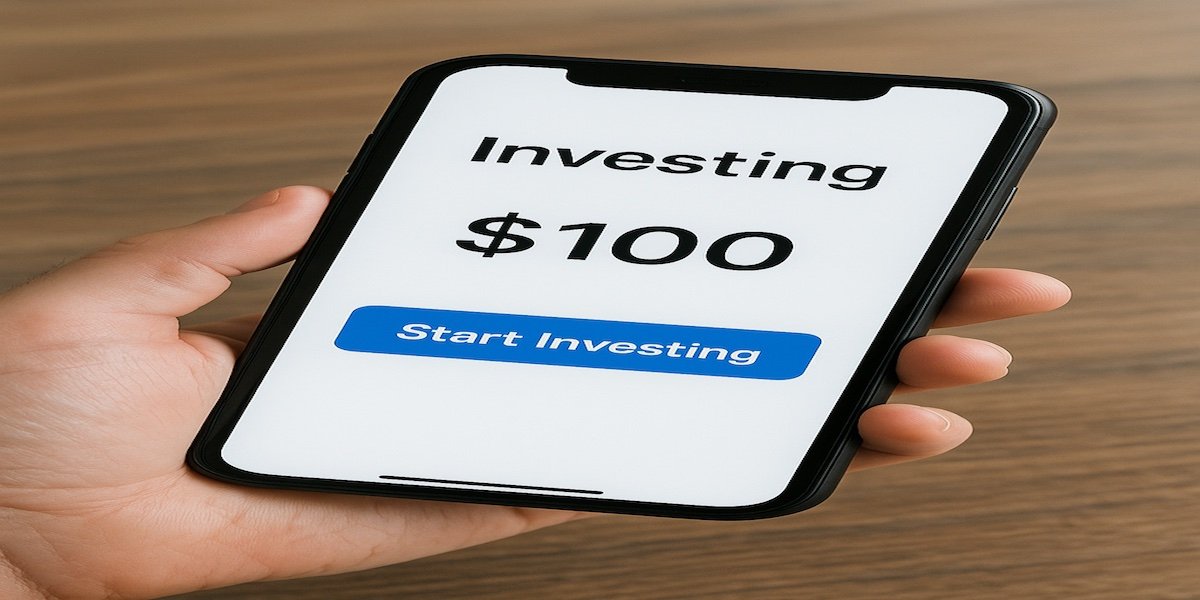
Think you need stacks of cash to invest? You do not. With just $100, you can open the door to long-term wealth building that many people never walk through because they keep waiting for “enough money.” Meanwhile, that same $100 sits in a checking account doing almost nothing while inflation quietly reduces what it can buy over time.
The truth most beginners miss is that starting matters more than the starting amount. The investing system available today is very different from the one that existed when brokerages had high minimums, commissions were normal, and small investors were effectively priced out. Now, a beginner can use a low-cost platform, buy fractional shares, invest in broad-market funds, and automate contributions without needing to be wealthy first. The article you are reading is not about pretending $100 makes you rich overnight. It is about understanding why the first $100 is strategically important inside the Investing & Wealth Growth system.
The goal is simple: start small, stay consistent, and stop waiting for the mythical point where you feel perfectly informed and financially flawless before you begin. That point usually never arrives. The investor who starts imperfectly with $100 and keeps going is almost always in a better position than the person who waits two years for the “right moment” and still has nothing invested.
Why $100 Is More Powerful Than It Looks
Investing still carries psychological baggage for a lot of people. It feels like something reserved for people with high salaries, finance degrees, inherited knowledge, or much larger balances. That perception lingers even though the actual mechanics of starting have changed dramatically.
The first reason $100 matters is not because it creates a large account balance immediately. It matters because it gets you into the game. It breaks the inertia. It replaces the vague identity of “someone who should probably invest someday” with a much more useful identity: “someone who has already started.” That shift changes behavior. Once you have money in the market, you begin learning differently. Headlines make more sense. Risk feels less abstract. Account types, funds, and investing language stop feeling like somebody else’s world.
The second reason $100 matters is habit formation. In the PersonalOne system, the early stage of investing is less about maximizing returns and more about building repeatable behavior. A person who starts with $100 and then adds $25, $50, or $100 on a recurring schedule has created something far more valuable than a one-time deposit. They have created a pattern.
The third reason $100 matters is compounding. The balance itself may be small, but it puts the core wealth-building mechanism in motion. Money earns returns. Those returns begin to generate their own returns. Over enough years, that compounding becomes the difference between people who merely earn income and people whose assets help support them. The article’s original math framing makes this point well: the real power is not the initial amount but the long-term system built around it. :contentReference[oaicite:1]{index=1}
Step 1: Make Sure the $100 Is Actually Investable
Before you invest anything, ask the boring but necessary question: is this money truly available for long-term use? If the answer is no — if this is money you might need next week for groceries, rent, a minimum debt payment, or an emergency expense — then it is not investable capital yet. That does not mean you have failed. It means the order of operations matters.
A beginner investor should not be trying to build wealth on top of chaos. If you are living paycheck to paycheck, have no buffer, or are carrying high-interest credit card debt that is draining your monthly cash flow, the investing decision has to be placed inside a larger financial structure. This is why the cluster exists inside the full PersonalOne system. Investing is not isolated. It sits on top of stability, cash-flow awareness, and an understanding of where your money is already going.
That is one of the biggest upgrades from the original article: instead of sending readers sideways into unrelated tool-based content, the right path is to use this article as an entry point into the Investment Fundamentals cluster. If your money system is unstable, that cluster and the broader authority hub help you correct the foundation before you layer on investing.
So the first step is not opening an app. The first step is deciding whether the $100 can sit for years rather than days. If it cannot, build the buffer first. If it can, then you are ready to move.
What Makes a Good Beginner Investing Platform
Once the $100 is truly investable, the next question is where to put it. The original article did a good job highlighting the kinds of platforms that work best for beginners, and that logic still holds. A beginner-friendly investing platform should do three things well: reduce barriers to entry, keep costs low, and make the first few investing decisions easier rather than harder. :contentReference[oaicite:2]{index=2}
The exact platform matters less than the platform characteristics. A strong beginner platform usually includes no or very low account minimums, fractional shares, a reasonably clean interface, and access to diversified funds. It should not pressure you into constant trading. It should not encourage you to treat the market like a game. The best beginner platform is the one that allows you to start, automate, and stay consistent.
That is why three broad categories tend to work for new investors:
Automated investing platforms. These are useful for people who know they will overthink every decision if left on their own. The value is not just convenience; it is decision reduction. The platform handles allocation, rebalancing, and in some cases recurring deposits, so the beginner can focus on building the habit rather than designing a portfolio from scratch.
Commission-free brokerages with fractional shares. These are useful for people who want more hands-on control. They allow you to buy slices of larger funds or companies without needing the full share price. That matters because the old objection — “I cannot afford one share of that” — is no longer a barrier.
Long-term oriented brokerages. These tend to be better for investors who want a platform they can grow into over time. They may feel less trendy, but they are often better aligned with long-term investing behavior because they emphasize research, retirement accounts, and funds rather than constant action.
The real mistake is not choosing the “wrong” beginner platform. The real mistake is letting platform choice become another excuse to delay starting. A good-enough platform used consistently beats the perfect platform you never actually fund.
Where to Put Your First $100
This is the moment where most beginners get overwhelmed. The investing world offers thousands of stocks, hundreds of ETFs, mutual funds, crypto assets, hot tips, and social-media opinions pretending to be strategy. None of that is useful if the goal is to start fearlessly. Fearless does not mean reckless. It means simple enough to act on.
For most beginners, the cleanest first move is a broad market investment such as an index fund or ETF. That is because one purchase can spread your money across a large number of companies rather than concentrating it in one name. Diversification matters more than excitement at the beginning. It reduces the chance that one bad pick turns your first investing experience into a painful lesson.
The original article explained this well: when you buy a broad-market fund, you are not betting on a single company. You are participating in a larger slice of the market. That is exactly why these vehicles fit Cluster 1 so well. They allow beginners to enter the market without pretending they already know how to analyze businesses deeply. :contentReference[oaicite:3]{index=3}
A second option is fractional shares of strong, established companies. This can be useful for learning and for building emotional engagement with the investing process, but it should not replace diversification. If you go this route, treat it as a small satellite around a more diversified base, not as the entire strategy. The point is to learn, not to gamble.
A third option is a robo-advisor or other automated portfolio tool. For a beginner who knows they do not want to research funds or worry about asset allocation, this can be a strong starting point. The cost is usually modest on small balances, and the benefit is that it keeps the investor from doing nothing while waiting to understand every variable first.
The key principle across all three choices is the same: the first $100 should go somewhere that encourages long-term behavior, broad exposure, and low-friction continuation. This is why understanding the basics of index funds vs. ETFs for beginners is a much better use of your time than hunting for the next viral stock.
Why Consistency Beats Timing
One of the strongest parts of the uploaded article was its emphasis on consistency over timing, and that idea absolutely belongs in the PBT version because it is one of the most important beginner truths. Waiting for the “perfect moment” sounds rational, but in practice it often means waiting indefinitely. Markets will always look too high, too volatile, too uncertain, or too complicated depending on the week.
Consistency solves that problem by removing prediction from the system. If you start with $100 and then add small amounts on a recurring basis, you are no longer trying to guess the ideal entry point. You are building exposure over time. You are turning investing into a process rather than a series of emotionally loaded decisions.
This is where the first $100 becomes much more valuable than it appears. It is the beginning of an automatic behavior loop. Once recurring contributions are in place, the amount matters less than the continuity. As the original article noted, the difference between a one-time deposit and a schedule of ongoing contributions is massive over the long run. :contentReference[oaicite:4]{index=4}
In system language, this is the point where investing stops being an occasional act of motivation and starts becoming infrastructure. That is what PersonalOne is really after: making the right financial behavior the default behavior.
The first $100 is not the finish line. It is the switch that turns the system on.
Build your investing confidence the right way by starting with the full beginner framework.
Investment Fundamentals for Beginners →What Tools Actually Help a Beginner
Tools matter, but only if they reduce friction instead of creating more noise. A beginner does not need ten dashboards, advanced charting, or constant notifications. What helps is a simple account, easy funding, automatic contributions, and clear access to diversified investments.
This is another place where the uploaded article had strong substance worth preserving. The useful beginner tools today are the ones that lower the distance between intention and action: fractional investing, recurring transfers, low fees, and clean interfaces. That is enough. Anything beyond that should be treated as optional rather than necessary. :contentReference[oaicite:5]{index=5}
The danger is confusing more features with better investing. Beginners often do better with fewer buttons, fewer decisions, and fewer reasons to trade impulsively. A tool that quietly helps you invest every month is usually more valuable than a tool that makes you feel busy every day.
Rookie Mistakes to Avoid
The article’s original “rookie mistakes” section was strong and should stay because it captures the emotional traps that actually damage beginners. The biggest problems usually are not technical. They are behavioral. :contentReference[oaicite:6]{index=6}
FOMO investing. Buying whatever is trending because it is everywhere on social media is not a strategy. It is usually an invitation to arrive late and pay peak prices for someone else’s excitement.
Overtrading. A beginner portfolio does not need constant activity. Frequent trading increases the chance of emotional errors and usually reflects anxiety more than strategy.
Ignoring fees. Costs matter because they compound against you. Even small recurring fees can take a larger bite out of long-term growth than beginners realize.
Panic selling. Market drops are normal. If the first decline causes you to liquidate, then the investment process never gets a chance to work. The beginner needs to expect volatility before it happens rather than treating it as a sign they made a mistake.
Waiting for the perfect time. This is the cleanest route to never starting. Time in the market is structurally more useful than trying to outguess the next short-term move.
This is also why “fearlessly” in the article title should not be interpreted as emotionally numb. Fearless investing at the beginner stage means acting through uncertainty with a sensible structure, not pretending uncertainty does not exist.
What Happens After You Invest the First $100
One of the most important expectations to set is that nothing dramatic happens immediately. Your balance will not explode. Your identity will not suddenly feel transformed overnight. The account may move a little. It may even go down at first. That is not failure. That is investing.
The point is not immediate excitement. The point is that the first deposit changes the pattern. Once money is invested, the next task is to keep the system running. Add more when you can. Review the account periodically, not obsessively. Let the balance build slowly enough that the process feels boring. Boring is fine. In fact, boring is often a sign you are doing it right.
That long horizon is what separates investing from speculation. The investor who can tolerate slow progress usually ends up in a much stronger position than the person who demands immediate proof that the strategy is “working.”
Final Word: Starting Is the Real Wealth Move
The biggest lie in beginner investing is that you need to be rich to begin. The more accurate statement is the opposite: beginning is part of how people eventually become wealthy.
That first $100 is not impressive because of its size. It is impressive because it represents a decision to stop waiting. It says you are willing to learn in motion instead of waiting for a level of certainty that almost never arrives. It says you understand that wealth is usually built slowly, through compounding and repetition, not through one perfect move.
Most people delay. They wait for more money, more clarity, less debt, less fear, a better market, more free time, or a stronger sense that now is the right moment. The problem is that each of those conditions can always be pushed further into the future.
So yes, the uploaded version had the right core message: starting is what makes the rest possible. The PBT version keeps that message but places it where it belongs — inside the full investing system, with the correct upward links and the correct cluster role. :contentReference[oaicite:7]{index=7}
Resources
Official Sources
Investor.gov — U.S. government investor education resource covering investing basics, risk, and long-term planning.
SEC Investor Education — Securities and Exchange Commission educational materials for new investors.
FINRA Investor Resources — Educational guidance on investment products, scams, and beginner investing concepts.
Continue Building Your Investment Fundamentals
This article is one piece of the complete beginner investing framework. Continue through the Investment Fundamentals for Beginners cluster and the Investing & Wealth Growth authority hub to build the full system.
Frequently Asked Questions
Can I really start investing with only $100?
Yes. The amount is enough to begin if the platform allows fractional investing or low minimums. The larger value is that it gets you into the habit and gives you real market exposure to learn from.
Should I invest if I still have debt?
It depends on the debt. High-interest debt usually deserves priority because the guaranteed cost can outweigh expected investment returns. Lower-rate debt may be manageable alongside investing if the rest of the system is stable.
What if the market drops right after I invest?
That possibility is normal and should be expected. A short-term decline does not automatically mean the decision was wrong. For a long-term investor, market movement is part of the process, not a sign to panic.
Should beginners buy individual stocks or broad funds?
Broad funds are usually the better starting point because they offer diversification immediately. Individual stocks can come later, once the investor has a stronger base and understands the added concentration risk.
How long does it take to see meaningful growth?
Investing is a long-horizon system. Early progress is often modest. The real effect becomes visible over years of consistent contributions and compounding, not weeks or months.
Disclaimer: This article is for informational and educational purposes only and does not constitute financial advice. Investing involves risk, including possible loss of principal. Individual financial situations vary. Consult a qualified professional before making significant financial decisions.