
Updated: March 21, 2026
Home › Side Hustles & Entrepreneurship › Side Hustle Foundations › The Rise of the Side Hustle Nation
The Rise of the Side Hustle Nation: Why Supplemental Income Has Gone Mainstream
TL;DR
— 35% of U.S. workers now hold a side hustle or multiple income sources, according to a January 2026 ZipRecruiter survey — more than one in three working Americans.
— Gen Z leads adoption at 53%, followed closely by Millennials at 50%. But the fastest-growing segment by 2026 data is high-income earners, where 44.8% of workers earning over $150,000 annually have supplemental income — side hustles are not just about financial survival anymore.
— The shift from "extra cash" to "income strategy" is driven by three forces: digital platforms that eliminated the barriers to starting, AI tools that increased individual productivity, and persistent financial pressure that made a single income feel structurally risky.
— What begins as a side hustle frequently becomes the primary income. The path from first client to full-time practice is well-documented and repeatable for anyone who builds the right foundation from the start.
— The infrastructure matters as much as the hustle itself. Managing income, banking, and tax obligations correctly from day one determines whether supplemental income builds financial stability or creates new financial problems.
The rise of the side hustle nation is one of the more significant economic shifts of the past decade. What was once considered a workaround for people who could not make ends meet on a single paycheck has become the deliberate income strategy of workers across every income level, age group, and professional background. In 2026, having supplemental income is not a signal of financial struggle. For a growing share of workers — particularly younger ones — it is the standard approach to income, financial stability, and long-term career strategy.
This article covers why the side hustle economy has grown to its current scale, what the data says about who is participating and why, and what it means for anyone considering building supplemental income for the first time in 2026.
The Numbers: Where the Side Hustle Economy Stands in 2026
A January 2026 ZipRecruiter survey of 1,500 employed workers found that 35% currently hold a side hustle or multiple income sources. That figure represents a meaningful structural shift in how the American workforce thinks about income, not a marginal increase at the edges. More than one in three working people has stepped outside primary employment to generate additional revenue — a proportion that would have been considered unusual a decade ago and is now increasingly unremarkable.
The generational breakdown is instructive. 53% of Gen Z workers and 50% of Millennials report having a side hustle, reflecting a generation that entered the workforce during or after a period of sustained economic disruption and concluded that a single income source was not adequate insulation against it. What is more surprising is the income breakdown: workers earning over $150,000 per year are the most likely group to have supplemental income at 44.8% — outpacing lower-income brackets. At the highest income levels, side hustles are not about covering rent. They are about accelerating wealth accumulation, maintaining professional leverage, and refusing to leave viable income opportunities on the table.
The global picture reinforces the domestic one. The global gig economy was valued at over $550 billion in 2024 and is projected to continue growing at a compound annual rate of approximately 16%, with U.S. freelancers expected to represent nearly half the total workforce by late 2026. The number of independent workers in the United States earning over $100,000 annually reached 4.7 million in 2024, up from 3 million in 2020. What was once an alternative for workers who could not secure traditional employment has become a parallel career track for some of the most productive professionals in the economy.
What Drove the Growth: Three Converging Forces
The scale of the side hustle economy did not emerge from a single cause. Three forces converged over the same period to produce the current landscape, and understanding all three matters for anyone trying to assess whether the trend is durable or cyclical.
Digital platforms eliminated the startup barrier. A decade ago, starting a freelance practice, selling products, or offering a service to customers outside a geographic radius required meaningful infrastructure investment: a website, payment processing, client acquisition systems, and often a business license or physical location. Platforms like Upwork, Fiverr, Etsy, Rover, and TaskRabbit absorbed that infrastructure entirely, reducing the barrier to first client to a profile, a completed background check, and competitive pricing. The result was that the skills already developed in primary employment became immediately monetizable without the capital or risk of traditional business formation.
AI tools multiplied individual productivity. The past two years represent the most significant increase in individual productivity available to solo operators since the spreadsheet. AI writing tools, design assistants, automation platforms, and analysis tools allow a single practitioner to produce output that previously required a team. A freelance writer using AI assistance can produce more content per hour than was possible without it. A social media manager can schedule, analyze, and optimize across multiple clients simultaneously. An automation consultant can build systems for small business clients that would have required a developer team years earlier. The net effect is that the same number of hours now produces more billable output, which changes the economics of part-time side hustle work significantly.
Financial pressure made single-income households feel structurally risky. The economic disruptions of the past several years — inflation, layoffs concentrated in previously stable industries, rising housing costs, and student debt loads that did not recede — produced a recalibration of how many working Americans think about income. One in three adults now says they need a side hustle to cover regular living expenses. That figure is not a measure of poverty. It is a measure of how the cost structure of a middle-class life has evolved relative to the wage structure of traditional employment. The side hustle is, for many households, the mechanism that closes that gap.
The Gen Z Effect: Entrepreneurship as Default, Not Deviation
The side hustle economy looks different among younger workers than it does among older ones, and the difference is not just participation rate. Among Gen Z, the relationship to entrepreneurship itself has shifted. Approximately one in three Gen Z workers pursues a side hustle out of passion or interest — a higher rate than older generations, who are more likely to cite financial necessity as the primary driver. For this cohort, blending income and interest is not a compromise. It is the expected model of a working life.
That orientation produces a specific type of side hustle: coaching, content creation, digital art, social media consulting, niche product lines, and community-based businesses that reflect genuine interest rather than pure income optimization. The financial outcomes of passion-driven side hustles are not reliably better or worse than purely income-driven ones — but the retention rates are. Workers who enjoy what they are building persist through the early low-income ramp-up phase that causes most people to quit. The willingness to work through the first 60 days of limited results is where most side hustles either become durable income streams or get abandoned.
Understanding how to start a side hustle that makes money — not just one that occupies time — is the foundational question this generation is increasingly asking. The answer involves choosing a hustle with genuine market demand behind it, pricing it at market rate from the start, and committing to a single approach for 60 to 90 days before evaluating whether to continue, adjust, or switch. All three of those decisions are available in the Side Hustle Foundations cluster.
Side Hustles as the New Safety Net
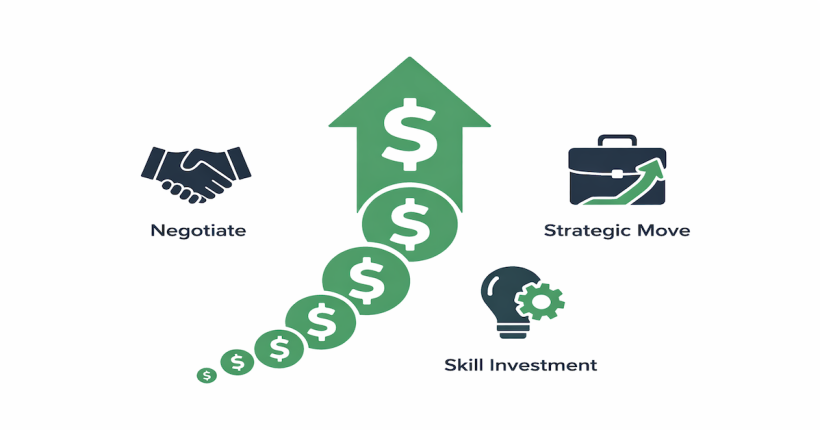
The original function of the side hustle — supplemental income to cover a specific financial gap or save for a specific goal — has not disappeared. It has been joined by a second, less visible function: income resilience. Workers with supplemental income have a structurally different relationship to their primary employer than workers without it. ZipRecruiter’s 2026 data found that workers with a side hustle are significantly more likely to reject a job offer (49% vs. 32%) and nearly twice as likely to say they would leave their current job without another one lined up. The side hustle is not just money. It is leverage.
That leverage operates at a practical level too. A household with $800 per month in side hustle income has a meaningfully different response capacity to an unexpected expense than one without it. The emergency fund builds faster. The debt payoff timeline compresses. The negotiating position at a primary employer improves because the financial consequences of leaving are lower. The side hustle, at any income level, increases financial options in a way that a raise in primary employment often does not — because a raise is contingent on a single employer’s continued goodwill, while a self-built income stream is not.
The side hustle economy is not a trend. It is the new income architecture. The question is not whether to participate — it is which hustle, at what rate, with what systems behind it.
The complete side hustles and entrepreneurship hub covers every stage from choosing and launching to scaling systems and managing income long-term.
Explore Side Hustles & Entrepreneurship →From Side Business to Main Business: The Transition Path
The side hustle that becomes the primary income source is not rare. It is the documented outcome for a meaningful percentage of solo operators who build consistently over 12 to 24 months. The transition follows a predictable arc: first client secured, profile and reviews established, rates increased as demand grows, client base reaches a threshold where the side income matches or approaches primary employment income, decision to transition made from a position of financial stability rather than necessity.
What separates the operators who reach that transition point from those who plateau at $300 to $500 per month is almost never talent. It is systems. Specifically: a dedicated business bank account that separates hustle income from personal spending, a tax reserve practice that prevents the year-end tax bill from consuming the year’s earnings, and a rate-increase discipline that prevents the income from being permanently capped at entry-level rates. For freelancers and self-employed operators, setting up the right banking structure for freelance income is the infrastructure decision that determines whether the money earned actually builds financial position or disappears into an undifferentiated pool of spending.
By 2030, the prospect of a single employer providing the entirety of a household’s income and stability looks increasingly like a legacy model. The workforce data available in 2026 already shows the trajectory clearly. Portfolio careers — professionals running a primary employment role alongside one or more income-generating side practices — are not fringe behavior. They are how a growing plurality of skilled workers have chosen to structure their working lives. The infrastructure, platforms, and tools to support that model are better in 2026 than they have ever been.
What This Means If You Are Starting Now
The primary advantage of entering the side hustle economy in 2026 rather than five years ago is not the availability of platforms — those have existed for years. It is the depth of proven frameworks for what actually works at each stage of building. The pattern of what produces consistent income within 60 to 90 days of starting, what causes most new side hustlers to plateau or quit, and what separates a hustle that grows into a durable income stream from one that stays at $200 to $300 per month indefinitely — all of that is documented, tested, and available.
The framework that consistently produces results looks like this: one hustle chosen based on existing skills and realistic time availability, priced at market rate from the first client, with a dedicated bank account and a 25 to 30% tax reserve practice from the first payment. Not five options sampled simultaneously. Not the hustle with the highest theoretical ceiling. The one that matches what is available today and has a clear path to a paying client within the first two to four weeks.
The Side Hustle Foundations cluster on PersonalOne covers the complete starting framework: how to select the right hustle type for your situation, how to structure first pricing, how to acquire the first client, and how to manage the income correctly once it arrives. That foundation is what determines whether the side hustle becomes a financial variable that matters or a short-term experiment that does not.
Resources
Bureau of Labor Statistics — Occupational Employment and Wage Statistics
IRS — Self-Employed Individuals Tax Center
FTC — Policy Statement on Enforcement Related to Gig Work
SBA — 10 Steps to Start Your Business
This article is part of the Side Hustles & Entrepreneurship system on PersonalOne — a complete framework for building income outside your primary job at every stage.
Frequently Asked Questions
Why are so many people starting side hustles in 2026?
Three factors are driving the growth simultaneously. Digital platforms have eliminated the startup barrier that previously required capital investment to begin earning outside primary employment. AI tools have increased the output achievable per hour, making part-time side hustle work more productive than it was even two years ago. And persistent financial pressure — from inflation, housing costs, and income that has not kept pace with the cost of a middle-class life — has made single-income households feel structurally risky to an increasing number of working people. The combination of lower barrier to entry, higher individual productivity, and stronger financial motivation has produced a workforce where more than one in three workers now generates supplemental income.
Is the side hustle trend durable or is it a cycle?
The structural indicators suggest it is durable. Platform infrastructure, AI productivity tools, and the documented financial benefits of income diversification are not temporary conditions — they are permanent features of the current economic environment. The high-income participation rate (44.8% of workers earning over $150,000 have supplemental income) is a particular signal: when the highest earners are building additional income streams, it reflects strategic financial behavior, not financial desperation. That pattern is not cyclical.
Does a side hustle affect my primary employment?
In most cases, no — but employment contracts should be reviewed for non-compete clauses, conflict of interest policies, and moonlighting disclosure requirements before starting. The practical rule is straightforward: do not use company time, company equipment, or company client relationships for side hustle work. Most employers are indifferent to outside income-generating activity that does not compete with or impair the primary role. Workers who are concerned about their specific situation should review their employment agreement or consult an employment attorney for guidance on their particular circumstances.
What is the most important first step for someone starting a side hustle in 2026?
Choose one hustle based on existing skills and available hours — not the one with the highest theoretical ceiling — and commit to it for 60 days before evaluating. The data on why side hustles fail consistently points to the same cause: starting too many things simultaneously, abandoning during the normal ramp-up phase before results arrive, or underpricing to the point where the math cannot reach a meaningful income level regardless of effort invested. One focused approach for 60 days, priced at market rate, with a dedicated bank account and a tax reserve from the first payment, is the foundation that either succeeds or gives a clean picture of what needs to change.
Disclaimer: This content is for educational purposes only and does not constitute financial advice. Statistics cited reflect published survey and research data current as of early 2026. Consult a qualified financial professional for personalized guidance on income, tax, and business decisions.



2 Comments
This hits home. The idea that entrepreneurship isn’t just about starting a business, but owning your time, really stands out. 2025 feels like the year people are realizing that one job isn’t enough — not because they’re greedy, but because they’re smart about security and freedom.
It’s wild how fast the side hustle movement evolved. A few years ago, freelancing was just “extra cash” — now it’s practically a safety net. Between AI tools, social platforms, and inflation, it’s no surprise people want more control over their income streams.