Updated: August 30, 2026
Home › Investing & Wealth Growth › Real Estate & Alternative Investments › Alternative Real Estate Investing
Part of Real Estate & Alternative Investments — building wealth beyond a single rental property.
What You Need to Know
— "Alternative" real estate no longer means obscure or risky. It means anything outside traditional office, retail, industrial, and apartment buildings, and several categories have outperformed those traditional sectors in recent years.
— Data centers and manufactured housing have posted some of the strongest trailing returns of any real estate category, driven by AI infrastructure demand and a persistent housing affordability gap, not speculation.
— None of this requires buying a whole property or being an accredited investor. Publicly traded REITs and fractional platforms bring the minimum investment down to as little as $10 to $100.
— Liquidity is the real tradeoff. Direct real estate funds can lock up your money for years; publicly traded REITs trade like stocks but come with more price volatility day to day.
— The right alternative depends on what you're optimizing for: income, growth, or simplicity. There isn't one correct answer for every investor.
Alternative real estate investing used to mean something genuinely niche and hard to access. That's changed. Data centers, manufactured housing communities, and fractional ownership platforms have moved from institutional-only territory into something a regular investor can actually buy into, often with less money than a single month's rent, and without needing to qualify for a mortgage or manage a property yourself.
This isn't about chasing something exotic for its own sake. Several of these categories have posted stronger returns than traditional real estate sectors over the past decade, for reasons that are structural rather than speculative: an aging population, a persistent housing shortage, and an explosion of AI infrastructure demand. Here's what each one actually is, what it costs to get in, and who it fits, without the institutional jargon most coverage of this topic assumes you already know.
What Counts as "Alternative" Real Estate
Traditional commercial real estate covers four categories: office, retail, industrial, and multifamily apartments. Everything else, data centers, manufactured housing, self-storage, senior housing, student housing, medical office, and a handful of other niches, falls under "alternative." The label used to imply higher risk or a smaller, less-tested market. That's no longer accurate.
Alternative property types have grown from roughly $67 billion in total value in 2000 to more than $600 billion by 2024, and they've outperformed traditional sectors over the past decade: annualized returns around 11.6% for alternatives compared to roughly 6.2% for traditional core property types. The demand driving this growth isn't a passing trend. It's demographic and technological: an aging population needing senior housing, a housing affordability gap driving demand for manufactured housing, and an AI buildout that needs physical data center capacity to run on.
This shift is also generational. Real estate industry surveys have found that younger real estate professionals and investors, those under 40, favor alternative property types noticeably more often than their older counterparts when asked where they see the greatest opportunity going forward. That's worth noting specifically for a Millennial or Gen Z investor: this isn't a niche corner of the market chased only by specialists. It's increasingly where a younger generation of capital is actually heading.
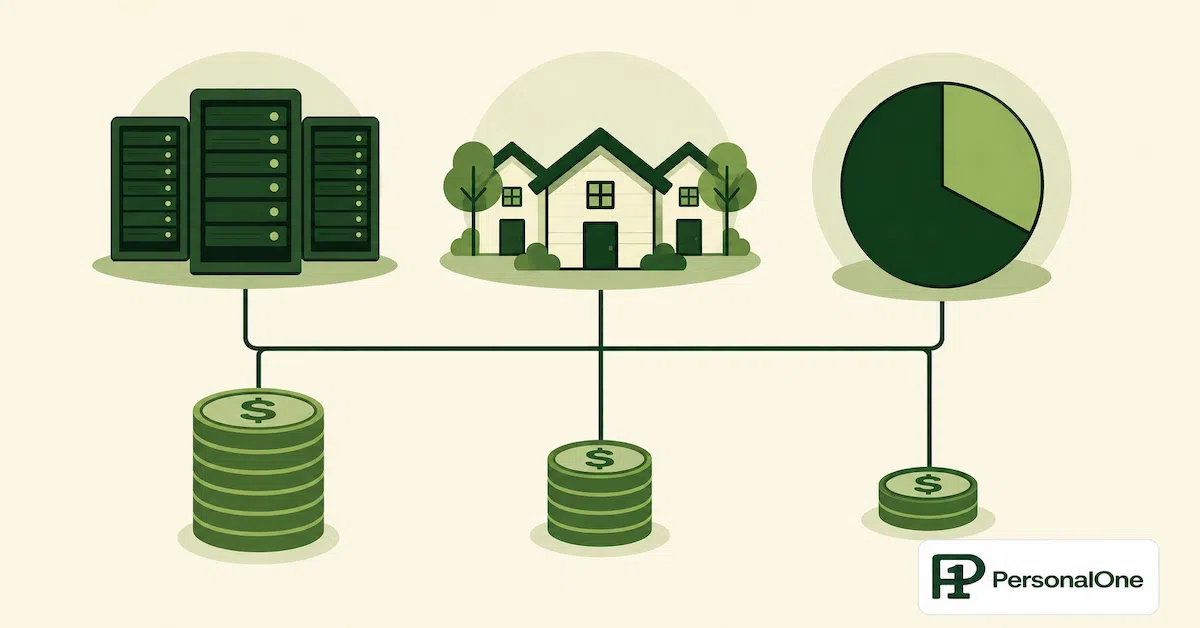
This cluster hub's broader guide to real estate and alternative investments covers traditional rental property investing in depth. This article focuses specifically on the three alternative categories with the clearest combination of strong recent performance and genuine accessibility for a smaller investor: data centers, manufactured housing, and fractional ownership.
Data Centers: The AI-Driven Asset Class
Data centers, the physical buildings that house the servers running everything from cloud storage to AI models, were one of the strongest-performing real estate categories of the past two years, posting an 11.2% return in a year when the broader real estate index was flat. Vacancy in major North American markets has hovered around 1%, driven by explosive demand for AI infrastructure that shows no sign of slowing down anytime soon.
You don't need to buy or build a data center to get exposure. Publicly traded data center REITs, real estate investment trusts that specifically own and operate this kind of property, trade on major stock exchanges like any other stock, with no minimum beyond the price of a single share. Some real estate-focused ETFs also include data center holdings alongside other property types, giving broader exposure in a single purchase.
From the Field
I’ve learned over the years that you don’t have to own a building to benefit from real estate. Early on, I tended to think of real estate investing in the traditional way: buy property, finance it, collect rent, and manage everything that comes with ownership. But that also means concentrating a lot of money in one asset and taking on responsibilities that many investors simply don’t want. That’s what makes something like a data center REIT worth understanding. You can participate in a part of the real estate market being driven by cloud computing, digital services, and AI infrastructure without buying the land, financing a multimillion-dollar facility, or managing tenants. You’re trading direct ownership and control for accessibility and simplicity. I wouldn’t look at strong recent data center returns and assume they’ll continue indefinitely. I’d look at the underlying question instead: is there a durable economic reason these properties should continue to be needed? With data centers, that is the part of the story I find more compelling than any one-year return number. The investment still has risk, but at least the demand can be understood. — Don Briscoe, Founder of PersonalOneThe risk worth knowing: data center REITs can be more concentrated than a broad real estate fund, since a relatively small number of companies own most large-scale data center capacity. That concentration cuts both ways, it's part of why the sector has performed strongly, but it also means a downturn in AI infrastructure spending specifically would hit this category harder than a diversified real estate portfolio.
Large institutional funds have taken notice too. Some of the biggest names in asset management have raised multi-billion-dollar funds specifically dedicated to developing hyperscale data centers, a signal that this isn't a speculative retail trend but a category institutional capital is committing to at scale. For an individual investor, that institutional conviction is worth knowing about, though it doesn't remove the concentration risk described above.
Manufactured Housing: Steady Demand, Real Returns
Manufactured housing communities, sometimes still called mobile home parks, have quietly become one of the top-performing real estate categories by trailing return, outperforming traditional multifamily in several recent measurement periods. The demand driver is straightforward: manufactured housing is often the only genuinely affordable homeownership path left in many markets, and that affordability gap isn't closing anytime soon.
The typical structure in this space: an investor or fund owns the land and community infrastructure, while individual residents own their own manufactured home and pay a lot rent. This is worth knowing because it's also been the subject of real controversy, since consolidation of these communities under a small number of institutional owners has drawn criticism over lot rent increases and resident protections. It's a genuine tradeoff between strong returns and a business model some find ethically uncomfortable, worth weighing honestly rather than glossing over entirely.
Access here typically comes through publicly traded REITs with manufactured housing holdings, or through real estate crowdfunding platforms that include manufactured housing communities in their portfolios, with minimums that can range from the price of a single REIT share up to a few hundred dollars for some crowdfunding platforms specifically.
One structural detail worth understanding before investing here: unlike an apartment building, where the landlord owns both the building and the land underneath it, a manufactured housing community typically involves the operator owning the land and shared infrastructure while residents own their individual homes outright. This split ownership model is part of what makes the returns attractive, land and infrastructure require less ongoing maintenance than a full apartment building, but it's also the specific structure that draws the resident-protection concerns mentioned above, since residents who own their home but not the land underneath it have less leverage if lot rents rise sharply.
Fractional Real Estate Investing: Owning a Slice
Fractional real estate investing lets you buy a small ownership share of a specific property, or a specific fund holding several properties, rather than purchasing an entire building yourself. Instead of a six-figure down payment, credit approval, and the responsibilities of being a landlord, you own a percentage alongside dozens or hundreds of other investors, and your returns scale with your share.
This is the most accessible entry point of the three categories covered here. Several platforms allow investing with as little as $10 to $100, dramatically lower than what direct property ownership or even most REITs require in practical terms. Some fractional platforms focus on single residential properties; others pool investor money into diversified funds spanning multiple property types, including some of the same data center and manufactured housing exposure covered above.
A Simple Comparison
Traditional route: Save a 20% down payment on a $300,000 rental property, roughly $60,000, plus qualify for financing, handle tenant issues, and manage ongoing maintenance yourself.
Fractional route: Invest $100 into a platform holding a diversified pool of properties, own a proportional share of the income and appreciation, and never speak to a tenant or a plumber. The dollar exposure is smaller, but so is the barrier to simply getting started.
The tradeoff is liquidity. Publicly traded REITs can be sold on a stock exchange in seconds. Fractional ownership in a specific property or a private fund often comes with lock-up periods or limited redemption windows, sometimes 90 days notice or longer, since the underlying real estate itself isn't quick to sell. This isn't a reason to avoid fractional investing, but it does mean treating this money as a longer-term commitment rather than funds you might need on short notice, similar in spirit to how you'd think about money in a certificate of deposit rather than a checking account.
Which Alternative Fits Your Situation
| Category | Typical Minimum | Liquidity | Best For |
|---|---|---|---|
| Data center REITs | Price of one share | High — trades like a stock | Growth exposure to AI infrastructure demand |
| Manufactured housing | One share to a few hundred dollars | Varies — REIT shares liquid, fund shares less so | Steady income-oriented investors comfortable with the sector's tradeoffs |
| Fractional ownership | $10–$100 on most platforms | Low — lock-up periods common | Smaller investors starting with limited capital, willing to wait |
None of these are mutually exclusive. A common approach is starting with a publicly traded REIT for liquidity and simplicity, then adding fractional exposure to a specific category once you've confirmed the sector genuinely fits your goals. The point isn't to own all three categories at once from day one. It's understanding that each solves a different problem, quick liquid exposure, steady income, or the lowest possible entry cost, so you can choose deliberately rather than defaulting to whichever platform happened to show up in an ad. Our guide to investing in real estate with just $100 covers the mechanics of getting started with minimal capital in more depth.
Getting Started Without Overcommitting
The accessibility of these categories is genuinely useful, but it also creates a specific risk worth naming directly: because the entry point is so low, it's tempting to spread a small amount of money across several alternative categories at once without really understanding any of them well. A $50 position each in data centers, manufactured housing, and a fractional platform sounds diversified, but if none of it is backed by an actual understanding of what you own, it's closer to a collection of small bets than a strategy.
A more deliberate approach: pick one category that genuinely interests you based on the tradeoffs described above, put a meaningful but still small amount into it, and actually track how it performs over a full year before adding a second category. This gives you real, first-hand experience with how a specific alternative real estate investment behaves, its price movements, its distributions, its liquidity in practice, rather than a scattered handful of positions you never quite understood in the first place, each one too small to have taught you anything useful.
It's also worth treating any alternative real estate position as a satellite around a core portfolio, not a replacement for one. A diversified index fund foundation, covered in our Investing & Wealth Growth hub, should generally come first, before any alternative allocation. Alternative real estate works best as an addition once that foundation exists, not as a substitute for it.
Build a Complete Real Estate Investing Strategy
Alternative real estate is one piece of a broader real estate strategy. The Real Estate & Alternative Investments hub covers traditional rental property investing, REITs, and how real estate fits into your overall portfolio.
Official Sources
More From This Hub
Return to Investing & Wealth Growth for the complete system — investment fundamentals, retirement accounts, index funds, real estate, and portfolio discipline.
Frequently Asked Questions
Do I need to be an accredited investor to invest in alternative real estate?
No, not for the categories covered here. Publicly traded REITs are open to any investor with a standard brokerage account, and most fractional real estate platforms are open to non-accredited investors as well. Accreditation requirements apply mainly to certain private funds, not the publicly available options most beginners start with, so accessibility is rarely the barrier people assume it is.
Are data center REITs riskier than traditional real estate REITs?
They can be more concentrated, since a smaller number of companies dominate large-scale data center ownership, which means sector-specific news can move the whole category more than it would move a broadly diversified real estate fund. This isn't necessarily "riskier" in every sense, but it is less diversified, and that concentration is worth weighing against the strong recent performance before allocating a large share of your portfolio to it.
Is manufactured housing a good investment if I have ethical concerns about the sector?
That's a legitimate reason to look elsewhere. The returns in this category are real, but so are the concerns about lot rent increases and resident protections under consolidated institutional ownership. If that tradeoff doesn't sit well with you, data centers or diversified fractional real estate funds don't carry the same specific controversy, and there's no requirement to invest in every alternative category covered here.
How much of my portfolio should be in alternative real estate?
There's no universal number, and it depends on your broader investment strategy and risk tolerance. Alternative real estate is generally best treated as a diversifying satellite position alongside core investments like index funds, not a replacement for a diversified portfolio foundation you build first.
Can I lose money in fractional real estate investing?
Yes. Fractional ownership carries the same underlying real estate risk as any property investment, property values can decline, and the added liquidity constraints mean you may not be able to exit quickly if you need to. It is not a guaranteed-return product regardless of how accessible the entry point is.
Should I start with one alternative category or spread money across several at once?
Starting with one is generally the better approach, especially with a small amount of capital. Spreading a small position across several categories at once often means never developing a real understanding of any single one, which makes it harder to evaluate whether the investment is actually working for you a year or two later.
This content is for educational purposes only and does not constitute financial advice. PersonalOne is not a licensed financial advisor, broker, or investment professional. Individual financial situations vary — consult a qualified financial professional for personalized guidance.