

January 17, 2026
Updated: February 2026 • 7 min read
Home › FinTech & Modern Money Tools › Open Banking, AI & Emerging FinTech › How Gen Z Uses Banks, Apps & FinTech Differently
About the Author
Don Briscoe is a Financial Systems Coach with 12+ years of experience helping Millennials and Gen Z escape paycheck-to-paycheck cycles. He founded PersonalOne on a framework-first philosophy — less willpower, more infrastructure — and provides structured, honest, free financial education.
How Gen Z Uses Banks, Apps, and FinTech Differently — And What It Means for Your Money
Gen Z doesn't manage money the way previous generations did — and they shouldn't have to. The tools finally match how they live. Here's how the shift actually works, and why the hybrid approach they've built is worth understanding regardless of your age.
TL;DR
- Mobile-first banking is the default: Gen Z prioritizes smartphone access over physical branches — account opening, transfers, and customer service all happen from one device
- Automation replaces manual tracking: Budgeting happens in the background through AI categorization and real-time alerts — less friction means better consistency
- Credit cards used as system tools: Focus on building payment history and automating full-balance payoff — not rewards chasing or emergency spending
- Real-time feedback changes behavior: Knowing what you spent the moment you spend it creates fundamentally different financial decision-making than discovering it on a monthly statement
- Hybrid wins: Combining traditional banking infrastructure with FinTech tools creates a system that's more flexible and more automated than either alone
Over the last decade, a clear shift has emerged in how younger people interact with money. Not because they're careless — but because the tools finally match how they live. Gen Z doesn't manage money the way their parents did, and they shouldn't have to.
Instead of bank branches, paper statements, and guesswork, Gen Z expects real-time feedback, instant access, and control from their phone. That change explains why the modern open banking and FinTech ecosystem looks so different today — and why understanding the full picture matters for anyone building a financial system in 2026.
Banking Is Mobile-First by Default
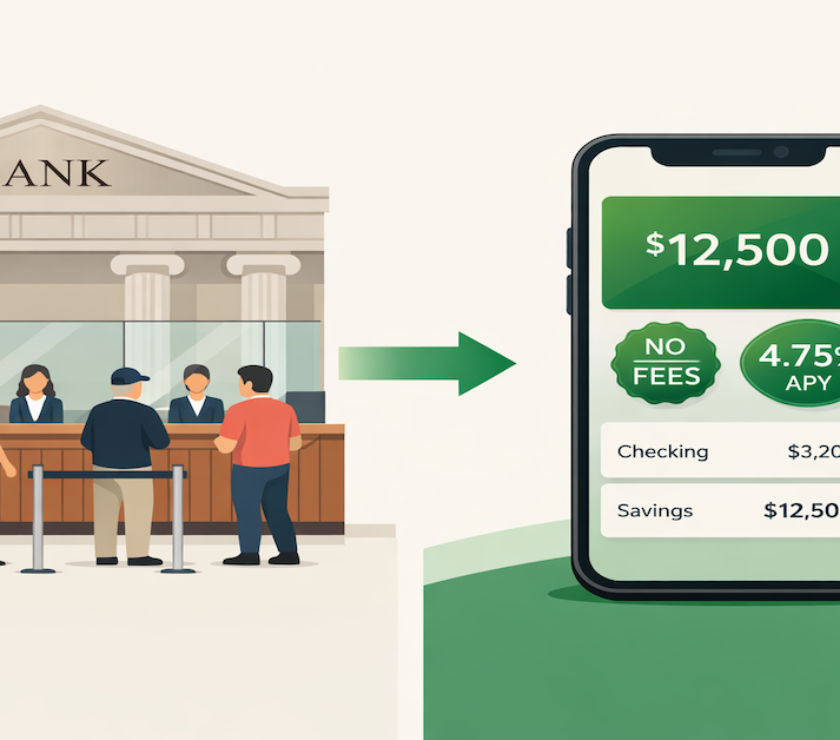
For Gen Z, banking begins — and often ends — on a smartphone. Physical branches are optional at best, unnecessary at worst. What matters is fast access, instant alerts, and frictionless transfers between accounts.
This shift explains the explosive rise of neobanks and digital-first banking platforms. These digital-only banks align perfectly with how young adults already manage work, shopping, and communication — all consolidated in one device, accessible anywhere, anytime. Traditional banks responded by improving their apps, but the experience often feels like a website crammed into a phone screen. Neobanks, built mobile-first from inception, design every feature around the smartphone experience.
What mobile-first actually means in practice:
- Account opening completed in 5–10 minutes from a phone
- Instant push notifications for every transaction
- Peer-to-peer payments integrated natively
- Check deposits via photo capture
- Card controls — freeze, unfreeze, spending limits — accessible immediately
- Budget tracking and spending analytics built directly into the app
- Customer service through in-app chat, not phone trees
For Gen Z, visiting a bank branch feels as outdated as mailing a letter instead of sending a text. The expectation isn't just convenience — it's that money management should be as seamless as every other aspect of digital life.
Budgeting Happens in the Background
Traditional budgeting required discipline, spreadsheets, and constant check-ins. Previous generations tracked expenses in ledgers, then migrated to Excel, then to budgeting software that still required manual categorization and regular updates.
Gen Z rejected that labor-intensive approach not out of laziness, but because technology made it obsolete. Why manually categorize transactions when AI does it instantly? Why calculate remaining budget when the app shows it in real time? Modern budgeting tools automatically categorize spending, track subscriptions, identify recurring charges, and show cash flow continuously. Less friction leads to better consistency — and consistency builds better habits.
How automated budgeting works:
- Automatic categorization: Transactions sort into spending categories without manual input
- Subscription detection: Apps identify and alert you to recurring charges you may have forgotten
- Spending insights: Patterns emerge showing where money actually goes versus where you think it goes
- Budget alerts: Notifications when approaching category limits prevent overspending before it happens
- Goal tracking: Visual progress toward savings targets without manual calculation
Gen Z's preference for automated money management reflects a broader shift toward tools that track spending across all accounts in one place (affiliate) without manual tracking — turning budgeting from an active chore into passive infrastructure that runs in the background. The budget operates like every other automated system in their lives: always working, rarely requiring attention.
Credit Cards Are Used as System Tools, Not Safety Nets
Credit cards aren't treated as emergency lifelines or lifestyle flexes. Instead, they're viewed as financial infrastructure — deliberately used for building credit history, smoothing cash flow, and establishing autopay systems that keep payment history clean without manual effort.
Gen Z watched their parents struggle through the 2008 financial crisis and student loan debt. They learned caution, but also recognize that strategic credit card use builds the scores necessary for future financial goals — mortgages, car loans, apartment applications. The goal isn't to avoid credit. It's to use it deliberately.
How Gen Z uses credit cards differently:
- Credit building is the primary goal: Establishing positive payment history matters more than maximizing rewards
- Autopay full balance: Automatic payments prevent interest charges and missed payments without requiring monthly manual action
- Spending alerts: Real-time notifications keep spending visible and intentional
- Lower limits initially: Deliberately requesting lower credit limits prevents overspending temptation while still building history
- Card controls as guardrails: App features to set spending limits or freeze cards make the card system-compatible
- Rewards are secondary: Cash back and points are a bonus, not the reason for having the card
This practical approach means Gen Z carries lower average credit card debt than previous generations at similar ages, despite entering a more expensive economy. The difference isn't income — it's strategy and the tools that enable it.
Real-Time Feedback Changes Financial Behavior
When spending updates instantly, financial decisions improve dramatically. Previous generations received feedback on spending weeks after the fact — credit card statements arrived by mail, bank statements came monthly, and by the time you realized you'd overspent, the month was over and the damage was done.
Gen Z receives feedback within seconds. The difference in financial outcomes isn't willpower — it's the timing of information.
Immediate Awareness
Knowing you spent $47 on takeout the moment you order it creates different decision-making than discovering it weeks later when reviewing a statement.
Pattern Recognition
Weekly spending summaries surface behaviors — "You spent $180 on dining out this week" — that would otherwise go unnoticed until they create a cash flow problem.
Mid-Month Correction
Budget limit alerts allow course corrections before overspending occurs — not after. The intervention window that didn't exist for previous generations is now standard.
Instant Fraud Detection
Unusual transactions flagged the moment they occur can be disputed immediately — not discovered months later when recovery is harder and more expensive.
That's why mobile-first banking apps consistently outperform traditional systems for younger users. It's not just convenience — it's the continuous feedback loop that turns awareness into control. The cause-and-effect connection that was once delayed by weeks now happens instantaneously.
The Hybrid System That Actually Works
Gen Z isn't rejecting traditional banks outright — they're layering FinTech tools on top of traditional banking infrastructure. Traditional banks still matter for specific services: mortgages, business accounts, physical check deposits, established relationships. But the daily management of money happens through apps, digital wallets, and neobank interfaces.
The traditional bank holds the accounts. The FinTech tools make those accounts useful. Understanding how to structure accounts underneath the tools is what makes the hybrid approach work rather than just adding complexity.
The Gen Z Hybrid System in Practice
Traditional Bank
Direct deposit, bill payments, established credit relationships, mortgage — the infrastructure layer
High-Yield Savings
Emergency fund earning 4.5%+ APY at an online bank — not sitting at 0.01% at a brick-and-mortar
Neobank Account
Daily spending with instant notifications, zero fees, and budgeting tools built in — the visibility layer
Budgeting App
Connects every account into one dashboard — the aggregation layer (affiliate) that shows the full picture
Payment Apps
Peer-to-peer transfers and bill splitting — pass-through tools, not savings vehicles
Investment Apps
Automated contributions to retirement accounts and robo-advisors — the wealth layer that runs on its own
This multi-platform approach might seem complex, but Gen Z navigates it seamlessly because they've grown up managing multiple apps simultaneously. The complexity that feels overwhelming to older generations feels like normal digital life to digital natives. The key is that each tool has one job — and together they form a system that's more automated and more visible than any single bank account could provide.
Where This Fits in the PersonalOne System
Open Banking, AI & Emerging FinTech Hub
The technology layer underneath Gen Z's hybrid approach — how open banking APIs connect accounts, how AI categorizes spending automatically, and how account aggregation gives you the full financial picture in one place.
Neobanks & Digital Banking Hub
The complete breakdown of which neobanks Gen Z is actually using, how they compare, and how to pick the right one for your hybrid system — including FDIC safety, fee structures, and feature comparisons.
Banking Systems Hub
The hybrid approach only works when the account architecture underneath it is correct. The Banking Systems hub covers how to structure checking, savings, and bills accounts so the FinTech layer has something solid to connect to.
Credit Building & Protection Hub
Gen Z's strategic credit card approach — autopay, low utilization, building history — is covered in full here, including which starter cards to consider and how to build a credit profile from scratch.
Frequently Asked Questions
Why does Gen Z prefer mobile banking over physical branches?
Mobile banking reduces friction and eliminates unnecessary steps. Real-time alerts, instant transfers, and complete visibility make it easier to stay in control without extra effort. For a generation that manages work, social life, and commerce entirely from smartphones, banking through the same device is the natural expectation — not a preference or a workaround.
Are neobanks safe for Gen Z users?
Most major neobanks are safe, specifically because they partner with FDIC-insured banks to hold deposits. The critical step is confirming where deposits are actually held before opening an account. Legitimate neobanks clearly disclose their partner banks and FDIC insurance coverage. Always verify FDIC membership status before opening — the Neobanks hub covers which platforms meet this standard in 2026.
Does Gen Z avoid credit cards entirely?
Not at all. Gen Z uses credit cards strategically for building credit history and maintaining financial flexibility — while avoiding high balances and missed payments through autopay and card controls. The difference is intentional, systemized usage rather than either avoidance or overuse. Avoiding credit cards entirely actually makes it harder to build the credit score needed for future financial goals like renting an apartment or qualifying for a mortgage.
How does automated budgeting compare to spreadsheet budgeting?
Automated budgeting removes the manual labor of categorizing transactions and calculating totals — which is what makes consistent tracking actually happen. Spreadsheet budgeting provides more customization but requires ongoing time investment that most people can't sustain beyond a few weeks. For most users, automated tools deliver better long-term results purely because they get used consistently. A slightly less customized system you actually follow beats a perfectly designed system you abandon.
Is the multi-app approach too complicated to manage?
It's more complex on paper than in practice. The reason it works is that each app has one specific job — and most of them are automated. Your neobank sends instant notifications automatically. Your budgeting app categorizes transactions automatically. Your investment app contributes automatically on payday. Once the system is set up, the complexity disappears into the background. The initial setup takes a few hours. After that, you're reviewing, not managing.
See the Technology Layer Behind the System
Open banking, AI categorization, and account aggregation are what make Gen Z's hybrid approach possible. The Open Banking hub covers how it all works — and how to use it in your own financial system.
Explore Open Banking & AI FinTech →
Financial Disclaimer & Affiliate Disclosure: This page contains affiliate links marked "(affiliate)." PersonalOne may earn a commission at no additional cost to you. This article is for educational purposes only and does not constitute personalized financial advice. Banking products, features, and services vary by institution and are subject to change. FDIC insurance coverage and account terms should be verified directly with each financial institution before opening accounts.