April, 2026
Home › Investing & Wealth Growth › Index Fund Investing
Index Fund Investing: The Simplest Way to Build Long-Term Wealth
What You Need to Know
— Index funds are baskets of stocks or bonds that track a market index like the S&P 500
— They offer instant diversification, low costs, and historically strong long-term returns
— Most active investors underperform index funds over time due to fees and poor timing
— You can start with as little as $100 and automate contributions for consistent growth
— Index investing works because you own a piece of the entire market's growth
If you've ever felt overwhelmed by investing—wondering which stocks to pick, when to buy, or how to build a portfolio—index fund investing offers a different approach. Instead of trying to beat the market, you simply own the market. Instead of researching individual companies, you invest in hundreds or thousands of them at once. Instead of paying high fees to active fund managers, you pay a fraction of the cost.
This is the foundation of wealth building for millions of investors, from beginners to billionaires. Warren Buffett famously recommended that his own estate be invested 90% in index funds. Why? Because index fund investing removes the guesswork, lowers the costs, and lets you focus on what actually matters: consistent contributions over time.
This guide explains what index funds are, how they work, why they outperform most alternatives, and how to get started building long-term wealth through index investing.
What Is an Index Fund?
An index fund is a type of mutual fund or exchange-traded fund (ETF) designed to track the performance of a specific market index. A market index is simply a collection of stocks or bonds that represents a segment of the market.
For example, the S&P 500 index tracks the 500 largest publicly traded companies in the United States. When you invest in an S&P 500 index fund, you're buying a small piece of all 500 of those companies—Apple, Microsoft, Amazon, Johnson & Johnson, and 496 others—in a single transaction.
Instead of an active fund manager picking stocks and trying to beat the market, an index fund passively tracks the index. If the index goes up 10%, your index fund goes up roughly 10%. If it goes down 5%, your fund goes down roughly 5%. You're not trying to outsmart the market—you're matching it.
This passive approach has three major advantages: instant diversification, extremely low costs, and tax efficiency. You're spreading your money across hundreds or thousands of companies, paying minimal fees, and avoiding the constant buying and selling that triggers taxes.
Why Index Funds Outperform Most Investors
Here's the uncomfortable truth: most professional investors fail to beat the market over time. Study after study shows that roughly 80-90% of actively managed funds underperform their benchmark index over a 10-year period. The reason isn't lack of intelligence or effort—it's math.
Active funds charge higher fees, typically 0.5% to 1.5% per year or more. Index funds charge as little as 0.03% to 0.20% per year. Over decades, those fees compound against you. A 1% fee might not sound like much, but over 30 years, it can cost you hundreds of thousands of dollars in lost growth.
Active funds also trade frequently, which triggers capital gains taxes and increases costs. Index funds trade rarely—only when the index itself changes—which keeps tax bills low and lets more of your money stay invested.
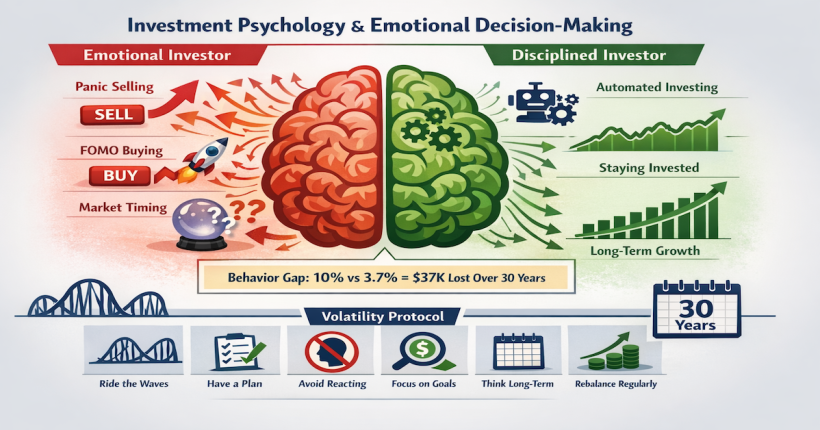
Finally, human behavior works against active investors. People buy when markets feel good and sell when markets feel scary. This emotional timing consistently destroys returns. Index fund investors who stay invested through ups and downs historically capture the market's long-term growth, which has averaged around 10% per year for the S&P 500 over the past century.
You're not smarter than the market. But you don't need to be. Index investing removes the need to be right about individual stocks, market timing, or economic predictions. You simply own a diversified portfolio and let time do the work.
Types of Index Funds
Not all index funds are the same. The index it tracks determines what you own and how diversified you are. Here are the main types:
Total Stock Market Index Funds own virtually every publicly traded U.S. company—typically 3,000 to 4,000 stocks. This gives you exposure to large companies, mid-sized companies, and small companies all in one fund. Examples include Vanguard Total Stock Market Index Fund (VTSAX) and the ETF version (VTI).
S&P 500 Index Funds track the 500 largest U.S. companies. This is the most popular index in the world and represents about 80% of the U.S. stock market's value. Examples include Vanguard's VOO and Fidelity's FXAIX. The S&P 500 and Total Stock Market funds overlap heavily—about 80% of their holdings are identical.
International Index Funds invest in companies outside the United States. This includes developed markets like Europe and Japan, and emerging markets like China and India. Examples include Vanguard Total International Stock Index Fund (VTIAX) and its ETF version (VXUS).
Bond Index Funds track bonds instead of stocks. Bonds are loans to governments or corporations that pay fixed interest. Bond index funds provide stability and income, making them useful for balancing a stock-heavy portfolio. Examples include Vanguard Total Bond Market Index Fund (VBTLX) and its ETF version (BND).
Target-Date Index Funds automatically adjust your stock-to-bond ratio based on your expected retirement year. If you're young, the fund holds mostly stocks. As you approach retirement, it gradually shifts toward bonds. Examples include Vanguard Target Retirement 2060 Fund (VTTSX).
For most investors, a simple combination of a total stock market fund and a total bond market fund provides all the diversification needed. Some add international stocks for broader global exposure. The key is owning broad index funds, not niche sector funds or trendy thematic funds.
How to Start Index Fund Investing
Getting started with index funds is simpler than most people expect. Here's the basic process:
Open an investment account. You'll need a brokerage account or a retirement account like a Roth IRA or 401(k). Brokerages like Vanguard, Fidelity, and Schwab offer low-cost index funds with no account minimums and no trading commissions.
Choose your index funds. Start with a total stock market index fund or an S&P 500 index fund. If you want bonds for stability, add a total bond market index fund. A simple 80% stocks, 20% bonds portfolio works well for most people under 50.
Set up automatic contributions. The power of index investing comes from consistent contributions over time. Automate transfers from your checking account to your investment account every payday. Even $100 or $200 per month compounds into significant wealth over decades.
Ignore the noise. Markets go up and down. Headlines scream about crashes and corrections. Your job is to keep contributing, stay invested, and let compounding do its work. The investors who win are the ones who don't panic and sell during downturns.
You don't need to time the market. You don't need to pick the perfect moment to invest. You simply need to start, contribute consistently, and let the decades pass. That's the entire strategy.
The Three-Fund Portfolio
One of the most popular index investing strategies is the three-fund portfolio, which provides complete diversification with minimal complexity. Here's the structure:
Fund 1: U.S. Total Stock Market Index Fund — This gives you exposure to the entire U.S. stock market. Allocation: 40-70% depending on age and risk tolerance.
Fund 2: Total International Stock Index Fund — This gives you exposure to non-U.S. companies across developed and emerging markets. Allocation: 20-40% for global diversification.
Fund 3: Total Bond Market Index Fund — This provides stability and reduces volatility. Allocation: 10-40% depending on how close you are to retirement.
A 25-year-old might use 60% U.S. stocks, 30% international stocks, and 10% bonds. A 50-year-old might shift to 50% U.S. stocks, 20% international stocks, and 30% bonds. As you age, you gradually reduce stock exposure and increase bond exposure to protect your accumulated wealth.
The three-fund portfolio isn't fancy. It won't make you feel like a genius stock picker. But it works. It captures global market returns, costs almost nothing in fees, and requires almost no maintenance. That simplicity is its greatest strength.
Common Index Fund Investing Mistakes
Buying too many index funds. Owning 10 different index funds doesn't make you more diversified—it makes you confused. A total stock market fund already owns thousands of companies. You don't need to add a growth fund, a value fund, a dividend fund, and a tech fund on top of it. Keep it simple.
Chasing performance. When a specific sector or country performs well, people want to pile in. They buy a tech index fund after tech stocks soar, or an emerging markets fund after it has a great year. This is performance chasing, and it's a great way to buy high and sell low. Stick to broad index funds and ignore trends.
Panicking during downturns. Markets drop 10-20% regularly and drop 30-50% occasionally. If you sell during a crash, you lock in losses and miss the recovery. The investors who build wealth are the ones who keep contributing during downturns, buying shares at lower prices.
Ignoring fees. A 0.05% expense ratio and a 1.0% expense ratio might sound similar, but over 30 years, the difference is enormous. Always choose the lowest-cost index fund available. Vanguard, Fidelity, and Schwab all offer excellent low-cost options.
Trying to time the market. People wait for the "right time" to invest, hoping to buy at the bottom. Meanwhile, they sit in cash earning nothing while the market goes up. Studies show that time in the market beats timing the market. Start investing as soon as you have money to invest.
Index Funds vs Individual Stocks
Should you buy individual stocks or stick with index funds? For most people, index funds are the better choice. Here's why:
Diversification. One index fund gives you ownership in hundreds or thousands of companies. One stock gives you ownership in one company. If that company fails, you lose everything. If one company in your index fund fails, it barely affects you.
Simplicity. Stock picking requires research, monitoring, and decision-making. Index investing requires buying the fund and ignoring it for decades. Most people don't have the time, skill, or interest to analyze individual companies.
Performance. Most professional stock pickers underperform index funds. If professionals struggle, why would you expect to beat the market by picking stocks yourself? The odds are against you.
That said, some investors enjoy owning individual stocks and are willing to accept the risk. A reasonable approach is to put 80-90% of your portfolio in index funds for stability and diversification, and 10-20% in individual stocks if you enjoy the challenge. Just don't confuse speculation with investing.
Why Index Investing Works Long-Term
The reason index investing works isn't complicated: capitalism rewards ownership. When you own stock in companies, you own a piece of their profits, their growth, and their innovation. Over time, companies create value, economies grow, and markets rise.
There are recessions, crashes, and bear markets along the way. But every major downturn in history has been followed by recovery and new highs. Investors who stay invested through volatility capture that long-term growth. Investors who panic and sell lock in losses and miss recoveries.
Index investing doesn't require you to predict the future. It doesn't require you to outsmart other investors. It simply requires you to believe that over the next 20, 30, or 40 years, businesses will continue creating value and markets will continue growing. History suggests that's a very reasonable bet.
The investors who build wealth aren't the ones making brilliant trades. They're the ones who start early, contribute consistently, keep costs low, and stay invested through the ups and downs. That's not exciting. But it works.
Index fund investing is the foundation. Building wealth is the system.
The complete framework for building long-term wealth through disciplined investing is in the Investing & Wealth Growth guide.
Explore the Full System →Continue Learning: Index Fund Investing
Build Your Index Fund Strategy
What Is an Index Fund and How Does It Work? — Understand the mechanics of index funds and why they're different from actively managed funds.
S&P 500 vs Total Market Funds: What's the Difference? — Learn which index fund gives you broader diversification and when each makes sense.
How to Choose Your First Index Fund — Pick the right index fund based on your goals, timeline, and risk tolerance.
Why Most Investors Underperform the Market — Discover the behavioral and structural reasons active investors struggle to beat index funds.
The Truth About Beating the Market — Understand why trying to beat the market often backfires and what works better.
Resources
Official Sources
SEC: Index Funds Overview — Official guidance on index fund basics and how they differ from actively managed funds.
Investor.gov: Mutual Funds and ETFs — Government resource on fund investing, including index fund mechanics and investor protections.
Return to the Complete Guide
Index fund investing is one cluster within a complete wealth-building system. The full framework for building long-term wealth through disciplined investing is in the Investing & Wealth Growth guide.
Frequently Asked Questions
How much money do I need to start investing in index funds?
Many brokerages now have no account minimums and allow you to buy fractional shares, meaning you can start with as little as $1. Realistically, starting with $100-500 and contributing $100-200 per month is a solid foundation for building wealth over time.
Are index funds safe?
Index funds are not "safe" in the sense that their value fluctuates with the market. They will go down during recessions and bear markets. However, they're diversified across hundreds or thousands of companies, which makes them far less risky than owning individual stocks. Over long time periods (10+ years), broad stock market index funds have historically recovered from every downturn and reached new highs.
What's the difference between a mutual fund and an ETF?
Both can be index funds. Mutual funds are priced once per day after markets close and are bought directly from the fund company. ETFs trade throughout the day like stocks on an exchange. For long-term investors, the difference barely matters—both offer low-cost index fund options. ETFs tend to have slightly lower expense ratios and more tax efficiency.
Should I invest in index funds during a recession?
Yes. Recessions are when stocks go on sale. If you have stable income and an emergency fund, continuing to invest during downturns lets you buy more shares at lower prices. Many of the best long-term returns come from investing during scary times when others are selling.
Can I lose all my money in an index fund?
For a broad market index fund like the S&P 500 or Total Stock Market fund to go to zero, virtually every major company in the economy would need to fail simultaneously. This has never happened and would represent a collapse of capitalism itself. Index funds can lose 30-50% during severe bear markets, but total loss is effectively impossible with diversified index funds.
How long should I hold index funds?
Index funds are designed for long-term investing—ideally 10+ years, and often 20-40 years for retirement investing. The longer your time horizon, the more you can ride out market volatility and benefit from compounding. If you need money within 5 years, index funds may be too volatile, and you should consider bonds or savings accounts instead.
PersonalOne Money System
This content is researched, written, and owned by PersonalOne — a free financial education platform built to help Millennials and Gen Z build real financial systems.
Disclaimer: This article is for educational purposes only and does not constitute financial, investment, or legal advice. Investing involves risk, including the potential loss of principal. Past performance does not guarantee future results. Index fund performance varies based on market conditions, and no investment strategy can guarantee profits or protect against losses. Consult a qualified financial advisor before making investment decisions. PersonalOne is not a registered investment advisor and does not provide personalized investment recommendations.