

March 11, 2026
March 11, 2026
Don Briscoe is a personal finance coach with over 12 years of experience helping people take control of their money. As the founder of PersonalOne.org, he makes complex financial concepts accessible and actionable for everyday Americans.
TL;DR - Quick Summary
- Too many accounts creates confusion and overdrafts, not control
- Unequal funding leaves some accounts empty while others overflow
- No automation means the system relies on remembering transfers
- Mixing goals in one account defeats the purpose of separation
- Wrong bank choices cost you hundreds in fees and lost interest
- Bottom line: A good multi-account system reduces decisions, not increases them
The multi-account banking system works. When done right, it eliminates overdrafts, builds savings automatically, and makes every dollar visible. But most people sabotage themselves before they see results.
The problem isn't the concept. The problem is implementation. You set up multiple accounts thinking more structure equals more control. Then you end up checking five different balances, transferring money manually every week, and wondering why your "organized" system feels more chaotic than when everything lived in one checking account.
These five mistakes explain why 70% of people who try multi-account banking abandon it within 90 days. Fix them, and the system becomes invisible infrastructure that runs your money without you thinking about it.
Mistake 1: Creating Too Many Accounts
More accounts does not equal more control. It equals more decisions, more logins, more transfers, and more mental overhead. The goal of a multi-account system is to reduce financial decisions, not create new ones every time you get paid.
The Sweet Spot: 3-5 Accounts Total
- Bills account: Fixed expenses that repeat monthly
- Spending account: Variable expenses (groceries, gas, life)
- Emergency savings: 3-6 months of expenses (separate bank)
- Goals account (optional): Vacation, down payment, big purchases
- Debt payoff account (optional): Extra payments beyond minimums
What happens when you go beyond this: You create a dedicated account for groceries, another for gas, another for pet expenses, another for car maintenance, another for holiday gifts. Now you're managing nine accounts and transferring money between them constantly because you didn't fund the "gas account" enough this week.
The system becomes a part-time job instead of invisible automation.
The fix: Combine variable expenses into one spending account. Let the budget app or spreadsheet track categories. Let the account just hold your flexible spending money. This is what "simplicity through separation" actually means.
Mistake 2: Funding Accounts Unevenly
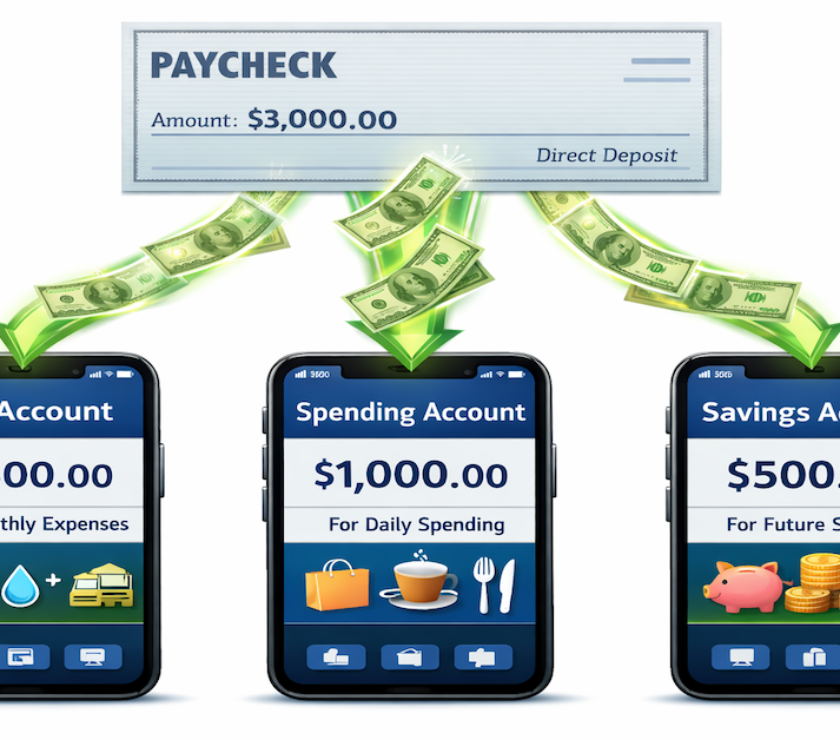
You set up your bills account, spending account, and savings account. Payday hits. You transfer $1,200 to bills, $400 to spending, and "whatever's left" to savings. Two weeks later, your spending account is at $12 and your bills account has $600 sitting idle until the mortgage payment hits.
This is the funding allocation mistake. You're not matching money flow to actual timing and needs.
How to Fund Each Account Correctly
Bills Account:
- Calculate total monthly bills
- Divide by number of paychecks per month
- Transfer that amount every payday
- Let it accumulate until bills hit
Spending Account:
- This gets the flexible money (groceries, gas, restaurants, shopping)
- Should reset near zero by next payday
- Balance = your actual spending capacity right now
Savings Account:
- Pay yourself first (automate before you see the money)
- Start with 10% of income, increase over time
- Never withdraw except for true emergencies
Example allocation for $4,000 monthly income (biweekly paychecks):
Paycheck 1 ($2,000): $700 to bills, $200 to savings, $1,100 to spending
Paycheck 2 ($2,000): $700 to bills, $200 to savings, $1,100 to spending
Total monthly: $1,400 bills, $400 savings, $2,200 spending
The bills account builds up over the month. The spending account gets depleted and refilled. The savings account only grows. This is what balanced funding looks like.
Mistake 3: No Automation (Manual Transfers Kill the System)
You get paid. You log into your bank. You manually transfer money to your bills account, savings account, and spending account. You do this every two weeks. You forget once. Then twice. Then you stop doing it entirely because "it's too much work."
Manual transfers are where multi-account systems go to die.
The entire point of account separation is to create a system that doesn't require willpower, memory, or decision-making. If you're logging in to move money around every payday, you've built a high-maintenance system that will eventually break when life gets busy.
Automate Everything Possible
- Paycheck split: Have your employer direct deposit into multiple accounts (bills, spending, savings) automatically
- Scheduled transfers: Set up automatic transfers on payday if direct deposit split isn't available
- Bill payments: Autopay from bills account so you never manually pay rent, utilities, insurance
- Savings transfers: Automatic transfer to separate bank on payday (makes it harder to pull back)
The 80/20 rule for automation: Automate the predictable 80% (bills, savings, paychecks). Manually manage the unpredictable 20% (irregular expenses, windfalls, adjustments).
When your system runs without you thinking about it, that's when it becomes permanent infrastructure instead of a temporary budgeting project.
Mistake 4: Mixing Multiple Goals in One Account
Your savings account holds your emergency fund, your vacation fund, your new car fund, and your "someday buy a house" fund. It shows $8,000 total. How much can you actually spend on vacation without destroying your emergency fund?
You don't know. So you don't spend it. Or worse—you spend it, then panic when an actual emergency hits and your "emergency fund" is depleted because it was really a vacation fund in disguise.
This is the goal mixing mistake. One account, multiple purposes, zero clarity.
Separate Goals by Timeline and Purpose
Emergency Fund (Account 1):
- 3-6 months of expenses
- Never touched except job loss, medical, major repairs
- Separate bank (online high-yield savings)
Short-Term Goals (Account 2):
- Vacation, holiday gifts, car maintenance, annual insurance
- Accessed 1-2 times per year
- Can be at primary bank initially
Long-Term Goals (Account 3 or Investment Account):
- House down payment, car replacement, kid's college
- Not touched for 3+ years
- Consider moving to brokerage account for returns
Why this matters: When your emergency fund is sacred and separate, you'll protect it. When your vacation fund has its own account, you'll actually take the vacation without guilt. When your house down payment lives in a labeled account, you'll watch it grow with intention.
Separation creates permission. Mixed accounts create hesitation.
Mistake 5: Choosing the Wrong Banks for Each Account
You open all your accounts at the same bank because it's convenient. You're paying $12/month in fees on your checking accounts. Your savings account earns 0.01% interest. Your bills account charges overdraft fees when you miscalculate timing. You're losing hundreds of dollars per year to convenience.
Not all accounts should live at the same bank. The best multi-account systems use strategic bank selection.
Strategic Bank Selection by Account Type
Bills & Spending Accounts:
- Primary brick-and-mortar bank or credit union
- Free checking, no minimum balance
- Easy ATM access for spending account
- Overdraft protection linked to savings
Emergency Fund:
- Online high-yield savings account (4.0%+ APY)
- Different bank from checking (reduces temptation)
- 1-3 day transfer time (intentional friction)
- No fees, no minimums
Goals & Wealth Building:
- High-yield savings for short-term (vacation, car fund)
- Brokerage account for long-term (house, retirement)
- Consider money market funds for 6-12 month goals
Example banking setup:
Local credit union: Bills account + Spending account (free, convenient, local ATM access)
Marcus by Goldman Sachs: Emergency fund (4.5% APY, online-only, separate institution)
Ally Bank: Short-term goals account (4.35% APY, easy buckets feature)
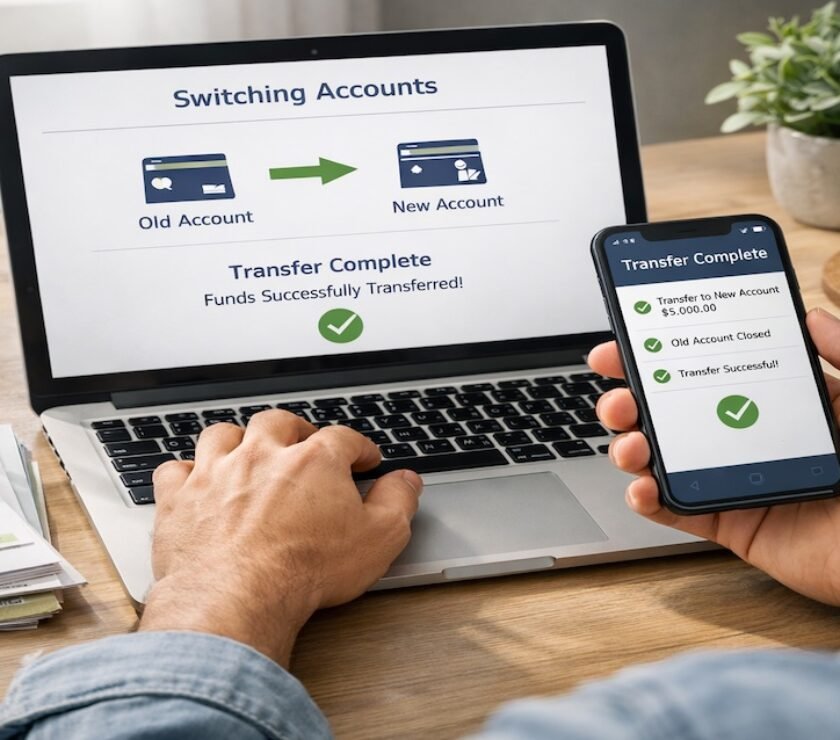
This setup eliminates fees, maximizes interest, and creates natural separation between everyday accounts and long-term savings. You're earning an extra $360/year on a $8,000 emergency fund versus keeping it at a traditional bank earning 0.01%.
Ready to Build a Multi-Account System That Actually Works?
Stop guessing. The multi-account budgeting system eliminates these five mistakes by design—showing you exactly how to set up, fund, and automate accounts that run your money for you.
Get the Complete Multi-Account System GuideWhy These Mistakes Happen (And How to Avoid Them)
Most people make these mistakes because they're copying what sounds good in theory without understanding the practical mechanics of money flow. You hear "separate your accounts" and assume more is better. You hear "automate your finances" but don't actually set up the automation. You hear "high-yield savings" but keep everything at your local bank because switching feels hard.
The fix isn't trying harder. The fix is understanding the system design:
Simplicity beats complexity. Three well-designed accounts outperform seven poorly managed ones.
Automation beats discipline. Set it up once, let it run forever. Don't rely on remembering to transfer money.
Separation creates clarity. Mixed-purpose accounts create confusion. Dedicated accounts create permission.
The right bank for the job beats convenience. You'll earn more and pay less when you match accounts to specialized banks.
If you're currently making any of these five mistakes, you're not failing at multi-account banking. You're just running the wrong version of it. Fix the design, and the system starts working for you instead of against you.
Frequently Asked Questions
How many bank accounts is too many?
More than five accounts for most people creates unnecessary complexity. The ideal setup is 3-5 total: bills, spending, emergency fund, and optional goals or debt payoff accounts. Beyond this, you're adding management overhead without meaningful benefit. If you can't explain the purpose of each account in one sentence, you probably have too many.
Should I use the same bank for all my accounts?
No. Use a local bank or credit union for checking accounts (bills and spending) where you need ATM access and in-person service. Use online high-yield savings banks for emergency funds and goals where you want maximum interest and intentional separation. Spreading accounts across banks creates natural friction that protects your savings while maximizing returns.
What if I forget to transfer money between accounts?
That's why automation is critical. Set up automatic transfers on payday or use direct deposit splitting so money flows to the right accounts without you remembering. If you're manually transferring money every paycheck, your system will eventually fail when life gets busy. Automation removes the memory requirement.
Can I combine my emergency fund and savings goals in one account?
You can, but you shouldn't. Mixing your emergency fund with vacation savings or car replacement funds destroys the psychological boundary that makes emergency funds work. When you see $8,000 and half of it is "vacation money," you'll justify spending it. Separate accounts create permission to use goal-specific money and protection for emergency reserves.
How do I know if my accounts are funded correctly?
Your bills account should accumulate enough to cover monthly bills without going negative. Your spending account should reset near zero by next payday. Your savings account should only grow, never shrink except for true emergencies. If your bills account is always empty or your spending account is always maxed out, your funding allocation percentages need adjustment.
What's the biggest mistake people make when starting a multi-account system?
Creating too many accounts without automation. They set up seven accounts for hyper-specific purposes, then manually transfer money between them every payday. This creates decision fatigue and management overhead that kills the system within weeks. Start with three accounts, automate everything, then add a fourth or fifth only if there's a clear purpose that automation supports.
Related Resources
Disclaimer: The information provided in this article is for educational and informational purposes only and should not be construed as financial advice. PersonalOne.org is not a financial advisor, and the content presented here is based on research, industry best practices, and general financial principles.
Every individual's financial situation is unique. Before making banking decisions, opening new accounts, or restructuring your finances, consider consulting with a qualified financial advisor who can assess your specific circumstances and provide personalized guidance.
Banking products, interest rates, and fee structures change frequently. While we strive to provide accurate information, always verify current terms, rates, and conditions directly with financial institutions before making decisions. PersonalOne.org is not responsible for any actions taken based on the information provided in this article.