

March 16, 2026
March 16, 2026
Home › Banking Systems › Multi-Account Budgeting System › The 4-Bucket Money System
This article is part of the Multi-Account Budgeting System cluster on PersonalOne. Use it when you have the 3-account foundation working and want to upgrade to a four-bucket structure that separates necessities, goals, and discretionary spending into distinct accounts.
The 4-Bucket Money System: Advanced Multi-Account Strategy for Complete Control
Don Briscoe is a personal finance coach with 12+ years of experience helping people take control of their money. As the founder of PersonalOne.org, Don specializes in building financial systems for Millennials and Gen Z that work in real life, not just on paper.
TL;DR
— The 4-bucket system separates obligations, necessities, goals, and wants into four distinct accounts for complete money visibility.
— Bucket 1 (Obligations): fixed bills that must be paid — rent, loans, insurance, utilities.
— Bucket 2 (Necessities): variable survival spending — groceries, gas, prescriptions, basic needs.
— Bucket 3 (Goals): savings, debt payoff, and investments — every dollar here builds your financial future.
— Bucket 4 (Wants): guilt-free discretionary spending — restaurants, entertainment, hobbies, within defined limits.
— This is an advanced system for people who have mastered the 3-account foundation and want surgical precision over every dollar.
The 3-account system works. Bills account, spending account, savings account. It eliminates most money stress for most people. But if you have been running that system for six to twelve months and you want the next level of control, the 4-bucket method gives you precise visibility into every category of your financial life.
This is not a beginner system. If you are still learning to separate bills from spending or your budget is running month to month, stay with three accounts. The 4-bucket approach is for people who want to separate necessities from discretionary spending, who want dedicated infrastructure for financial goals, and who are comfortable managing slightly more complexity in exchange for complete money clarity.
The difference between 3 accounts and 4 buckets is the difference between "my spending is under control" and "I know exactly where every dollar goes and why."
Why 4 Buckets Instead of 3 Accounts?
The standard 3-account system puts everything that is not bills or long-term savings into one spending account. Groceries, gas, restaurants, shopping, coffee, and entertainment all share a single balance. This works until you want more granular control — specifically, the ability to answer: am I overspending on wants because I am underfunding necessities? Am I raiding grocery money to fund restaurants?
The 4-bucket system answers these questions by creating a distinct account for each type of spending. The foundational mechanics are explained in the multi-account budgeting system guide — the 4-bucket approach builds on that foundation by splitting the spending account into three distinct buckets: necessities, goals, and wants.
The Evolution: 3 Accounts to 4 Buckets
3-Account System: Account 1: Bills — Account 2: Spending (all variable) — Account 3: Savings
4-Bucket System: Bucket 1: Obligations — Bucket 2: Necessities — Bucket 3: Goals — Bucket 4: Wants
The key insight: spending is not monolithic. There is spending you must do to survive and spending you choose to do because you want to. Separating these two categories creates both clarity about where money goes and permission to enjoy discretionary spending without guilt.
Bucket 1: Obligations
Bucket 1: Obligations Account
Purpose: Fixed monthly bills that must be paid regardless of anything else.
What goes here: Rent or mortgage, car payment, insurance (auto, health, renters), utilities, minimum loan payments, childcare or tuition, critical subscriptions.
Account type: Checking account at primary bank. Autopay only — never used for manual spending.
Funding: Calculate total monthly obligations, divide by paychecks per month, auto-transfer that amount every payday.
Mental model: This is infrastructure. You never check it for spending decisions. It funds itself and pays bills automatically.
Example: Monthly obligations total $2,150 (rent $1,200 + car $350 + insurance $220 + utilities $180 + phone $85 + internet $70 + student loan minimum $45). Biweekly funding: $1,075 per paycheck via automatic transfer.
This bucket is identical to the bills account in the 3-account system. Nothing changes here. The innovation is in how the old spending account gets split into three distinct buckets.
Bucket 2: Necessities
Bucket 2: Necessities Account
Purpose: Variable spending required to survive and function — things you must buy but have some control over how much you spend.
What goes here: Groceries and household essentials, gas for commuting, prescriptions and medical copays, basic clothing replacements, household maintenance, pet food and vet care, haircuts and basic personal care, school supplies.
Account type: Checking account with debit card access — this account gets used frequently.
Funding: Track actual spending for two to three months, calculate the average, fund that amount per paycheck.
Mental model: This is your life operations account. The balance shows what remains for essentials this pay period. Not for fun — for function.
Example: Monthly average $850 (groceries $450 + gas $180 + household $80 + medical $60 + personal care $50 + pet $30). Biweekly funding: $425 per paycheck.
The critical distinction from Bucket 4: if you stopped funding Bucket 2 today, your quality of life would collapse within days. No food. No gas to get to work. Bucket 2 is not optional. Bucket 4 is.
Bucket 3: Goals
Bucket 3: Goals Account
Purpose: Money working toward specific financial objectives — this is where your financial future gets built.
What goes here: Emergency fund contributions, extra debt payments beyond minimums, down payment savings, retirement contributions beyond employer match, investment contributions, education savings, large purchase funds.
Account type: High-yield savings account at a separate bank for protective friction and higher interest.
Funding: Pay yourself first — automate the transfer before you see the money. Start at 10 to 15 percent of income and increase over time.
Mental model: This is your freedom account. Every dollar here buys future optionality — weathering job loss, escaping debt, building wealth.
Example: Monthly contribution $650 (emergency fund $200 + extra debt payment $250 + down payment savings $150 + IRA $50). Biweekly funding: $325 per paycheck via automatic transfer to separate bank.
Advanced move: As goals shift, adjust internal allocations without changing the total contribution. Emergency fund fully built? Redirect those $200 to investments. Credit card paid off? Move that payment toward the down payment fund. The bucket total stays consistent while internal priorities evolve.
Bucket 4: Wants
Bucket 4: Wants Account
Purpose: Pure discretionary spending with zero guilt — life enhancement that is not necessary but makes life worth living.
What goes here: Dining out and takeout, entertainment, hobbies and recreation, non-essential shopping, streaming services, coffee shops, social outings, impulse purchases.
Account type: Separate checking account or prepaid debit card. A prepaid card creates a hard boundary — when it is empty, spending stops automatically.
Funding: Whatever remains after Buckets 1, 2, and 3 are funded — typically 10 to 20 percent of income.
Mental model: This is your permission account. When the balance exists, spend it without guilt. When it is gone, you are done until payday. No shame. Just boundaries.
Example: Monthly allocation $400 (restaurants $200 + entertainment $100 + hobbies $60 + coffee and treats $40). Biweekly funding: $200 per paycheck.
The psychological power of Bucket 4 comes from knowing the other three buckets are protected. When necessities are covered and goals are funded, the money in Bucket 4 is not irresponsible spending — it is an intentional choice to enjoy life within defined limits.
How Money Flows Through the 4-Bucket System
The flow is straightforward: income arrives, money splits into buckets automatically, each bucket funds its designated purpose, everything resets on the next payday.
Example: $5,000 Monthly Income, Biweekly Paychecks ($2,500 each)
Bucket 1 (Obligations): $1,075 auto-transfer → bills pay automatically
Bucket 2 (Necessities): $425 auto-transfer → groceries, gas, essentials
Bucket 3 (Goals): $325 auto-transfer → savings and debt payoff
Bucket 4 (Wants): $200 auto-transfer → guilt-free discretionary spending
Remaining in primary account: $475 → buffer for irregular expenses or additional goal funding
Monthly totals: Obligations $2,150 — Necessities $850 — Goals $650 — Wants $400 — Buffer $950
The buffer can stay as a checking cushion, flow into a fifth account for irregular annual expenses, or split between goals and wants based on your priorities that month.
Who Benefits Most From the 4-Bucket System
You Are Ready for 4 Buckets If:
You have successfully run a 3-account system for six or more months. Your income exceeds basic needs by at least 20 percent. You want to separate survival spending from enjoyment spending. You carry guilt around discretionary purchases. You want dedicated infrastructure for financial goals. You are comfortable managing four account logins and balances.
Stick With 3 Accounts If:
You are new to account separation. Your income is tight and you are covering basics. You find four accounts overwhelming. The 3-account system already gives you the control you need. You prefer tracking categories in an app over maintaining physical account boundaries.
The best system is the one you will actually maintain. If three accounts works and produces the outcomes you want, there is no reason to add complexity. If you are ready for surgical precision, four buckets delivers it.
How to Set Up the 4-Bucket System
If you are already running a 3-account system, you already have Bucket 1 (bills) and Bucket 3 (savings) set up. You are only adding two new accounts: Bucket 2 for necessities and Bucket 4 for wants.
Step 1: Track spending for 60 days. Before splitting your spending account, collect data. Categorize every purchase as either necessity (groceries, gas, medical, household) or want (dining out, entertainment, shopping, discretionary). Calculate the monthly average for each. That average becomes your funding amount.
Step 2: Open two new accounts. Bucket 2 as a second checking account at your primary bank for frequent debit card use. Bucket 4 as a third checking account or a prepaid debit card — the prepaid card option creates a physical hard stop when funds run out.
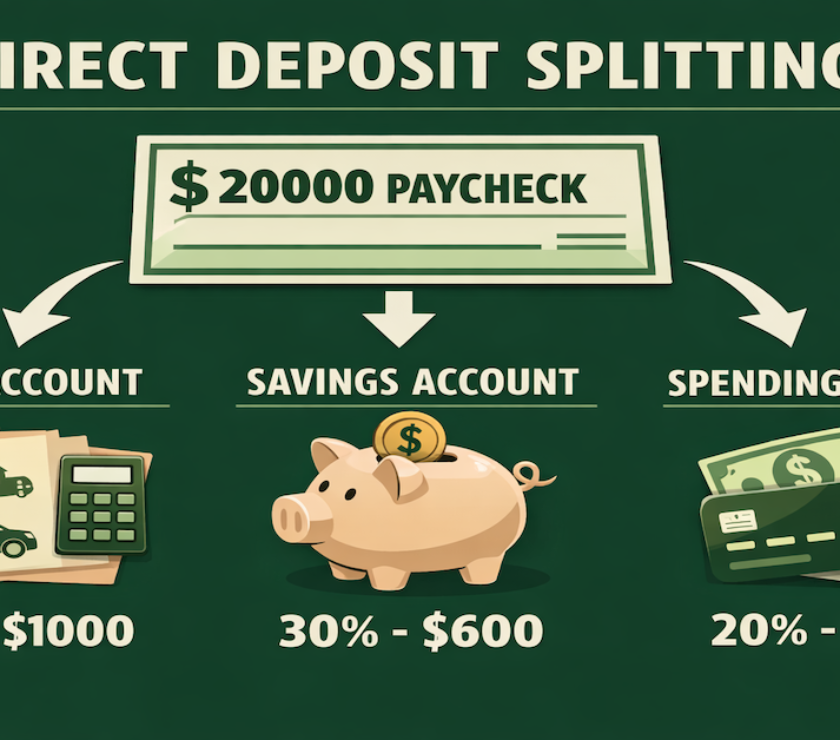
Step 3: Set up automatic funding. Use direct deposit split or automatic transfers so every payday funds all four buckets without manual action. You should wake up on payday with every bucket already funded correctly.
Step 4: Assign the right card to each bucket. Bucket 1: no debit card, bills autopay only. Bucket 2 card: grocery stores, gas stations, pharmacies, household stores. Bucket 3: no debit card, savings only. Bucket 4 card: restaurants, entertainment, shopping, anything discretionary.
Step 5: Run it for 90 days before adjusting. The first month feels clunky — you will grab the wrong card, second-guess allocations, wonder if it is worth the complexity. By month two, muscle memory develops. By month three, the system runs as invisible infrastructure. Adjust allocations only after 90 days of real data.
The 4-bucket system is the advanced layer. The Banking Systems hub is the complete picture.
Account structure, cash flow design, paycheck routing, and banking infrastructure all connect into one complete system. See the full framework.
Explore the Banking Systems Hub →Common Challenges and How to Handle Them
Using the wrong bucket card. This happens constantly in the first 30 days. You are at the grocery store and grab the Bucket 4 card by accident. Do not stress about it. As long as the money exists somewhere in your system, the overall structure is intact. The goal in the first 90 days is directional accuracy, not perfection. Muscle memory develops over time.
One bucket running out while another has excess. You allocated $425 to necessities but consistently need $500. Meanwhile the wants bucket has $100 left every payday. This means the initial allocation was wrong, not that the system is broken. Rebalance quarterly using real spending data. Shift $75 from wants to necessities. The system should match your actual life, not force your life to match arbitrary numbers.
Managing four accounts feels overwhelming. If tracking four balances and using four cards creates more stress than clarity, the system is not the right fit right now. Drop back to three accounts and track necessities versus wants in a budgeting app instead. There is no shame in using the simpler system. The best system is the one you maintain.
The Psychology of Separate Wants Money
The most powerful aspect of the 4-bucket system is not the mechanics of separation — it is the permission that separation creates.
When your wants bucket shows $200 and you spend $40 at a restaurant, you are not wasting money or being irresponsible. You are using money that was intentionally allocated for exactly this purpose. Necessities are covered. Goals are funded. Obligations are handled. The $200 in Bucket 4 exists purely to make life enjoyable, and spending it is not a financial failure — it is the system working as designed.
That shift — from guilt to permission — changes how discretionary spending feels. Instead of second-guessing every coffee or dinner out, you feel intentional. You built space for this. You are living within that space. When the bucket runs dry before payday, you are not failing. You are done spending until it refills. No crisis. Just boundaries.
More From Multi-Account Budgeting System
How to Build a Banking System That Supports Your Budget — Structure your accounts around your budget so the two systems reinforce each other
The Modern Banking Stack — How to layer checking, savings, and apps into a complete banking infrastructure
How to Fix Banking Mistakes That Are Quietly Costing You Money — The structural banking errors most people never notice and how to correct them
How to Build a Banking System Where Overspending Is Structurally Impossible — Design your account structure so the right behavior is the default
The Psychology of Account Separation — Why physical boundaries beat mental accounting every time
You are here: The 4-Bucket Money System
Resources
CFPB — Bank Accounts: Consumer Tools and Guidance
FDIC — Money Smart Financial Education Program
Bureau of Labor Statistics — Consumer Expenditure Survey
This article is part of the Banking Systems hub on PersonalOne — a complete framework for building the account structure and cash flow infrastructure that controls your financial outcomes.
Frequently Asked Questions
Do I need four separate banks or can all buckets be at one bank?
All four can be at the same institution. Most people keep Buckets 1, 2, and 4 (checking accounts) at their primary bank and open Bucket 3 (goals and savings) at a separate online bank for higher interest rates and the protective friction of a slower transfer. The key requirement is distinct account numbers, not distinct institutions.
What if my income varies month to month?
Fund buckets in priority order using percentages rather than fixed dollar amounts. Approximately 40 percent to obligations, 20 percent to necessities, 20 percent to goals, and the remaining 20 percent to wants. In strong income months all buckets grow. In lean months all scale down proportionally, but the priority order ensures obligations and necessities are always covered first.
Should couples combine buckets or keep them separate?
The most common approach is shared buckets for household obligations, necessities, and goals plus individual Bucket 4 accounts for each person's personal discretionary spending. This covers shared financial responsibilities while preserving individual autonomy over personal wants. Fully combined or fully separate systems both work — choose based on what creates clarity rather than conflict in your specific relationship.
How do I handle expenses that do not fit cleanly into one bucket?
Create a simple personal rule and apply it consistently. Gas for commuting is Bucket 2. Gas for a road trip is Bucket 4. Work clothes are Bucket 2. Fashion clothes are Bucket 4. The line will not always be perfect, and that is acceptable. Pick the more accurate bucket, track the pattern for 90 days, and adjust the allocation if a category is consistently wrong.
What is the difference between Bucket 3 and a traditional emergency fund?
Bucket 3 contains multiple sub-goals and the emergency fund is the first priority within it. Once the emergency fund reaches its target, that contribution redirects to debt elimination. Once high-interest debt is cleared, contributions shift to long-term investing. The bucket total stays consistent throughout — what changes is where within the bucket the money is flowing.
Can I skip from one account directly to four buckets?
You can, but the learning curve is significantly steeper without the 3-account foundation first. Most people benefit from three to six months with a 3-account system before upgrading — that time builds the automation habits, spending awareness, and comfort with multi-account management that the 4-bucket system requires to run smoothly.
Disclaimer: This content is for educational purposes only and does not constitute financial advice. Individual financial situations vary — consult a qualified financial professional for personalized guidance. Banking products, account features, and fee structures vary by institution and change frequently. Always verify current terms directly with your bank before opening new accounts.